
Housing Backyard Chickens

Owning a small flock of chickens is increasing in popularity, particularly in areas where local ordinances prohibit larger domestic animals, but allow for birds and/or small animals. Chickens not only furnish a ready source of home-grown meat and eggs, but also provide great pleasure as exhibition stock and even as pets. The purpose of this fact sheet is to give an overview of basic housing principles for small flocks of chickens.
Objectives
Reasons for providing proper housing facilities for chickens include:
- Protection from predators;
- Protection from rain, snow, and other inclement weather;
- Protection from excessive heat and cold (i.e,. moderation of extreme temperature changes); and
- Provision of feed and water space and nesting facilities.
General Considerations
Chickens are very adaptable and no single best way exists to house them. Creative architectural construction may even be considered in building a “designer” chicken house in order to enhance the backyard landscape. Regardless of ultimate design, the following practical considerations should be observed. The building must:
- Be large enough for proper air circulation (i.e. ventilation) but small enough to keep from getting too cold and drafty in winter;
- Allow 1.5 to 2.0 ft2 (0.14 to 0.19 m2) floor space per adult chicken;
- Provide easy access to feed and water; and
- Provide nesting areas for hens in egg production.
Building Design
As previously mentioned, workable designs of chicken houses are highly variable and may even be extremely decorative in some cases. Many sites are available on the Web and in reference books that may help you in designing your facility. A few selected resources are listed here.
House Design:
- “How to Raise Chickens” by Christine Heinrichs. Voyageur Press. 2007.
ISBN-13: 978-0-7603-2828-6 - Virginia Cooperative Extension: https://web.archive.org/web/20080701125540/http://www.ext.vt.edu/pubs/poultry/factsheets/designs.html
- University of Minnesota: https://web.archive.org/web/20080304034358/http://www.ansci.umn.edu/poultry/resources/housing_small-scale.htm
- The Bantam Roost, “A Small Hen House”: https://web.archive.org/web/20080324020841/http://www.geocities.com/heartland/plains/4175/henhouse.html
Energy management and solar heating concepts:
Ventilation Basics
In order to provide a comfortable building for chickens, it is necessary to keep in mind a few basic concepts regarding ventilation:
- Warm air rises and cooler air, being heavier, settles to the floor. Adequate air circulation and exchange is necessary to keep different air temperatures from stratifying and air from becoming stale.
- Warm air holds more moisture than cold air. For every 18°F (10°C) increase in air temperature, its water-holding capacity doubles. This concept is important in managing potential moisture buildup, particularly in well-insulated, tightly-sealed chicken houses.
- Ventilation needs in summer are different than in winter. During summer, warm stale air must be removed, allowing fresh air to enter and circulate. During cold seasons, only enough cold outside air should be allowed in for adequate air exchange. It is preferred to bring this air in from near the roof of the building which allows it to warm as it drops towards the floor. This colder air will warm (by the birds’ own body heat and/or with additional heaters) and pick up moisture. A method must be available to vent this air from the building allowing the cycle to continue. (Refer to Figures 1 and 2 for summer and winter ventilation concepts.)
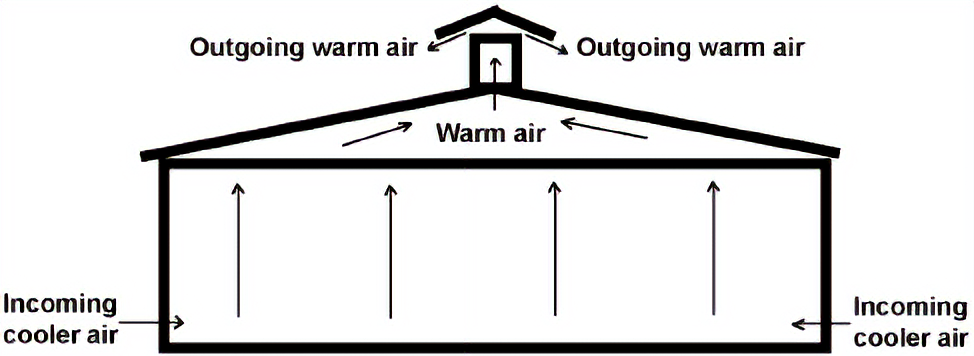
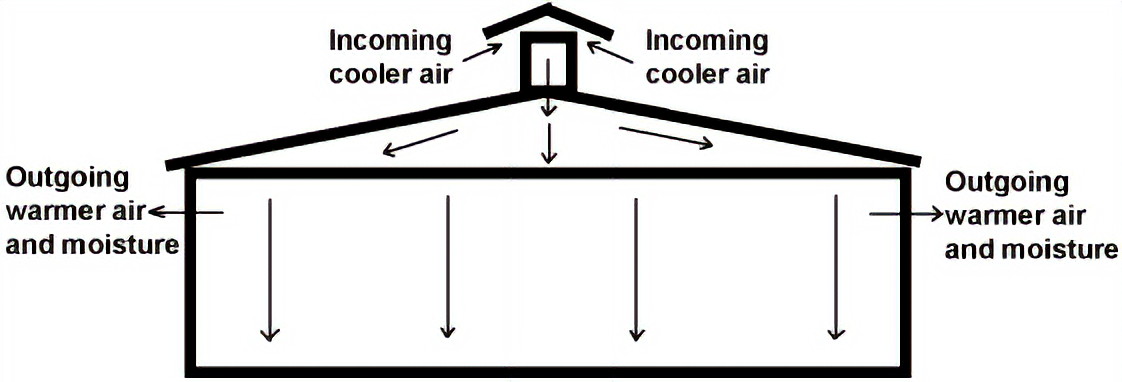
In small chicken houses, these factors can generally be sufficiently controlled without employing power ventilation (i.e. fans). The judicious and well-placed use of windows and vents will usually suffice. During summer, natural convection and/or gentle breezes will usually be adequate to drive air out the upper vents, or cupola, and bring in fresh air through windows or lower vent openings. Place upper vent openings on the side opposite of wind direction (i.e. leeward side).
Although not mandatory, it is usually a good idea to provide perches for your chickens. Perches will allow birds to stay off the floor – particularly as they roost at night. Most breeds seem to enjoy spending time on perches. Manure will tend to accumulate in greatest concentration under the roost area, thereby helping to keep the rest of the bedding material in the house cleaner. A good rule of thumb is to allow 6 to 10 inches (15 to 25 cm) of linear perch space for each chicken housed.
Perches should be located in an area of the house that will not interfere with daily chores such as feeding, watering, and egg gathering. Construct the perches so they are removable or are hinged for lifting out of the way for easier cleanout of manure. It is worth the extra effort to build them right in the beginning – it will save you a lot of time and effort during house cleanup. Perches should not be more than about 3 feet (0.9 m) off the ground; otherwise, there may be an increased tendency to bruise feet or cause egg rupture as the hens mount the roost. Plan at least 12 inches (30 cm) clearance under the perches; final height and dimensions will depend on individual building design and convenience of being able to clean out the manure underneath them.
Any suitable building material may be used to construct perches: 2 x 2 inch (5 x 5 cm) material with rounded tops is ideal. Space the perch bars 14 inches (36 cm) apart.
Nest Boxes
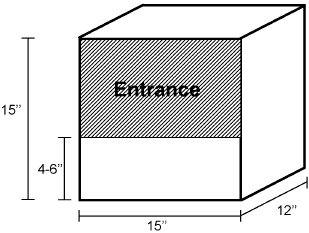
Nest boxes are essential furnishings of any hen house because she will seek a secluded place to lay her eggs. Properly constructed and maintained nest boxes provide a clean environment for laid eggs and facilitate gathering them. Also, nests make it easier to identify and remove “broody” hens. (A broody hen is one that has ceased laying eggs and desires to raise a clutch of chicks. She will remain in the nest box for prolonged periods, become territorial, and not allow entry of other hens needing to lay eggs.)
Again, there are no hard and fast rules for nest box construction. Commercial boxes are available from various retail sources or you may wish to construct your own. Nest box height and width should be 12 to 15 inches (30 to 38 cm); depth should be least 12 inches (30 cm). Figure 3 illustrates a generic nest box design that is functional for most applications.
- One nest box is required for each four to five hens.
- Place nest boxes no less than 18 inches (46 cm) off the floor.
- A front panel, 4 to 6 inches (10 to 15 cm) high, is necessary to provide seclusion and keep eggs from rolling out of the nest.
- A perch may be attached to each box, running parallel to the front of the box and located 6 to 8 inches out, to facilitate access.
Predator Control
- Maintain a rodent control program around the poultry house. An excellent fact sheet on rodent control is found at https://extension.okstate.edu/fact-sheets/print-publications/afs/rodent-control-in-the-poultry-house-afs-8207.pdf
- When building the floor, integrate heavygauge wire mesh beneath the subflooring to discourage entrance of predators.
- Cover windows and vent openings with good quality poultry wire to keep out birds.
- Make sure doors and windows fit tight. Caulk and seal all cracks and crevices. Small rodents can gain entry through holes the size of a nickel or quarter.
- Keep the poultry house locked to discourage theft and uninvited visitors.
Additional Housing Considerations
- Allow adequate space within the structure for feeders and waterers. (Feeding and watering equipment not discussed in this fact sheet.)
- Position equipment for ease of cleaning, egg gathering, and general upkeep.
- Before beginning to build, consider anticipated high/low temperatures, potential snow load, other environmental conditions, and local ordinances.
- For specific recommendations in your area, contact your local county agent or Extension poultry specialist.
June 2008
Utah State University Extension
Peer-reviewed fact sheet
Authors
David D. Frame, DVM, former Extension Poultry Specialist
Related Research
Basic Selection, Nutrition and Care of Show Poultry
The championship potential of a chicken is determined by genetics. Genetics are the traits inherited from its parents. The chicken’s environment dictates if the genetic potential can be met.

Basics for Raising Backyard Chickens
A guide to raising backyard chickens, covering brooding, housing, perches, nest boxes, water, feed, predator control, lighting, egg production and molting.
Basics for Raising Junior Market Turkeys for Junior Turkey Show
This fact sheet is constructed to be used by 4-H and FFA youth for training or as a tool to aid in the growing of market turkeys for the Utah Junior Turkey Show or for local turkey shows.
Biosecurity Principles for Poultry Exhibitors: Protecting Your Investment
A guide on disease prevention for exhibition poultry, covering biosecurity practices like flock isolation, sanitation, equipment disinfection, and quarantine procedures.

Causes and Control of Selected Diseases Related to Backyard Chicken Flocks in Utah
Although most small backyard flocks of chickens remain relatively healthy, it is useful to note a few diseases and abnormalities that may be occasionally encountered.
Handling Baby Poultry
Chickens, ducks, geese, turkeys, peafowl, and game birds can harbor and transmit certain agents that might infect people. These practices will help minimize the chance for disease transmission between you and your poultry.

Hatching and Caring for Chicks
This fact sheet provides essential guidelines for hatching eggs and raising chicks, covering topics such as egg collection, incubation, candling, hatching, and chick care. It includes best practices for ensuring a high hatch rate, proper storage, brooder

Information for the Poultry Showmanship Judge
A guide for judges evaluating youth poultry showmanship competitions, covering how to assess exhibitors' stewardship skills, bird presentation, and poultry knowledge.
Molting and Determining Production of Laying Hens
A guide to better understand and evaluate the status of egg production in the domestic fowl.

Organizing a Poultry Showmanship Contest
A guide to organizing a poultry showmanship contest, including eligibility, class divisions, equipment, location, timing and judge qualifications.

Preparing Your Bird for the Poultry Showmanship Contest
Careful preparation prior to the show is necessary to be an effective show person. The calmness of the chicken is a reflection of how much the bird has been handled and worked with prior to the show.
Principles of Feeding Small Flocks of Chickens at Home
An overview of feeding and nutrition principles for chicken owners, including water, feed quality, feeding systems and feed consumption.
Selecting and Preparing Broilers for Show
Raising meat-type chickens at home can be a rewarding and productive experience. Not only does it put meat in the freezer, it can also be a great 4-H project for young poultry enthusiasts.
What is Expected of the Poultry Showman?
Poultry showmanship is the opportunity for you as a young exhibitor to demonstrate your abilities as a poultry steward and to communicate your knowledge of the poultry industry.

Hatching and Caring for Chicks
Essential guidelines for hatching eggs and raising chicks, covering topics such as egg collection, incubation, candling, hatching, and chick care.

Egg Quality, Safety and Flock Health
This guide offers practical advice to help you raise resilient, high-laying hens and build a successful small-scale egg production system, no matter your level of experience.
Managing Chickens From Chicks to Peak Egg Production
This fact sheet covers poultry history, top egg-laying breeds, egg anatomy, nutrition, and practical tips to help farmers improve productivity and run successful egg production ventures.

A Farmer's Guide to Egg Quality, Safety, and Flock Health
This guide offers practical advice to help you raise resilient, high-laying hens and build a successful small-scale egg production system, no matter your level of experience.