
The Impact of Producer Attitudes and Concerns on Organic Adoption Decisions

Introduction
The Transition to Organic Partnership Program (TOPP), administered by the U.S. Department of Agriculture (USDA) Agricultural Marketing Service (AMS), was established to increase the number of successful organic producers, strengthen organic supply chains, and support the continued growth and resilience of organic agriculture in the United States (AMS, 2022). The program represents a five-year, approximately $100 million investment through partnerships with universities and organizations to expand education, technical assistance, and mentorship opportunities for organic and transitioning producers. TOPP recognizes that organic production can provide economic opportunities through premium markets and prices while also supporting environmental stewardship and sustainable agricultural practices (Crowder & Reganold, 2015; LaCanne & Lundgren, 2018; Tuck et al., 2014).

To better understand the educational and resource needs associated with organic production systems among Utah agricultural producers, Utah State University (USU) conducted a statewide producer survey in 2024. Researchers collected data through an online Qualtrics survey and received 131 usable responses. The survey examined farm and operation characteristics, current production practices, motivations for adopting organic methods, perceptions of organic agriculture, and concerns related to organic production, markets, and certification requirements. Respondents also evaluated the importance and usefulness of various information sources, tools, services, and educational programs that may support organic production decisions.
Researchers analyzed survey data to identify producer and operation characteristics, attitudes, and concerns that may influence decisions to adopt organic production methods. This fact sheet presents findings related to producer perceptions of organic production, market opportunities, and certification requirements, including factors that may encourage or discourage adoption of organic practices. The results provide insights to guide Extension educators, agricultural service providers, and organizations in developing targeted educational programs, technical assistance, and resources to support producers interested in organic agriculture.
Results Overview
Producer and Operation Characteristics
The survey respondents represented a diverse group of agricultural producers with varying levels of experience, operation size, and sales volume (Table 1). Just over one-third (39.9%) of respondents used organic production methods, while 61.1% did not. Nearly half of respondents (49.6%) had operated their business for more than 20 years, indicating a largely experienced producer population. Another significant portion reported operating for 1–5 years (22.9%). Most operations were small in terms of employment, with 74.8% employing five or fewer individuals. Regarding acreage, operations were split between very small and larger-scale farms. Approximately 38.9% managed 5 acres or less, while one-third operated more than 150 acres. Gross annual sales varied substantially across respondents. About one-quarter reported gross annual sales of $10,000 or less, while 16.9% reported sales exceeding $500,000.
Table 1. Respondent and Operation Characteristics
| Characteristic | Category | Sample (%) |
|---|---|---|
| Employ organic methods | Yes | 39.93% |
| No | 61.07% | |
| Business duration | Less than 1 year | 3.82% |
| 1 to 5 years | 22.90% | |
| 6 to 10 years | 13.74% | |
| 11 to 20 years | 9.92 % | |
| More than 20 years | 49.62% | |
| Number of employees | 1 or less | 35.11% |
| 2 to 5 | 39.69% | |
| 6 to 10 | 9.92% | |
| 11 to 20 | 7.63% | |
| More than 20 | 7.63% | |
| Total operation acreage | None or not applicable | 3.82% |
| 5 acres or less | 38.93% | |
| 6 to 10 acres | 4.58 % | |
| 11 to 50 acres | 12.21% | |
| 51 to 100 acres | 1.53% | |
| 101 to 150 acres | 4.58% | |
| More than 150 acres | 34.35% | |
| Gross annual sales | $10,000 or less | 25.95% |
| $10,001– $50,000 | 16.03% | |
| $50,001– $100,000 | 9.16% | |
| $100,001– $200,000 | 11.45% | |
| $200,001– $500,000 | 10.69% | |
| More than $500,000 | 16.97% | |
| Age | 25 to 34 | 4.58% |
| 35 to 44 | 24.43% | |
| 45 to 54 | 16.03% | |
| 55 to 64 | 22.90% | |
| 65 and over | 25.95% | |
| Gender | Man | 62.6% |
| Woman | 28.24% | |
| Prefer to self-describe | 9.16% | |
| Education level | High school diploma/GED | 11.45% |
| Associates degree/some college | 16.79% | |
| College degree (BS, BA, etc.) | 43.51% | |
| Graduate degree (MS, PhD, etc.) | 25.19% |
Respondents were older as half were 55 years or older, including 25.9% aged 65 and above and 24.4% were between 35 and 44 years old. Most respondents identified as men (62.6%), with women representing 28.2%. Educational attainment was high, with 68.0% holding at least a college degree, including 25.1% with graduate degrees.
How Producer Concerns Affect Organic Adoption Decisions
Survey respondents rated a series of concerns related to organic production, marketing, and certification/regulation on a three-point scale ranging from 1 (not a concern) to 3 (definitely a concern). The survey included 16 production-related concerns, nine market and marketing concerns, and nine certification and regulatory concerns. Detailed results for each concern are presented in the USU Extension fact sheet “Utah Agricultural Producer Barriers to Adopting Organic Production Methods.”
To reduce the 34 concern variables to a smaller set of underlying dimensions, we used factor analysis. Factor analysis is a statistical technique that identifies a smaller number of latent factors that explain the patterns of correlation among a larger set of observed variables (Webster & Houston, 2023). Six factors were extracted and subsequently included in the adoption model.
Table 2 presents the effects of these six concern factors on the likelihood of adopting organic production methods. Two factors had statistically significant negative effects on adoption: crop risk concerns and knowledge, skills, and planning concerns. Based on the marginal effects, producers with greater concerns about crop production risks, such as weeds, pests, and diseases, were 11.0% less likely to adopt organic production methods. Likewise, producers who expressed greater concerns about the knowledge, skills, and planning required for organic production were 15.5% less likely to adopt organic methods. The remaining concern factors, including those related to certification costs, administrative requirements, etc., were not statistically significant predictors of organic adoption.
Table 2. Production, Marketing, and Regulatory Concerns Modelling Results
| Variable | Coefficient estimates | Marginal effects |
|---|---|---|
| Crop risk concerns | -0.601** (0.304) |
-0.110** (0.052) |
| Knowledge/skills/planning concerns | -0.846** (0.350) |
-0.155*** (0.059) |
| Production constraint concerns | -0.307 (0.363) |
-0.056 (0.066) |
| Market access concerns | 0.115 (0.370) |
0.021 (0.067) |
| Administrative difficulty | 0.428 (0.312) |
0.078 (0.056) |
| Certification costs | 0.223 (0.279) |
0.041 (0.050) |
| Constant | -0.571*** (0.209) |
NA |
| McFadden R2 | 0.186 | |
| Observations | 131 | |
| Log likelihood | -71.295 | |
| Akaike inf. crit. | 156.590 |
Notes. A bivariate logit model was used in the analysis. The signs (+ or -) of the variable coefficient estimates indicate the positive or negative impact of the independent variable on the dependent variable or outcome. Variable marginal effects indicate how a change in an independent variable affects the probability of the outcome occurring, holding the other variables constant. Single, double, and triple asterisks (*,**,***) denote significance at the 10%, 5%, and 1% level, respectively.
How Producer Attitudes Affect Organic Adoption Decisions
Survey respondents rated their agreement with 10 statements about their attitudes or views of organic farming and organic products on a scale of 1 to 5, from strongly disagree to strongly agree. Figure 1 summarizes respondents' attitudes toward organic farming. Overall, responses indicate generally positive perceptions of organic agriculture, although concerns about the risks of transitioning and the level of community support remain.
The strongest positive perceptions relate to the environmental and long-term benefits of organic production. Approximately one-third of respondents strongly agreed that organic farming is better for the environment than conventional farming, is better for farmer health, and is important to them personally. Respondents reported similar levels of strong agreement that organic production supports farm diversification and viability and that they are interested in learning more about organic farming. An additional one-third of respondents somewhat agreed with these statements, indicating broad support for the potential benefits of organic agriculture.
Respondents were more divided on the economic aspects of organic farming. While many agreed that organic farming is more profitable in the long term, this statement also received one of the highest levels of neutral responses (approximately 38.1%), suggesting considerable uncertainty about its financial advantages. Likewise, opinions were mixed regarding whether organic products are of higher quality than conventional products.
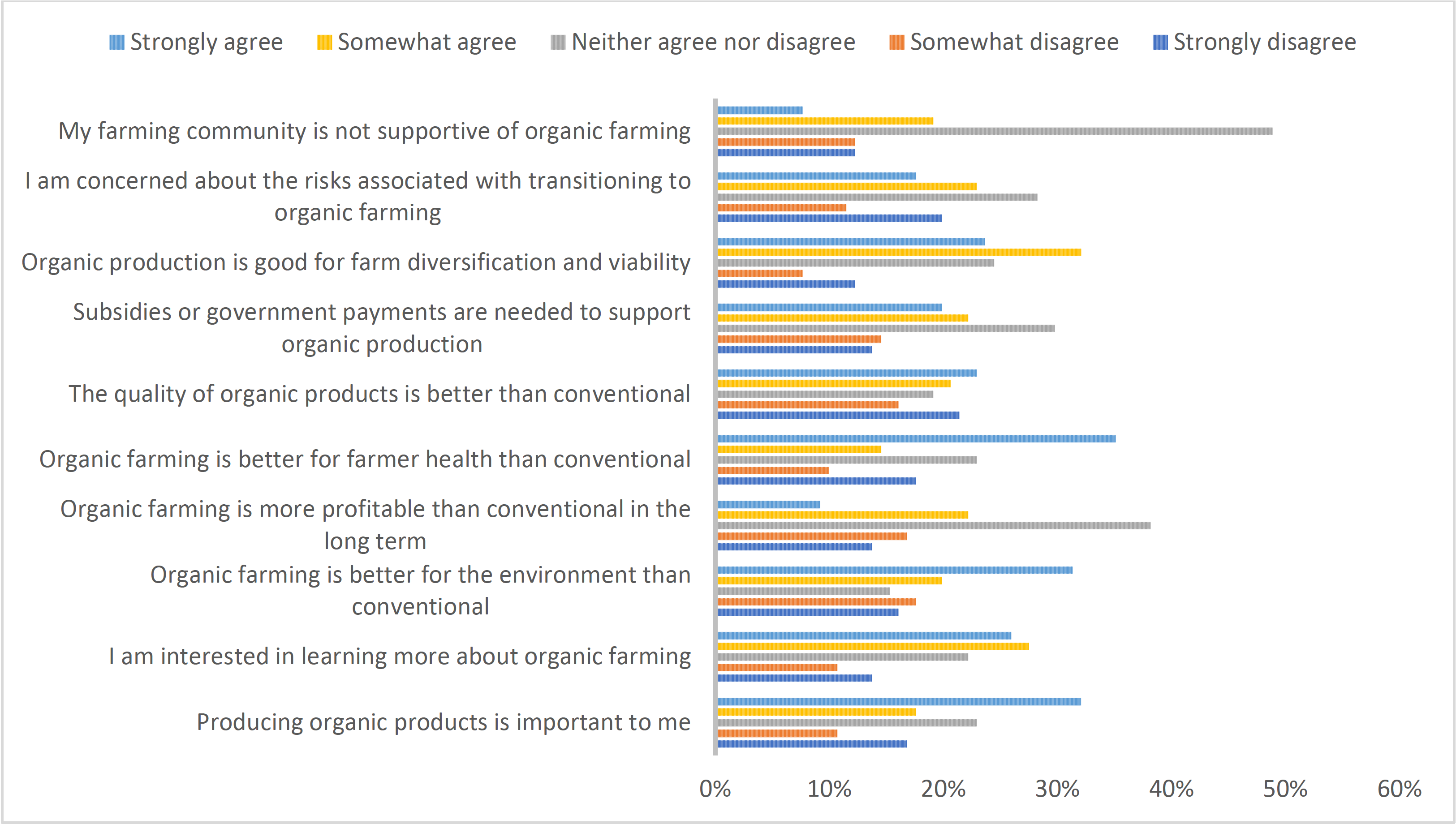
Several barriers to adoption also emerged. Almost half of the respondents were unsure about their farming community’s support for organic farming. Also, respondents expressed concern about the risks associated with transitioning to organic production, as 40.5% agreed or strongly agreed. In addition, many respondents (41.9% agree or strongly agree) feel that subsidies or government payments are needed to support organic production, indicating that financial assistance is viewed as an important factor for expanding organic adoption.
Table 3 presents the effects of producer attitudes on the likelihood of adopting organic production. Two attitude statements had significant positive effects on adoption, including Producing organic products is important to me, and Organic farming is more profitable than conventional farming in the long term. In contrast, agreement with the following statements had significant negative effects on the likelihood of adopting organic production, including Organic farming is better for farmer health than conventional farming, and I am concerned about the risks associated with transitioning to organic farming.
Based on the marginal effects, producers who agreed that producing organic products is important to them were 14.6% more likely to adopt organic production methods. Likewise, those who agreed that organic farming is more profitable than conventional farming in the long term were 7.9% more likely to adopt organic production. Conversely, producers who agreed that organic farming is better for farmer health than conventional farming were 9.5% less likely to adopt organic production methods, while those who expressed concern about the risks associated with transitioning to organic farming were 8.4% less likely to adopt organic production. The remaining attitude variables were not statistically significant predictors of organic adoption.
Table 3. Organic Attitudes Modeling Results
| Statement | Coefficient estimates | Marginal effects |
|---|---|---|
| Producing organic products is important to me | 1.330*** (0.457) |
0.146*** (0.043) |
| I am interested in learning more about organic farming | 0.315 (0.348) |
0.035 (0.038) |
| Organic farming is better for the environment than conventional | 0.466 (0.415) |
0.051 (0.044) |
| Organic farming is more profitable than conventional in the long term | 0.723** (0.334) |
0.079*** (0.034) |
| Organic farming is better for farmer health than conventional | -0.865* (0.452) |
-0.095** (0.047) |
| The quality of organic products is better than conventional | 0.022 (0.369) |
0.002 (0.040) |
| Subsidies or government payments are needed to support organic production | 0.128 (0.289) |
0.014 (0.032) |
| Organic production is good for farm diversification and viability | -0.022 (0.353) |
-0.002 (0.039) |
| I am concerned about the risks associated with transitioning to organic farming | -0.768*** (0.270) |
-0.084*** (0.026) |
| My farming community is not supportive of organic farming | -0.089 (0.303) |
-0.010 (0.033) |
|
Constant |
-5.090*** (1.924) |
NA |
| McFadden R2 | 0.482 | |
| Observations | 131 | |
| Log likelihood | -45.337 | |
| Akaike inf. crit. | 112.674 |
Notes. Single, double, and triple asterisks (*,**,***) denote significance at the 10%, 5%, and 1% level, respectively.
Conclusions
Overall, the findings here indicate that producer attitudes and concerns play an important role in adopting organic production practices. Producers generally viewed organic farming favorably, particularly for its environmental benefits, contribution to farm diversification, and long-term viability. Many respondents also expressed interest in learning more about organic production. However, uncertainty regarding profitability, concerns about transition risks, and a perceived lack of support within their farming communities suggest that important barriers to adoption remain.
The modeling analysis further demonstrates that specific attitudes and concerns significantly influence adoption decisions. Producers who believed that producing organic products was important and that organic farming is more profitable in the long term were more likely to adopt organic production methods. In contrast, concerns about transition risks, crop production risks, and the knowledge, skills, and planning required for organic production significantly reduced the likelihood of adoption. These findings suggest that informational and technical barriers may be as influential as financial considerations in shaping producer decisions.
The results have important implications for Extension programming and the USDA’s TOPP. Educational efforts that improve producers' knowledge of organic production practices, provide practical strategies for managing weeds, pests, and other production risks, and demonstrate the long-term economic viability of organic farming may help reduce barriers to adoption and improve the strength and viability of organic production in Utah.
Acknowledgments
This study was partially funded by the USDA Transition to Organic Partnership Program (TOPP). The authors of this fact sheet used ChatGPT for editing purposes only. Authors reviewed and edited the content provided and take full responsibility for the content.
References

September 2026
Utah State University Extension
Peer-reviewed fact sheet
Authors
Salma Shrity, Graduate Research Assistant, Department of Agricultural and Resource Economics; Kynda Curtis, Professor and USU Extension Specialist, Department of Agricultural and Resource Economics

Kynda Curtis
Food Systems Specialist
APEC Dept
Related Research

Agricultural Producer and Food Maker Food Processing Operation Needs Assessment Overview
Utah State University’s 2024 needs assessment explores the educational, funding, and infrastructure needs of Utah farmers, ranchers, and food makers involved in value-added food production. Results highlight respondent demographics, products, markets, lab

Assessing Utah's Agricultural Producer and Small Processor Interest in Value-Added Food Production
This fact sheet presents findings from a study on value-added food production among Utah farmers, ranchers, and food processors. Highlighting operational characteristics, production timelines, markets, sales goals, and key resources needed to support loca

Target Consumers for Beef Jerky
This study identifies the target market for packaged beef jerky in the western U.S., highlighting consumer demographics, purchasing habits, and willingness to pay premiums for organic, grass-fed, and locally sourced products.

Target Consumers for Bottled Mild Salsa
This fact sheet summarizes USU research on western U.S. consumers who purchase mild salsa, highlighting their demographics, food habits, and preferences. Target consumers are middle-aged, highly educated, engaged in local food systems, and willing to pay

Target Consumers for Bottled Tart Cherry Juice
This fact sheet provides an overview of the study results conducted by Utah State University to determine western U.S. consumer preferences and willingness to pay for regionally sourced processed food products. This fact sheet addresses target consumers f
The Impact of Producer Attitudes and Concerns on Organic Adoption Decisions
USU researchers examine how producers' concerns and attitudes influence decisions to adopt organic production among Utah agricultural producers. Findings highlight barriers such as production risks and knowledge gaps, while positive views of organic profi

The Organic Educational and Resource Needs of Utah's Agricultural Producers
USU researchers identify Utah producers’ top organic education and resource needs. Findings highlight certification, support programs, marketing, and hands-on learning.
The Organic Production Interests of Utah's Agricultural Producers
USU researchers surveyed Utah agricultural producers to understand their interest in organic production and the factors influencing their decisions. The findings highlight educational and resource needs for organic agriculture.
The Role of Producer and Operation Characteristics in Organic Production Adoption Decisions
USU researchers examine how producer and operation characteristics influence organic production adoption decisions among Utah agricultural producers. Findings highlight factors that can help Extension target education, technical assistance, and mentoring

U.S. West Consumer Preferences for Specialty Labeled Processed Foods
Highlighting consumer preferences and willingness to pay for specialty-labeled processed foods, including organic, local, grass-fed, and non-GMO products. Survey results show strong consumer value for health, safety, freshness, and transparency, especiall

U.S. West Consumer Processed Food Preferences and Consumption Habits
This article summarizes a 2024 Utah State University study examining processed food preferences and purchasing behaviors among 1,282 consumers across the western United States. Findings highlight key values such as taste, price, product quality, and trust
Utah Agricultural Producer Barriers to Adopting Organic Production Methods
USU researchers identify key barriers to organic production in Utah, including production costs, labor, market uncertainty, and certification requirements. Findings highlight opportunities to provide producers with practical guidance, financial support, a

Utah's Value-Added Food Processing Options
Explaining what value-added foods are and how producers can increase profit through processing, direct marketing, and vertical integration. Also outlining Utah’s regulatory options and programs to help small food businesses choose the right path for produ