
Optimal Drought Management Actions for Cattle Operations on Navajo Nation
Introduction
Highlights
- Drought significantly threatens cattle operations on the Navajo Nation by reducing forage, water availability, and ranch income.
- Profitable drought responses depend on hay prices and risk tolerance, with hay purchases favored only at low prices.
- Risk-neutral ranchers face small long-term return differences across strategies, allowing more flexibility in decision-making.
- Proactive drought planning and market monitoring improve outcomes, including timely herd adjustments and careful postdrought rebuilding.
Agriculture remains and important economic activity on U.S. Native American Indian reservations. Native Americans in the arid Southwest rely on livestock grazing for subsistence, and it’s an inseparable part of their culture and a traditional source of livelihood as well (Redsteer et al., 2013). Yet frequent, prolonged droughts increasingly threaten the financial viability of cattle operations in this region. Drought conditions degrade rangeland quality and reduce water availability, leading to lower cattle productivity and diminished economic returns (Hamilton et al., 2016; Wold et al., 2023). Recent research indicates that ranch income decreases by as much as 11% when an additional share of pastureland is exposed to abnormally dry conditions and by up to 15% for severe drought conditions (Rodziewicz et al., 2023).
On the Navajo Nation, 3.5% of the population is employed in the agriculture, forestry, fishing/hunting, and mining sectors, which is almost double the U.S. national average of 1.8% (U.S. Census Bureau, 2022). Crop sales on the Navajo Nation represent 79.1% of all agricultural sales, and livestock sales represent the remaining 20.9% (National Agricultural Statistics Service [NASS], 2020). In terms of livestock inventory, cattle and calves represent the second most important group (71,374 head), behind sheep and lamb (194,034 head). A major agricultural producer on the Navajo Nation is the Navajo-owned “Navajo Agricultural Products Industry” (NAPI), which operates an estimated 110,000 acres of cultivated land, of which 74,000 acres are under pivot irrigation. The major crops include alfalfa, feed corn, small grains, dry beans, and potatoes, and the products are labeled with the “Navajo Pride” stamp (Marchant, 2019).
The Navajo Nation is primarily located in Arizona, one of the driest states in the U.S. Arizona’s average yearly precipitation was 11.24 inches between 2000 and 2019 (National Centers for Environmental Information, 2023). Between April 2022 and May 2023, on average, 59% of alfalfa hay acreage and 50% of cattle inventory in Arizona were affected by moderate to severe drought (U.S. Drought Monitor, 2023). According to the U.S. Drought Monitor (2025a), moderate drought causes some crop and pasture damage and results in low stream, reservoir, and well levels. Reduced grazing quality, feed, and water supply have negative implications for animal health, reproduction, and overall production systems (Nardone et al., 2010), potentially with significant economic impacts. For example, livestock producers in the Hualapai Tribe lost $1.6 million between 2001 and 2007 due to a 50% loss in grazing efficiency and a resulting 30% herd reduction (Knutson et al., 2007). On the Navajo Nation, an estimated reduction of cattle inventory by 2,400 head (3.72%) due to a two-year moderate drought led to $3.5 million in losses to cattle operations (Drugova et al., 2022).
In this fact sheet, we examine the drought management options available to cattle operations on the Navajo Nation, the largest Native American reservation in the U.S. Specifically, we discuss the results of a study evaluating the economic outcomes of two common drought response strategies: herd reduction and supplemental hay purchases. We also provide recommendations for ranchers regarding optimal strategies, i.e., those which would maximize profits, for two rancher types, differentiated by their willingness to accept (risk-neutral) or avoid risk (risk-averse). A third potential drought response strategy, leasing additional grazing land, was not included in the analysis, as this option isn’t normally possible. The vast majority of Native American reservation lands are held in trust by the U.S. government, and thus, land-leasing agreements must go through a lengthy approval process at the U.S. Department of the Interior. The one exception is reservations with approved HEARTH Act regulations, which allow tribal governments to approve land-leasing agreements directly (see HEARTH Act Leasing).
Study Approach and Data
In the study, net returns were calculated over 10 years for the selected drought management scenarios listed in Table 1. For example, in Scenario 2, due to drought, available forage could not support all eight head of cattle, so the rancher sells six head and purchases additional hay for the remaining two head. The scenario that yields the highest net returns over the 10-year period is the most optimal one from a financial perspective.
| Scenario | Share of cattle sold* | Purchase additional hay |
|---|---|---|
| 1 | 100% | None |
| 2 | 75% | 25% of cattle |
| 3 | 50% | 50% of cattle |
| 4 | 25% | 75% of cattle |
| 5 | 0% | 100% of cattle |
Note. *Calculated for all cattle not supported on available forage.
To calculate net returns, we used data from available cost-of-production studies in the region (Utah State University [USU] Extension, 2024). We simulated cattle prices and forage production using historical data to use variable cattle prices and forage production in the analysis. The remaining variables were held constant, including starting herd size, cattle production ratios, cull rate, cattle forage and feed needs, and fixed costs. We simulated forage production in the first year only, and we defined drought as simulated forage production below the historical average. In the following years, we assumed normal forage production and allowed ranchers to repurchase cattle. We also assumed that the drought occurred in one year only. Additional analysis would be needed to determine the most profitable actions in periods of persistent (multi-year) drought. Research shows that herd rebuilding may take from 3–6 years after a multi-year drought, while rangeland recovery takes 1–3 years for moderate drought and 3–5 years for severe drought (Countryman et al., 2016; Peel, 2023; U.S. Drought Monitor, 2025b).
We did not simulate hay prices; rather, we calculated net returns for each hay price between $100 and $275/ton at $25 increments to examine the impact of variable hay prices on the optimal management scenario. Note that the average hay price in Arizona in 2024 was $181/ton, which is a reduction from the 2020–2024 average of $230/ton (NASS, 2025). We collected available weekly steer prices for Arizona between 2019 and 2023 (Cattle Range, 2023). We then calculated heifer and slaughter cattle prices based on estimated historical relationships between steer, heifer, and slaughter cattle prices. We obtained yearly forage production data for the Navajo Nation from 1986–2021 (Agricultural Research Service [ARS], 2023). Table 2 reports the summary statistics for the cattle prices and forage data used in the simulation.
| Variable | Mean | St. dev. | CV (%) | Min | Max |
|---|---|---|---|---|---|
| Steer prices | 170.24 | 19.48 | 0.11 | 137.17 | 227.13 |
| Heifer prices | 148.26 | 16.96 | 0.11 | 119.45 | 197.79 |
| Slaughter prices | 76.00 | 8.70 | 0.11 | 61.23 | 101.39 |
| Forage productiona | 135.95 | 32.96 | 24.2% | 67.11 | 217.52 |
aSource: ARS, 1986-2021
Study Results
Figure 1 shows the estimated average returns over ten years for risk-neutral ranchers and certainty equivalents (CE) for risk-averse ranchers. Certainty equivalent is the return that a risk-averse rancher would accept to avoid the risk, and thus it is lower than the average return. Examined drought management scenarios are differentiated by circle color, which plots the average return or certainty equivalent in $1,000 (y-axis) for the drought option at a given hay price (x-axis). The highest plotted circle per hay price represents the most profitable option at that hay price.
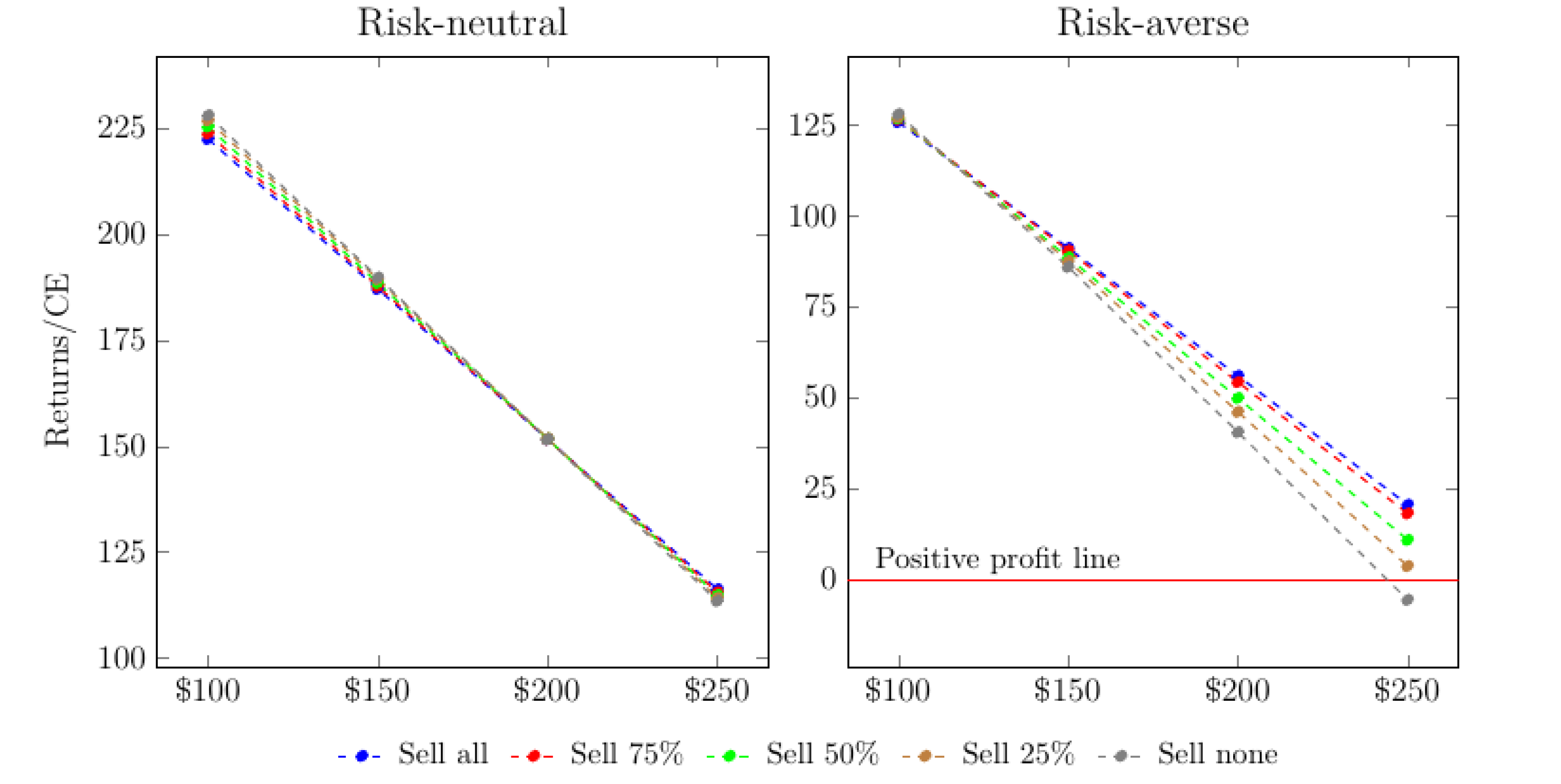
Note. Hay prices are $/ton. CE is certainty equivalent. Per Table 1, “Sell all” is Scenario 1, “Sell 75%” is Scenario 2, “Sell 50%” is Scenario 3, “Sell 25%” is Scenario 4, and “Sell none” is Scenario 5.
Risk-Neutral Ranchers
For risk-neutral ranchers, the difference in average returns across the drought management scenarios is relatively small, but it matters more as hay prices increase and average returns decrease. The variability of returns (i.e., uncertainty, measured using standard deviation) increases as the rancher moves from selling all unsupported cattle (Scenario 1) to purchasing additional hay only (Scenario 5) at any hay price.
At the lowest examined hay price of $100/ton, which is much lower than recent hay prices in Arizona, purchasing additional hay to keep all cattle is most profitable ($228,000). The returns are 2.5% higher than returns when selling all cattle that cannot be supported during drought ($223,000). Note that these are average 10-year returns of 1,000 simulations per year, and the actual return observed in any given 10-year period may be lower or higher.
When the hay price is $200/ton, the difference in average returns across the five drought management scenarios is virtually $0. There are likely differences in returns in the short term, but they disappear in the long term (10 years), assuming the drought lasts only one year. But purchasing hay only (Scenario 5) is the riskiest, with the possibility of observing the lowest return. Also, as hay price increases above $200/ton, the option to sell some or all unsupported cattle becomes economically attractive. At the highest examined hay price of $275/ton, selling all unsupported cattle yields the highest return ($98,000). It is 4.5% higher than purchasing additional hay for all cattle ($94,000), and 2.2% higher than selling 50% of the unsupported cattle and purchasing additional hay for the remaining cattle ($96,000).
Risk-Averse Ranchers
Risk-averse ranchers avoid risk, and incorporating risk aversion into calculations leads to significantly lower average certainty equivalents when compared to the average returns for risk-neutral ranchers, as shown in Figure 1. Similarly, as in the case of risk-neutral ranchers, the differences in returns are relatively small at lower hay prices, but they increase rapidly at hay prices above $150/ton. At or above this hay price level, selling all cattle that cannot be supported due to drought is the most profitable option. Given the 2024 average hay price of $181/ton in Arizona, these findings suggest that risk-averse ranchers sell all cattle that cannot be supported during drought to maximize profits.
Conclusions
We examined average returns and their variability for five drought management scenarios for cattle operations on the Navajo Nation. We find that purchasing additional hay to retain all cattle during drought is riskier, since it can yield the lowest returns. But on average, it is the most profitable option if hay prices are low. As hay prices increase, selling some cattle and purchasing less (additional) hay becomes more profitable. Considering hay prices in Arizona in 2024, the differences between average returns across the examined options are minimal in favor of purchasing hay and keeping all cattle, but not large enough to outweigh the uncertainty associated with that option. At hay prices at or above $150/ton, the analysis shows that selling all cattle that cannot be supported during drought is the best option for risk-averse ranchers.
These results are consistent with expectations that, as hay prices increase, it becomes more expensive to maintain cattle and, thus, better from a financial perspective to reduce the herd. But the differences in average returns across drought actions are small for a risk-neutral rancher, suggesting that there is no clear right or wrong approach. On the other hand, risk-averse ranchers benefit greatly from herd reductions at higher hay prices. We assumed that cattle ranchers have a drought management plan in place and monitor the weather conditions so that they can act promptly.
Recommendations
- Monitor current and forecasted regional drought conditions (U.S. Drought Monitor).
- Monitor forage and hay prices closely. When hay prices increase, selling unsupported cattle is usually the better option.
- Have a drought plan in place. Set clear triggers for herd reduction or supplemental feeding based on forage and water availability.
- Risk-neutral ranchers can maintain more cattle through hay purchases when prices are low.
- Risk-averse ranchers should reduce their herds early during drought to avoid financial losses.
- Rebuild herds cautiously after drought once forage recovers and market prices are favorable.
- Build resilience by storing hay in good years, exploring insurance programs, and maintaining accurate cost-of-production returns records to improve future drought-response decision-making.
- Collaborate with tribal and government programs to improve range management and drought response capacity.
Acknowledgments
Funding for this publication was made possible by a grant from the National Institute of Food and Agriculture, U.S. Department of Agriculture (USDA), under award number 2020-68006-31262.
The authors used ChatGPT to generate the “Recommendations” and “Highlights” sections from the fact sheet text, which the authors edited to ensure accuracy. The authors take full responsibility for the content.
References
- Agricultural Research Service (ARS). (2023). Rangeland analysis platform: Herbaceous biomass, 1986–2021 [Data set]. U.S. Department of Agriculture. https://rangelands.app/rap/?biomass_t=herbaceous&ll=39.0000,-98.0000&z=5
- Cattle Range. (2023). Weekly market summary [Data set]. https://www.cattlerange.com/pages/market-reports/weekly-summary/
- Countryman, A. M., Paarlberg, P. L., & Lee, J. G. (2016). Dynamic effects of drought on the U.S. beef supply chain. Agricultural and Resource Economics Review, 45(3), 459–484.
- Drugova, T., Curtis, K. R., & Kim, M. K. (2022). The impacts of drought on Southwest tribal economies. Journal of the American Water Resources Association, 58(5), 639–653.
- Hamilton, T. W., Ritten, J. P., Bastian, C. T., Derner, J. D., & Tanaka, J. A. (2016). Economic impacts of increasing seasonal precipitation variation on southeast Wyoming cow-calf enterprises. Rangeland Ecology & Management, 69(6), 465–473.
- Knutson, C. L., Hayes, M. J., & Svoboda, M. D. (2007). Case study of tribal drought planning: The Hualapai Tribe. Natural Hazards Review, 8(4), 125–131.
- Marchant, T. (2019, February 28). Pride of the Nation. Potato Grower. https://www.potatogrower.com/2019/02/pride-of-the-nation
- Nardone, A., Ronchi, B., Lacetera, N., Ranieri, M. S., & Bernabucci, U. (2010). Effects of climate changes on animal production and sustainability of livestock systems. Livestock Science, 130(1–3), 57–69.
- National Agricultural Statistics Service (NASS). (2020). 2017 Census of agriculture, Navajo Nation profile [Report]. U.S. Department of Agriculture. https://www.nass.usda.gov/Publications/AgCensus/2017/Online_Resources/Navajo_Nation_Profiles/Navajo-Nation.pdf
- National Agricultural Statistics Service (NASS). (2025). Quick stats [Data set]. U.S. Department of Agriculture. https://quickstats.nass.usda.gov
- National Centers for Environmental Information. (2023). Climate at a glance: Statewide time series [Data set]. National Oceanic and Atmospheric Administration. https://www.ncei.noaa.gov/access/monitoring/climate-at-a-glance/statewide/time-series
- Peel, D. S. (2023, June 12). Starting the herd rebuilding clock. Cow-Calf Corner, Oklahoma State University Extension. https://extension.okstate.edu/programs/beef-extension/cow-calf-corner-the-newsletter-archives/2023/june-12-2023.html
- Redsteer, M. H., Bemis, K., Chief, K., Gautam, M., Middleton, B. R., Tsosie, R., & Ferguson, D. B. (2013). Unique challenges facing southwestern tribes. In G. Garfin, A. Jardine, R. Merideth, M. Black, & S. LeRoy (Eds.), Assessment of climate change in the Southwest United States (pp. 385–404). Island Press.
- Rodziewicz, D., Dice, J., & Cowley, C. (2023). Drought and cattle: Implications for ranchers [RWP No. 23-06]. Federal Reserve Bank of Kansas City. https://www.kansascityfed.org/documents/9582/rwp23-06rodziewiczdicecowley.pdf
- U.S. Census Bureau. (2022). 2017–2021 American community survey 5-year estimates [Data set]. U.S. Department of Commerce. https://www.census.gov/tribal/
- U.S. Drought Monitor. (2025a). Current conditions map. National Drought Mitigation Center. https://droughtmonitor.unl.edu/CurrentMap.aspx
- U.S. Drought Monitor. (2025b). Drought and ranch management. National Drought Mitigation Center. https://ranchdrought.unl.edu/Learn/Management.aspx
- U.S. Drought Monitor. (2023). U.S. Agricultural commodities in drought: Livestock & forage [Data set]. National Drought Mitigation Center. https://agindrought.unl.edu/Table.aspx?2
- Utah State University Extension. (2024). Navajo Nation, cow-calf production costs and returns, 100 head. https://extension.usu.edu/apec/navajo.pdf
- Wold, A. N., Meddens, A. J., Lee, K. D., & Jansen, V. S. (2023). Quantifying the effects of vegetation productivity and drought scenarios on livestock production decisions and income. Rangelands, 45(2), 21–32.

January 2026
Utah State University Extension
Peer-reviewed fact sheet
Authors
Tatiana Drugova, Research Associate, USU Department of Applied Economics; Kynda Curtis, Professor and USU Extension Specialist, USU Department of Applied Economics; Man-Keun Kim, Professor, USU Department of Applied Economics

Kynda Curtis
Food Systems Specialist
APEC Dept
Related Research

Agricultural Producer and Food Maker Food Processing Operation Needs Assessment Overview
Utah State University’s 2024 needs assessment explores the educational, funding, and infrastructure needs of Utah farmers, ranchers, and food makers involved in value-added food production. Results highlight respondent demographics, products, markets, lab

Assessing Utah's Agricultural Producer and Small Processor Interest in Value-Added Food Production
This fact sheet presents findings from a study on value-added food production among Utah farmers, ranchers, and food processors. Highlighting operational characteristics, production timelines, markets, sales goals, and key resources needed to support loca
Target Consumers for Beef Jerky
This study identifies the target market for packaged beef jerky in the western U.S., highlighting consumer demographics, purchasing habits, and willingness to pay premiums for organic, grass-fed, and locally sourced products.

Target Consumers for Bottled Mild Salsa
This fact sheet summarizes USU research on western U.S. consumers who purchase mild salsa, highlighting their demographics, food habits, and preferences. Target consumers are middle-aged, highly educated, engaged in local food systems, and willing to pay
Target Consumers for Bottled Tart Cherry Juice
This fact sheet provides an overview of the study results conducted by Utah State University to determine western U.S. consumer preferences and willingness to pay for regionally sourced processed food products. This fact sheet addresses target consumers f
U.S. West Consumer Preferences for Specialty Labeled Processed Foods
Highlighting consumer preferences and willingness to pay for specialty-labeled processed foods, including organic, local, grass-fed, and non-GMO products. Survey results show strong consumer value for health, safety, freshness, and transparency, especiall

U.S. West Consumer Processed Food Preferences and Consumption Habits
This article summarizes a 2024 Utah State University study examining processed food preferences and purchasing behaviors among 1,282 consumers across the western United States. Findings highlight key values such as taste, price, product quality, and trust
Utah's Value-Added Food Processing Options
Explaining what value-added foods are and how producers can increase profit through processing, direct marketing, and vertical integration. Also outlining Utah’s regulatory options and programs to help small food businesses choose the right path for produ