
What is an invasive weed?
Invasive, noxious, weeds are not native to North America that can pose serious environmental threats. These plants did not evolve in our ecosystems and therefore do not have native predators or diseases to keep their populations in check. They can spread like wildfire, crowding out native biodiversity, increasing soil erosion, reducing water quality, and more.
The management of invasive weeds is the most time-consuming and expensive restoration project Swaner’s conservation team tackles each year! Swaner pursues multiple grants and funding sources specifically for this project to improve habitat and ecosystem function by removing these plants and revegetating with native species.
Interns, staff, and volunteers spend hundreds of hours each year physically removing thousands of pounds of weeds across the Preserve. Want to get involved and lend a hand? Check out our upcoming volunteer projects!
Swaner participates in the ongoing research of biocontrols and organic herbicides on invasive plants. Biocontrols are living agents like insects or fungus that specifically target the invasive plant and can help control populations.


Resources
Find local resources and learn more at the Summit County Weed Department or Summit CWMA.
Invasive Weeds on Swaner Preserve
Class 1B
Early detection (ED)
Plants that occur in Summit County at very low levels. They are a high priority to eradicate all known populations and prevent new ones.
- Garlic mustard, Alliaria petiolata
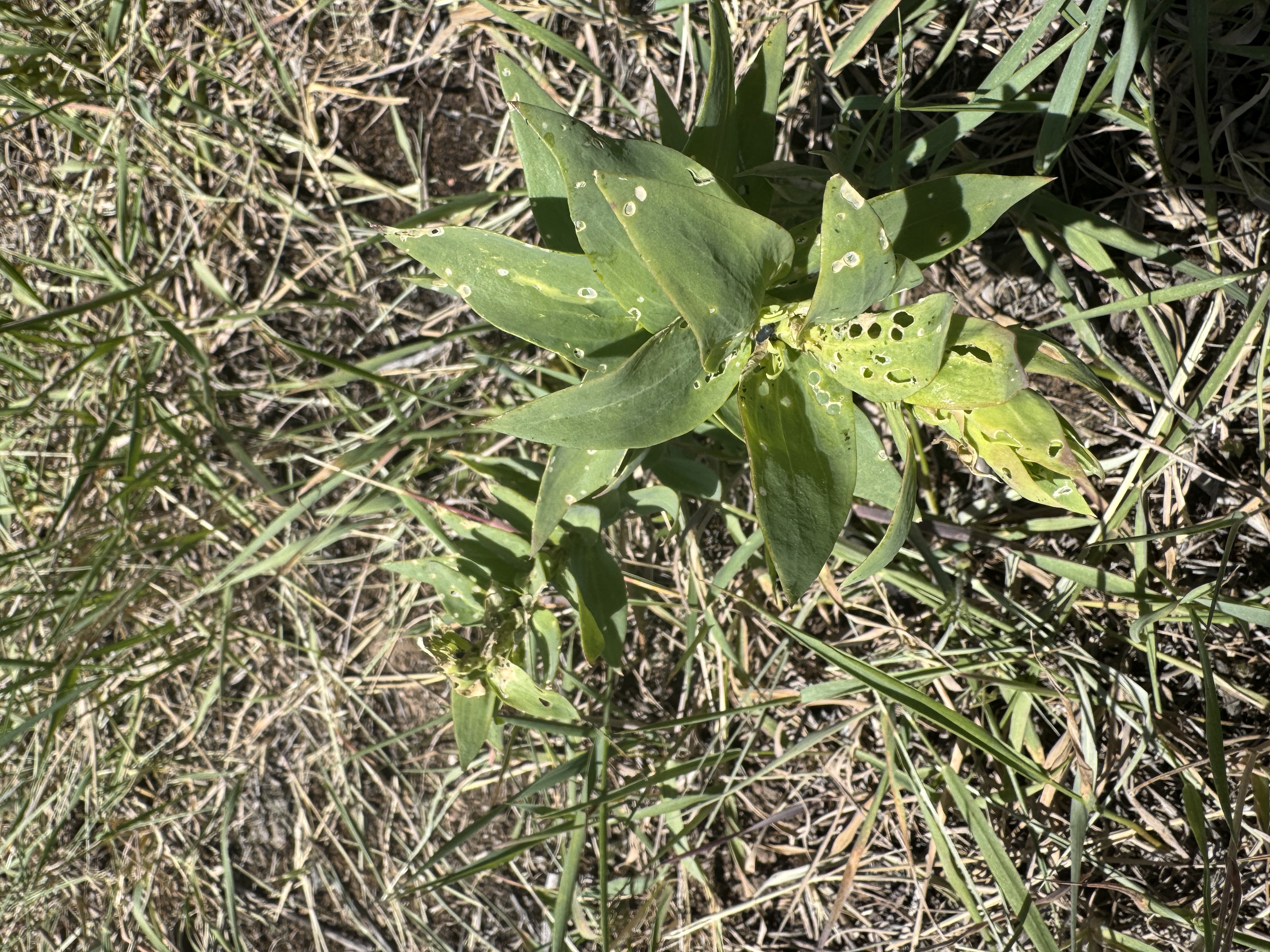
- Leafy Spurge, Euphorbia esula
- Diffuse Knapweed, Centaurea diffusa
- Cutleaf Vipergrass, Scorzonera laciniata
Class 2
Control
Plants that have a reasonable distribution in Summit County, but do not occur everywhere. These should be given a high priority for control.
- Dyer’s Woad, Isatis tinctoria
- Houndstongue, Cynoglossum officinale
- Oxeye Daisy, Leucanthemum vulgare
- Black Henbane, Hyoscyamus niger
- Perennial pepperweed, Lepidium latifolium
- Spotted Knapweed, Centaurea stoebe
- Canada Thistle, Cirsium arvense
- Musk Thistle, Carduus nutans
- Scotch Thistle, Onopordum acanthium
- Dalmatian Toadflax, Linaria dalmatica
- Poison Hemlock, Conium maculatum
- Scentless Chamomile, Tripleurospermum perforatum
- Mayweed Chamomile, Anthemis cotula
- Corn Chamomile, Anthemis arvensis
- Common burdock, Arctium minus
- Hoary Cress, Cardaria draba
- Phragmites, Phragmites australis
Class 3
Contain
Plants widely distributed in Summit County. The current populations of these plants should be contained to halt their spread. These plants should not enter commercial channels.
- Field Bindweed, Convolvulus arvensis
- Quackgrass, Elytrigia repens
- Myrtle Spurge, Euphorbia myrsinites
Class 4
Prohibited
Plants that are present in Summit County, appear to be arriving in nursery stock/seed, and are being sold as ornamentals. This is now illegal.
- Dame's Rocket, Hesperis matronalis