
Lameness in Dairy Cattle: A Practical Overview
Key Takeaways
- Lameness is a sign of underlying pain or injury, not a disease itself.
- Many lame cows show subtle changes before obvious limping, making early detection challenging.
- Lameness is common in dairy herds and is often underdetected.
- Lameness reduces milk production, reproductive performance, and herd longevity.
- Early recognition and prevention are key to improving cow welfare and farm performance.
This fact sheet provides an overview of lameness in dairy cattle, including what it is, why it matters, and how to recognize and manage it. Information is geared toward producers, consultants, and educators.
What Is Lameness?
Lameness is not a disease, but a visible sign that a cow is experiencing pain or difficulty walking, often due to problems in the hoof, limb, or musculoskeletal system (Cramer et al., 2024b).
Importantly, lameness is not limited to cows that are obviously limping. Many lame cows show subtle changes in gait that are easily missed during daily routines. As a result, relying solely on visible limping often identifies only more advanced cases and may underestimate the true prevalence of lameness within a herd (Leach et al., 2010). This means that many lame cows may go unnoticed without careful observation.
Why Lameness Matters
Lameness has important implications for production, sustainability, and animal welfare in dairy systems.
Production and Performance
Lame cows produce less milk, with reported losses ranging from 1,784 to 2,838 pounds per lactation compared with non-lame cows (Puerto et al., 2021). Lameness is also associated with impaired reproductive performance, including calving intervals that are approximately 34 days longer, as well as an increased risk of culling (Ózsvári, 2017; Puerto et al., 2021). Increased culling of lame cows can reduce productive lifespan within the herd and increase replacement costs for producers.
Together, these effects demonstrate the broad impact of lameness on productivity, reproduction, and herd longevity.
Efficiency and Sustainability
Lameness reduces production efficiency, which can increase greenhouse gas emissions per unit of milk produced. One analysis estimated an additional 13.6 kg of CO₂-equivalents per ton of fat- and protein-corrected milk for cows with hoof lesions compared to those without (Mostert et al., 2018). These increases are driven by factors such as feed production, enteric methane emissions, and manure management associated with raising replacement heifers. Reducing lameness can decrease the number of replacement heifers needed, making this particularly important as the U.S. dairy industry works toward its goal of greenhouse gas neutrality by 2050 (Undeniably Dairy, 2026).
Together, these inefficiencies illustrate how lameness influences production efficiency and environmental sustainability.
Animal Welfare
Lameness is a major animal welfare concern and is recognized as an important indicator of the ethical care and management of food-producing animals. (Fraser, 2008). Lame cows experience pain, as demonstrated by reduced nociceptive thresholds (Whay et al., 1998), and show changes in normal behaviors such as feeding and lying time (Magrin et al., 2023).
These effects demonstrate the impact of lameness on cow comfort and overall well-being.
How Common Is Lameness?
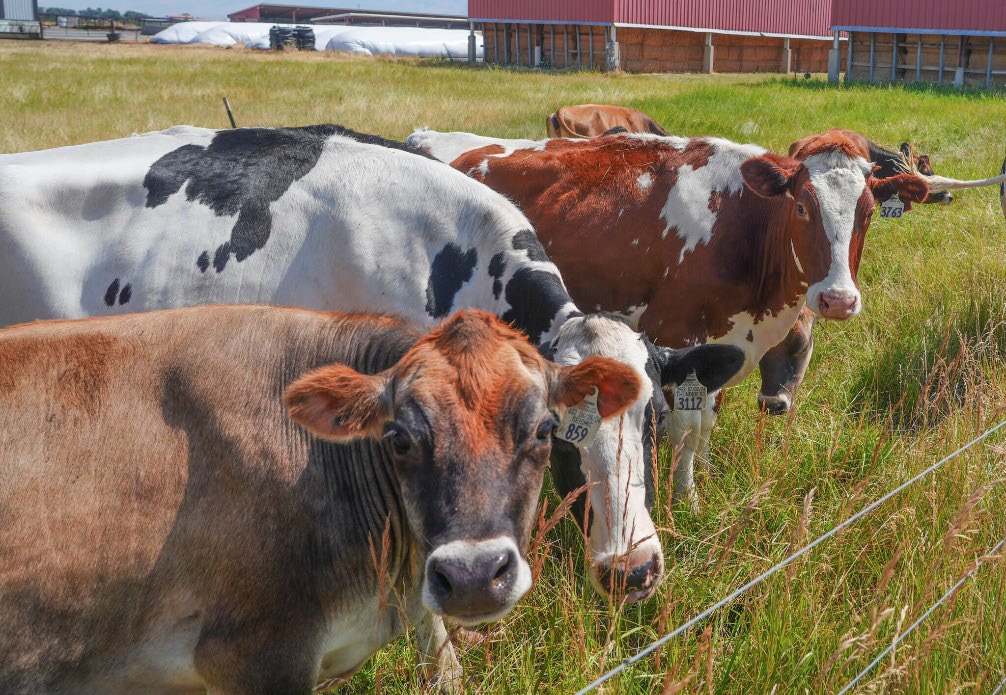
Lameness is a widespread issue in North American dairy herds, with published estimates suggesting that approximately 10% to 55% of cows may be affected at any given time (Adams et al., 2017; Cook et al., 2016; Von Keyserlingk et al., 2012). This wide range reflects differences in production systems; summaries of the literature report prevalence estimates as low as approximately 8%–10% in pasture-based systems and as high as 55% in indoor-housed herds (Cramer et al., 2024a).
Lameness risk is influenced by housing (e.g., bedding, flooring, and stall design), management (e.g., cleanliness, hoof trimming, and stocking density), and individual cow characteristics such as body condition, parity, and hock injuries (Roche et al., 2024).
Together, these factors highlight that lameness is both common and influenced by multiple interacting components of the production system.
Causes of Lameness
Lameness in dairy cattle can arise from a range of conditions, including hoof lesions, trauma, arthritis, muscle or tendon injuries, and neurologic disease (Cramer et al., 2024b). Although most lame cows have underlying hoof lesions, not all cows with lesions are visibly lame, particularly when lesions are mild or in early stages (van Huyssteen et al., 2020). In North American dairy herds, the most common hoof lesions associated with lameness are digital dermatitis (Figure 1A), sole ulcers (Figure 1B), and white line disease (Figure 1C) (Cramer et al., 2008; DeFrain et al., 2013; Solano et al., 2016).
(A) Active Digital Dermatitis, (B) Sole Ulcer, and (C) White Line Disease
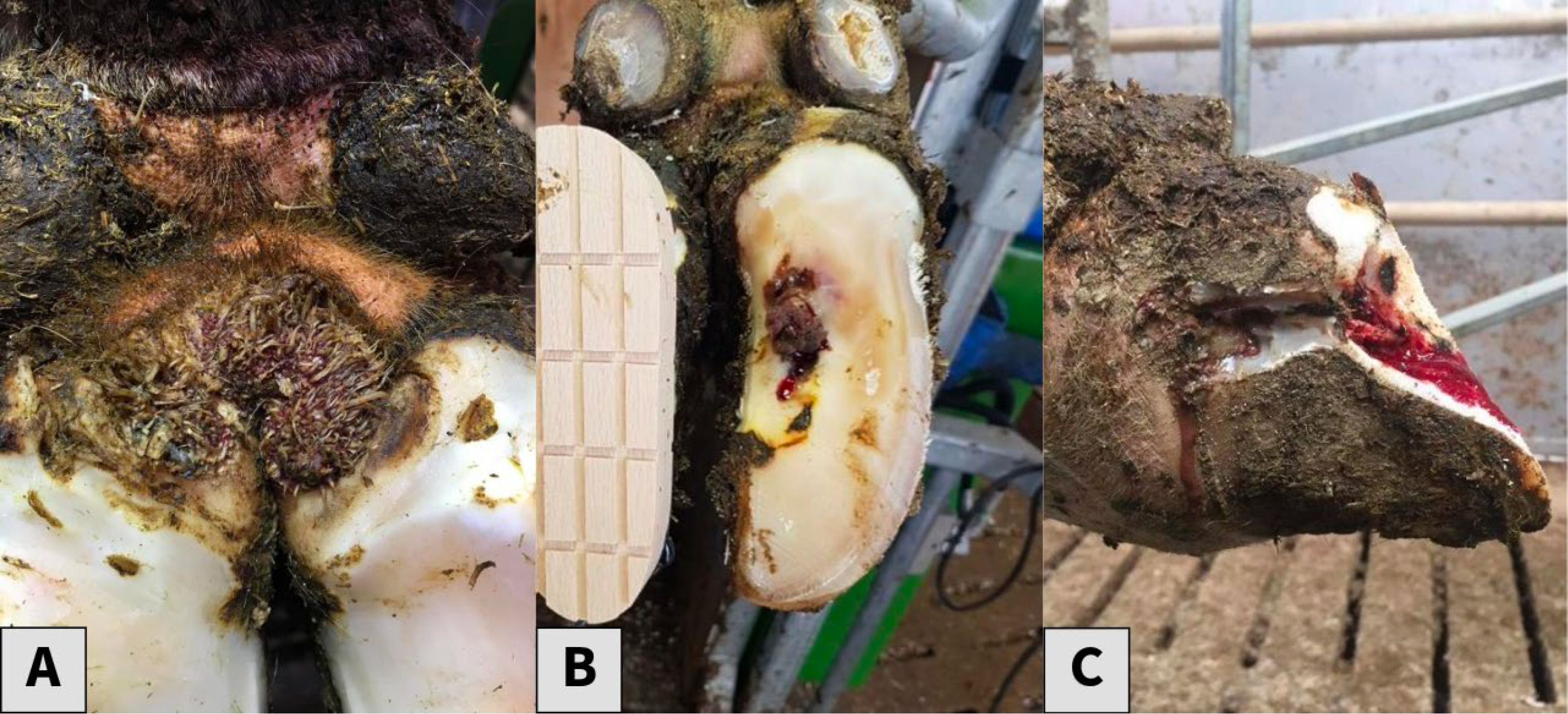
Photos provided and used with permission from William Davy.
For a more practical, producer-focused overview of these hoof lesions, see the USU Extension fact sheet “Three Common Hoof Problems in Dairy Cows: What to Watch for and How to Prevent Them.”
For a more technical overview of these hoof lesions, see USU Extension’s “Digital Dermatitis, Sole Ulcers, and White Line Disease in Dairy Cattle: Pathogenesis, Diagnosis, and Treatment.”
Summary
Lameness is not a disease itself, but a visible sign of underlying pain or dysfunction that can have substantial consequences for dairy cattle welfare, productivity, and longevity. Many cases are subtle and easily missed, contributing to the underestimation of its true prevalence on farms. Recognizing the importance of lameness and the factors that influence its occurrence is an essential first step toward improving hoof health management.
Acknowledgments
Dennis Hinkamp, USU Extension, provided the photos, unless otherwise noted. The authors of this content used ChatGPT to improve writing clarity and flow. The tool was not used to identify sources, generate ideas, or interpret findings. Authors reviewed and edited the content provided by the AI tool, and they take full responsibility for the content.
Continued Reading and Works Cited
Adams, A. E., Lombard, J. E., Fossler, C. P., Román-Muñiz, I. N., & Kopral, C. A. (2017). Associations between housing and management practices and the prevalence of lameness, hock lesions, and thin cows on US dairy operations. Journal of Dairy Science, 100(3), 2119–2136. Scopus. https://doi.org/10.3168/jds.2016-11517
Cook, N. B., Hess, J. P., Foy, M. R., Bennett, T. B., & Brotzman, R. L. (2016). Management characteristics, lameness, and body injuries of dairy cattle housed in high-performance dairy herds in Wisconsin. Journal of Dairy Science, 99(7), 5879–5891. https://doi.org/10.3168/jds.2016-10956
Cramer, G., Lissemore, K. D., Guard, C. L., Leslie, K. E., & Kelton, D. F. (2008). Herd- and cow-level prevalence of foot lesions in Ontario dairy cattle. Journal of Dairy Science., 91(10), 3888–3895. https://doi.org/10.3168/jds.2008-1135
Cramer, G., Solano, L., & Abuelo, A. (2024a, September). Epidemiology of lameness in cattle. In Merck veterinary manual. https://www.merckvetmanual.com/musculoskeletal-system/lameness-in-cattle/epidemiology-of-lameness-in-cattle
Cramer, G., Solano, L., & Abuelo, A. (2024b, September). Overview of lameness in cattle - musculoskeletal system. In Merck veterinary manual. Accessed February 10, 2026, from https://www.merckvetmanual.com/musculoskeletal-system/lameness-in-cattle/overview-of-lameness-in-cattle.
DeFrain, J. M., Socha, M. T., & Tomlinson, D. J. (2013). Analysis of foot health records from 17 confinement dairies. Journal of Dairy Science, 96(11), 7329–7339. https://doi.org/10.3168/jds.2012-6017
Leach, K. A., Whay, H. R., Maggs, C. M., Barker, Z. E., Paul, E. S., Bell, A. K., & Main, D. C. J. (2010). Working towards a reduction in cattle lameness: 1. Understanding barriers to lameness control on dairy farms. Research in Veterinary Science, 89(2), 311–317. https://doi.org/10.1016/j.rvsc.2010.02.014
Magrin, L., Contiero, B., Cozzi, G., Gottardo, F., & Segato, S. (2023). Deviation of behavioural and productive parameters in dairy cows due to a lameness event: A synthesis of reviews. Italian Journal of Animal Science, 22(1), 739–748. https://doi.org/10.1080/1828051X.2023.2241870
Mostert, P. F., van Middelaar, C. E., de Boer, I. J. M., & Bokkers, E. A. M. (2018). The impact of foot lesions in dairy cows on greenhouse gas emissions of milk production. Agricultural Systems, 167, 206–212. https://doi.org/10.1016/j.agsy.2018.09.006
Ózsvári, L. (2017). Economic cost of lameness in dairy cattle herds. Journal of Dairy, Veterinary & Animal Research, Volume 6(2). https://doi.org/10.15406/jdvar.2017.06.00176
Puerto, M. A., Shepley, E., Cue, R. I., Warner, D., Dubuc, J., & Vasseur, E. (2021). The hidden cost of disease: II. Impact of the first incidence of lameness on production and economic indicators of primiparous dairy cows. Journal of Dairy Science, 104(7), 7944–7955. https://doi.org/10.3168/jds.2020-19585
Roche, S. M., Renaud, D. L., Saraceni, J., Kelton, D. F., & DeVries, T. J. (2024). Invited review: Prevalence, risk factors, treatment, and barriers to best practice adoption for lameness and injuries in dairy cattle—A narrative review. Journal of Dairy Science, 107(6), 3347–3366. https://doi.org/10.3168/jds.2023-23870
Solano, L., Barkema, H. W., Mason, S., Pajor, E. A., LeBlanc, S. J., & Orsel, K. (2016). Prevalence and distribution of foot lesions in dairy cattle in Alberta, Canada. Journal of Dairy Science, 99(8), 6828–6841. https://doi.org/10.3168/jds.2016-10941
Undeniably Dairy. (2026). Environmental impact of dairy farming. https://www.usdairy.com/sustainability/environmental-sustainability/net-zero-initiative
van Huyssteen, M., Barkema, H. W., Mason, S., & Orsel, K. (2020). Association between lameness risk assessment and lameness and foot lesion prevalence on dairy farms in Alberta, Canada. Journal of Dairy Science, 103(12), 11750–11761. https://doi.org/10.3168/jds.2019-17819
Von Keyserlingk, M. A. G., Barrientos, A., Ito, K., Galo, E., & Weary, D. M. (2012). Benchmarking cow comfort on North American freestall dairies: Lameness, leg injuries, lying time, facility design, and management for high-producing Holstein dairy cows. Journal of Dairy Science, 95(12), 7399–7408. Scopus. https://doi.org/10.3168/jds.2012-5807
Whay, H. R., Waterman, A. E., Webster, A. J. F., & O’Brien, J. K. (1998). The influence of lesion type on the duration of hyperalgesia associated with hindlimb lameness in dairy cattle. The Veterinary Journal, 156(1), 23–29. https://doi.org/10.1016/S1090-0233(98)80058-0

July 2026
Utah State University Extension
Peer-reviewed fact sheet
Authors
Drew Swartz, Kalen Taylor, Jacob Hadfield, and Justin Clawson

Drew Swartz
Extension Assistant Professor | Dairy Cattle Specialist

Kalen Taylor
Extension Associate Professor with Tenure | Agriculture | Millard County Director
Agriculture and Natural Resources

Jacob Hadfield
Extension Associate Professor | Agriculture and Natural Resources | Utah and Juab Counties | Juab County Director
Agriculture and Natural Resources

Justin Clawson
Extension Assistant Professor | Agriculture & Natural Resources | Cache County
Agriculture and Natural Resources