
Creating Sustainable School and Home Gardens: Managing Rainwater

“Where water runs, make it walk.”
― Masanobu Fukuoka
The concept of sustainability includes two key points: the ability of a system (A) to operate efficiently and for an extended period, while (B) avoiding negative impacts on the surrounding environment. Applying sustainability concepts to a garden means that the garden, as much as possible, uses:
- Naturally produced fertilizers and natural methods for weed and pest control.
- Natural methods to ensure efficient rainwater management that supports plant growth and protects the garden from soil erosion.
- Native plants and appropriate planting strategies (e.g., companion planting) to maximize plant output.
This resource sheet specifically addresses No. 2—using natural methods to ensure efficient rainwater management. For more information on item No.1 (natural methods for fertilizing and for controlling weeds and pests) see Utah State University (USU) Extension’s “Organic Pest Management,” “Beneficial Biological Control Insects,” and “Composting” in the Smart Foodscapes resource sheet series. Find additional information on item No. 3 (native plants and planting strategies) in these resource sheets from the series: “Companion Planting,” “Raised Bed Gardening,” “Vertical Gardens,” “Gardening With Native Plants,” and “Welcoming Pollinators.”
Using natural methods to ensure efficient rainwater management is often termed “rainscaping,” which the Missouri Botanical Garden (2026a) defines as “any combination of plantings, water features, catch basins, permeable pavement, and other activities that manage stormwater onsite where it falls, rather than moving it through a pipe or offsite.” The primary goals of rainscaping are to intercept rain as it contacts the ground, slow surface runoff, and allow more rainfall to soak into the ground, where it can be used by plants. These goals sometimes are stated as “slow it down, spread it out, and soak it in” (Spotts, n.d.-b). Figure 1 shows rainscaping at work.
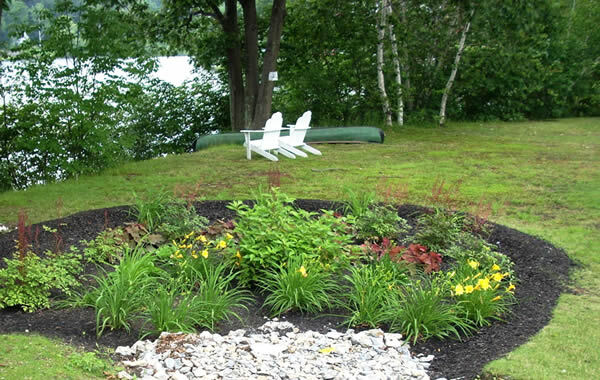
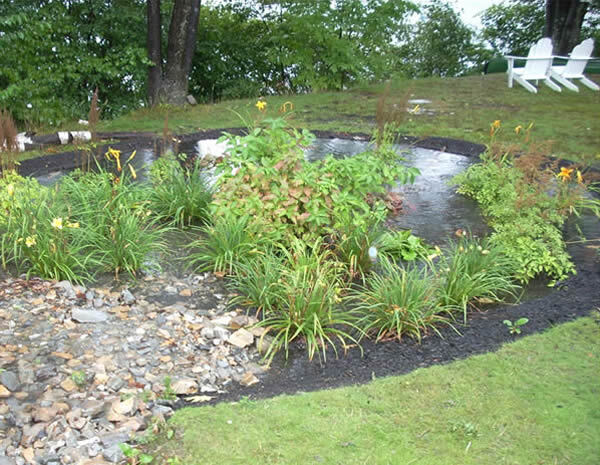
Photo credit: Massachusetts Watershed Coalition
Rainscaping
- Slow it down: Manage rainfall to slow
surface runoff.- Spread it out: Distribute surface
runoff across flat-lying areas.- Soak it in: Allow surface runoff to
soak into the ground.
Rainscaping is (or can be) one part of a more holistic effort to garden sustainably. That holistic approach to gardening is one example of an approach called “permaculture,” so named from a contraction of the words “permanent” and “agriculture” (Brain & Thomas, 2013), although the principles and approaches to permaculture have now been applied to a wide range of settings and land uses.
Rainscaping Benefits
Rainscaping can provide a range of benefits and can address various goals, depending on your personal preferences and landscape needs (Missouri Botanical Garden, 2026b). For example, rainscaping can help solve drainage problems, reduce erosion, improve water quality, and conserve soil by effectively managing rainwater movement across the landscape. It can also provide environments with increased biodiversity while reducing the need for supplemental watering. From a human perspective, rainscaping can increase property value and provide a more aesthetically pleasing environment. Figure 2 illustrates a number of these benefits.
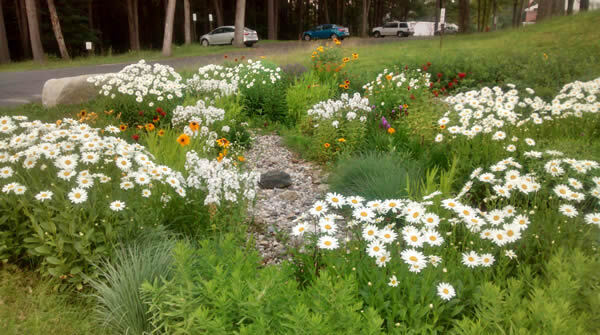
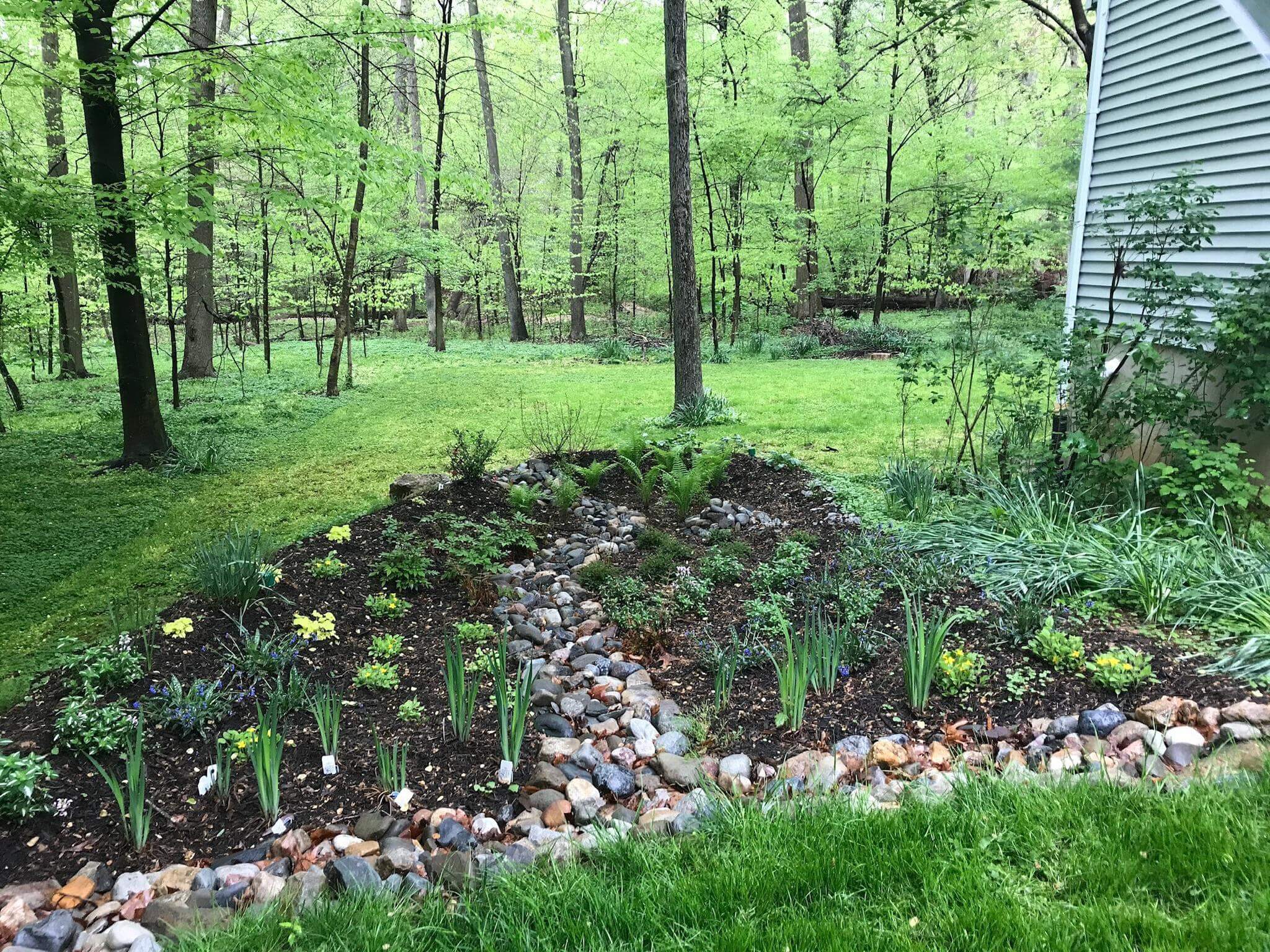
Photo credits: (left) U.S. Air Force, showing the U.S. Veterans Administration Central Western
Massachusetts Healthcare System facility and (right) University of Maryland Extension
Rainscaping provides a major step toward creating a sustainable and water-wise garden (see USU Extension’s “Water-Wise Gardening” in the Smart Foodscapes resource sheet series).
Rainscaping: How to Begin
Observe Garden Characteristics and Define Goals
Planning for effective water management in a garden begins by observing the physical characteristics and climate of the planned garden and its surroundings, as well as identifying your garden goals (Morganello, 2020). These characteristics are important for estimating the amount of water to be managed, the locations and intensities of natural runoff, and the likely role of natural infiltration into the ground. For example:
- What is the topography of the planned garden and its surroundings—flat, gently sloping, steeply sloping, or irregular?
- What are the rainfall characteristics of the area? Consider the total amount of precipitation, its distribution through the year, and the intensity of extreme events.
- What is the nature of the existing soil or other surficial material? Is it sandy, muddy, or bare rock?
- How much sunlight does the area receive, and how does that vary throughout the year?
- What vegetation presently exists in the area, and will any of the existing vegetation (e.g., existing trees) be incorporated into the garden?
Water management planning also will be influenced by your garden goals; is the garden intended to be predominantly ornamental, to produce food from annual plants, to produce food from perennial plants, or a combination?
Identify Rainscape Strategies
Once you have made these observations and defined the goal(s) of your garden, you can begin to identify the rainscaping strategies and design elements most appropriate for your garden. In many cases, the most effective rainscaping design will incorporate multiple strategies. For example, one strategy to “slow it down” is modifying the ground’s slope, a strategy to “spread it out” is installing small check dams, and strategies to “soak it in” could include amending the soil with compost or installing a small rain garden.
Several comprehensive resources are available online to help you consider options for your rainscape design. These include the Missouri Botanical Garden (2026a) and Royal Horticultural Society (2026a) in the U.K. You can also consult your local Extension office, your local U.S. Soil and Water Conservation District office, and local, environmentally minded horticulturalists and nurseries for advice.
A more technical discussion of rainscaping considerations is available in the Metropolitan St. Louis Sewer District’s “Landscape Guide for Stormwater Best Management Practices Design” (2012), although its recommended native plant lists are specific to the North American midcontinent.
Strategies for "Slowing It Down"
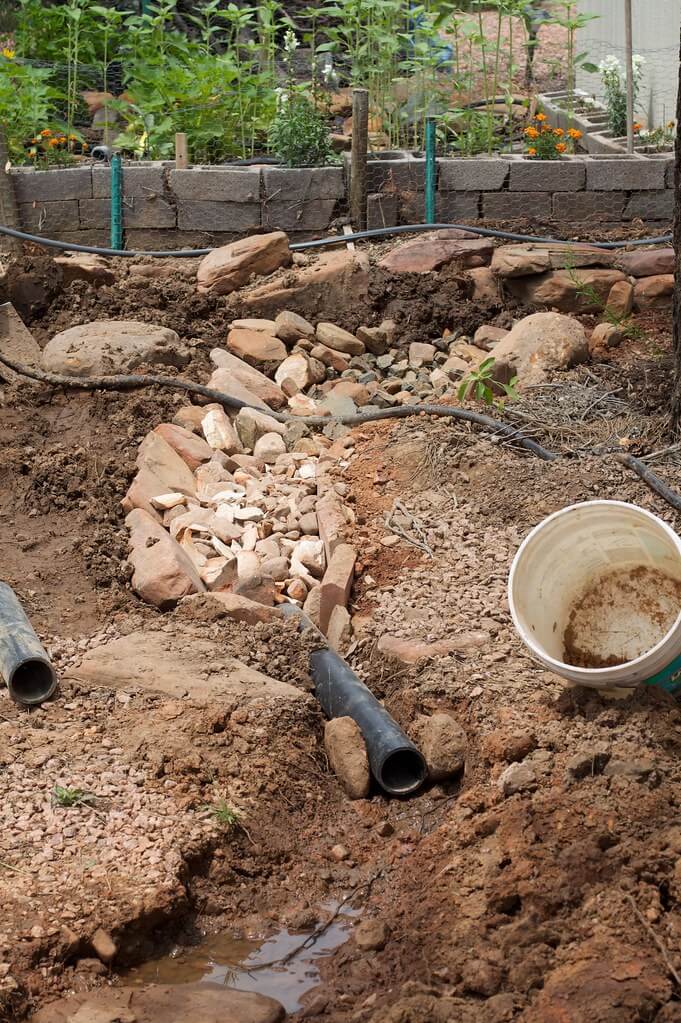
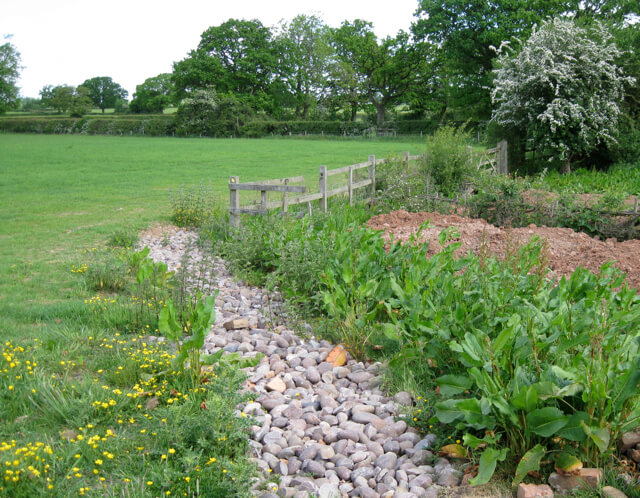
(right) Established
Photo credit: (left) cogdogblog, CC0 1.0 and (right) Robin Stott is licensed under CC BY-SA 2.0
The speed of surface water runoff is affected by: (1) how much water is running off, (2) the slope and permeability of the ground’s surface, and (3) resistance to flow (i.e., friction) caused by irregularities on the ground surface. Any or all of these factors can be modified to slow down surface water runoff, depending on local circumstances.
Install a Rain Barrel
If some of the surface water runoff originates from a building’s roof, you can tap or “harvest” that water for later use by installing a rain barrel at the point where the water leaves the roof (such as by attaching the gutter downspout to the rain barrel, illustrated in this resource sheet’s banner image). For more on installing and using a rain barrel, see USU Extension’s “Rain Barrels” in the Smart Foodscapes resource sheet series.
Create a French Drain
A second approach for reducing the amount of surface water flowing downslope is installing a so-called French drain (Figure 3), which is designed to increase the rate of water infiltration into the ground at one location and rapidly move that water to another location as groundwater (groundwater doesn’t cause surface erosion). The French drain consists of a trench dug parallel to the hillside above the area that’s being protected from erosion; once the trench is beyond the ends of the area being protected, the trench is turned downslope and continued to a location where the excess water can be discharged (such as a rain garden). At a minimum, the trench is backfilled with very coarse sand and/or gravel, which allows surface runoff to infiltrate rapidly into the trench. If desired, a perforated plastic drainage pipe can be placed in the trench to increase the rate of groundwater flow, then cover it with gravel, perhaps capped by a layer of coarse sand (Mihalic, 2019; National Diversified Sales, 2026).
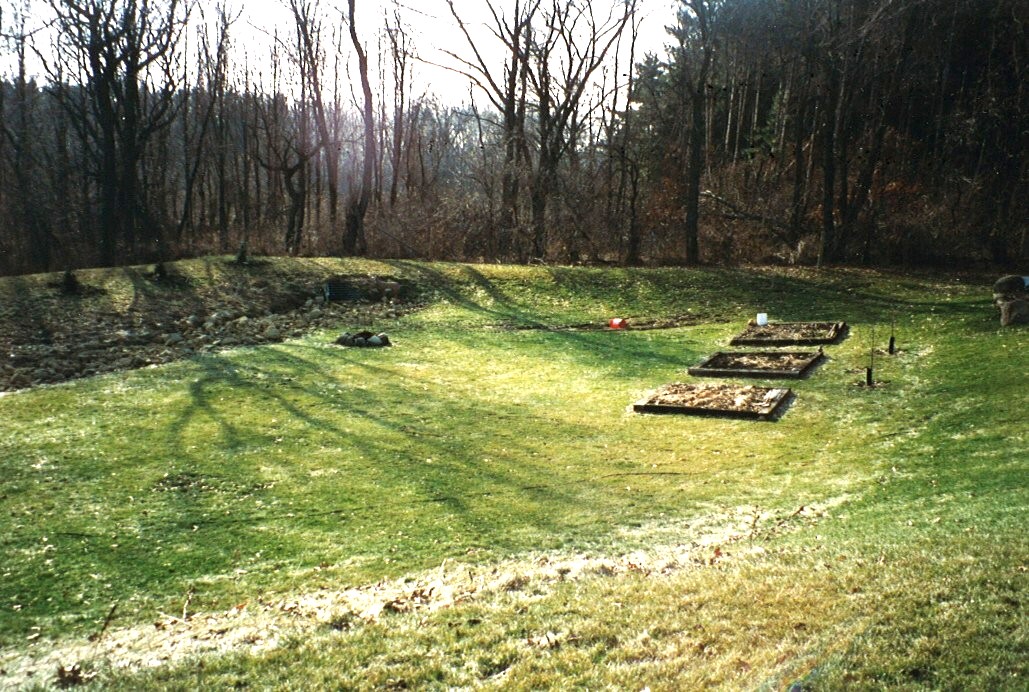
Photo credit: Aaron Volkening, CC BY 2.0
Construct Berms and Swales
If a garden site ranges from gently sloping to steeply sloping, you can modify the slope to slow the runoff water by constructing small berms and swales parallel to the hillside (on gentler slopes) or terraces parallel to the hillside (on steeper slopes) (Charbonneau, 2019). Figure 4 illustrates the role of constructed berms and swales for reducing ground slopes and directing runoff.
The presence of low vegetation on the ground surface, such as grass or a “cover crop” in a garden, reduces the runoff speed by increasing resistance to water flow. This vegetation also helps strengthen and protect the soil structure, thereby reducing erosion due to runoff. Moreover, although it may seem counterintuitive to the idea of “spreading it out,” the overall effect of surface runoff across a garden may actually be decreased by concentrating the flow into downhill-oriented swales if the swales are vegetated. Such vegetated swales are commonly referred to as “bioswales” (Missouri Botanical Garden, 2026d; Mihalic, 2019).
Strategies for "Spreading It Out"
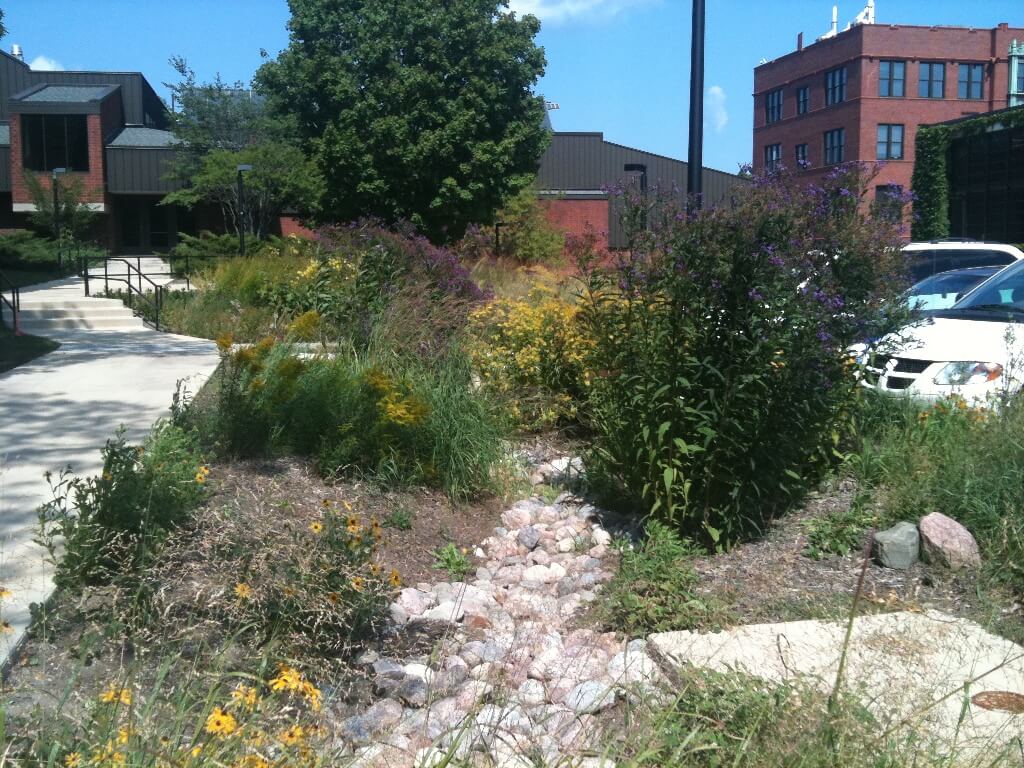
Photo credit: Aaron Volkening, CC BY 2.0
The goal of spreading surface runoff over as much surface area as possible is to maximize the amount of surface water that infiltrates into the ground (i.e., “soaking it in”), because each square foot of ground surface has a limit on how much water it can hold and transmit. Transferring as much water as possible from surface runoff into groundwater has advantages: (1) providing groundwater resources for plants to use during growth, and (2) reducing the amount of surface runoff decreases the speed of the surface flow, thereby reducing the potential for damaging erosion, especially during and after major rainfall events.
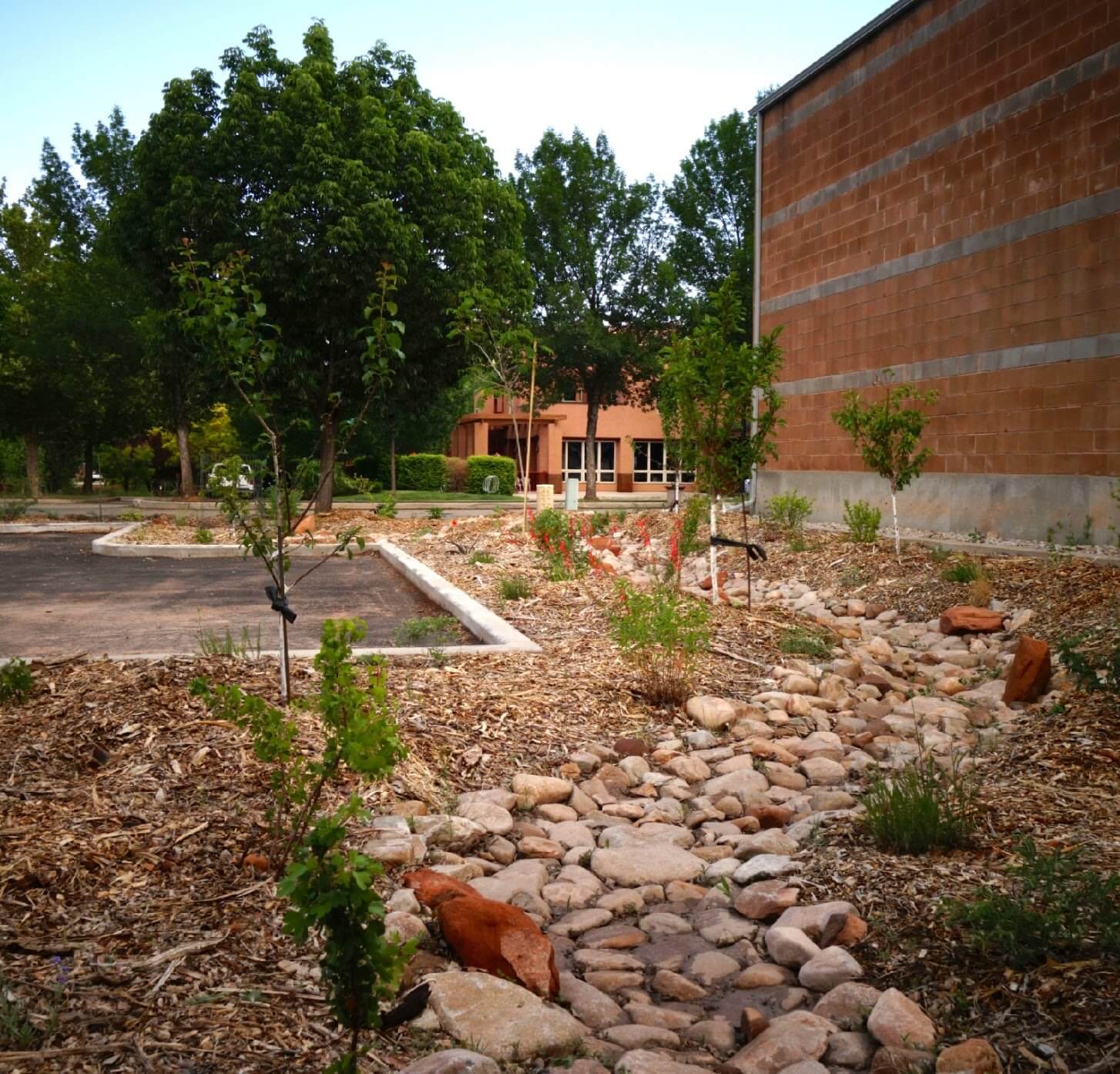
Photo credit: USU Extension
Spreading-it-out options include constructing multiple channels that lead downslope away from each major upslope runoff source. Visualize this by placing your hand on a table and spreading out your fingers. Your wrist represents the upslope source of runoff, such as the downspout from a gutter system, if that water isn’t being harvested with a rain barrel. Your spread fingers represent the multiple channels that distribute the runoff over a larger area as the water flows downslope. Those channels may be dry most of the time and may take the form of swales that are either vegetated (the bioswales mentioned previously) or lined irregularly with large stones (e.g., cobbles) to reduce runoff speed and minimize erosion of the swale banks (Figure 5; Mihalic, 2019). If the ground slopes gently and/or the space available is limited, these channels may run directly downhill. If the ground slopes more steeply and/or more space is available across the hillside, the channels may be constructed with multiple bends (like a so-called “meandering stream,” as in Figure 6), which helps slow runoff and reduce erosion.
As mentioned above, a French drain can be used to reduce runoff in part of the garden; if desired, construct a network of channels or swales to disperse water from the French drain’s downslope outlets.
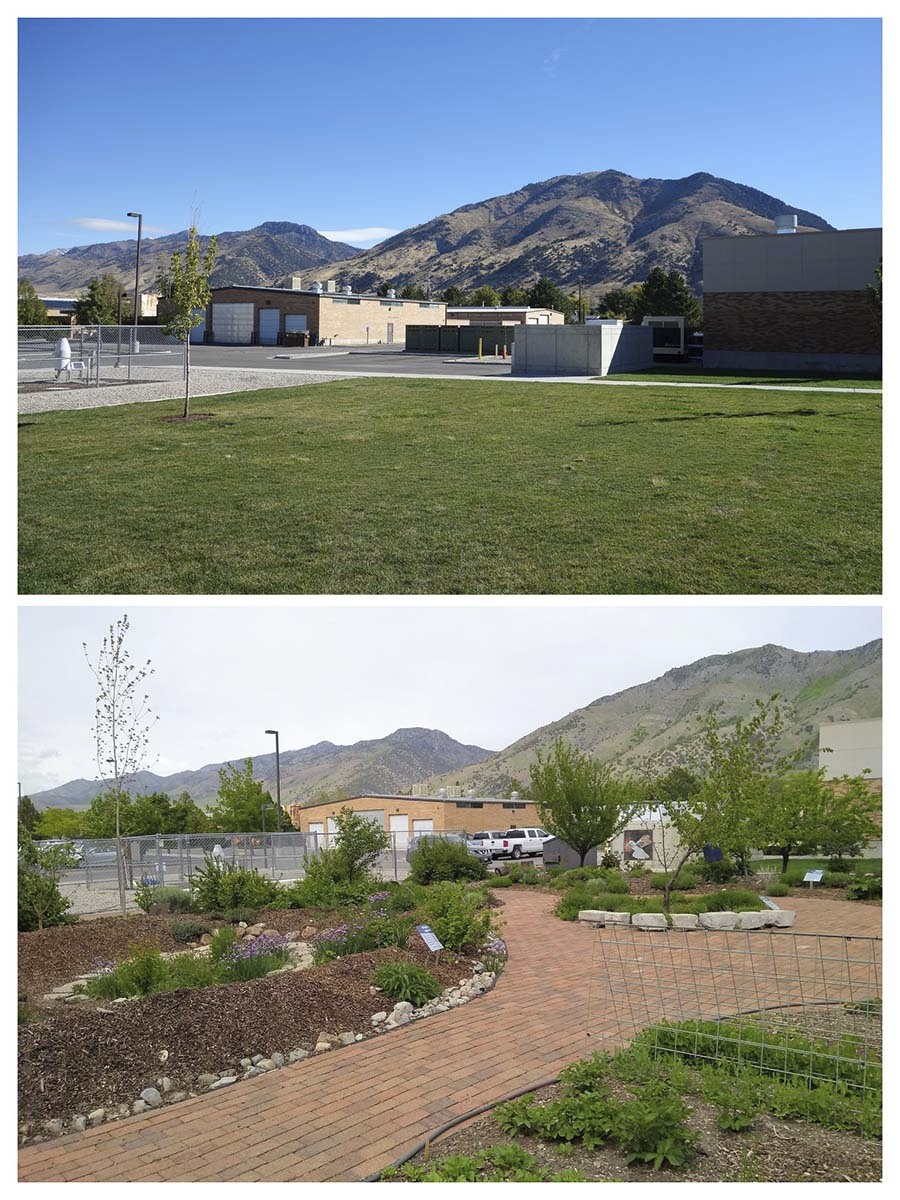
Photo credit: USU Extension
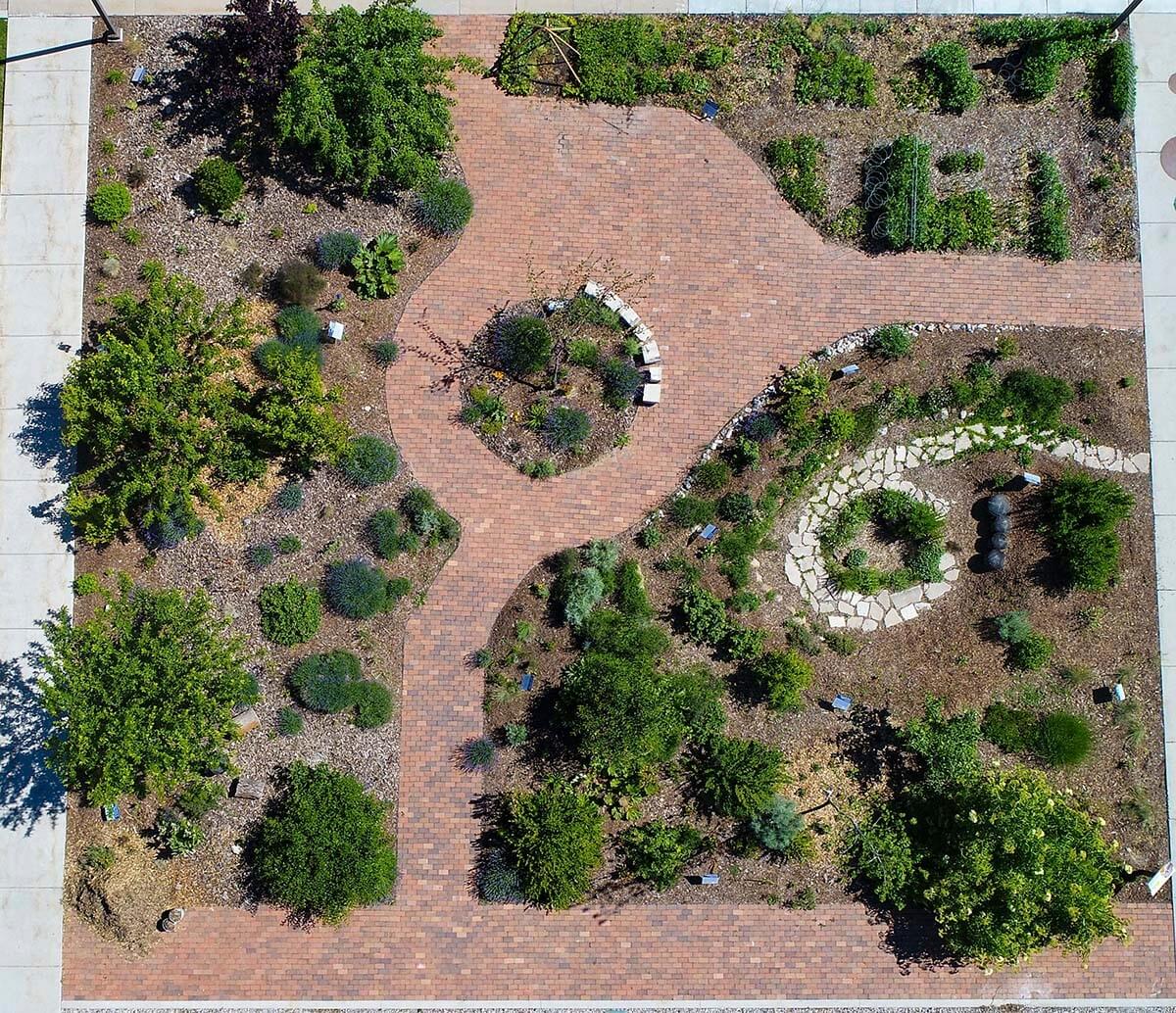
If enough space is available, an effective way to transition from “spreading it out” to “soaking it in” is to construct a “rain garden” at the end of a bioswale or at a French drain’s exit point. A rain garden is a relatively small, low-lying area in the landscape that collects rainwater and runoff and promotes infiltration into the ground. Rain gardens generally are planted with grasses, flowering perennials, and perhaps small shrubs. Figures 7 and 8 show rain garden examples, and the downhill portions of the rainscaping shown in Figures 1, 2, 4, and can also be considered rain gardens. The Missouri Botanical Garden (2026c) provides a thorough discussion of rain gardens, how to decide if a site is suitable for a rain garden, and rain garden design considerations. Other sources of information about rain gardens include Houzz magazine (Thornton, 2017), the U.S. Environmental Protection Agency (2026), Spotts Garden Service (n.d.-a), and the Royal Horticultural Society (2026b).
Strategies for "Soaking It In"
Infiltration of surface water into the ground (i.e., soaking it in) is favored by surface water that moves slowly, if at all, and by relatively uncompacted soil, meaning there is abundant open space between the soil particles (i.e., pore space) and the open spaces are well-connected so that water can move through the soil. Water can be held in a rain garden (Figures 1 and 8) or in shallow swales that are oriented parallel to the hillside (Figure 4). You can increase the soil’s water-holding and water-transmitting characteristics by:
- Mixing in mulch or compost.
- Replacing turf grass with deep-rooted native plants and mixed plantings.
- Replacing impervious surfaces (such as concrete, brick, and asphalt) with permeable pavers (Figure 8).
The Missouri Botanical Garden (2026c) provides additional information about each of these options.
A significantly less natural soil amendment, which may improve the soil’s water-holding capacity, involves mixing the absorbent fill from clean disposable diapers into the soil. For larger plants (i.e., shrubs and trees) or larger areas, a similar technology is sold commercially as “tree diapers.”
Summary
Summary Rainscaping a garden and its surroundings offers a significant step toward long-term sustainability with a wide range of potential benefits. However, the details of rainscaping your garden are very site-specific, affected by the amount of space and money available, your garden’s physical and weather/climate characteristics, and your garden goals. Careful observation and thoughtful design at the beginning of your rainscaping efforts will lay the foundation for a successful rainscaping outcome.
Resources and References
Brain, R. & Thomas, B. (2013). Permaculture [Fact sheet]. Utah State University Extension. https://extension.usu.edu/sustainability/research/permaculture.pdf
Charbonneau, J. (2019). Let’s talk about swales. Southern Exposure Seed Exchange. https://blog.southernexposure.com/2019/08/lets-talk-about-swales/
Metropolitan St. Louis Sewer District Staff. (2012). Landscape guide for stormwater best management practices. https://portal.laserfiche.com/Portal/DocView.aspx?id=447944&repo=r-a96260ce
Mihalic, F. (2019). How to move water through your landscape. Houzz. https://www.houzz.com/magazine/how-to-move-water-through-your-landscape-stsetivw-vs~35829438
Missouri Botanical Garden. (2026a). Rainscaping guide. https://www.missouribotanicalgarden.org/sustainability/sustainability/sustainable-solutions-for-you/rainscaping-guide
Missouri Botanical Garden. (2026b). Rainscaping guide: Benefits and goals. https://www.missouribotanicalgarden.org/sustainability/sustainability/sustainable-solutions-for-you/rainscaping-guide/benefits-and-goals
Missouri Botanical Garden. (2026c). Rainscaping guide: Rain gardens. https://www.missouribotanicalgarden.org/sustainability/sustainability/sustainable-solutions-for-you/rainscaping-guide/rain-gardens
Missouri Botanical Garden. (2026d). Rainscaping guide: Vegetated bioswales. https://www.missouribotanicalgarden.org/sustainability/sustainability/sustainable-solutions-for-you/rainscaping-guide/vegetated-bioswales
Morganello, K. C. (2020). Water management in the home landscape [Factsheet HGIC 1884]. Home and Garden Information Center, Clemson Cooperative Extension. https://hgic.clemson.edu/factsheet/water-management-in-the-home-landscape/
National Diversified Sales (NDS). (2026). French drain installation guide. https://www.ndspro.com/us/en/resources/articles/french-drain-installation-guide
Royal Horticultural Society (RHS). (2026a). Managing water in your garden. https://www.rhs.org.uk/gardening-for-the-environment/water
Royal Horticultural Society (RHS). (2026b). Rain gardens. https://www.rhs.org.uk/garden-features/rain-gardens
Spotts Garden Service.(n.d.-a). Managing water with rain gardens and bioswales. https://spottsgardens.com/rain-gardens-bioswales-rainscaping/
Spotts Garden Service. (n.d.-b). Rainscaping the garden: Managing rainwater with sustainable solutions. https://spottsgardens.com/rainscaping-manage-rainwater-rain-garden-drainage-bioswale/
Thornton, A. (2017). Great home project: Install a rain garden. Houzz. https://www.houzz.com/magazine/great-home-project-install-a-rain-garden-stsetivw-vs~76271049
U.S. Environmental Protection Agency. (2026). Soak up the rain: Rain gardens. https://www.epa.gov/soakuptherain/soak-rain-rain-gardens
Acknowledgments
Smart Foodscapes (usu.edu/smart-foodscapes)
Scan the QR code to learn more.

USDA – National Institute of Food and Agriculture (NIFA) – Sustainable Agricultural Systems (SAS) Grant #2021-69012-35952
The authors did not use generative AI in creating this content, and it is solely the work of the authors. This content should not be used for the purposes of training AI technologies without express permission from the authors.
June 2026
Utah State University Extension
Authors
Lawrence Krissek and Kathy Cabe Trundle
Related Research