
Part II: Sustainable Irrigation Practices for Cut Flowers
Overview
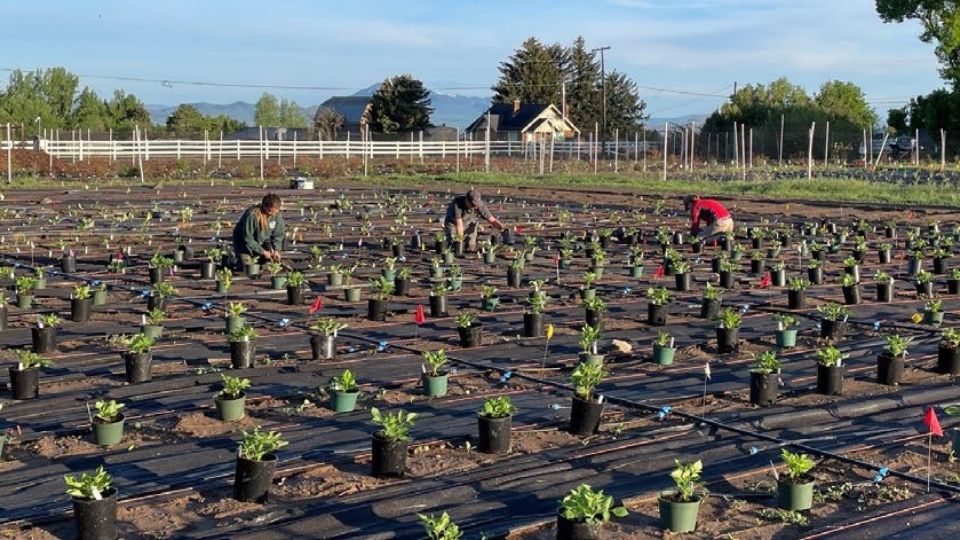
Sustainable irrigation uses crop and environmental information to guide the frequency (how often) and amount (how much) of water to apply. Without this balance, poor irrigation practices can result, causing crop stress from too little or too much water, nutrient loss and contamination, or wasted water that drains below the root zone. This fact sheet covers the basics of soil water storage, crop water demand, considerations for designating irrigation zones, using free weather stations, and water conservation strategies for gardens and small farms, with a focus on cut flowers. It supplements the “Do-It-Yourself Guide to Backyard Drip Irrigation,” as well as “Part I: Drip Tape Irrigation for Cut Flowers” from Utah State University (USU) Extension.
The Soil-Water-Air Relationship
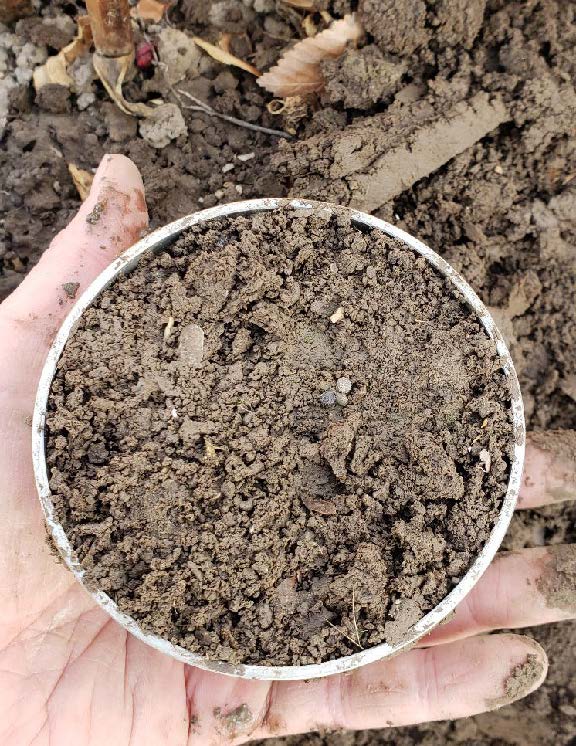
Water is held in spaces, known as pores, between soil particles. A helpful analogy is picturing a cleaning sponge, with the yellow sponge material representing the soil particles and the holes in the sponge representing the soil pores. Pores may account for 30% to 60% of the total soil volume, depending on soil texture. That means only about half of the ground we stand on is soil solids and the rest is pore space! The pores hold water and air, and the amount of each depends on the soil moisture content, or volume of pores filled with water.
Measuring soil moisture is one tool for managing irrigation. Crop-specific moisture thresholds can be developed to trigger when and how much to irrigate. For general information on moisture volumes by soil type and irrigation thresholds, see Oklahoma State University Extension’s “Understanding Soil Water Content and Thresholds for Irrigation Management” fact sheet. Crop-specific moisture thresholds are also a current area of cut flower research at USU. For example, some cut flowers, such as dahlia, prefer consistently moist soils and easily become water-stressed. Others, such as the more water-wise and drought-tolerant echinacea, benefit from longer dry-down periods before the next irrigation (e.g., allowing the soil to become drier by waiting longer between irrigations). Similarly, lisianthus may yield more marketable stems from these dry-downs. The goal of our research is to ultimately determine irrigation thresholds for each cut flower crop.
Irrigation by Soil Type
Knowing the soil texture helps determine the irrigation frequency and pore volume. Soil texture is the proportion of sand, silt, and clay minerals of a soil:
- Sand, the largest particle-size category, is generally spherical, has low surface area, lacks a surface electrical charge, and has large pores. As a result, soil water storage is low (about 30% water storage capacity) and water infiltrates and drains quickly. Sandy soils should be irrigated more often, but with small amounts of water each time. Read “Gardening in Sandy Soils” for more information.
- Silt is intermediate in particle and pore size, has a spherical shape, and moderate ability to infiltrate, store, and drain water.
- Clay, the smallest particle-size category, has a layered, platy shape (i.e., visualize thin, stacked sheets) with a large surface area, strong surface electrical charge, and small pores. As a result, soil water storage is high (up to 60% water storage capacity), and water infiltrates slowly and takes longer to drain. Clayey soils should be irrigated less often, slowly, and with larger amounts of water each time.
The ideal soil texture for many plants, a loam, has a mix of these three particle sizes, allowing water to infiltrate, store, and drain (Figure 1). For beds or gardens with varying soil textures, consider treating these as different irrigation zones, and adjusting irrigation according to soil texture. The Utah State University Analytical Laboratories (USUAL) both estimates and measures soil texture, with test options and pricing available on their website. Soil texture can also be estimated using the “mason jar method” for a DIY approach at home (Montana State University, 2021). The free SoilWeb is also available as a website and app, allowing users to input a postal address to retrieve and visualize the National Cooperative Soil Survey data from the Natural Resources Conservation Service for native soils across the U.S. (California Soil Research Lab, 2026). Be aware that the native soils on residential lots, especially in urban areas, have often been removed, mixed, combined with imported material, or otherwise disturbed.
Soil organic matter is the remains of decomposed plants and animals that coat the soil minerals, giving topsoil a darker color (think rich, dark soil). Organic matter is an important component of healthy soil; it helps create structure, adds and holds nutrients, improves infiltration and drainage in clayey soils, improves moisture storage in sandy soils, and provides many other benefits. For more information on supporting soil organic matter, read the “Preparing and Improving Garden Soil” fact sheet.
Crop Water Demand
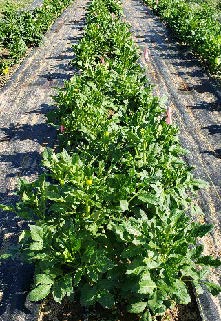
Each crop has a water requirement, or demand, for optimal growth and production. Too much water is wasteful and can result in lower germination, higher disease incidence, and plant mortality. Too little water can delay growth and flowering, stunt crops, and increase stem susceptibility to lodging (toppling over). Grouping crops with similar water demands together in the same bed and/or irrigation zone helps ensure each crop receives the appropriate amount of irrigation, and no more. For example, grouping high-demand crops in one zone and low-demand crops in another saves water by reducing the irrigation in the low-water zone and avoiding over-irrigation (Figure 2). See Table 1 for cut flowers grouped by low-, moderate-, and high-water-demand categories.
A crop’s water demand changes over the course of a season. For most cut flowers, three main growth stages drive changes in their water demand: early/ establishment (initial), vegetative (crop development), and flowering (mid/reproduction). Most crops require less water early in the season, when the plants are small (short height and small canopies) and their roots are shallow. The duration of the early stage depends on the crop, conditions, and transplant date (Pereira et al., 2025), but for most cut flowers, it typically lasts about 2 to 3 weeks after transplant. Irrigating frequently, with small amounts of water each time, maintains consistent moisture near the soil surface (e.g., time irrigation to be frequent, such as once per day, but keep it brief to wet only the shallow root zone each time).
The water demand then steadily increases as crops grow vegetatively. This stage begins after the early stage (i.e., after establishment) and ends before bloom, while the crop is growing in height, canopy coverage, and rooting depth. Irrigation can be less frequent (e.g., 2 to 3 times per week), but the duration of irrigation is greater, and increases until bloom. This stage can last weeks to months, depending on the crop, conditions, and season (Pereira et al., 2025). Water stress during this stage can result in slowed growth and mortality.
For cut flowers that are harvested for fresh stems and grown as annuals, the final stage is flowering. The onset of flowering varies by each cut flower crop, and timing can differ even across plants within the same cultivar and bed. USU trials considered the onset of flowering to occur when at least 50% of the plants of one crop produced a first bud. During this stage, the crop has the greatest water demand and is most sensitive to water stress. Water stress can cause delayed bloom, reduced yields, and lower-quality stems (e.g., short, misshapen). Irrigation is typically at the same frequency as the vegetative stage, but the amount of water applied is greater, as this is the crop’s seasonal peak. Note: For some perennial cut flowers, or for annuals that are harvested for dry blooms or seed heads in the field, a fourth growth stage, known as late, occurs. During this stage, the water demand, and hence irrigation, decreases as the plant matures.
In Table 1, cut flower crops are grouped by their general water demand of low, moderate, and high. Their maximum, or peak seasonal, water demand is during the flowering stage. Although this is an area of ongoing research, an approximation for weekly water required during flowering is that crops in the low category require up to 1 inch, moderate require 1.0 to 1.75 inches, and high require more than 1.75 inches in Cache Valley, Utah.
Table 1. Cut Flower Crops Classified by Their Estimated Low, Moderate, and High Water Demand
| Common name | Scientific name | Notes |
|---|---|---|
| Low water demand | ||
| Amaranth | Amaranthus spp. L. | Warm-season annual; deep, infrequent irrigations3 |
| Anemone | Anemone coronaria L. | Early, cool-season annual, sensitive to salinity1, shade; produces longer stems3 |
| Aster | Aster spp. L. | Perennial, shade not recommended3 |
| Bachelor buttons | Centaurea cyanus L. | Warm-season annual, shade not recommended3 |
| Basketflower | Centaurea americana Nutt. | Warm-season annual, shade not recommended3 |
| Black-eyed Susan | Rudbeckia hirta L. | Perennial (may be grown as an annual2), salt-tolerant2 |
| Carnation | Dianthus caryophyllus L. | Both cool- and warm-season annual, avoid overwatering1 |
| Celosia | Celosia argentea L. | Warm-season annual, fairly drought-tolerant1 |
| Coneflower | Echinacea spp. Moench. | Perennial, drought-tolerant2, avoid overwatering1 |
| Cosmos | Cosmos spp. Cav. | Warm-season annual |
| Daffodil | Narcissus spp. L. | Perennial, bulb |
| Dusty miller | Jacobaea maritima L. | Annual, avoid overwatering1 |
| False indigo | Baptisia australis (L.) R. Br. | Perennial, salt- and drought-tolerant2 |
| Globe amaranth | Gomphrena globosa L. | Warm-season annual, shade not recommended3, heat-tolerant3 |
| Globe thistle | Echinops bannaticus Rochel ex Shrad., Echinops ritro L. | Perennial, drought-tolerant |
| Hyacinth | Hyacinthus orientalis L. | Perennial, bulb |
| Lace flower | Ammi majus L., Visnaga daucoides Gaertn. | Warm-season annual |
| Lavender | Lavandula angustifolia Mill., Lavandula x intermedia | Perennial, salt- and drought-tolerant2 |
| Millet | Setaria italica (L.) P. Beauv., Pennisetum glaucum (L.) R. Br. | Warm-season annual |
| Ornamental onion | Allium spp. L. | Perennial, bulb |
| Orache | Atriplex hortensis L. | Annual |
| Poppy | Papaver orientale L. | Perennial, drought-tolerant2 |
| Sea holly | Eryngium spp. Tourn. Ex L. | Perennial, salt- and drought-tolerant3, shade not recommended3 |
| Statice | Limonium spp. Mill. | Full sun annual, moderate salt tolerance1 |
| Strawflower | Xerochrysum bracteatum (Vent.) Tzvelev | Warm-season annual, allow soil to dry between irrigations3 |
| Sunflower | Helianthus annuus L. | Warm-season annual |
| Yarrow | Achillea millefolium L. | Perennial, drought-tolerant |
| Zinnia | Zinnia elegans Jacq. | Warm-season annual, drought-tolerant1 |
| Moderate water demand | ||
| Bells of Ireland | Moluccella laevis L. | Annual |
| Delphinium | Delphinium elatum L., Delphinium x belladonna | Perennial, may be considered low demand after the establishment year |
| Larkspur | Consolida spp. Gray | Annual, may be considered low demand in early production |
| Lisianthus | Eustoma russellianum (Hook.) G. Don | Annual (in Utah), prefers moist soil that is allowed to dry between waterings1, sensitive to salinity1 |
| Peony | Paeonia spp. L. | Perennial |
| Ranunculus | Ranunculus asiaticus L. | Early, cool-season annual, shallow roots1, sensitive to salinity1 |
| Rose | Rosa spp. L. | Perennial |
| Snapdragon | Antirrhinum majus L. | Cool season annual, benefits from shade3 |
| Stock | Matthiola incana (L.) W. T. Aiton | Cool-season annual, needs consistent moisture1 |
| Sweet Pea | Lathyrus odoratus L. | Early, cool-season annual, needs consistent moisture1 |
| High water demand | ||
| Dahlia | Dahlia pinnata Cav. | Warm-season annual, avoid water stress during flowering1 |
Sources: 1Small Farms Lab (2026); 2Jordan Valley Water Conservancy District (2026); 3Armitage and Laushman (2003)
Environmental Water Demand
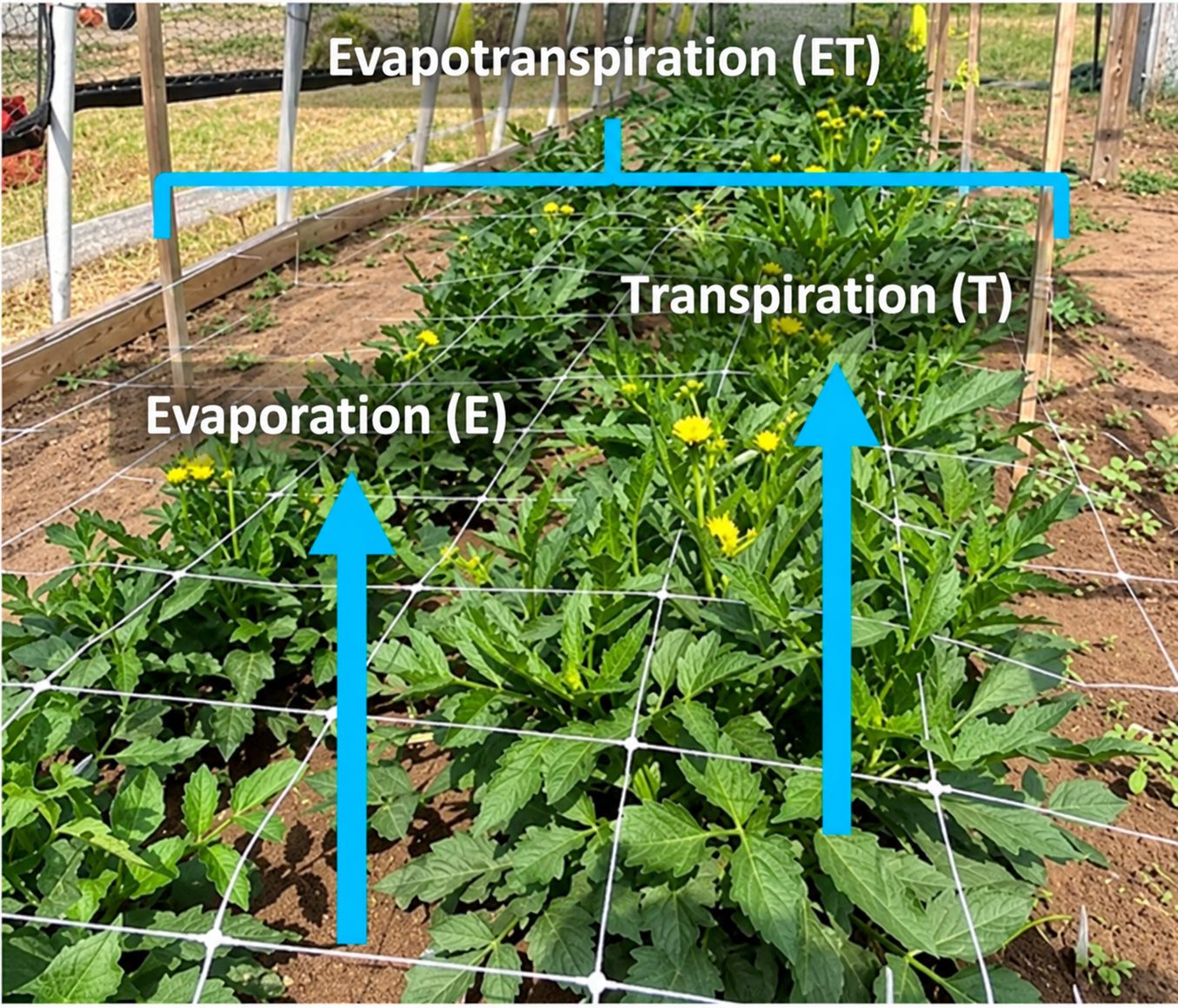
Irrigation also depends on environmental water demand, which varies by season and location. This is greatest—meaning more irrigation is needed—during weeks with high temperatures, dry air (no rain and low humidity), full sun (intense solar radiation—think midsummer), and windy conditions. Conversely, it is lowest with cool, humid, cloudy, and calm weather.
Areas with southern or western sun exposure can also experience higher water demand because of a warmer microclimate. Greater environmental water demand causes greater evaporation (E) from the soil surface to the atmosphere, and greater transpiration (T) from plants (the process by which water travels out of the plant’s leaves as water vapor). This is collectively called “evapotranspiration” or ET (Figure 3). Note that high-elevation locations typically have cooler and shorter growing seasons, resulting in lower rates of ET.
Crop Plus Environmental Demand
A readily accessible sustainable irrigation strategy in Utah is to irrigate based on ET estimates. This brings together information on the general water demand of the crop (low, moderate, high), its growth stage (early, vegetative, flowering, late), and the environmental demand (location and weather conditions).
The Utah Climate Center has over 50 weather stations statewide that measure weather conditions, including air temperature, precipitation, wind speed, and solar radiation. From these data, each weather station automatically calculates and reports “reference ET,” which can serve as a starting point for estimating water use in all other crops (Table 2). Reference crops are assumed to be well-watered and maintained at a uniform height. The two most common reference crops are turfgrass (ET0) and alfalfa (ETr). Using ETr is more responsive to varying climate conditions and is recommended for estimating water demand of cut flower crops. For example, in Salt Lake County, the ETr averages 1.6 inches per week at the start of the growing season in May, when it is cooler and more humid, and increases to 2.2 inches per week by July, when conditions are warmer and drier, and then decreases to 0.8 inches per week by the fall. These weekly values will fluctuate based on weather conditions and location in the county and need to be tailored to the crop. In general, however, consider these reference amounts to approximate the weekly irrigation needed for moderate- and high-water demand flowers.
Table 2. Average Total Weekly Reference Evapotranspiration of Alfalfa (ETr) in Inches by Month During the Growing Season1
| County | City | Elevation (ft) | April | May | June | July | August | September | October |
|---|---|---|---|---|---|---|---|---|---|
| Cache | Logan | 4,365 | 1.1 | 1.5 | 1.8 | 2.0 | 1.6 | 1.1 | 0.6 |
| Utah | Santaquin | 4,791 | 1.1 | 1.4 | 1.8 | 1.8 | 1.6 | 1.2 | 0.7 |
| Summit | Midway | 5,748 | 1.2 | 1.5 | 2.0 | 2.1 | 1.8 | 1.3 | 0.8 |
| Salt Lake | Murray | 4,290 | 1.3 | 1.6 | 2.2 | 2.2 | 1.9 | 1.4 | 0.8 |
| Garfield | Panguitch | 6,550 | 1.5 | 1.7 | 2.1 | 1.9 | 1.6 | 1.4 | 1.0 |
| Grand | Castle Valley | 4,527 | 1.6 | 2.0 | 2.5 | 2.4 | 2.0 | 1.6 | 1.0 |
1Data was acquired from one weather station per county (city and elevation given) and averaged across 10 years, 2016 to 2025 (Utah Climate Center, 2026).
Note. A range of counties across Utah are given to show variation by region and elevation.
Applying Growth Stage to ETr: Crop Coefficients
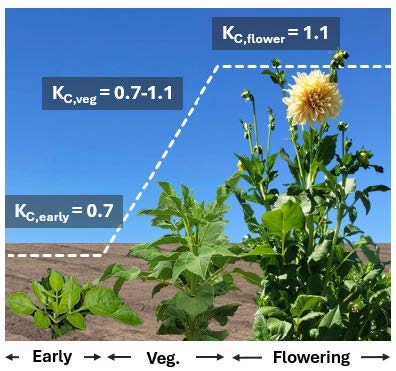
To apply ETr to a cut flower crop, a “crop coefficient” (Kc) is used to represent the crop’s current growth stage (Figure 4). Though Kc by growth stage has not been developed for most cut flower crops and is an area of current research at USU, examples for related crops are given in Table 3. Each cut flower crop’s ET, or water demand, is calculated by multiplying ETr by Kc. The early stage has a small Kc of 0.35 to 0.70 because less water is needed. For example, dahlia is sensitive to water stress and its Kc = 0.7 during the early stage, which lasts 2 to 3 weeks. If the ETr is 1.5 inches per week in May (Table 2), then 0.7 x 1.5 inches = 1.1 inches of irrigation is needed for dahlia that week. For a more water-wise flower, like sunflower, Kc = 0.35, and 0.35 x 1.5 inches = 0.5 inches of water needed, less than half that of dahlia. This is yet another reason to group crops by water demand.
Vegetative growth (the stage between early and flowering) has a steadily increasing Kc because the crop needs more water as it grows. For dahlia, the Kc starts at 0.7 at the onset of the vegetative stage (approximately late May/early June in most of Utah) and reaches 1.0 by the end of this stage (July). Therefore, if ETr is 1.8 inches per week in June and 2.0 inches in July (Table 3), then dahlia will need 0.7 x 1.8 inches = 1.3 inches of irrigation per week to start and 1.0 x 2.0 inches = 2.0 inches per week by the end of this stage.
Because the flowering stage has peak water demand, the Kc is greatest and remains at this value throughout this stage. For dahlia, Kc = 1.1 during flowering, which typically occurs by late July and continues until first frost. If weekly ETr is 2.0 in July, then 1.1 x 2.0 inches = 2.2 inches of irrigation per week (Table 3). As it gets cooler in fall and ETr decreases, overall irrigation decreases too, even though Kc may remain the same. For example, in October (assuming no early frost events occurred), dahlia’s irrigation need would be 1.1 x 0.6 inches = 0.7 inches of water per week. Most cut flower crops are removed right after flowering, but perennials or annuals harvested for dry blooms or seed, have a fourth stage, late, with a lower Kc. Use Table 3 to consider the crop coefficients by growth stage for crops with growth habits similar to cut flowers. For example, consider reference options with similar characteristics, such as annual or perennial, cool- or warm-season, mature size, production of tubers, and low-water tolerance.
Table 3. Examples of Crop Coefficients (Kc), by Early, Vegetative, Flowering, and Late Stages
| Crop1 | Early2 | Vegetative | Flowering | Late3 | Notes |
|---|---|---|---|---|---|
| Cool-season annual | |||||
| Broccoli4 | 0.30 | 0.30–0.90 | 0.90–1.05 | --- | Upright growth habit, harvested for its immature bud |
| Pea4 | 0.25–0.30 | 0.30–0.95 | 0.95–1.00 | (0.85-1.05) | Similar height to some taller cut flowers |
| Warm-season annual | |||||
| Dahlia5 | 0.70 | 0.70–1.00 | 1.10 | --- | Tall, continuous harvest of larger flowers, produces tubers |
| Pepper, bell4 | 0.30 | 0.30–0.90 | 0.90–1.05 | (0.80–0.95) | Similar height to shorter, non-tuberous cut flowers |
| Sunflower4 | 0.30 | 0.30–1.00 | 1.00–1.10 | (0.20–0.30) | Tall. Refers to large, single bloom types grown for seed or oil |
| Perennial | |||||
| Lemon balm4 | 0.30 | 0.30–0.85 | 0.85–1.00 | --- | Shorter height, broader leaf shape, spreading growth habit, water-wise |
| Lavender4 | 0.30 | 0.30–0.80 | 0.80–0.90 | --- | Shorter height, narrow leaf shape, water-wise |
| Yarrow4 | 0.30 | 0.30–0.85 | 0.85–0.95 | --- | Taller height, water-wise |
| Miscellaneous | |||||
| Artichoke4 | 0.30 | 0.30–0.85 | 0.85–0.95 | --- | Annual/Biennial, growth habit: basal rosette and taproot; a thistle with silvery leaves harvested for its immature bud |
| Flax4 | 0.25–0.30 | 0.30–0.90 | 0.90 | (0.20–0.25) | Refers to annual flax, grown for fiber or seed |
| Potato4 | 0.30 | 0.30–0.90 | 0.90–1.05 | 0.45–0.55 | Annual, produces tubers |
1Kc were adjusted from a short, reference crop under standard climate conditions to a tall reference crop under Utah’s climate, as calculated from 10-year averages of data from each weather station used in Table 2. 2Calculation of early-stage values assumes the use of a drip, not sprinkler, irrigation system. 3Late stage often refers to a fruit or seed stage after flowering that is generally not relevant to cut flowers. 4Pereira et al., 2025; 5Seeborg et al., 2026.
Note. As most cut flower crops have not been studied, various fruit, fiber, oil, and vegetable crops are shown for their relevant height, growth habit, or production of flowers or tubers.
A Note on Protected Cultivation
High tunnel systems alter growing conditions, such as blocking precipitation and wind, increasing temperature and humidity, and modifying solar energy. For these systems, we recommend a soil moisture-based approach. For more information, read the “Irrigation Management in High Tunnels” fact sheet.
Water Conservation Strategies
Additional methods can help save water on a flower farm. A short list of practices is included here.
Precipitation: Decrease irrigation amounts following precipitation. For example, if 0.5 inches of rain falls one week, reduce that week’s irrigation by that amount.
Mulch: Conserve soil moisture in the root zone by reducing evaporation from the soil surface. You can accomplish this by covering the soil with mulch, and there are many effective options. Natural/organic sources include straw, wood chips, wool, paper, and leaf litter. Inorganic sources include plastic fabric and films. Each type has advantages and disadvantages, so it is important to weigh what is best for your operation. For more information about mulch types, read the “Using Mulches in Utah Landscapes” and “Plastic Mulch” fact sheets.
In 2025 USU trials (unpublished data), researchers applied unwashed wool to form a 3-inch-thick mulch for field production of echinacea, eryngium, and echinops cut flowers, which are perennials with lower water demands. Wool mulch reduced irrigation by 30% during the establishment year, while plastic landscape fabric reduced water use by 10%, compared to bare soils. In an earlier trial (2023–2024), researchers grew six warm-season annual cut flowers (basket flower, cosmos, gomphrena, miniature carnation, statice, and strawflower) in an open field with 4 inches of wool mulch versus bare soils. To simulate drought, all plants received the same limited amount of water. Yields of the six crops were generally greater with wool mulch than with bare soils.
Weeds: Weeding also helps reduce water consumption, as weeds compete with crops for soil moisture (as well as nutrients and light). Removing weeds ensures the irrigation water applied is used by the desired plants.
Deficit irrigation: Some crops benefit from this practice, which means deliberately applying less water than the crop’s full demand. This practice saves water by targeting growth stages that are less sensitive to water stress and encouraging the plant to develop greater root systems. Success with deficit irrigation is highly crop-specific, and research on its effects on cut flower crops is limited. In one USU trial, deficit irrigation of dahlia was studied and resulted in lower yields compared to plants receiving full irrigation and, thus, it is not a recommended practice for dahlia.
Shade: Other considerations include using natural shade or installing shade cloth. While the air temperature under shade is the same as in full sun, the surface temperatures (e.g., of the ground or soil, leaves, blooms) remain cooler. Research at USU found surface temperatures up to 20 °F cooler under shade (Maughan et al., 2017). This can decrease water loss, encourage longer stems, and help plant surfaces stay cool, reducing sunburn and water stress, and hence transpiration. See the “Using Shade for Fruit and Vegetable Production” fact sheet for more information, and the Notes column of Table 1 in this fact sheet for shade recommendations for cut flowers.
Soil health: Building soil health, such as through sustainable additions of organic matter and reducing tillage, helps improve water infiltration, storage, and drainage in the soil. Learn more in the “Measuring and Building Soil Health” fact sheet. Planting cover crops and incorporating their residues also maintains and builds soil health. See “Introduction to Cover Crops for Vegetable Production in Utah” for information on cover crop types and cultivation. Cash crops (e.g., corn and wheat) can also be used as cover crops. Read more in “Cash Crops, and Their Residues, Are the Best Cover Crops” from Wahington State University.
Soil salinity: Sites with elevated salinity (e.g., above 2.0 dS/m) that are growing horticultural crops may need additional irrigation to increase soil moisture and reduce crop stress. Leaching salts through additional irrigation is typically done in spring, when soils are still moist from snowmelt. This helps push salts below the root zone, and adequate soil moisture should be maintained to prevent the salts from returning. The following fact sheets are helpful guides for these situations: “Solutions to Soil Problems I. High Salinity (soluble salts)” and “Managing Saline and Sodic Soils and Irrigation Water.” Another strategy for soils with elevated salinity is to choose crops that have greater salinity tolerance, such as cut foliage crops. See the Notes column of Table 1 to identify cut flowers with greater salinity tolerance, as well as those that are sensitive to elevated salinity.
Growing Cut Flowers During Drought
It’s important to consider the risk of crop failure due to drought conditions and restrictions. Recommendations include using protected cultivation, such as high tunnels, to start growing and harvesting earlier in the season when the ET demand is lower and water is more available. Another option is to choose crops that naturally grow and mature early in the year before seasonal water restrictions, like tulips and other spring bulbs, or to select cut flower crops with low water demands (Table 1).
Summary
Irrigation decisions are based on each farm’s soil properties, location, the crops being grown, and season and growth stage. Using free, local weather station data and deliberate irrigation zoning, you can confidently apply enough water to optimize yield, timing, and quality, while avoiding water waste.Irrigation decisions are based on each farm’s soil properties, location, the crops being grown, and season and growth stage. Using free, local weather station data and deliberate irrigation zoning, you can confidently apply enough water to optimize yield, timing, and quality, while avoiding water waste.
Disclaimers and Acknowledgments
Using original figures and tables without written permission from the authors is prohibited. The authors did not use generative AI in creating this content, and it is solely the work of the authors. This content should not be used for the purposes of training AI technologies without express permission from the authors. This project was funded by Western Sustainable Agriculture Research and Education Professional Development grant. The information reflects the views of the authors and not funding agency.
References

October 2026
Utah State University Extension
Peer-reviewed fact sheet
Authors
Chloe Seeborg, Melanie Stock, Burdette Barker, Alex Rodriguez, and Jon Meyer

Melanie Stock
Urban and Small Farms Specialist
PSC Dept

Burdette Barker
Irrigation Specialist
Civil and Environmental Engineering
Related Research