
Midlife Brain Health: Menopause, Dementia, and Protective Strategies
 Introduction
Many women experience what is commonly described as brain fog, or cotton brain, during perimenopause or menopause. Difficulty recalling words or names, concentrating, or remembering why they walked into a room. These experiences may cause women to be concerned about cognitive decline or dementia.
Midlife (ages 40-65 years) is an important time for women to pay particular attention to their brain health. Although the relationship between dementia and menopause is still being studied, adopting healthy lifestyle habits before and during this stage of life may help reduce the risk of cognitive decline later in life.
Understanding Menopause-Related Brain Fog
During menopause, estrogen levels fluctuate and decline, which may affect memory, attention, and concentration. Menopause can also increase the likelihood of having sleep disturbances, mood changes, anxiety, and stress, all of which may further impact cognitive functioning (Maki & Jaff, 2022).
However, menopause-related brain fog generally involves mild cognitive difficulties that do not substantially interfere with daily functioning. Dementia involves progressive cognitive decline that interferes with everyday activities (The Menopause Society, 2025).
Menopause and Dementia: What Does Research Say?
Women account for approximately two-thirds of Alzheimer’s diagnoses. A clinical diagnosis of dementia or Alzheimer's is given when symptoms interfere with daily living significantly and is rare before the age of 65 years. Furthermore, younger people tend to experience more issues with communication with early onset dementia than memory issues alone (Dementia UK. 2026; The Menopause Society, 2025). While age is a primary risk factor for dementia, and women often live longer than men, experts do not fully understand why women experience dementia more than men (Alzheimer’s Association, 2026). Recent research studies suggest that hormonal changes during the menopausal transition may be associated with an increased risk of dementia (Mervosh & Devi, 2025).
Estrogen plays an important role in protecting brain health by supporting communication between brain cells, helping the brain produce energy, and maintaining healthy blood vessels (Mervosh & Devi, 2025). As estrogen levels decline during menopause, researchers believe the hormonal changes may influence how the brain functions and potentially contribute to cognitive decline later in life. However, Maki and Jaff (2022) emphasize that although research has identified associations between menopause-related changes and cognitive health, these findings do not establish that menopause causes dementia. Further research is needed to determine whether declining estrogen directly increases the risk of dementia.
Can Hormone Therapy Reduce Dementia Risk?
Hormone replacement therapy (HRT) replaces or supplements hormones that decline during menopause, primarily estrogen, sometimes combined with progesterone or progestogen. HRT is used to manage menopausal symptoms, including hot flashes and night sweats. Because estrogen plays a role in brain health, researchers have investigated whether hormone therapy may also reduce the risk of dementia. However, findings are mixed, and current research does not support using HRT specifically to prevent dementia. The potential benefits and risks may vary depending on a woman’s age, the timing of treatment, and her individual health history (The North American Menopause Society, 2022). Women experiencing premature or early menopause, including those who have had removal of both ovaries, may have different hormone therapy recommendations. Women considering hormone therapy should discuss their options with a healthcare provider.
Protective Strategies for Brain Health
Whether menopause occurs naturally or surgically, midlife is an important opportunity for women to adopt healthy habits that may reduce the risk of dementia later in life. Research has identified several modifiable risk factors associated with dementia, highlighting opportunities for prevention through healthy lifestyle choices and preventive healthcare (Gonzales-Gomez et al., 2026; Livingston et al., 2024; Ngandu et al., 2015). These include:
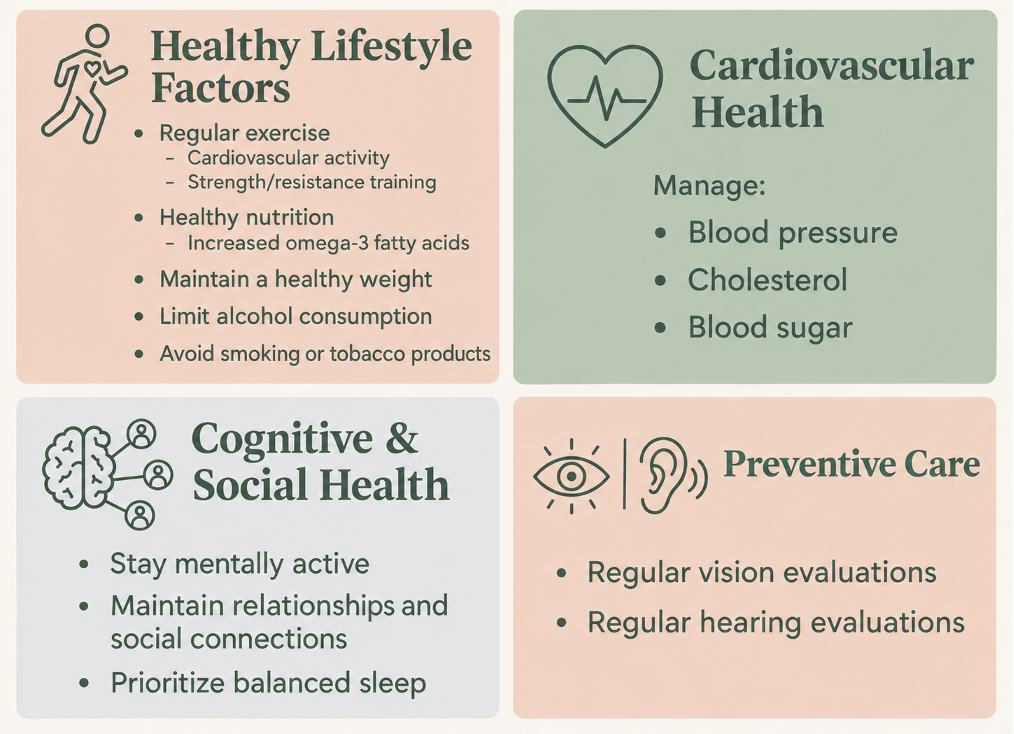
Image create with ChatGPT.
Research has identified untreated hearing and vision loss as potentially modifiable risk factors for dementia (Livingston et al., 2024). These issues relate largely with social connections and maintaining relationships, which are also key protective factors in preventing cognitive decline (The Menopause Society, 2025). Furthermore, there is a body of emerging research that indicates that exercise (with both cardiovascular and strength or resistance training activities) is a protective factor for brain health (Gonzales-Gomez et al., 2026; Ngandu et al., 2015). Women should talk to their healthcare provider about cognitive changes, especially if memory difficulties worsen or interfere with daily activities.
Conclusion
Every woman will eventually experience menopause, whether naturally or surgically. Although brain fog is common during menopause, these cognitive changes do not necessarily indicate dementia. Although further research is needed to fully understand the relationship between menopause and dementia, women can take protective steps during midlife to support their cognitive health and potentially reduce the risk of dementia later in life. These protective factors can be started at any point. Women can start protecting their brain health today with healthy lifestyles, managing cardiovascular health, supporting cognitive health, maintaining social connections, and engaging in preventative care with their medical providers.
Additional Resources
- Young onset dementia: Perimenopause, menopause, and dementia: DementiaUK
- For more information about menopause and healthy aging, visit www.menopause.org.
- Understanding brain fog during menopause: https://extension.usu.edu/midlife-health-menopause/research/understanding-brain-fog-during-menopause
- USU Extension: Midlife Health and Menopause
References
Alzheimer’s Association (2026). Women and alzheimer’s. https://www.alz.org/alzheimers-dementia/how-alzheimers-impacts-different-groups/women
Dementia UK. (2026, April 1). Young onset dementia: perimenopause and menopause - Dementia UK. https://www.dementiauk.org/information-and-support/young-onset-dementia/living-with-young-onset-dementia/perimenopause-and-menopause/
Gonzalez-Gomez, R., Demnitz, N., Coronel, C., Gates, A. T., Kjaer, M., Siebner, H. R., ... & Ibanez, A. M. (2026). Randomized controlled trial of resistance exercise and brain aging clocks. GeroScience 48, 3251–3262 (2026). https://doi.org/10.1007/s11357-026-02141-x
Livingston, G., Huntley, J., Liu, K. Y., Costafreda, S. G., Selbæk, G., Alladi, S., Ames, D., Banerjee, S., Burns, A., Brayne, C., Fox, N. C., Ferri, C. P., Gitlin, L. N., Howard, R., Kales, H. C., Kivimäki, M., Larson, E. B., Nakasujja, N., Rockwood, K., . . . Mukadam, N. (2024). Dementia prevention, intervention, and care: 2024 report of the Lancet standing Commission. The Lancet, 404(10452), 572–628. https://doi.org/10.1016/s0140-6736(24)01296-0
Maki, P. M., & Jaff, N. G. (2022). Brain fog in menopause: a health-care professional’s guide for decision-making and counseling on cognition. Climacteric, 25(6), 570–578. https://doi.org/10.1080/13697137.2022.2122792
Mervosh, N., & Devi, G. (2025). Estrogen, menopause, and Alzheimer’s disease: understanding the link to cognitive decline in women. Frontiers in Molecular Biosciences, 12, 1634302. https://doi.org/10.3389/fmolb.2025.1634302
Ngandu, T., Lehtisalo, J., Solomon, A., Levälahti, E., Ahtiluoto, S., Antikainen, R., ... & Kivipelto, M. (2015). A 2 year multidomain intervention of diet, exercise, cognitive training, and vascular risk monitoring versus control to prevent cognitive decline in at-risk elderly people (FINGER): a randomised controlled trial. The Lancet, 385(9984), 2255-2263. 10.1016/S0140-6736(15)60461-5
“The 2022 Hormone Therapy Position Statement of The North American Menopause Society” Advisory Panel (2022). The 2022 hormone therapy position statement of The North American Menopause Society. Menopause (New York, N.Y.), 29(7), 767–794. https://doi.org/10.1097/GME.0000000000002028
The Menopause Society. (2025, June 5). Mental Health | The Menopause Society. https://menopause.org/patient-education/menopause-topics/mental-health
Authors
Janna Potter, Health & Wellness Intern; Dr. Ashley Yaugher, Professional Practice Extension Associate Professor and Emma Parkhurst, Professional Practice Extension Associate Professor

Ashley Yaugher
Professional Practice Extension Associate Professor | Health and Wellness | HEART Initiative | Carbon & Emery Counties
Home and Community Department

Emma Parkhurst
Professional Practice Extension Associate Professor | Health and Wellness | Davis County Director
Home and Community Department
Related Research