
Horse Project Rules
Approved 11/18/2025
Article 1: WEBER COUNTY 4-H GENERAL RULES
- Weber County 4-H qualifying horse shows will be determined by the Weber County 4-H Horse Council.
- Weber County 4-H will educate/practice safe biosecurity measures.
- There will be a responsible adult, parent, or guardian accompanying every registered 4-H Horse project member at shows.
- All Western and English 4-H project horses must be registered in Weber County prior to show registration closing date. All other disciplines (to include Working Horse Ranch, Two-handed, Minis, etc.) will be registered before county registration closes or before state registration opens.
- Weber County 4-H will require registration for all events starting with the new 4-H year (September 1st). This includes all 4-H Horse Shows. Registration will close nine (9) days prior to each show. To register for a county horse event or show, register through 4h.zsuite.org. The fee for the show must be paid on-line. No late registration allowed.
- Weber County Qualifying 4-H Horse Show check-in will start 30 minutes prior to show start time
- Weber County 4-H Saturday Qualifying Horse shows will start at 8:00 a.m. with the 4-H Pledge and the introduction of the judges. Night Horse shows will start at 5:00 p.m. Males will remove hats during the pledge. Questions will also be answered at this time.
- Weber County 4-H Horse Tests will be administered online. The testing window will open the next business day after show registration ends and will close at noon the business day before the show. This time frame should be adjusted to give the exhibitors approximately 8 days to test. The test will have a time limit and be open book.
- Test Review: Youth may review their tests for 24 hours after scores are released. All scores will be final 24 hours after scores are released.
- The qualifying Weber County 4-H Horse Shows will be determined at the March Horse Council Meeting.
- Each registered project member will receive two identical numbers at their first show of the year and will use these numbers throughout the show season. One number will be worn on the back during showmanship, after that, one number will go on the left side of the saddle pad and one number will go on the right side of the saddle pad.
- A Weber County 4-H Horse club may sponsor a qualifying horse show. The club’s responsibilities would include:
- Have arena ready for 4-H project members.
- Provide water for judges and ring stewards.
- May have concessions available, if allowed, whether providing themselves or having another group, i.e. Teen Council or Ambassadors, use it as a fundraiser. The group providing the concessions will be responsible for any fees.
- Explain any rules pertaining to that particular arena.
- Clean up
- Grooming arena
- Must compete and complete in showmanship and test and are encouraged to compete in all events in order for points to count. (See Appendix A)
- All rules will be followed by 4-H members, all adults, parents/guardians, and leaders.
- No horseplay
- No riding double
- No one but the 4-H member can ride a horse after arriving at show
- Horse must have hackamore or bridle on if being ridden
- No abuse of animals
- No physical or verbal abuse to anyone or anything
- No profane language in arena or show grounds
- No water fights
- No running horses outside of arena
- No alcohol consumption
- One verbal warning will be given. The next violation will result in the 4-H member being disqualified and must leave show.
- Approaching of Judges – 4-H project member and adult may respectfully approach a judge to ask questions with the member doing the talking.
- Dress Code for Weber County 4-H Qualifying Horse Shows – will promote safe and modest clothing.
- Tests
- Western – Dressed in Western show attire (see #3 below)
- English – Dressed in English show attire (see Utah State 4-H English Rule Book)
- Ranch Horse – Dressed in Ranch Horse competition attire (see Ranch Horse rules).
- Helmets: During 4-H Horse shows, each exhibitor is required to wear a properly fitted, ASTEM/SEI approved, horse-riding helmet (with harness fastened properly under chin) anytime the 4-H member is mounted on the horse.
- Riders without helmets will not be allowed to enter the event arena and will be disqualified from their class.
- Helmets will be worn at all times at any 4-H event while mounted (practices, club activities and events, trail rides, etc.).
- Judged Events (Western and Two-handed)
- Western hats are allowed only in the showmanship class (a non- mounted class); helmets MAY be worn and are encouraged.
- Felt
- Straw
- Helmet (required for all events, excluding showmanship)
- Must wear an ASTEM/SEI horse-riding helmet
- Must be properly fitted with harness attached an properly fitted under chin.
- Shirt – Must button or snap down the front with collar and long sleeves and must be tucked in.
- No transparent material
- No cut outs
- No spandex
- Sequins as trim or applique but not all of the shirt
- No vests or show jackets
- Pants – long, blue or black denim; no holes
- No colored jeans
- Any other pre-approved, i.e. culottes
- No chaps
- Footwear– must be western cowboy boots with heel
- No riding shoes
- Belt – Western
- 4-H patch or official silk-screened or embroidered 4-H emblem on upper left shoulder. If no emblem is properly displayed, it is a ribbon drop. Patch must be approved through Utah State University.
- Western hats are allowed only in the showmanship class (a non- mounted class); helmets MAY be worn and are encouraged.
- Speed Events – same as #3, except:
- Club t-shirt or short or long-sleeved western shirt.
- Club t-shirt is preferred, but any other official 4-H t-shirt is allowable.
- If club t-shirt, 4-H shirt or western shirt is not worn, it is a ribbon drop.
- Belt is optional
- 4-H patch or official silk-screened embroidered 4-H emblem on upper left shoulder. If no emblem is properly displayed, it is a ribbon drop. Patch must be approved through Utah State University.
- Colored jeans may be worn in speed events only
- Timers for speed events must be knowledgeable in speed events and know what qualifies as a disqualification.
- Two timers from different clubs will time together for an event.
- Club t-shirt or short or long-sleeved western shirt.
- Tests
- Novice Guidelines
- Novice is for those 4-H members who are just learning to ride or have a horse they are training. This class is walk and trot for judged events only.
- To be determined by parent, member and leader.
- Dress code is the same for all other age groups and test requirements.
- If the 4-H member decides to move up to their appropriate age group after completing one show, they may move back into the Novice group for safety reasons but must remain there for the remainder of that show season.
- Novice will be judged according to the Danish system as a Blue, Red or White, but will not be placed.
- Novice will not qualify for Region or State Individual show.
- Class/Event rules will apply to this division the same as for the other age groups.
- English – Follow state guidelines (See Utah 4-H English Rule Book).
- Ranch Horse – follow Ranch Horse Rules. Effective 2019, helmets are required in the 4-H Ranch Horse Project.
- The Mini horse project will follow the general rules for Weber County.
Article 2: SUBSTITUTING A WEBER COUNTY 4-H HORSE PROJECT
- The 4-H Horse Program is designed to emphasize youth development. The horse should be a vehicle that reflects in its actions the knowledge and skills learned by its rider (per current Western Horse Rule Book).
- At all 4-H contests, each 4-H member must provide the horse he/she uses. The horse may be leased or borrowed, providing the member has access to the horse at all times during the project year and has MAJOR responsibility for its care and maintenance. This does not necessarily include financial support. This rule applies to all horse disciplines (per current Western Horse Rule Book).
- At all State 4-H Contests, the limit is one horse per person and one person per horse. Situations requiring a substitution of the project horse should be cleared through the County 4-H Horse Council with input from the County Program Coordinator (per current Western Horse Rule Book).
- The 4-H members’ project is centered around one primary project horse, but additional horses may be used for breeding, the Two-handed training classes, English competition, Working Ranch horse, colt training, trail riding, etc. (per current Western Horse Rule Book).
Section 1: WEBER COUNTY 4-H QUALIFYING HORSE SHOWS –
- Go by the Utah State Horsemanship Contest rules (see above).
- Unsafe horse – if a horse is deemed unsafe by leader and/or show committee the Weber County 4-H Horse project member may substitute a horse. The new horse will have to be shown at three of the Weber County 4-H qualifying horse shows in order to qualify for Region/State shows. Member cannot go back to unsafe horse unless proven to be safe. A letter must be submitted requesting the substitution.
- A red ribbon in a horse’s dock indicates the horse may kick. A red ribbon in a horse’s forelock indicates the horse may bite. Always keep a horse’s length spacing when approaching an identified horse.
- Injured or ill horse – The Weber County 4-H Horse project member may substitute a horse at the county level, but points are not transferable to other horse. A letter must be submitted requesting the substitution. If first project horse has qualified for the Region/State show, and that horse is proven sound by a veterinarian the 4-H member may use the now sound horse for the show. This will be the horse they will deem as their primary project horse. The horse/rider that qualifies for Region/State is the horse/rider that goes.
- Training of horse – Private individual lessons are encouraged where the 4-H member and horse learn and grow together. Project horses should not be left exclusively at the trainers where the 4-H youth is not involved with the training. 4-H members are encouraged to participate in not only 4-H shows, but open and breed shows if they choose
Section 2: REGION SHOW –
- Parent/Leader must immediately inform the Weber County 4-H Program Coordinator if a horse is ill or injured.
- Horse substitutions will be permitted in cases of illness, lameness, or death, provided that a veterinarian’s note is submitted to the County 4-H Program Coordinator
- If a horse substitution isn’t possible, the alternate for the Region team will be notified.
- If a horse is ill or injured the morning of the Region Show and there is no time to call the alternate then Weber County 4-H Horse project Region Team for that age group will participate short.
- The alternate, if they show at the Region 4-H Horse Show, will also qualify for the county Region Show Award.
- A member who violates the Code of Conduct at a regional event will forfeit the county’s regional award.
- All horses going to the Region Horse Show will be sound and will participate in all events.
Section 3: STATE INDIVIDUAL 4-H HORSE SHOW –
- Parent/Leader must notify the Weber County 4-H Program Coordinator immediately of an ill or injured horse or member can’t participate. A letter must be submitted stating the illness or injury with a veterinarian stating diagnosis and prognosis.
- Horse substitutions will be permitted in cases of illness, lameness, or death, provided that a veterinarian’s note is submitted to the County 4-H Program Coordinator.
- If a horse substitution isn’t possible, the alternate for the State Individual 4-H Horse show will be notified.
- If necessary an independent veterinarian will be selected and remunerated by the Weber County 4-H Horse Council to examine the horse that is injured or ill. The Weber County 4-H Horse Council will take under advisement the recommendation of said veterinarian.
- The county’s State Individual Horse Show Gift will be given to the top youth who compete at the State Horse Show.
- All horses going to State 4-H Individual Horse Shows will be sound and will participate in all events.
- A member who violates the Code of Conduct at a state event will forfeit the county’s state award.
Article 3: WEBER COUNTY QUALIFYING SHOWS, REGION TEAM SHOW, STATE INDIVIDUAL SHOW, AND 4-H HORSE AWARDS NIGHT
- At the March Weber County 4-H Horse Council meeting it will be decided how many qualifying county shows will be held. There will also be a Region team show, and a State Individual show.
- Must attend and complete three qualifying shows in order to qualify for the Region and State Individual shows.
- Region Team Show – will consist of the top eight in each age group that meets the requirements. Horse must be sound to attend.
- State Individual Show – will consist of the top five (unless otherwise stipulated by Weber County 4-H Horse Council) in each age group that meets the requirements specified in Section 3. Horse must be sound to attend.
- If the Weber County 4-H Horse Council allows for provisional qualification, those provisional qualifiers must have earned a minimum of 200 points (including test scores) through their top three qualifying shows to be eligible to compete in state competition.
- Must turn in portfolio in order to receive end of year Weber County 4-H Horse awards by September 1st.
Article 4: TWO-HANDED HORSE AND TWO-HANDED STATE INDIVIDUAL SHOW
- Weber County will follow State 4-H Horsemanship Contest Rules with the exception of the dress code, which will follow the Weber County 4-H Horse Show dress code.
- Two-handed horses must be registered in the county before county registration closes or before state registration opens.
- Member must provide proof of horse’s age in the form of horse registration papers or vet’s certification to register a Two-handed horse.
- Any 4-H contestant meeting these criteria and having county 4-H Program Coordinator approval may participate at the State Two-handed show.
- Must attend one Two-handed Show to qualify for State.
- The purpose of these classes is to give 4-H members an opportunity to exhibit a young horse they have trained. It is intended the 4-H member be responsible for the primary training effort assisted by individuals with experience starting colts. After training in a snaffle or hackamore, the horse will be able to progress to a bit and perhaps become a primary project animal used in more 4-H contests.
- Horses must be five years old or younger, with a limit of three years shown in Two- handed on a State level.
- The horse must have been shown only in a snaffle bit (no shank) or a hackamore (nonmechanical, bosal) and never been shown in a curb bit.
Article 5: HORSELESS CONTESTS
- Horseless contests include Horse Public Speaking, Horse Demonstrations (individual/team), Horse Judging, Horse Bowl and Hippology. These contests help increase knowledge of horses, life skills, self-confidence and team work.
- Junior and Intermediate age groups:
- Help prepare youth for contests in the senior age group.
- Provide and prepare them for contests in their age group(s).
- Senior age groups:
- State Contest Qualifications: must compete in the county contest and be selected through the county contest procedure. State rules will be followed.
- Each youth attending state contest will be responsible for their own registration fees, money for their meals and any other expenses.
- Each youth attending State Contests will sign and agree to follow all state regulations.
- National Teams
- Must pay for own registration by deadline.
- Must be in good standing.
- Must be able to meet at least once a week.
- Must participate in fund-raisers if necessary
- Junior and Intermediate age groups:
Article 6: RANK ADVANCEMENTS
- Rank Advancements will be awarded on the State level and follow the Utah 4-H State Rank Advancement Guidelines.
Article 7: ENGLISH RIDING PROJECT
- Youth may use their Western project horse for the English project or they may use another horse. The Utah State 4-H English Rules will be followed.
- State English Show participants:
- Horse must be registered in the county as an English project.
- Any contestant meeting these criteria and approved by the English project leader and Agent/Educator may participate in the State English show.
- State English Show participants:
Article 8: RANCH HORSE PROJECT
Article 9: DISCIPLINE OF WEBER COUNTY 4-H HORSE PROJECT LEADERS AND/OR MEMBER
- A written formal complaint must be filed with the Weber County 4-H Program Coordinator.
- A copy of said formal complaint must be sent to the Weber County 4-H Horse project leader and/or member.
- Weber County 4-H Program Coordinator will then determine if it is necessary to bring it to the Weber County 4-H Horse Council.
- Weber County 4-H Program Coordinator will call the 4-H project member and parents to address the complaint.
- The Weber County 4-H Horse project leader/member will have an opportunity to address the complaint.
- The leader/member in question will have the opportunity for a hearing.
- Hearing committee will consist of the Horse Council Executive Committee and the 4-H Program Coordinator.
- Committee will read complaint and leader/member will be given an opportunity to respond, then they will be excused.
- Committee will then make recommendations to the Weber County 4-H Program Coordinator.
- The Program Coordinator will then let the leader/member know of the recommendation.
- All information and meetings to be kept CONFIDENTIAL.
- ANY LEADER/MEMBER BREAKING THIS CONFIDENTIALITY IS SUBJECT TO DISCIPLINE.
- Probation of Weber County 4-H Horse leader and/or project member:
- Will be recommended by the hearing committee to the Weber County 4-H Program Coordinator, who will then agree/disagree and will let the leader/member in question know.
- In the event of the probation of a project leader/member the Weber County 4-H Program Coordinator will determine the term of probation.
Article 10: STATE RULES
- For any issues not addressed by Weber County 4-H Horse Rulebook, the Utah State 4-H Horse rules will apply.
Article 11: INDEMNIFICATION / HOLD HARMLESS
- The Weber County 4-H Horse Council members, leaders, and Weber County 4-H Program Coordinator shall be held harmless from and indemnified by Weber County 4-H Horse Council against any and all claims or demands of any party arising out of the performance of their duty conducted for and on behalf of Weber County 4-H Horse Council and Weber County 4-H Horse project, including, but not limited to, attorney’s fees and expenses incurred in the defense of any litigation resulting there from.
APPENDIX A
Scoring Summary for Weber County 4‐H Western Horse Shows
NOTE – Scores are POSTED from each class as soon as they are available. Please do not request scores at the registration desk before they are posted.
- Each show will have seven classes- test, three judged events & three speed events
- For each judged and speed event youth will receive one of the following scores:
- Blue – 15 points
- Red – 10 points
- White – 5 points
- DQ (disqualified) – 1 point
- Each test will be worth 15 points
- In addition, the top 6 scoring youth in each class will be awarded extra points as follows (each participant will receive a certificate with blue, red or white ribbon stickers for each class at the conclusion of the show):
- 1st – 6 points
- 2nd – 5 points
- 3rd – 4 points
- 4th – 3 points
- 5th – 2 points
- 6th – 1 point
- Note: Novice youth are not placed 1st – 6th.
- Points at each qualifying show will be totaled.
- The three highest western shows will be added together to determine each member’s final score.
- The top 8 scores in each division (junior, intermediate, and senior) will be selected to compete in the Regional Show.
- The top 5 scores (unless otherwise stipulated by State 4-H Horse Council) in each division (junior, intermediate, and senior) will be selected to compete in the State Show. If the State 4-H Horse Council allows for provisional qualification, those provisional qualifiers must have earned a minimum of 200 points (including test scores) through their top three qualifying shows to be eligible to compete in state competition.
APPENDIX B
HELMET CERTIFICATION, FITTING, AND SAFETY
Helmet Certification When purchasing an equestrian helmet, riders should look for American Society for Testing Materials (ASTM) and Safety Equipment Institute (SEI) certification. These certifications insure the helmet complies with the basic helmet safety regulations. Helmets not certified by ASTM and SEI do not comply with industry standard and may offer sub-standard protection.
Equestrian helmets are constructed differently from other safety helmets (bicycle and motorcycle) as they are designed to protect more of the rider’s head while not interfering with sight or balance. They are specifically made to reduce penetration by blunt objects (such as a horse’s hoof) and to absorb some of the impact from a fall. Bicycle and motorcycle helmets do not provide the flexibility and safety offered by equestrian helmets.
Proper helmet fit is important In the past helmets have been uncomfortable, hot, and ill fitting, leading many riders to forego the use of helmets. Recent advances, such as ventilation, lighter weight, and adjustable chin straps, however, have made helmets safer and more comfortable. More western looking helmets are being developed for those riders that want safety with a western look.
Each rider should have a helmet that is properly fitted to his/her head for maximum safety. Therefore, equestrian helmets should not be shared among riders.
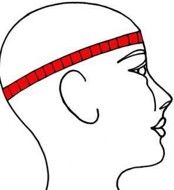
Helmet Fitting Equestrian helmets come in many sizes and styles. Finding a proper fitting helmet for your riding discipline can save money, time and effort. Helmet sizes are based on the circumference at the widest part of the rider’s head approximately one inch above the eyebrows (Figure 1). This measurement is then matched to the proper helmet size (each style of helmet should have an appropriate sizing chart).
Figure 1
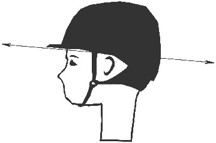
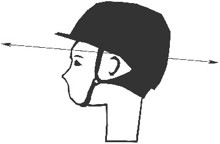
Helmets may vary with style and brand so trying on helmets before purchase is highly recommended. The helmet should fit around the rider’s entire head with the visor level just above the eyebrows (should not be above 1.5 inches (Figure 2)). The chin strap should be attached so the strap is touching the skin under the rider’s chin, not hanging loose. The suspension and chin straps should not pinch the rider’s ears.
Figure 2
Properly Fitting Helmet
Improperly Fitting Helmet
The rider should be able to move his/her head vigorously with minimal helmet movement. If the helmet slides, a smaller size may be needed while a larger size is warranted if the helmet is too tight, causing discomfort. Long hair should not be placed under the helmet in a bun, in a high pony tail or flipped underneath but rather should be pulled back into a low enough pony tail so that it does not interfere with fitting. Most helmet retailers can assist in the helmet fitting process if the rider remains unsure as to proper fit.
SAFETY
In order to maximize the benefits of helmet usage, there are some recommendations that are suggested that helmet owners follow. Helmets should be replaced at least every 5 years, due to the possibility for unseen material deterioration. Helmet standards are continually changing and new technologies frequently appear on the market. Purchasing a new helmet every 5 years allows you to stay up to date on the latest helmet safety and fashion.
Helmets should be replaced after any major impact to ensure the rider’s protection. When you take a fall, a certified helmet absorbs energy by crushing. This extends your head’s stopping time to reduce the peak impact on the brain. While difficult to see on the outside, the “crushing effect” will diminish with additional falls, decreasing the helmets ability to protect. Replacing helmets when appropriate insure the highest level of safety and comfort to the rider.