
Creating Sustainable School and Home Gardens: The Buzz About Bees

Frequently Asked Questions About Bees
What is a bee?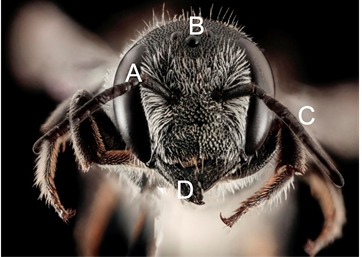
Image: U.S. Geologic Survey (USGS), public domain
All bees belong in a group of organisms (i.e., order) called “Hymenoptera.” The word Hymenoptera comes from two ancient Greek words: "hymen," which means membrane and "pteron," which means wing. Thus, Hymenoptera refers to the membranous wings of insects in this order. All bees share the following characteristics: six legs, four wings, two compound eyes on the sides of their heads, three small single-lens eyes (ocelli) on top of their heads, elbowed antennae, mandibles, a proboscis (i.e., elongated sucking mouthpart), and most importantly, branched hairs on their body for pollen collection (Figures 1 and 3).
How many species of bees are there?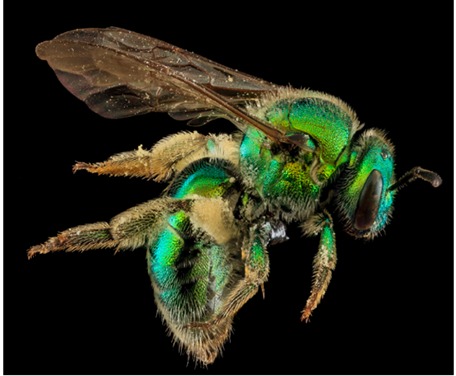
Image: USGS, public domain
There are over 20,000 described species of bees in the world, and an estimated 3,600 in North America. Bees are most diverse in arid and temperate habitats, differing from overall insect biodiversity, which tends to be highest in tropical regions.1 Bees come in all shapes, sizes, and colors, matching the diverse flowers they pollinate (Figure 2). The adaptation between pollinator and flowers occurred through coevolution (adaptation and co-dependence over millions of years).
What is a honey bee and how many species of honey bees are there?Honey bees (Apis sp.) are social bees (i.e., live in colonies) that make their homes out of wax and store lots of honey. There are only eight species of honey bees around the world, and only one is domesticated and kept by beekeepers in hives in the U.S.: the western honey bee (Apis mellifera) (Figure 3). The western honey bee is not native to the U.S. It was introduced by colonists in the 1600s and spread across the U.S.2 The Indigenous peoples of North America called them the "white man's flies."3
What are examples of native bees in the U.S.?
Image: USGS, public domain
Nearly all of the 3,600 species of bees you might encounter in the U.S. are native bees, including bumble bees, carpenter bees, sweat bees (Figure 2), leafcutter bees (Figure 1), blueberry bees (Figure 5), mason bees, squash bees, sunflower bees, resin bees, cuckoo, bees, mining bees, cellophane bees, and many more. Most of these bees are solitary bees (i.e., they do not live in colonies or hives), and each of these species exhibits unique traits and has distinct functions in the ecosystem. Many native bee species make their homes in the ground or in twigs.
How and why do bees pollinate?Bees visit flowers to collect nectar and pollen for food for themselves and their offspring. Bees collect pollen with branched hairs on their body. Often, the hairs (scopa) are concentrated on certain areas of their body (e.g., legs, belly) (Figure 4) or packed into pollen baskets on their legs (corbicula) (Figure 3). Pollen is a significant protein source, while nectar provides carbohydrates. Pollen falls off their bodies as they visit flowers, providing pollination services for flowers, which benefits us!
Why are bees disappearing? Are honey bees endangered?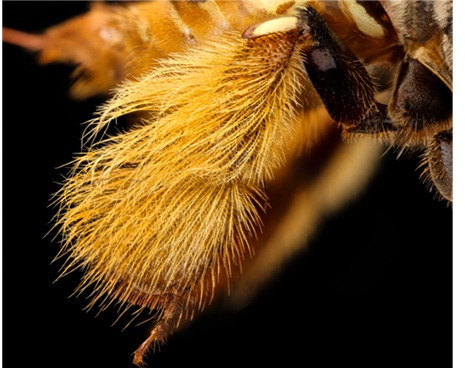
Image: USGS, public domain
All bees are currently facing unprecedented threats from habitat loss, pesticide use, climate change, diseases, and parasites.4 Native bee populations are experiencing declines, and several species, including some bumble bees, have been listed as endangered species.5 Honey bees have received the most publicity because their losses are easily measured and reported compared to wild bee populations; however, western honey bees are not endangered anywhere in the world. Since they are not native species to the U.S., and they have substantial population sizes (over 2 million managed hives), they cannot be listed as endangered. Honey bee losses are complex and due to many stressors including Varroa mites, pesticides, and overwintering issues.
Why should I care about bees?Bees pollinate a wide variety of plants, including wildflowers, which helps maintain ecosystems and supports diverse animal species that depend on these plants for food and habitat. They are crucial for pollination, which helps plants reproduce. Around 75% of the world's crops use pollinators like bees, making them vital for global food security.6 Honey bees have been heavily relied upon to pollinate the industrial non-native food system; however, they are only one species, and many bee species are better pollinators for specific crops (Figure 5).
How can I help bees?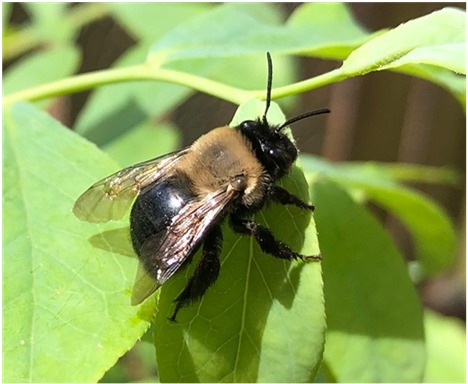
Image: Kaitlin U. Campbell
You can help protect bees by:
- Planting diverse bee-friendly flowers that bloom in different seasons,
- Avoiding pesticide use,
- Supporting organic farming,
- Providing water sources, and
- Building bee hotels for solitary bees.
Be sure to provide resources for all bees, all season long. To learn more about helping bees, check out the following resources.
Resources
Fact Sheets- Campbell, K., Hagevik, R., & Trundle, K. (2024). Creating sustainable school and home gardens: Welcoming pollinators. Utah State University Extension. https://qcnr.usu.edu/smart-foodscapes/files/Welcoming_Pollinators_May2024.pdf
- Cane, J. H., & Kervin, L. (2013). Gardening for native bees in Utah and beyond. Utah State University Extension and Utah Plant Pest Diagnostic Laboratory. https://digitalcommons.usu.edu/cgi/viewcontent.cgi?article=1907&context=extension_curall
- Utah State University Extension. (n.d.). Utah’s native bees. https://extension.usu.edu/planthealth/bees/index
- Lady Bird Johnson Wildflower Center.(n.d.). Special value to native bees. University of Texas at Austin. https://www.wildflower.org/collections/collection.php?collection=xerces_native
- Xerces Society for Invertebrate Conservation. (n.d.). Pollinator-friendly native plant lists. https://xerces.org/pollinator-conservation/pollinator-friendly-plant-lists
- Xerces Society for Invertebrate Conservation. (n.d.). Pollinator conservation resource center. https://xerces.org/pollinator-resource-center
References
- 1Orr, M. C., Hughes, A. C., Chesters, D. , Pickering, J., Zhu, C. , & Ascher, J. S. (2021). Global patterns and drivers of bee distribution, Current Biology, 31(3), 451–458. https://doi.org/10.1016/j.cub.2020.10.053.
- 2Oertel, E. (1976). Early records of honeybees in the Eastern United States - Part III. American Bee Journal, 116(4), 156–157.
- 3Jefferson, T. (1832) Notes on the State of Virginia. Boston: Lilly and Wait, Library of Congress PDF transcription from the Joseph Meredith Toner Collection.
- 4Mull, A., Gunnell, J., Hansen, S., Ramirez, R., Walker, A., Zesiger, C., & Spears, L. (2022). Factors contributing to bee decline [ENT-235-22-PR]. Utah State University Extension and Utah Plant Pest Diagnostic Laboratory. https://extension.usu.edu/planthealth/factsheets/factors-contributing-to-bee-decline-PR.pdf
- 5Xerces Society for Invertebrate Conservation. (n.d.). Species profiles: At-risk invertebrates. https://www.xerces.org/endangered-species/species-profiles.
- 6Klein, A. M., Vaissiere, B. E., Cane, J. H., Steffan-Dewenter, I., Cunningham, S. A., Kremen, C., & Tscharntke, T. (2007). Importance of pollinators in changing landscapes for world crops. In Proceedings of the royal society B: Biological sciences, 274(1608), 303–313. https://doi.org/10.1098/rspb.2006.3721.
Acknowledgments
Smart Foodscapes (usu.edu/smart-foodscapes)
Scan the QR code to learn more.

USDA – National Institute of Food and Agriculture (NIFA) – Sustainable Agricultural Systems (SAS) Grant #2021-69012-35952
September 2025
Utah State University Extension
Authors
Kaitlin U. Campbell, Rita Hagevik, and Kathy Cabe Trundle
Related Research