
Creating Sustainable School and Home Gardens: Gardening With Native Plants

“Native plants are the most powerful tool
in our conservation tool box; without
increasing their use and protection, we will
fail in our conservation efforts.”― Douglas Tallamy, author of
Nature’s Best Hope
Native Plants Defined
Native, indigenous plants occur naturally in a geographic region over long periods (e.g., thousands of years) without human introduction or intervention (U.S. Forest Service, n.d.-b). In North America, native species include plants that were present before Europeans began establishing permanent settlements in the 1500s. Native plants include herbaceous (e.g., mosses, ferns, perennials, annuals, grasses) and woody (e.g., shrubs, vines, trees) plants (Potterfield, n.d.).
In contrast, plants become non-native when they grow outside their natural range. People can introduce exotic, nonindigenous plants intentionally or unintentionally, and introduced species can be noninvasive or invasive. Table 1 shows examples.
Table 1. Non-Native Plant Introduction and Examples
| Non-native plants introduced | Example |
|---|---|
| Intentionally | Using exotic landscape plants from other countries or regions |
| Unintentionally | Transporting embedded seeds on clothing |
| Noninvasive species | Tomatoes, bell peppers, petunias |
| Invasive species | Kudzu, English ivy, garlic mustard |
Invasive species grow aggressively, spread rapidly, dominate native ecosystems, outcompete native plants for resources, alter habitats, reduce biodiversity, and can be costly to manage or control (Hubbard, 2023). Including native plants in your landscape and gardening plans reduces the risk of introducing invasive plant species into your local environment and supports healthy, natural ecosystems (Moorman, 2025). The following resources can guide your native plant selections and help you avoid invasive, exotic species:
- U.S. National Botanical Garden.
- Lady Bird Johnson Wildflower Center.
- North Carolina Botanical Garden.
- Utah State University (USU) Extension Native Plant Species Finder Tool (EcoRestore Utah Portal, n.d.).
For suggestions specific to your area, consult your state Extension office, local master gardeners, or a local nursery that specializes in native plants.
Native Plant Benefits
Gardening and landscaping with native plants offer numerous environmental benefits and advantages for humans and the natural ecosystem.
- More biodiversity. Native plants support biodiversity by providing essential food, shelter, and nesting sites for native wildlife (e.g., birds, mammals, and insects).
- Improved drought tolerance and soil health. Native plants typically develop significantly deeper and more extensive root systems than introduced nonindigenous species, making them more drought tolerant. Root systems also improve soil health and help control runoff, flooding, and erosion.
- Reduced pesticide use and expense. Because native plants are naturally adapted to local environments, they require minimal fertilizer, pesticides, and supplemental water once established, reducing chemical pollution and enabling water conservation and cost savings.
- Less maintenance and pollution. Native plants require less maintenance, saving time and money while reducing pollution associated with traditional lawn care and landscaping upkeep (e.g., mowing and trimming). Less pollution yields a healthier ecosystem for all living things, including humans!
Importantly, from a human perspective, native plants help beautify the environment throughout the seasons with colorful flowers and beautiful foliage (Figure 1; Moorman, 2025; National Audubon Society, 2026).
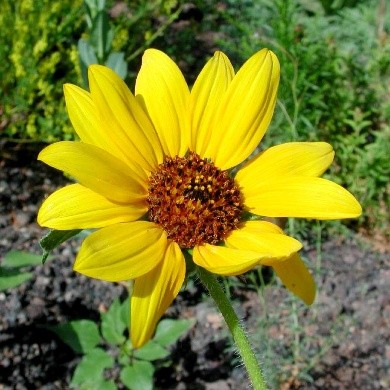
Photo: Kathy Cabe Trundle
Native Plant Considerations
Clarify your native plant garden goal.
Define its purpose and identify your landscaping goals. Do you want to attract pollinators and birds? Do you want to create an eco-friendly environment with more natural habitats? Do you want to conserve water or manage low-lying wet areas? Do you want to reduce traditional lawn maintenance? Do you want to add color to your landscaping without the expense of annuals by replacing them with perennials? Your goal will help guide your plant selections.
Plan for proper placement.
As with all plantings, including landscape beds and vegetable gardens, identify and evaluate the area where you plan to install your native plants:
- Identify the hardiness zone for your location (2023 USDA Plant Hardiness Zone Map).
- Consider average seasonal rainfall and temperatures for your geographic region (see National Weather Service or Utah Climate Center).
- Assess soil conditions, including water retention, amount of organic materials and related nutrient content, texture (e.g., amounts of sand, clay, silt), and pH level (i.e., acidity/alkalinity) (see USDA Web Soil Survey or USU Analytical Laboratories). Soil conditions directly impact plant health and will determine if your plants thrive, struggle to survive, or die.
- Evaluate the topography of the site (e.g., higher- and lower-elevation areas, slope of the land), which may influence drainage.
- Consider variations in sunlight throughout the day and seasons (Potterfield, n.d.).
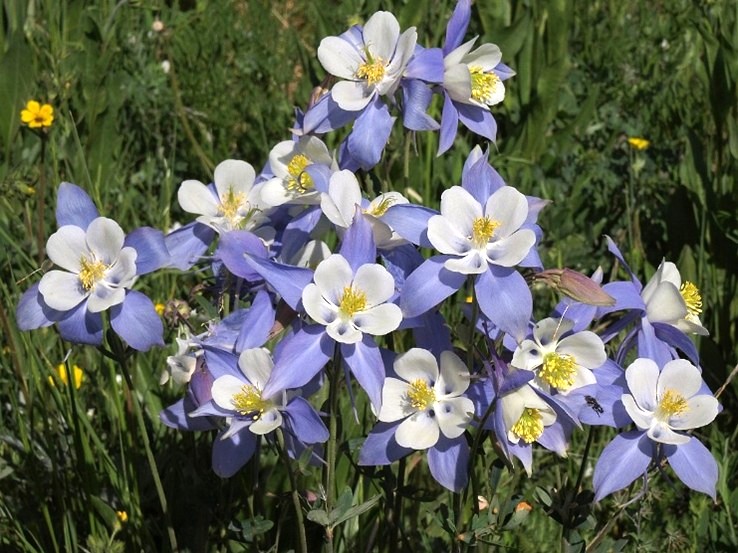
Photo: Jim Morefield, CC BY-SA 2.0

Based on your site assessment, develop a garden or landscape plan that aligns with plant needs (e.g., water needs, sun tolerance) and meets your goals while staying within your budget. You might need to amend the soil by adding organic matter (e.g., compost) to improve nutrient content, or coarse materials (e.g., small pebbles) to improve drainage. Avoid amending clay soil with sand (Wager et al., 2020).
Select plants native to your area.
Based on your goals and site assessment, choose plants best suited to your site and geographic area. Several organizations provide resources to assist with plant selection. The Xerces Society offers lists of native plants for each U.S. geographic region, and the Audubon Society and the National Wildlife Federation host searchable databases to identify native plants by zip code. Your state government, Extension office, university, or local nonprofit organizations may offer lists of recommended native plants for your specific area (e.g., USU Extension, Kansas Department of Transportation, North Carolina Botanical Garden, University of Georgia, Tennessee Invasive Plant Council).
Photos: Kathy Cabe Trundle
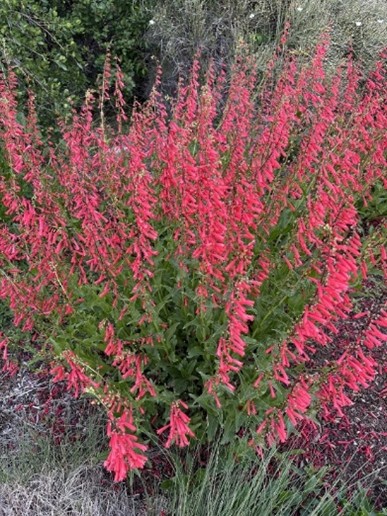
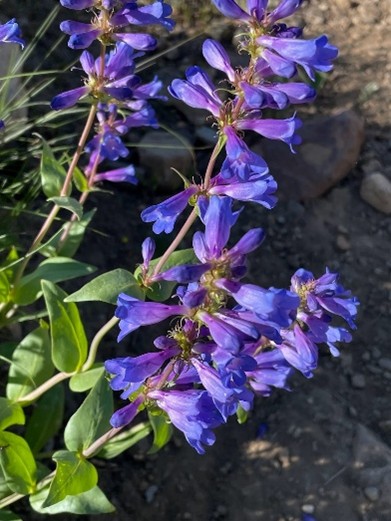
Examples of Utah native plants commonly added to home gardens and landscaping include blue columbine (Aquilegia scopulorum; Figure 2), penstemon (Penstemon; Figure 3), Utah serviceberry (Amelanchier utahensis; Figure 4), showy milkweed (Asclepias speciosa), sunflower (Helianthus annuus; Figure 1), wild bergamot/bee balm (Monarda fistulosa), and yarrow (Achillea millefolium).
Avoid hybrid and invasive species.
Hybrid varieties, which are usually bred for showy flowers, leaves, or size, often lack the quantity and quality of pollen and nectar that native plants provide to native pollinators. Hybrids may not be suitable for your local environment, making them less hardy than native plants. As described above, avoid invasive plants that can dominate ecosystems and outcompete native plants for resources, thereby reducing biodiversity in natural areas (EcoScapes, n.d.-a). The resources offered by the North Carolina Botanical Garden can help you accomplish both goals (see the specific resources in the section labeled Invasive plants to avoid and the free, downloadable booklet titled “Controlling Invasive Plants”). USU Extension also offers fact sheets and guides on invasive species.
Include blooms across the seasons.
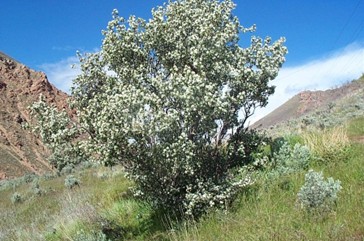
Photo: Tony Frates, CC BY-NC-SA 2.0
To support pollinators, select plants with different bloom times, from late winter/early spring through late fall/early winter, so the pollinators have reliable food sources throughout the growing season (De Luca, 2025). Early bloomers for Utah include sagebrush buttercup (Ranunculus glaberrimus), steer’s head (Dicentra uniflora), and serviceberry (Amelanchier utahensis; Figure 4). Blanket flower (Gaillardia) and yarrow (Achillea millefolium) offer summer blooms, while the prairie aster (Machaeranthera tanacetifolia) provides color and nourishment during the fall. USU Extension (Gunnell, n.d.) and the NH Audubon (De Luca, 2025) provide guidelines for seasonal blooms. Note that the USU list includes both native and non-native species, so cross-check with the Native Plant Species Finder Tool (EcoRestore Utah Portal, n.d.) to ensure that your selections are, indeed, native.
Purchase from reputable nurseries.
To ensure that you are purchasing native, locally sourced plants, seek out reputable nurseries and other resources (e.g., native plant societies, universities, state or local governments), with a goal to purchase nursery-propagated plants rather than wild-collected plants. The plants that are most likely to thrive will be sourced from within a 50-mile radius of your garden (Illinois Department of Natural Resources, 2026). Local, reputable nurseries will help you identify native plants best suited to your specific garden area (EcoScapes, n.d.-a, n.d.-b). The National Audubon Society offers information about purchasing native plants (Ebersole, 2013).
Never collect from the wild.
To protect threatened or endangered plants, never collect from the wild. Collected plants may not survive the transplantation process, and they may not be well-suited for your local ecosystem (EcoScapes, n.d.-a, n.d.-b).
Support native plant establishment.
Some native plants may take from several months up to a year or so to become well established, which means they are likely to require supplemental watering during that time. Plants that are large at the time of transplanting will require more supplemental water for a longer period. Check with your local resources for establishment guidelines for your specific plant selections (EcoScapes, n.d.-a; U.S. Forest Service, n.d. a).
Maintain your plants.
Low maintenance does not equate to no maintenance. As with all landscaped areas, monitor your site regularly to identify any issues with your plants and garden area (e.g., pest infestations, plant diseases, drainage issues, soil erosion, changes in sunlight availability due to construction or tree growth, drought conditions). Early detection will allow you to make adjustments and prevent severe damage to or loss of plants. Mulch can help with weed control, reducing competition for the resources your plants need to survive and thrive.
Native plants form the foundation for healthy local and regional ecosystems. By adding native plants to your gardening and landscape plans, you will contribute to nature’s best hope for the soil health, habitat resilience, and biodiversity we need for a brighter, more sustainable future for ourselves, our children, and our grandchildren.
Resources
De Luca, D. (2025). Build it and they will come: Plan for blooms all season. NH Audubon. https://nhaudubon.org/build-it-and-they-will-come-plan-for-blooms-all-season
Ebersole, E. (2013). How to buy native plants. National Audubon Society. https://www.audubon.org/news/how-buy-native-plants
EcoRestore Utah Portal. (n.d.). Native plant species finder tool. Utah State University Extension. https://extension.usu.edu/ecorestore/assessment-tool?list=true
EcoScapes. (n.d.-a). Points to live by when shopping and gardening with native plants. Marine Extension and Georgia Sea Grant, University of Georgia. https://gacoast.uga.edu/wp-content/uploads/2016/05/2017shopping-and-gardening-with-native-plants.pdf
EcoScapes. (n.d.-b). Purchasing native plants: Considerations and nursery sources. Marine Extension and Georgia Sea Grant, University of Georgia. https://gacoast.uga.edu/wp-content/uploads/2016/05/2017where-to-find-natives-word.pdf
Gunnell, J. D. (n.d.). Seasonal splendor: Planting for color. Center for Water-Efficient Landscaping, Utah State University Extension. https://extension.usu.edu/cwel/research/seasonal-splendor
Hubbard, P. (2023). Why use native plants? Penn State Extension. https://extension.psu.edu/why-use-native-plants
Illinois Department of Natural Resources. (2026). How to plant and maintain native plants. State of Illinois. https://dnr.illinois.gov/education/plantlists/plantlistmaintain.html
Moorman, C. (2025). Benefits of using native plants. North Carolina State Extension. https://gardening.ces.ncsu.edu/how-to-create-wildlife-friendly-landscapes/why-landscapes-for-wildlife/benefits-of-using-native-plants/
National Audubon Society. (2026). Why native plants matter. https://www.audubon.org/content/why-native-plants-matter
North Carolina Botanical Garden. (2025). Controlling Invasive Plants. University of North Carolina at Chapel Hill. https://ncbg.unc.edu/wp-content/uploads/sites/963/2025/10/Controlling-Invasive-Plants-2025_Web.pdf
North Carolina Botanical Garden. (2026). Resources for gardeners: Native plant gardening. University of North Carolina at Chapel Hill. https://ncbg.unc.edu/plants/resources-for-gardeners/
Potterfield, T. (n.d.). Points to live by when shopping and gardening with native plants. EcoScapes, Marine Extension and Georgia Sea Grant, University of Georgia. https://gacoast.uga.edu/wp-content/uploads/2016/05/2017shopping-and-gardening-with-native-plants.pdf
Tallamy, D. W. (2020). Nature's best hope: A new approach to conservation that starts in your yard. Timber Press.
U.S. Forest Service. (n.d.-a) Basic instructions for native plant landscaping projects. U.S. Department of Agriculture. https://www.fs.usda.gov/wildflowers/Native_Plant_Materials/Native_Gardening/instructions.shtml
U.S. Forest Service. (n.d.-b) What are native plant materials? U.S. Department of Agriculture. https://www.fs.usda.gov/wildflowers/Native_Plant_Materials/whatare.shtml
Wagner, K., Stock, M., & Sagers, L. (2020). Preparing and improving garden soil [Fact sheet]. USU Extension. https://extension.usu.edu/yardandgarden/research/preparing-and-improving-garden-soil
Acknowledgments
Smart Foodscapes (usu.edu/smart-foodscapes)
Scan the QR code to learn more.

USDA – National Institute of Food and Agriculture (NIFA) – Sustainable Agricultural Systems (SAS) Grant #2021-69012-35952
The authors did not use generative AI in creating this content, and it is solely the work of the authors. This content should not be used for the purposes of training AI technologies without express permission from the authors.
April 2026
Utah State University Extension
Authors
Kathy Cabe Trundle and Lawrence Krissek
Related Research