
Creating Sustainable School and Home Gardens: Creative Ways to Store Seeds

"Most of us take seeds for granted. The
fate of human kind is resting on these
genetic resources: Seeds. So nothing
could be more important."Cary Fowler
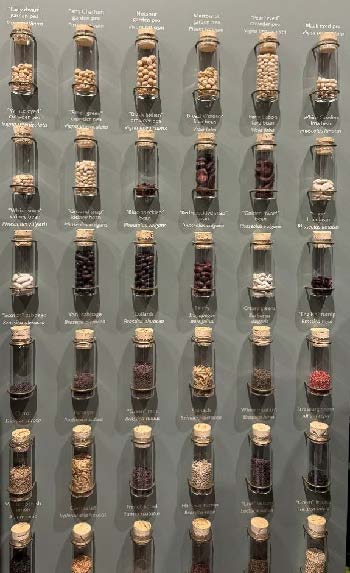
Photo: K. Campbell
Seed saving, the practice of collecting and preserving seeds from plants (e.g., vegetables, herbs, and flowers), allows them to be planted in future seasons. It’s commonly used by home gardeners, farmers, and seed stewards. Traditionally, this practice was a vital part of agriculture, allowing farmers and gardeners to maintain resilient crops adapted to local conditions (Seed Savers Exchange, 2026). Before the rise of commercial seed companies in the 19th century (Smithsonian Libraries, 2018), communities relied on seed saving to ensure food security and pass down plant varieties through generations (Figure 1). Many of these varieties remain available today and are known as heirloom seeds.
Overall, seed saving is a sustainable and cost-effective way to maintain greater control over food production systems. In this way, seed saving serves not only as a link to traditional agricultural practices but also as a critical strategy for promoting sustainable, resilient, and locally adapted food systems (Seed Savers Exchange, 2026; Native Seed Search, 2026).
Cultural and Historical Connections
Seed Storage
Seed storage evolved from ancient Indigenous praactices to modern, high-tech global seed depositories (Breen, 2015; Fowler, 2016). For most of human history, people obtained food through hunting and gathering. While the earliest indication of seed saving dates back 30,000 years, the slow transition to agriculture, a relatively recent development around 12,000 years ago, necessitated more systematic and widespread gathering, cleaning, and storage of seeds (Allaby et al., 2017; Fowler, 2016).
A global, fail-safe seed vault to protect against
natural and human-created disasters, the
Svalbard Global Seed Vault in Norway opened
in 2008 and holds duplicates of seeds from
seed banks worldwide.
More recently, seed saving at national and international scales has been practiced for the past century. Nikolai Vavilov, a Russian botanist, created the first significant, systematic seed bank in Leningrad during the 1920s. This initial effort involved collecting seeds from 64 countries and focused on crop diversity. In 1958, the U.S. established the National Seed Storage Laboratory, often described as the “Fort Knox of the Seed World,” a long-term cold-storage system for seed conservation. Efforts in the 1970s led to the development of an international network of gene banks designed to secure genetic resources for major food crops. Twenty years later, in the 1990s, scientists shifted their focus from simply storing seeds to developing backup strategies and international regulation of genetic material, leading to the formation of the International Plant Genetics Resources Institute. The International Treaty on Plant Genetic Resources for Food and Agriculture, which provides legal guidelines for the international exchange of plant genetic resources, was adopted in the early 2000s. In 2004, plans began for a global, fail-safe seed vault to protect against natural and human-created disasters, the Svalbard Global Seed Vault in Norway, which opened in 2008 and holds duplicates of seeds from seed banks worldwide. From the mid-2000s to the present, international collaborations have focused on developing climate-resilient crops and recognizing community-led seed banks in the Southern Hemisphere (Curry, 2022; Fowler, 2016).
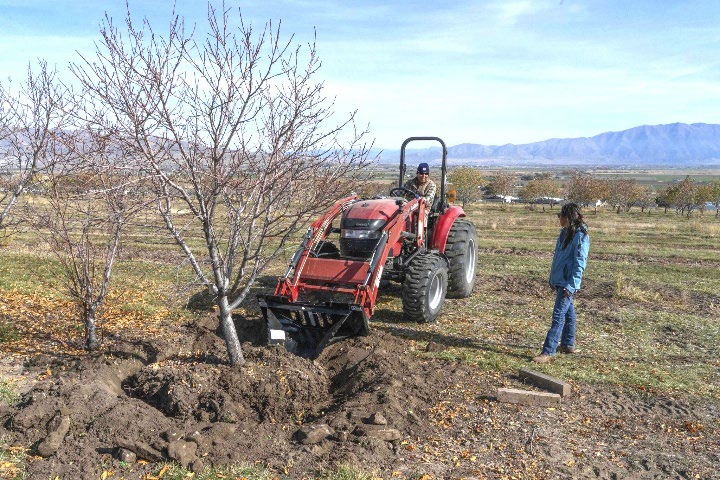
Photo: USU Extension
Seed Rematriation
Seed rematriation, the reclamation of Indigenous cultural seed heritage, involves the return of ancestral Indigenous seeds from seed banks, museums, and private collections to their original Indigenous communities. Rematriation efforts are designed to support Indigenous communities as they reclaim their food sovereignty, repair severed cultural connections, and restore traditional, sustainable agricultural practices (Breen, 2015; Herrighty, 2022; White, 2018). Organizations like Sierra Seeds, Native Seeds/SEARCH, and Seed Savers Exchange lead these reclamation efforts.
The work of Reagan Wytsalucy, a USU Extension assistant professor, provides an excellent example of seed rematriation. Reagan’s work involves re-establishing heirloom, native peaches in the Four Corners region, including Utah (Figure 2). She collaborates with organizations, including the National Park Service, to protect surviving ancient trees and establish new orchards from seed, with the goal of providing seeds to Indigenous families and communities to ensure food security, support biodiversity, revitalize traditional knowledge of ecosystems, and preserve cultural heritage. The Southwest peach or Navajo peach (Prunus persica), which has been cultivated by the Navajo, Hopi, and Zuni tribes for over 400 years, is a sacred symbol of resilience that is integrated into ceremonial dances, songs, and chants, in addition to providing nutritional value (e.g., high fiber, antioxidants, potassium) (Dolan, 2022; Munson, 2023).
Why Save Seeds?
According to Seed Savers Exchangea (2026) and Native Seeds Search (2026), saving seeds includes the following advantages:
- Preserves biodiversity.
- Promotes genetically diverse plants.
- Reduces costs associated with and reliancea on commercially produced seeds.
- Encourages resilient plants that thrive in your specific environment.
- Can be used for the restoration of native plants.
- Allows for the selection of desirable traits over time, such as flavor, yield, or disease resistance.
- Supports sustainable agricultural practices by reducing the environmental impact associated with seed production and transportation.
- Encourages knowledge sharing and community engagement through seed exchanges and seed libraries.
- Maintains autonomy over individual planting decisions.
- Preserves a history of seeds and the growing of plants over time (e.g., seeds are critical to reforestation efforts).
- Facilitates the establishment of seed libraries where community-based collections allow individuals to “borrow” seeds, grow plants, and return a portion of the harvested seeds for future use. Seed libraries foster education, knowledge-sharing, and community engagement, and provide a way for us to share stewardship of plant resources.
How Do I Collect Seeds?
Follow the steps below to collect seeds (Seed Savers Exchange, 2026; Native Seeds Search, 2026):
- Select healthy, mature plants. Choose plants that exhibit strong growth, vibrant colors, and resistance to pests and diseases—these traits will likely be passed on to the next generation.
- Wait until fruits or flowers are mature and have dried. For flowers, observe when seedpods turn brown and dry, but before they split open. Collect seed from multiple plants to maintain genetic diversity.
- Gently remove seeds from the plant. For fruits and vegetables, seeds can often be extracted directly from the flesh. For seeds encased in pods or husks, carefully break them open over a clean surface to avoid losing seeds. Discard any damaged or underdeveloped seeds.
- Clean and dry the seeds. Remove plant material, pulp, or chaff. Rinse, if necessary, then let them dry thoroughly in a well-ventilated space away from direct sunlight. Store in paper or open containers, not plastic bags, until they are completely dried. Proper drying is crucial to prevent mold or rot during storage.
- Sort and label the seeds by plant type and collection date. Store them in sealed containers placed in a cool, dark, and dry location (<50 °F and <50% relative humidity is recommended). This ensures their viability for future planting and allows you to maintain an organized seed library for your garden adventures.
- Replant and replenish the seed collection each year. Under optimal storage conditions, most seeds can last at least a year, but it is essential to replant and replace them with fresh material. Be sure to check your stored seeds regularly to detect any problems early.
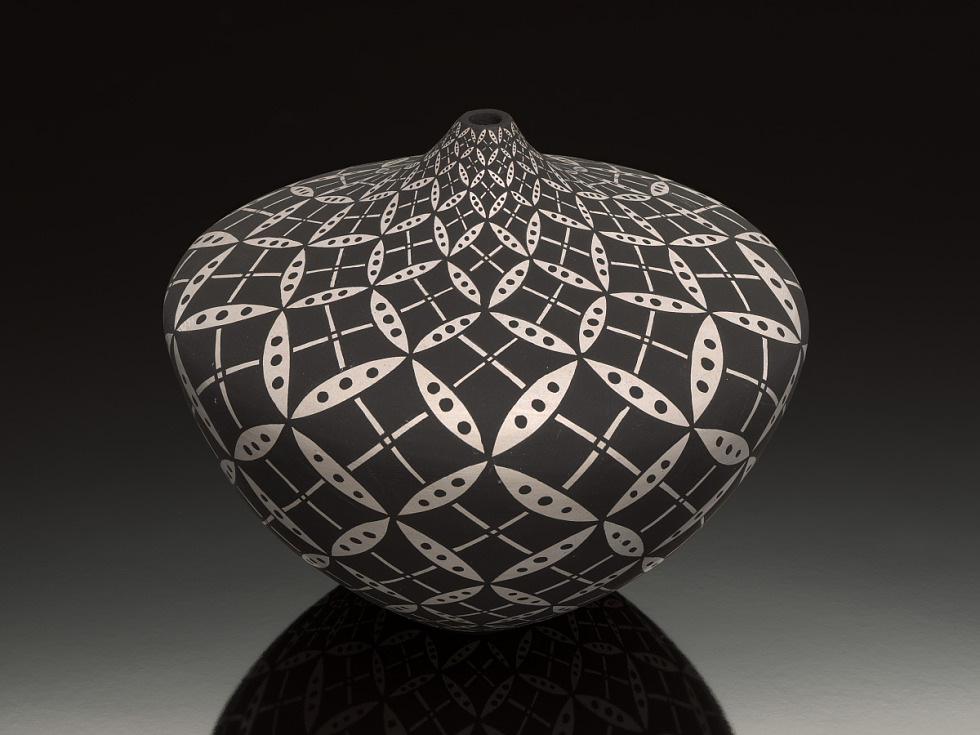
Credit: Seed Jar, by Dorothy Torivio, Acoma Pueblo, licensed under CC0
Creative Ways to Store Seeds
Traditional Methods of Seed Saving (Indigenous Knowledge)
Seed pots (Figure 3) were developed to effectively preserve seeds for planting the following season. A clay pot was made with a small hole, and large enough to pass seeds through but small enough to fit a plug to prevent access by mice. When planting season arrived, seed-filled clay pots would be broken, releasing the seeds for planting. The seed pots symbolize the cycle of life—shattering to release the seeds to bring forth a new generation (Eyes of the Pot, 2026; Nablan,1989).
Artistic Methods of Seed Saving (Pocket Accordion Seed Book)
Seeds can be stored inside a handmade book (Figure 4). Create an accordion-style book with pockets and add seed packets inside. Add information cards for each type of flower seed, including planting instructions.
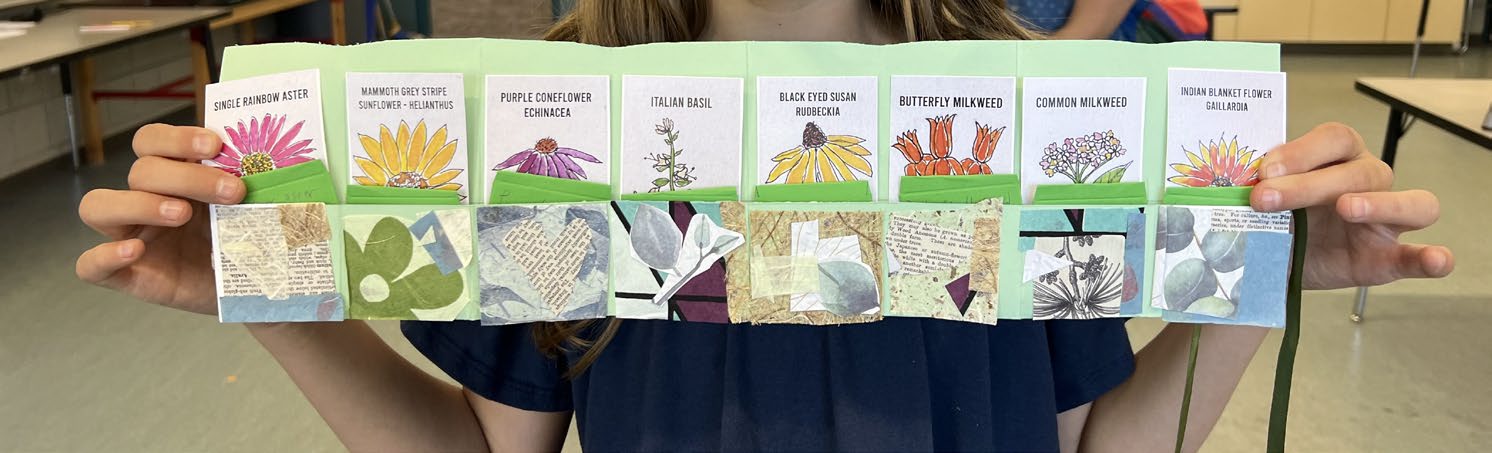
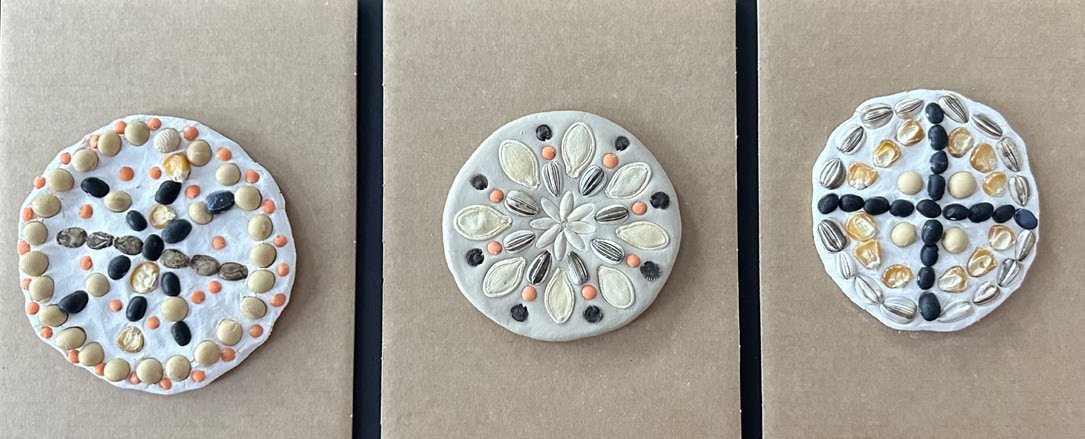
Photo: A. Hughes Villa
Creative Uses for Seeds
Seed Clay Mandala
Seeds can be used to create mandala-inspired artwork. A seed mandala (Figure 5) is created by using air-dry clay and a variety of natural seeds (e.g., pumpkin and sunflower). Form the air-dry clay into a ball, then flatten it into a circle on a cardboard base. Collect a variety of seeds and press the seeds into the wet air-dry clay. Start in the center of the clay and continue pressing the seeds into the clay to create a symmetrical design.
Seed Mosaics
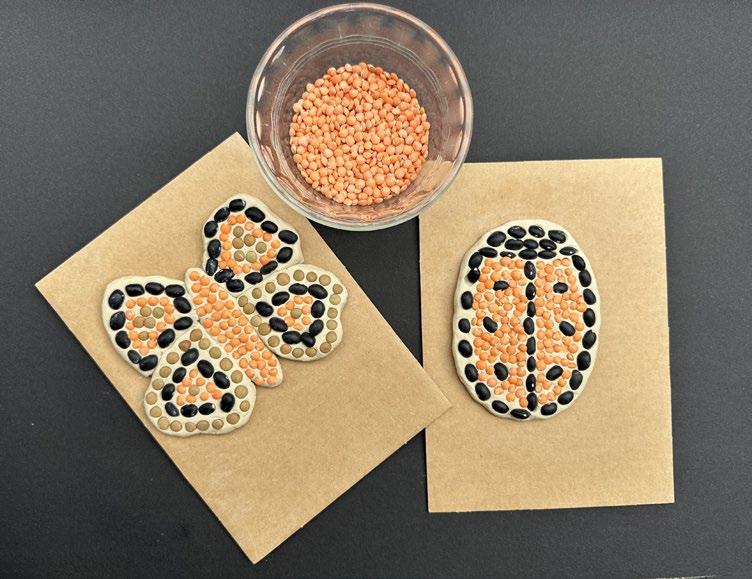
A seed mosaic (Figure 6) is a form of mosaic art created by arranging and gluing various seeds onto a surface (like cardboard, paper, or clay) to form images (abstract or representational), patterns, or designs. Form the wet clay into a shape, then press the seeds into it, making sure to fill the entire shape.
Found Object/Seed Collage
Seeds can be used to create found object seed collages. A seed collage (Figure 7) is made by gluing various seeds onto a base (like cardboard or wood) to create images, patterns, or designs. Collect seeds and arrange them on pre-cut cardboard, gluing them to the background with white glue. Draw the image onto the surface with the tip of the glue bottle, then press the seeds onto the outline of the glue.
Seed Bombs
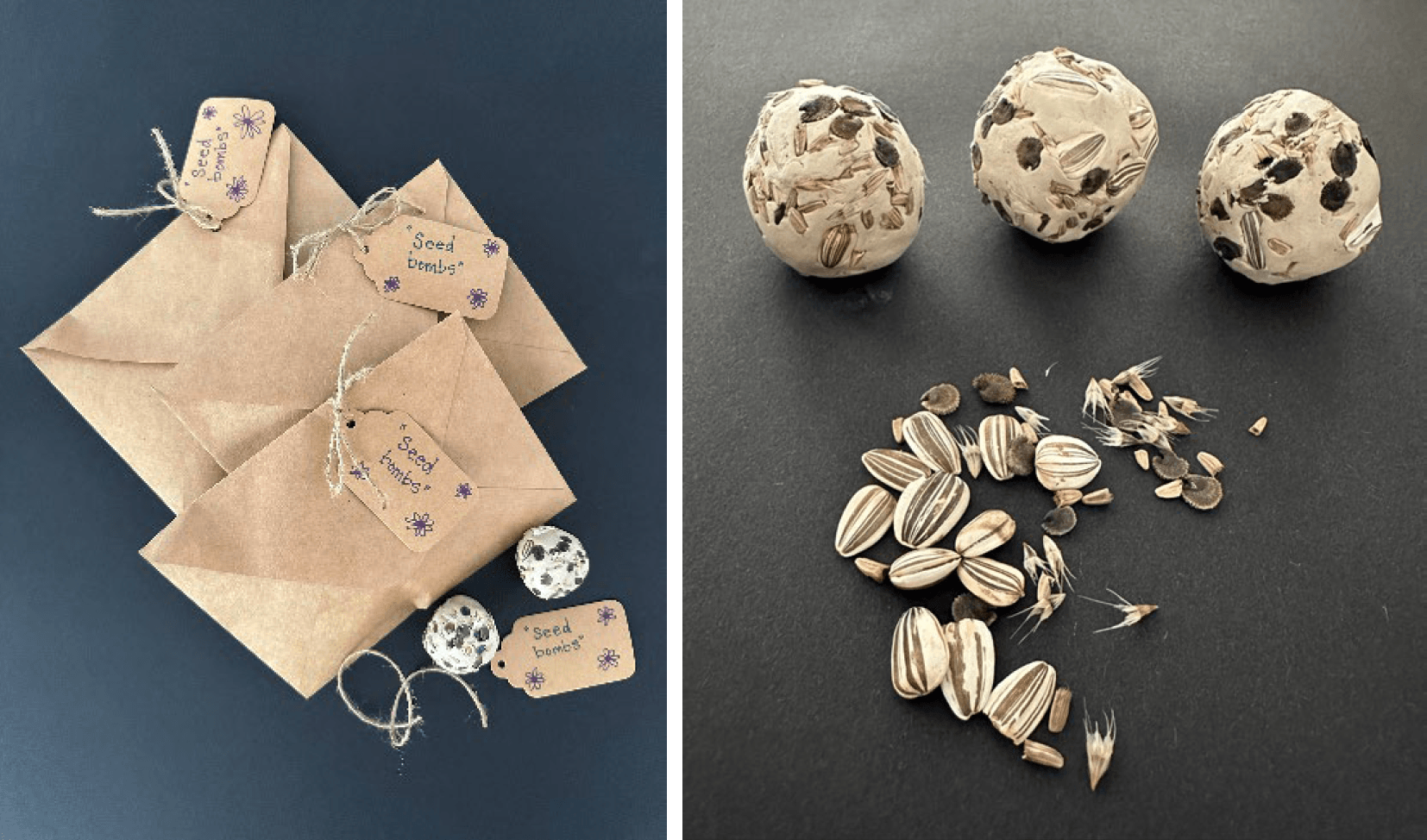
A seed bomb (Figure 8) is a ball made of clay, soil, and seeds, designed to be thrown into a garden. Roll the air-dry clay into small balls. Make a small indent in the clay balls. Add soil and a pinch of seeds, then re-roll and let dry. Toss the seed bombs into a garden plot or open area. When the seed bombs get wet, the clay breaks down, the seeds are watered and germinate, and new plants grow.
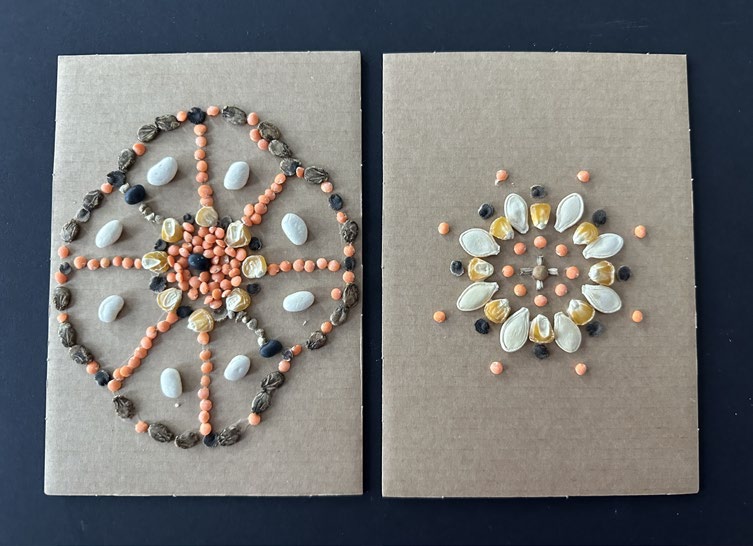
Photo: A. Hughes Villa
Seed saving is both a practical skill and a creative act. By collecting, storing, and sharing seeds, we protect biodiversity, strengthen food security, and maintain a living connection to the plants that sustain us. At the same time, the art of seeds invites us to slow down, observe patterns, textures, and stories held within each seed, transforming them into sources of inspiration and expression. We can all marvel at the diversity of colors, sizes, and shapes of seeds that make our beautiful world of plants possible. Together, seed saving and seed-based art remind us that seeds are more than the beginning of plants—they are carriers of culture, memory, and hope for the future. When we save seeds and engage with them creatively, we become active participants in caring for the land, preserving knowledge, and imagining resilient, sustainable communities for generations to come.
Resources
Seed Saving
- Seed saving (Seed Savers Exchange).
- Collecting native seeds (U.S. Forest Service).
- Collecting and using your own wildlife seed (Xerces Society).
- Seed saving instructions (Native Seed Search).
- Seed collecting and saving (North American Native Plant Society).
- Stewardship stories (Seed Savers Exchange).
- “Indigenous Seed Keepers Network” [Video] (Native American Food Sovereignty Alliance).
- “Seed Saving,” Virginia Home Grown [Video] (PBS Utah).
Books and Stories
- Book collections (Seed Savers Exchange).
- “Saving Seeds, Saving Stories – Sowing a New Generation of Growers: An Oral History Project” (Appalachian Regional Library).
- “Indigenous Tobacco From Ancient Seeds: History Comes Alive” (by Heidi Skinner, CoastalReview.org, North Carolina Coastal Federation).
- “Stewardship Stories” (Seed Savers Exchange).
- “Indigenous Seed Rematriation 2020” [Video] (Seed Savers Exchange).
- “SLAM & the Story of the Ancient Squash Seeds” (by Christina Tran and Tye G. McIvor, imaginED).
Traditional and Creative Ways to Store Seeds
- Native American seed pots (Native American Pottery).
- Native American seed pot images (The Wandering Bull, LLC).
- Pocket accordion book lesson plan (J. Willard Marriott Library, Book Arts Program, University of Utah).
Creative Uses for Seeds (Art and Science Activities)
- Seed mandala art project (Dr. Megan Zeni).
- Seed collage (My Baba).
- Seed mosaics with air dry clay (Raising Up Wild Things).
- Activities for kids – bean mosaic art (Jennifer Kalynuik).
- Seed bombs with air dry clay (Sheri Silver).
Acknowledgments
Smart Foodscapes (usu.edu/smart-foodscapes)
Scan the QR code to learn more.

USDA – National Institute of Food and Agriculture (NIFA) – Sustainable Agricultural Systems (SAS) Grant #2021-69012-35952
The authors did not use generative AI in creating this content, and it is solely the work of the authors. This content should not be used for the purposes of training AI technologies without express permission from the authors.
References
Breen, S. D. (2015). Saving seeds: The Svalbard Global Seed Vault, Native American seed savers, and problems of property. Journal of Agriculture, Food Systems, and Community Development, 5(2), 39–52. doi: http://dx.doi.org/10.5304/jafscd.2015.052.016
Curry, H. A. (2022). The history of seed banking and the hazards of backup. Social Studies of Science: 52(5). 664–688. doi: 10.1177/03063127221106728
Dolan, S. (2022, June 22). How a Navajo scientist is helping restore traditional peach horticulture. Park Science, National Park Service. https://www.nps.gov/articles/000/how-a-navajo-scientist-is-helping-to-restore-traditional-peach-horticulture.htm
Eyes of the Pot. (2026). Shapes and forms: Seed pots. Native American Pottery: Through the Eyes of the Pot. https://www.eyesofthepot.com/shapes-forms/seedpots.php
Fowler, C. (2016). Seeds on ice: Svalbard and the global seed vault. Prospecta Press.
Herrighty, E. M. (2022). Seed sovereignty, rematriation, and three sisters intercropping in Native American communities [Master's thesis, Iowa State University]. ProQuest Dissertations & Theses Global. https://www.proquest.com/dissertations-theses/seed-sovereignty-rematriation-three-sisters/docview/2678334703/se-2
Munson, K. (2023, September 12). Putting down roots with native peaches. Utah State Magazine, Utah State University. https://utahstatemagazine.usu.edu/environment/putting-down-roots-with-native-peaches/
Nablan, G. (1989). Enduring seeds: Native American agriculture and wild plant conservation. University of Arizona Press.
Native Seed Search. (2026). Seed saving instructions. https://www.nativeseeds.org/pages/seed-saving-instructions
Seed Savers Exchange. (2026). Seed saving introduction. https://seedsavers.org/learn/seed-saving/
Smithsonian Libraries. (2018). Cultivating America’s Gardens: Gardening as an enterprise. Smithsonian Institution. https://library.si.edu/exhibition/cultivating-americas-gardens/gardening-as-enterprise
White, R. (2018). Seed rematriation. Sierra Seeds. https://sierraseeds.org/seed-rematriation/.
March 2026
Utah State University Extension
Authors
Aurora Hughes Villa, Kaitlin U. Campbell, Rita Hagevik, and Kathy Cabe Trundle
Related Research