
Creating Sustainable School and Home Gardens: Companion Planting

What Is Companion Planting?
- John Muir
Companion planting is an agricultural practice in which two or more plants are intentionally grown together to enhance mutual productivity. The special relationships that plants have with other organisms help create balanced ecosystems. Companion planting can be used to reduce the need for chemical fertilizers and pesticides, increase yields, and attract beneficial insects such as pollinators.
History of Companion Planting
Texts dating back to 200 BCE mention methods of companion planting, and many ancient societies used companion planting. As the Greeks and Romans practiced companion planting, they observed that certain plants could benefit or harm their neighbors. The Chinese used mosquito ferns alongside rice crops to fix nitrogen and suppress weeds (Willis, 2007), and Marcus Terentius Varro noted that planting cabbage near grapes proved detrimental to the grapes (Plaff, 2021). Companion planting saw a resurgence in the 20th century, coinciding with the rise of organic farming, as gardeners sought natural methods to improve soil health and deter pests. Today, companion planting remains a key strategy in sustainable agriculture.
Examples of Companion Planting

Photo: National Agricultural Library
One of the most famous examples of companion planting comes from the “Three Sisters” method, a practice discovered and implemented by Indigenous people worldwide to enhance crop yields. This technique involves growing different varieties of corn, beans, and squash together in close proximity, with each plant benefiting the others (Figure 1). The corn stalks provide a structure for the trailing beans to climb up, the bean plants enrich the soil with nitrogen, and the squash plants shade the soil, preventing weed growth, deterring pests, and retaining soil moisture (Figure 2). This technique not only improves yields but also holds cultural significance, as the three crops complement each other in diet and tradition (Ngapo et al., 2021). Other companion planting pairs include:
- Tomatoes and basil (basil repels insects like thrips).
- Carrots and onions (onions deter carrot flies and aerate the soil, improving the onions' growth).
- Peppers and marigolds (marigolds deter nematodes and other pests that attack pepper plants).
- Thyme and strawberries (thyme repels worms that harm strawberries).
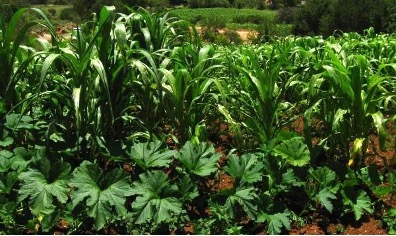
Photo: National Agricultural Library
In each case, these combinations of plants improve soil health, deter pests, and promote plant growth naturally. For additional examples of companion planting, see Companion Planting With USU Extension (Brosseau, 2021).
Trap Cropping
Trap cropping, a companion planting method, involves interplanting cash crops with crops that are more palatable to pests. Some trap plants inhibit the reproduction and spread of the pest. Examples of trap cropping include nasturtiums to attract aphids and flea beetles, and radishes to trap flea beetles, root maggots, and cabbage maggots away from plants in the cabbage family. Genetically engineered trap crops are an interesting type of companion plant. For instance, some trap crops can host a specific virus without allowing its insect vector to spread it. This method reduces the proliferation of vector-spread pathogens rather than directly controlling the pest population (Muntz et al., 2024).
Reasons for Companion Planting
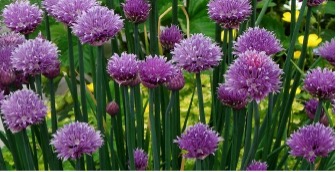
Photo: Maryland Extension
Attract pollinators: Some plants are adapted to attract specific pollinators, and many food crops rely on pollinators to reproduce. By interplanting plants such as nasturtium, thyme, rosemary, oregano, and cosmos, pollination and reproduction rates increase, improving crop yields.
Deter pests: Certain plants can deter harmful insects and attract beneficial ones, reducing the need for chemical pesticides. Many strongly scented plants like onions, garlic, and chives are known to repel common garden pests (Figure 3).
Enhance plant growth: Companion plants can also help improve the growing conditions for their neighboring plants, enhancing their growth overall. In the Three Sisters method described above, squash leaves shade the soil, keeping it moist and preventing erosion, which benefits the other plants in its vicinity. Legumes enrich the soil with nitrogen, which benefits nitrogen-loving plants, such as corn. Corn provides a natural trellis for bean plants to climb, increasing air circulation to prevent disease and deter pests and increasing their sunlight exposure to improve crop yields.
Additional Companion Plant Examples
- Basil attracts whiteflies, keeping them away from early-growing cucumbers and tomatoes.
- Aphids can’t stand garlic, making it a great barrier crop to vulnerable plants (Boeckmann, 2022).
- Dill attracts beneficial insects like ladybugs, which eat aphids. Many vegetables are great hosts to parasitic aphids, making ladybugs a valuable pest control method.
- Borage enhances strawberries’ flavor and yields by attracting pollinators (Figure 4).
- Nasturtium acts as a trap crop for brassicas, like broccoli, cabbage, cauliflower, kale, and Brussels sprouts.
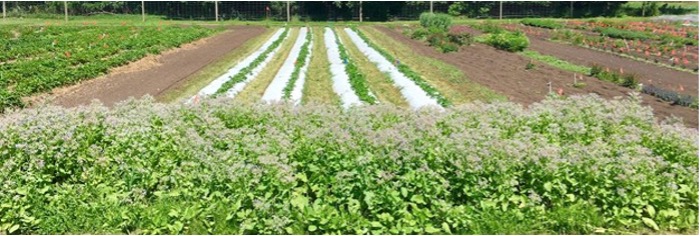
Photo: University of Minnesota
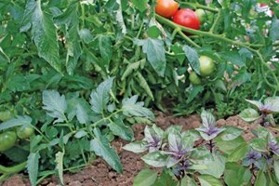
Photo: West Virginia University
- Mint and garlic deter deer and other predators because of their strong scents. Planting mint or garlic between rows of potatoes and lettuce can deter hungry pests (Boeckmann, 2022).
- Oregano (Figure 5) produces essential oils (i.e., carvacrol and thymol), which act as insecticides by inhibiting insect growth and increasing insect mortality.
- Sunflowers provide support for climbing plants such as beans or cucumbers.
Resources
- ATTRA Sustainable Agriculture Program. (2022, June). Companion planting & botanical pesticides: Concepts & resources. National Center for Appropriate Technology (NCAT). https://attradev.ncat.org/wp-content/uploads/2022/06/companion-planting.pdf
- Ben-Issa, R., Gomez, L., & Gautier, H. (2017). Companion plants for aphid pest management. Insects, 8(4), 112. https://doi.org/10.3390/insects8040112
- FamilyAndCommunityHealing. (2023, February 8). Companion planting. Foundation for Family and Community Healing. https://web.archive.org/web/20230208123456/https://familyandcommunityhealing.org/companion-planting/
- Franck, G. (n.d.). Companion planting: Successful gardening the organic way. Soil and Health Library. https://www.soilandhealth.org/wp-content/uploads/0302hsted/030217franck/franck.pdf
- Martin, J., Bhadha, J. H., & McAvoy, E. (2021). Companion planting to increase yield in cucumbers and habaneros. Journal of Agriculture, Food Systems, and Community Development, 10(2).
- Montoya, J. E., Arnold, M. A., Rangel de Alvarenga Paes, J., Stein, L. R., & Palma, M. A. (2020). Pollinator-attracting companion plantings increase crop yield of cucumbers and habanero peppers. HortScience, 55(2), 164–169. DOI: 10.21273/HORTSCI14468-19
- Thrive. (n.d.). Companion planting. The Society for Horticultural Therapy. https://www.thrive.org.uk/get-gardening/companion-planting
- Utah State University Extension. (2025). Treatment options. In Utah vegetable production guide. https://extension.usu.edu/vegetableguide/ipm-practices/treatment-options
Acknowledgments
Smart Foodscapes (usu.edu/smart-foodscapes)
Learn more by scanning the QR code.

USDA – National Institute of Food and Agriculture (NIFA) – Sustainable Agricultural Systems (SAS) Grant #2021-69012-35952
Unless otherwise noted, Utah State University Extension provided the photos in this fact sheet.
References
- Boeckmann, C. (2022, May 26). Companion planting chart: Tomatoes, potatoes, and veggies! Almanac. https://www.almanac.com/companion-planting-guide-vegetables
- Brosseau, L. (2021, December 1). Companion planting with USU Extension. PBS Utah. https://www.pbsutah.org/blogs/modern-gardener/companion-planting-with-usu-extension/
- Muntz, H., Miller, R., & Alston, D. (2024). Alternative pest control methods for homeowners. Utah State University Extension. https://digitalcommons.usu.edu/extension_curall/809/
- Ngapo, T. M., Bilodeau, P., Arcand, Y., Charles, M. T., Diederichsen, A., Germain, I., Liu, Q., MacKinnon,S., Jessiga, A. J., Mondor, M., Villeneuve, S., Ziadi, N., & Gariépy, S. (2021). Historical Indigenous food preparation using produce of the Three Sisters intercropping system. Foods, 10(3), 524. https://doi.org/10.3390/foods10030524
- Plaff, C. (2021, February 23). Companion plants: A partial history. Studio Campo. https://studio-campo.com/notebook/2021/2/23/companion-plants-a-partial-history
- Willis, R. J. (2007). The history of allelopathy. Springer. https://doi.org/10.1007/978-1-4020-4093-1
July 2025
Utah State University Extension
Authors
Ruby Mohr, Kathy Cabe Trundle, and Rita Hagevik