

What is the Success Sequence?

The Success Sequence is a research-based framework that, when followed, helps young people both avoid and get out of poverty. The steps for the Success Sequence are:
- Graduate from high school (and pursue further education, if possible)
- Get a full-time job
- Get married before having children
Research shows that 97% of young people who follow this sequence are not living in poverty in their 30's. This is true when controlling for race, SES, gender, and a variety of other demographic factors.
Simply put, following these steps in this order sets young people up for financial success as well as family stability.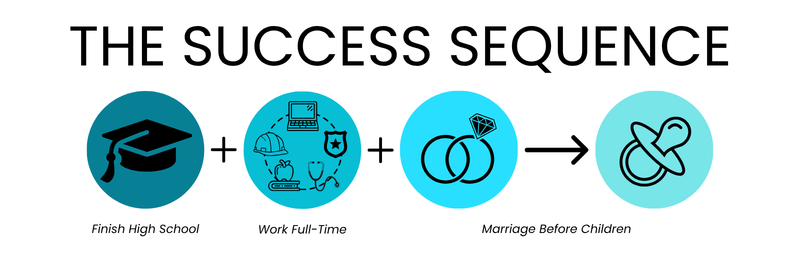
Utah Success Sequence Legislation
Recognizing the power of this sequence for strengthening the foundation of families and society at large, Utah legislators passed House Bill 281 (HB281) in the spring of 2025. This law added the Success Sequence to Utah Health Education standards, requiring that students receive instruction on this framework at least twice between 8th and 12th grade.
UMC’s Resources for Utah Health and Financial Lit Teachers
In September of 2025, the Utah Marriage Commission, in collaboration with the Utah State Board of Education and national curriculum expert Marline E. Pearson, developed three Success Sequence lessons in response to the passing of HB281. This includes two Health lessons, and one Financial Literacy lesson (a State Office of Education-recommended addition that provides an additional opportunity for students to internalize these principles).
These lessons range in length between 1 class period and 3 class periods and are intended to serve as a drop-in lessons for Utah teachers to assist them in presenting the Success Sequence in a way that fulfills the legal requirements in addition to teaching positive decision-making and healthy relationship skills.
Through the Success Sequence lessons, students learn to:
- Understand how education, employment, and marriage timing influence long-term financial and family stability
- Apply intentional decision-making skills using the “Decide, Don’t Slide” framework
- Recognize how relationship choices impact future outcomes
- Strengthen personal agency and align present decisions with future goals


CTE Specialists from the Utah State Board of Education have already begun distributing the Financial Literacy lesson to teachers, receiving positive feedback after preliminary implementation. In December of 2025, the two health lessons were approved for the USBE Midas curriculum database at a "Recommended Limited" approval rating — the highest rating available to supplemental lessons focusing on a single Utah Health Education standard.
The lesson plans, available below at no cost to Utah teachers, include all of the necessary materials, including a teacher script, accompanying PowerPoint slides, and active-learning exercises that encourage student engagement and application of principles.
If you have any questions about the development or use of these materials, please reach out to us: marriagecommission@usu.edu
Lesson Plans
The Success Sequence for Health I
PDF Slides
PDF Slides with Notes
PowerPoint Slides
Canva Presentation
Instructor Script with Activities
The Success Sequence for Health II
PDF Slides
PDF Slides with Notes
PowerPoint Slides
Canva Presentation
Instructor Script with Activities
The Success Sequence for Financial Literacy
PDF Slides
PDF Slides with Notes
PowerPoint Slides
Canva Presentation
Instructor Script with Activities
-->