
Preserving the Harvest: How to Preserve Chokecherries
Introduction
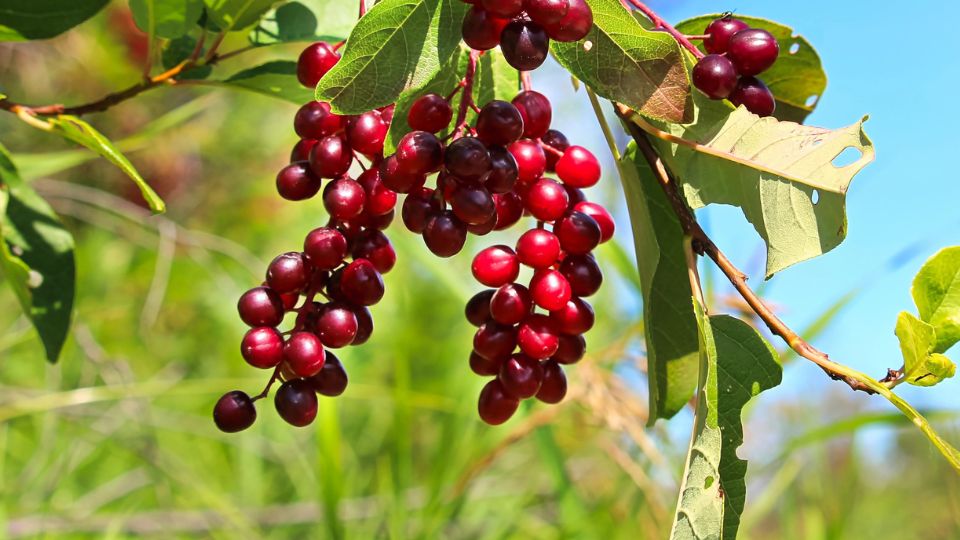
Chokecherry (Prunus virginiana) is a native shrub or small tree found throughout Utah’s foothills, canyons, and riparian zones (Wiser et al., 2014). Though the fresh fruit tastes astringent, chokecherries provide rich flavor in jellies, jams, syrups, and juice (Figure 1). With proper handling and using tested recipes, chokecherries can be safely preserved at home.
Historically, Indigenous peoples used chokecherries for food, medicine, and ceremonial purposes. Tribes such as the Lakota and Mandan used chokecherries as peace offerings, in teas, and in pemmican, a traditional food made from dried meat, rendered fat, and berries (Natural Resources Conservation Service [NRCS], 2003; South Dakota Department of Education, n.d.). Early pioneers also relied on chokecherries for homemade jellies, syrups, and wines, which were often featured at community fairs and in homestead recipes (Lamb, n.d.). Chokecherries’ cultural significance and versatility make them a valuable wild fruit in the Intermountain West.
Chokecherries in Utah
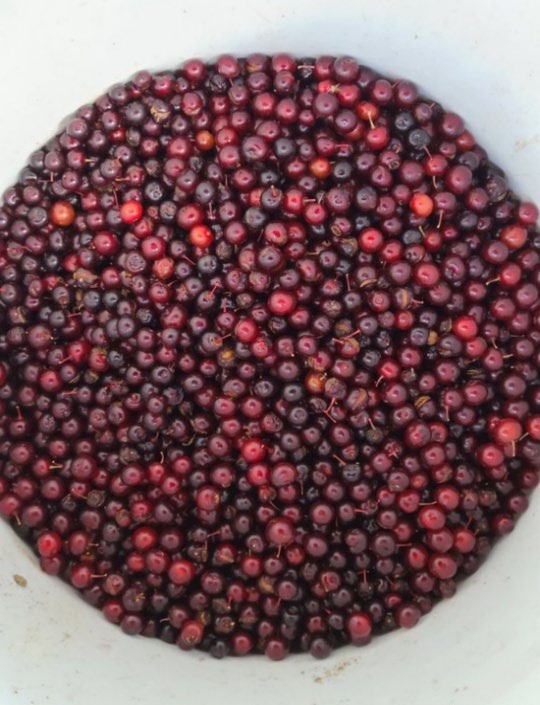
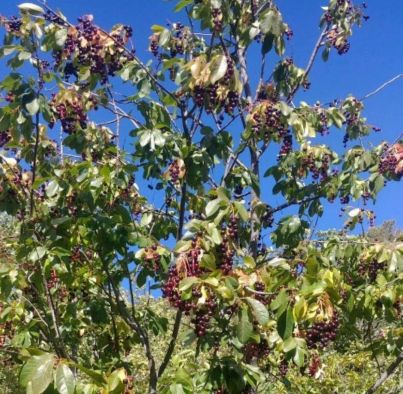
Widely distributed across Utah, chokecherries can be found at elevations ranging from about 4,900 to 10,200 feet (Utah State University [USU] Extension, n.d.). They are valued not only for their ecological role as a food source for birds and other wildlife but also for their ornamental and cultural uses. Cultivars such as the purple-leafed ‘Canada Red’ chokecherry find popularity as landscape trees, while the fruit has long been harvested for making jams, jellies, and syrups (Wiser et al., 2014). Harvest generally occurs from late July through September, when the berries mature to a deep red or black color, signaling they are ready for safe handling and preservation (Figures 2 and 3).

Only use the ripe fruit’s juice or
pulp in preserving. When
processing, take care not to crush
the pits to avoid releasing the
harmful toxins.
Despite their benefits, chokecherries also pose risks because the pits, stems, and leaves contain cyanogenic compounds. Cyanogenic describes plants or substances that can release cyanide, a poisonous chemical, when they are chewed or digested. This is a natural defense mechanism found in some seeds, roots, and leaves. Only use the ripe fruit’s juice or pulp in preserving. Note that wilted leaves and crushed pits can be toxic to livestock and should never be consumed (Albertson & Dinstel, 2021). When processing, take care not to crush the pits to avoid releasing the harmful toxins.
Safe Preservation Methods
Safe Preservation Methods Safely preserving chokecherries at home requires using research-tested recipes from land-grant universities and following proper extraction methods such as steam juicing or straining through cheesecloth (National Center for Home Food Preservation [NCHFP], 2015; Andress & Harrison, 2014). Follow recipes exactly, with no changes to the proportions of fruit, sugar, or pectin, as altering these can affect both safety and quality. Avoid outdated processing methods, such as jar inversion or paraffin wax sealing, as they do not provide a dependable seal or protect against spoilage (Andress & Harrison, 2014). Instead, all jams, jellies, and syrups must be processed in a boiling-water canner to ensure product safety and shelf stability (NCHFP, 2015).
Because much of Utah lies at higher elevations, processing times must be increased. At higher altitudes, the boiling point of water drops below 212 °F, so food may not reach temperatures high enough to kill harmful microorganisms. To compensate, extend boiling-water canning times and adjust pressure canning levels to ensure safety (NCHFP, 2015; South Dakota State University Extension, 2023; Penn State Extension, 2023).
Equipment Checklist
in Juicier and Fuller Fruit, While Early Spring or Late Frosts
Affect Utah’s Chokecherry Crop
The following items play a key role in ensuring safe and effective home preservation (NCHFP, 2015).
- Boiling-water canner with rack: provides the necessary heat treatment to prevent spoilage and ensure shelf stability.
- Mason jars (half-pints or pints) with new lids and rings: essential for creating a proper vacuum seal.
- Large saucepans and ladles: assists in the overall process of preparing jams, jellies, and juices.
- Steam juicer (optional): simplifies juice extraction and minimizes contact with potentially harmful pits.
- A jelly bag or several layers of cheesecloth: helps strain juice cleanly, removing solids and pits.
- Accurate measuring cups and spoons: critical for maintaining the proportions required in research-tested recipes.
Safety Note
Do not crush or grind chokecherry seeds. The pits contain cyanogenic glycosides, which can release the toxic compound cyanide when broken down in the body. Ingesting large amounts of these compounds can be harmful or even fatal. Only the juice or pulp should be used for food preservation (NRCS, n.d.).
Step 1: Extract Juice
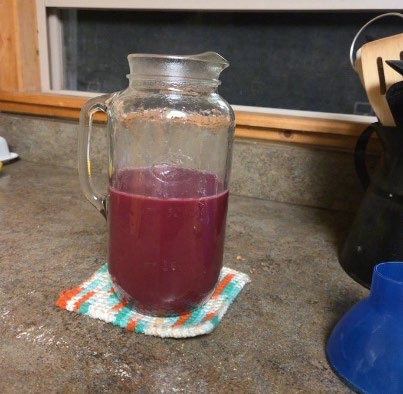
Juice can be extracted using either the traditional stovetop method or a steam juicer (Figure 4). Both approaches are safe and effective when handled properly. The steam juicer delivers convenience and efficiency, while the stovetop method offers accessibility and works well for small batches.
Traditional Stovetop Method
The stovetop method, a reliable way to prepare juice for jelly or syrup, does not require specialized equipment. This process is straightforward and safe when implemented correctly (Albertson & Dinstel, 2021).
Steps for Extracting Juice Using the Traditional Stovetop Method
- Prepare the fruit. Clean chokecherries under cool running water, discarding stems and leaves.
- Simmer it gently. In a large stainless steel or enamel saucepan, combine 4 cups of cleaned chokecherries with 1 cup of water. Place over low heat and simmer until the fruit is very tender, stirring occasionally. Take care not to crush the seeds.
- Strain the mixture. Pour the mixture into a damp jelly bag or several layers of cheesecloth placed in a colander. Allow the juice to drip into a bowl.
- Avoid pressing the mixture. For clear juice, do not twist or press the jelly bag or cheesecloth; pressing can cause cloudy juice.
- Store the juice. Use the juice immediately for jelly or syrup. For long-term storage, freeze or can the juice using approved methods.
- Yield: You can obtain approximately 2 cups of juice per pound of chokecherries.
Traditional Stovetop Method Advantages
- No special equipment required – Using common kitchen items (saucepan, strainer, cheesecloth) makes it accessible to most households.
- Small batch friendly – This method works well for modest quantities of fruit, ideal for those harvesting a few pounds at a time.
- Direct control – Simmering allows close monitoring of fruit softness and juice quality.
- Low-cost option – Purchasing a steam juicer is not required, keeping preservation affordable.
- Reliable yield – This method produces a consistent amount of juice (about 2 cups per pound of fruit) when directions are followed carefully.
Steam Juicer Option
A steam juicer offers a clean, efficient, and hands-off alternative to stovetop simmering for preparing chokecherry juice. According to Oregon State University Extension (n.d.), steam juicers are excellent tools for extracting juice from fruits and vegetables. Steam gently heats the produce without crushing it, allowing juice to drip into a collection container while leaving solids, pits, and pulp behind.
How to Use a Steam Juicer
A video by USU Extension demonstrates how to assemble and use a steam juicer (USU Extension, 2025). The demonstration illustrates the following process:
- Place water in the bottom chamber and boil it to produce steam.
- Fit the middle section to collect the extracted juice.
- Load the fruit into the perforated top basket.
- Collect the juice. Steam rises through the fruit, releasing juice, which drains into the jar through a small hose, providing hot, sanitized juice ready for preservation.
Steam Juicer Advantages
- Non-crushing extraction – Steam avoids crushing pits, reducing risk from cyanogenic compounds.
- Produces clear juice – The juice is clean and ready for canning or jelly-making without requiring additional straining (University of California Extension, 2024).
- Efficient and sanitary – Hot steam pasteurizes the juice in the extraction process.
- Simplifies handling – A trailer hose can directly transfer hot juice to jars, reducing handling risk.
Step 2: Choose a Tested Recipe
Below are tested, university-published recipes for chokecherry jelly and syrup. Each includes ingredients, methods, and processing guidelines. Always adjust processing times for the various Utah elevations.
Chokecherry Jelly With Powdered Pectin
(Recipe from Garden-Robinson and Smith [2023], North Dakota State University Extension)
Ingredients
- 3 1/2 cups chokecherry juice
- 4 cups sugar
- 1 package powdered pectin
Method
- Combine juice and pectin in a saucepan; bring to a rolling boil over high heat.
- Add sugar all at once, stirring constantly.
- Return to a full rolling boil and boil hard for 1 minute.
- Pour into hot, sterilized jars, leaving ¼-inch headspace.
- Wipe jar rims with a damp paper towel. Adjust two-piece canning lids.
Processing
- Process in a boiling-water canner for 5 minutes at 0–1,000 ft.
- Increase time according to Utah altitude.
Chokecherry Jelly With Liquid Pectin
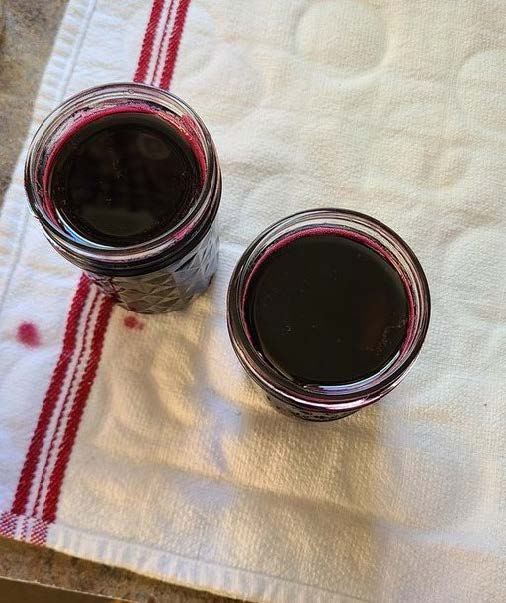
(Recipe from University of Minnesota Extension, 2021)
Ingredients
- 3 cups chokecherry juice
- 6 ½ cups sugar
- 1 box (2 pouches, 6 ounces total) liquid pectin
- ¼ teaspoon almond extract (optional)
Method
- Pour juice into a large, heavy saucepan. Add sugar and stir to mix.
- Place over high heat and bring to a boil, stirring constantly. Stir in pectin. Bring to a full, rolling boil and boil hard for 1 minute, stirring constantly.
- Remove from heat. Stir and skim off foam for 5 minutes. Add almond extract.
- Pour jelly into hot, sterilized half-pint or pint jars to ¼ inch from the top. Wipe the jar rim with a damp paper towel. Seal with two-piece canning lids.
- Process in a boiling-water bath. The time in the boiling-water bath varies by elevation.
Processing
- Process half-pint or pint jars for 5 minutes at 0–1,000 feet.
- Increase time according to Utah altitude.
Chokecherry Syrup
(Recipe from Andress and Harrison [2014], University of Georgia Extension)
Ingredients
- 1 ¼ cups chokecherry juice
- 1 ½ cups sugar • ¼ cup corn syrup
- 1 TBS lemon juice
Method
- Combine ingredients in a large saucepan.
- Bring mixture to a boil, stirring constantly.
- Boil until syrup coats a metal spoon.
- Pour into hot jars, leaving ¼-inch headspace.
- Wipe jar rims with a damp paper towel. Adjust two-piece canning lids.
Processing
- Process half-pint jars for 5 minutes at 0–1,000 feet.
- Increase time according to Utah altitude.
More Ways to Preserve Chokecherries
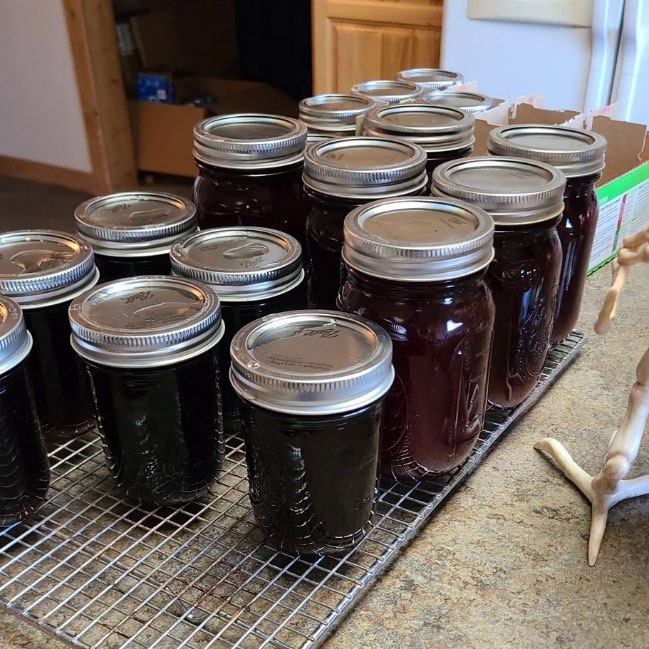
Beyond traditional jelly and syrup, several Extension services offer creative and research-tested recipes you can try:
- View recipes, including chokecherry syrup and jelly, chokecherry vinegar, chokecherry-apple butter, and chokecherry juice drink (Albertson & Dinstel [2021], University of Alaska Fairbanks Extension).
- “Jams and Jellies From Native (Wild) Fruit” includes guidance on chokecherries and other wild fruits common to the northern Great Plains (Garden-Robinson [2023], North Dakota State University Extension).
- “Chokecherry Jelly With Apples” combines tart chokecherries with apples for flavor balance and added natural pectin (DeVos-Cole [2022], New Mexico State University Extension).
Note. The above recipes come from land-grant universities and follow USDA research-based food preservation standards.
Conclusion
A treasured wild fruit in Utah and across the Intermountain West, chokecherries offer both cultural heritage and culinary versatility. With proper handling and research-tested preservation methods, you can safely transform them into delicious jellies, syrups, and more. Whether using a steam juicer or stovetop method, following tested recipes and adjusting for elevation ensures both safety and quality. By preserving chokecherries at home, you not only enjoy their unique flavor year-round but also continue a tradition rooted in Indigenous knowledge and pioneer resilience.
References
Albertson, L., & Dinstel, R. R. (2021). Chokecherries (FNH-00113). University of Alaska Fairbanks Cooperative Extension Service. https://www.uaf.edu/ces/publications/database/food/chokecherries.php
Andress, E. L., & Harrison, J. A. (2014). So easy to preserve (6th ed.). University of Georgia Cooperative Extension. https://www.fcs.uga.edu/extension/so-easy-to-preserve
Colorado State University Extension. (n.d.). Preserve smart: Chokecherries. https://apps.chhs.colostate.edu/preservesmart/produce/jam/chokecherries/
DeVos-Cole, S. (2022). Chokecherry (aka Capulin): Identifying plants, harvesting fruit, and making jelly (Guide H-339). New Mexico State University. https://pubs.nmsu.edu/_h/H339/index.html
Garden-Robinson, J. (2020). Jams and jellies from native (wild) fruit (FN-1423). North Dakota State University Extension. https://www.ndsu.edu/agriculture/sites/default/files/2022-07/fn1423%20updated%2006-21.pdf
Garden-Robinson, J., & Smith, R. (2023). From the garden or orchard to the table: Jams and jellies from North Dakota fruits (FN590). North Dakota State University Extension. https://www.ndsu.edu/agriculture/extension/publications/garden-or-orchard-table-jams-and-jellies-north-dakota-fruits
Lamb, L. (n.d.). Eating the outdoors: Chokecherry jelly, syrup, and liqueur. Montana Fish, Wildlife and Parks. https://fwp.mt.gov/binaries/content/assets/fwp/montana-outdoors/recipes/chokecherries_so12.pdf
National Center for Home Food Preservation. (2015). USDA complete guide to home canning (Agriculture Information Bulletin No. 539). University of Georgia. https://nchfp.uga.edu/resources/category/usda-guide
National Center for Home Food Preservation (NCHFP). (n.d.). Ensuring safe canned foods. University of Georgia. https://nchfp.uga.edu/how/can/general-information/ensuring-safe-canned-foods/
Natural Resources Conservation Service (NRCS). (2003). Chokecherry plant guide. U.S. Department of Agriculture. https://www.nrcs.usda.gov/plantmaterials/kspmcpg5596.pdf
Oregon State University Extension. (n.d.). Using a steam juicer for extracting juice. https://extension.oregonstate.edu/mfp/steam-juicer
Penn State Extension. (2023). Time, temperature, and pressure in canning foods. https://extension.psu.edu/time-temperature-and-pressure-in-canning-foods
South Dakota Department of Education. (n.d.). All about chokecherries [Fact sheet]. https://doe.sd.gov/farmtoschool/documents/HOM/Chokecherry-FactSheet.pdf
South Dakota State University Extension. (2023). Altitude adjustments for home canning. https://extension.sdstate.edu/altitude-adjustments-home-canning
University of California Extension. (2024). Steam juicing basics. https://ucanr.edu/sites/default/files/2024-09/402577.pdf
University of Minnesota Extension. (2021). Chokecherry jelly and syrup made from wild fruit. https://extension.umn.edu/preserving-and-preparing/chokecherry-jelly-made-wild-fruit
Utah State University (USU) Extension. (2025). How to use a steam juicer [Video]. YouTube. https://www.youtube.com/watch?v=L1k69z0-5HE
Utah State University (USU) Extension. (n.d.). Chokecherry (Prunus virginiana). https://extension.usu.edu/rangeplants/shrubs-and-trees/chokecherry
Wiser, S., Maughan, T., & Black, B. (2014). How to grow chokecherry in your garden [Fact sheet]. Utah State University Extension. https://extension.usu.edu/yardandgarden/research/chokecherry-in-the-garden

May 2026
Utah State University Extension
Peer-reviewed fact sheet
Authors
Callie Adams and Andrea Schmutz

Callie Adams
Extension Associate Professor | 4-H Youth Development | Home and Community | Garfield, Wayne, & Piute Counties
Home and Community Department

Andrea Schmutz
Extension Associate Professor | Washington County
Home & Community Department
Related Research
Are Organic Matter Soil Amendments Created Equal?
Each class of material has specific characteristics and management issues when it comes to using it as a soil amendment.
Backyard Composting in Utah
The benefits of using compost as a soil amendment include increasing soil tilth, fertility, water holding capacity, aeration, and drainage.
Gardening in Sandy Soils
Learn the basics of clay, silt and sand soils with an emphasis on gardening in soils with high sand content. Get tips for gardening tips for managing sandy soils, and the types of plants that grow best in sandy soils.
It's All About Soil Structure!
The single best soil amendment—the one that provides desirable benefits regardless of the soil one applies it to—is organic matter.

Policies and Programs for Water-Wise Residential Landscaping in Utah
Water-wise landscaping is the practice of using plants in a landscape that are adapted to local conditions and only need small amounts of water. Converting yards to water-wise landscaping conserves water and is a climate adaptation action residents can ta
Preparing and Improving Garden Soil
A great garden starts with healthy soil. In Utah, there are unique considerations for creating and maintaining healthy soils.