
Maintaining and Improving Irrigation Application in Sprinkler and Drip Systems Quickguide
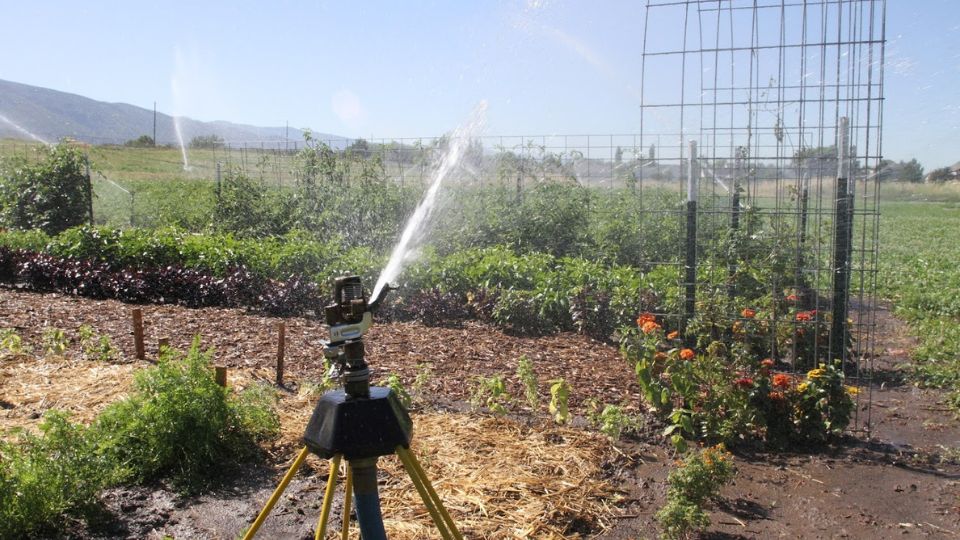
The goal of most irrigation system design and management is to provide all plants in an irrigated area with equal access to water, but all systems have some nonuniformities in how water is delivered. There are eight common causes of nonuniformities in irrigation: pressure variation in the system, manufacturing variation in nozzles, emitters, and other components, insufficient sprinkler or emitter spacing, irrigation system disrepair, clogged nozzles or emitters, weather conditions, irrigation duration, and soil water infiltration variability. Each of these may lead to nonuniformity in irrigation, but there are methods to minimize the negative effects.
Tips to Maximize Uniformity in Irrigation Application
- Maintain the proper inlet pressure for the system.
- Use pressure-regulating valves or flow-control nozzles/emitters.
- Select drip emitters that have a manufacturer’s coefficient of variation (CV) of less than 3%.
- Use consistent and sufficient spacing within an irrigation system.
- Use consistent nozzle/emitter sizes and models throughout the system, except where specifically designed to be different.
- Maintain the proper inlet pressure for the system.
- Replace sprinkler nozzles at proper intervals.
- Have proper filtration that excludes particles less than one half the diameter of the nozzle diameter.
- Use chemigation regularly.
- Check the system regularly for clogs and unclog promptly.
- Orient outlets and emitters upward from the lateral.
- Using sprinklers with larger droplets may minimize effects of wind and evaporation.
- Vary the time of day each part of the field is irrigated in areas where wind and evaporation are a problem.
- Maintain consistent irrigation set timing during irrigation cycle or across a field.
- Avoid runoff using combination of design and management.
- Apply less water during irrigation cycles to prevent runoff.
Irrigation application uniformity in sprinkler and drip irrigation systems depends upon designing, maintaining, and managing the irrigation systems. Maintaining proper system pressures, regularly replacing sprinklers, using offset lateral locations, and varying the time of day of irrigation for each area of the field are primary practices for maximizing sprinkler uniformity. Proper filtration and chemigation maintenance are primary practices to maintain drip irrigation uniformity.
Utah State University is an affirmative action/equal opportunity institution and is committed to a learning and working environment free from discrimination, including harassment. For USU’s non-discrimination notice, see equity.usu.edu/non-discrimination
References
Authors
Katelyn Parker, Burdette Barker, Sheridan Stewart, and Mark Nelson