
Irrigation Loss and Recovery in Utah Quickguide
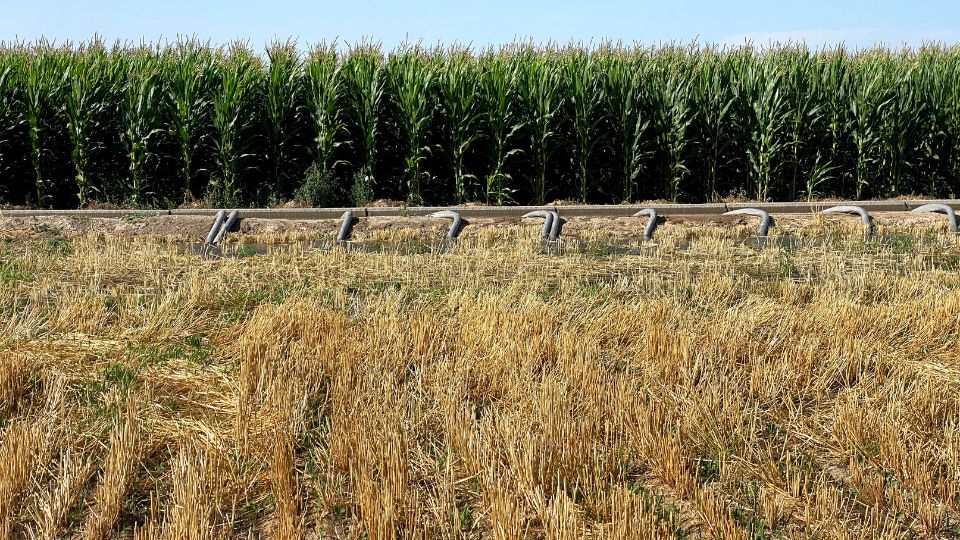
When deciding which irrigation systems to adopt, permit, or promote, it is important to consider how their efficiency and losses affect the water balance of Utah’s watersheds and drainage basins. Sprinkler, surface, or drip irrigation systems each have trade-offs in irrigation application efficiency, cost, and other factors. While some irrigation systems can be more efficient than others, the destination of consumptive uses, or “lost water,” is a vital consideration for long-term water balance management, as other system types have losses that are potentially recoverable.
Recoverable Water Loss (Return Flow)
Water that returns to Utah's water sources
 Deep Percolation
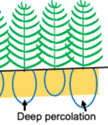 Deep percolation occurs when more water infiltrates into the soil than can be stored in the root zone. It is recoverable as it moves into the groundwater.
Runoff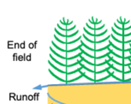
Runoff is visible, and most irrigators can easily see and manage it. Runoff leaves the field and often returns to other water sources like streams.
Non-Recoverable Water Loss (Consumptive Use)
Water Utah does not get back
Wetted Crop Canopy Evaporation
 The amount of evaporation from a wetted crop canopy depends on the canopy size and weather but is expected to be about 4% water loss of each irrigation.
Wind Drift
 Wind drift is water that is blown away before reaching the crop is not recoverable.
Sprinkler irrigation- includes wind drift and evaporation (spray) and deep percolation due to non-uniform irrigation or inadequate irrigation scheduling.
Surface irrigation- includes deep percolation and runoff.
Drip irrigation- includes deep percolation resulting from non-uniformity in emitter flow rates.
Each irrigation system type has benefits and drawbacks viewed from the perspective of a grower, a water manager, or other stakeholders. Although there are more efficient irrigation systems, based on the fraction of recoverable losses, some fields and areas in Utah with declining aquifers may be best served by continuing to use less efficient surface irrigation systems, depending on the considered trade-offs, needs, and constraints of a particular area.
Utah State University is an affirmative action/equal opportunity institution and is committed to a learning and working environment free from discrimination, including harassment. For USU’s non-discrimination notice, see equity.usu.edu/non-discrimination
References
Authors
Katelyn Parker, Bradley Crookston, Troy Peters, Matt Yost, and Burdette Barker