
Labeling for Commercial Businesses

The FDA sets requirements for the information required on packaged food labels, including:
- A clear description of what the food is;
- How much food is contained in the package;
- The ingredients used to make the food;
- The producer or distributor of the food; and
- Where each of these elements must be placed and how large the font should be.
The FDA considers any graphics, marketing or background story, or other elements (such as UPC symbols) to be optional. This means you must include all of the information the FDA requires, and if there’s not enough room for other items they must be left off (or you need to use a larger label).
This page will cover some of the basic requirements for food labels, but does not include detailed information for all possible labeling issues. We strongly recommend having your labels reviewed by a labeling specialist before you have them printed. You can find more specific information in the FDA’s Guidance for Industry: Food Labeling Guide. (Note that the Nutrition Facts section of this guide is out-of-date. Check out our Nutrition Facts page for more information and resources.)
The Principal Display Panel (PDP) is the part of the package that consumers see first – the side that faces out on the grocery store shelf. There are two pieces of information that must be included on the PDP.
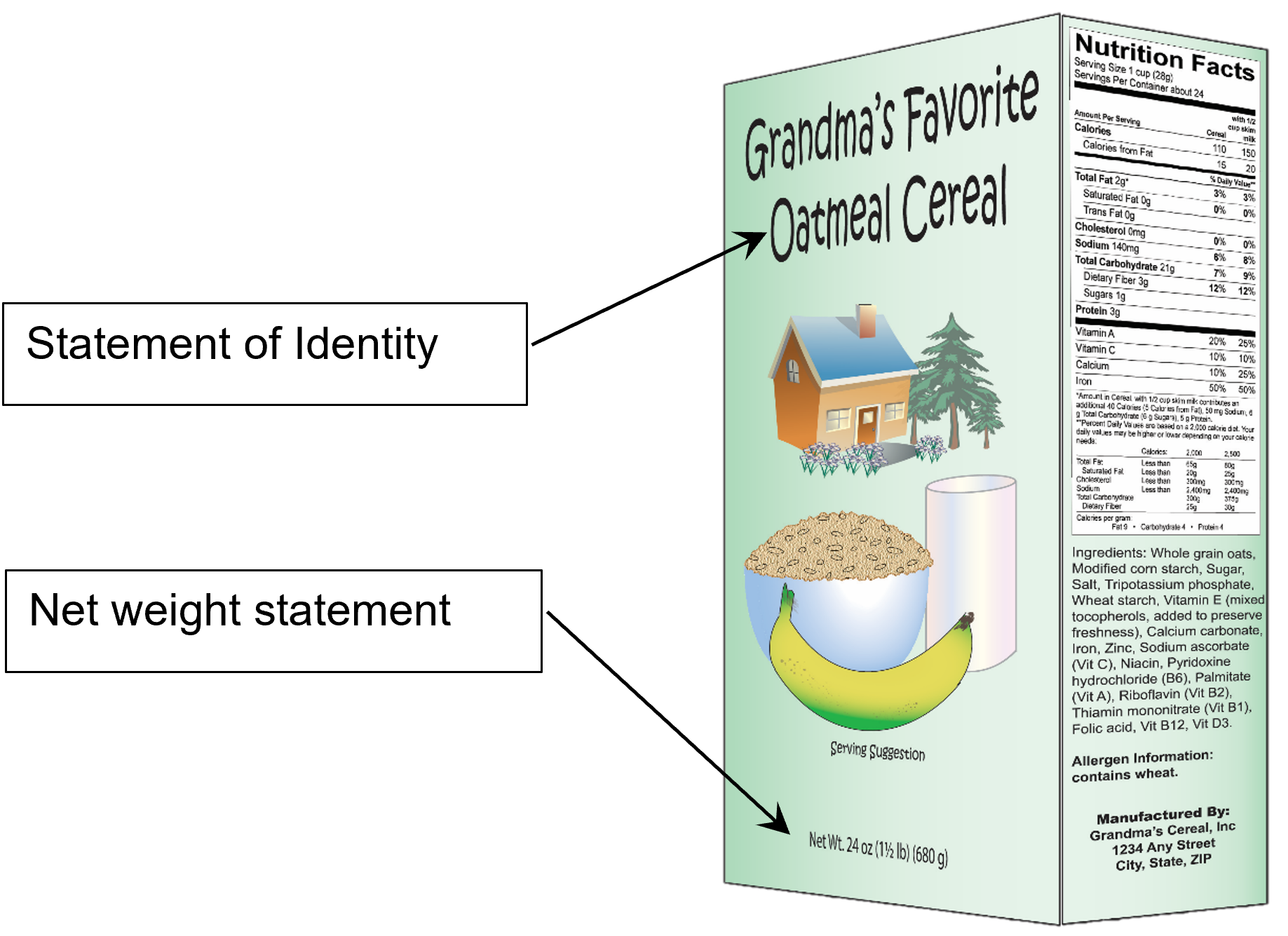
Statement of Identity, which is a clear description of the food. The FDA refers to this as a common or usual name, that is understood by the average consumer. The statement of identity must be in prominent (bold) type, and no more than ½ the size of the largest font used on the PDP. Branding, logos or graphics cannot overwhelm or obscure the statement of identity.
In some cases you must use the standard of identity as your product statement, a legally established description of certain types of food. Foods with standards of identity include some dairy products, canned fruits and vegetables, and chocolate. There are also specific labeling requirements that apply to imitation foods (or foods with imitation flavors) and beverages that contain fruit juice.
Net Contents Statement, which is a measure of how much food is in the package. This should not include the weight of any packaging materials. Solid, semisolid, and viscous foods (e.g. syrup) should be listed by weight (ounces and/or pounds). Liquid foods should be listed by volume (fluid ounces). Utah also requires that the metric measure be included (grams or milliliters).
This statement must appear in the bottom 30% of the PDP, with the minimum font size calculated based on the size of the PDP. For example, on a package with a PDP that is 10 inches wide and 12 inches tall (120 sq in), the height of the lower case “o” must be at least ¼ inch. For more information, see p. 15 of the FDA Food Labeling Guide.
The Information Panel is the part of the package immediately to the right of the PDP. For packages with two sides (e.g. chip bags), the Information Panel is the back of the package. For packages with only one label, all of the required parts of the Information Panel must appear on the PDP, in between the Statement of Identity and the Net Contents Statement.
There are four pieces of information found on the Information Panel. They must appear in the following order with no other information or graphics appearing in between.
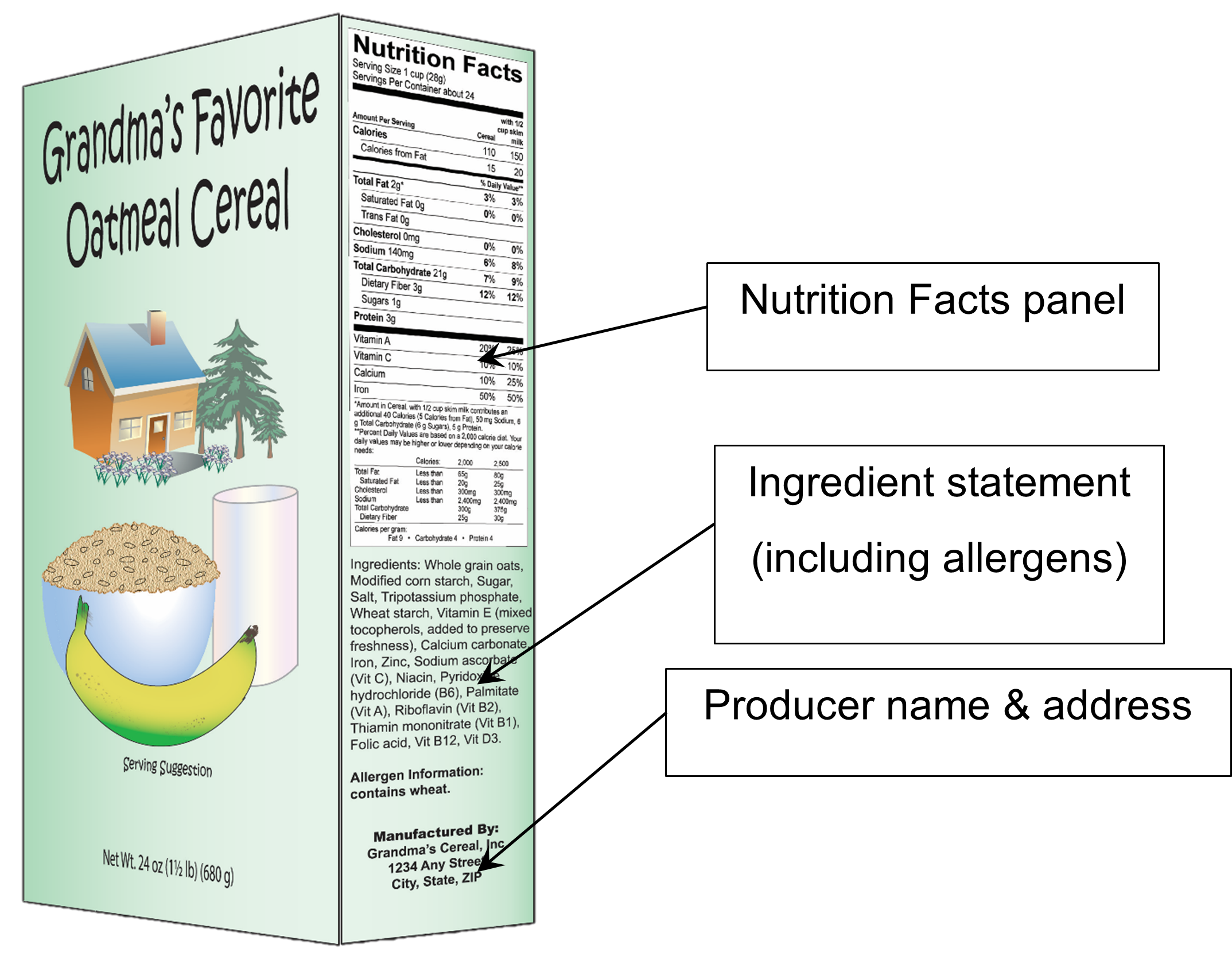
Nutrition Facts Panel, in an FDA compliant format. Depending on the total available label area of your package, you might be able to use a different format (e.g. all text). Some small companies may not need to include nutrition facts. More information on nutrition facts requirements can be found here.
Ingredient Statement, a listing of all ingredients used. Ingredients must be listed in order from highest weight to lowest, including water used as in ingredient (even if evaporates off during cooking or processing). There are many specific requirements for how ingredients are listed. Some of the most common issues include:
- Ingredients must be listed by their common and usual name. For example, table sugar can be listed as “sugar” or “granulated sugar”, but not as “evaporated cane juice” or “sucrose”.
- For any ingredients that themselves contain multiple ingredients, those ingredients should be listed in parentheses after the ingredient name. For example, in a product that contains butter, the butter would be listed as: “butter (cream, salt)”.
- Some ingredients can be listed as a group without specifying individual ingredients by name. For example, “Spices”, “Flavor and Color”, “Natural Flavors”, or “Artificial Flavors” may be listed in the ingredient statement by order of total weight for the group. Note that this does not apply to salt or spices derived from vegetables (e.g. onion powder or garlic). These ingredients must always be listed individually.
- Ingredients that have a preservative function must include a description of that function after their name. For example: “ascorbic acid to preserve color”.
Allergen Statement, a listing of any of the nine required allergens included in the product. The simplest way is to include a separate allergen statement (e.g. Contains milk and wheat), but this requirement can be met by listing the allergens by name within the ingredient statement itself.
The following allergens must be declared, using this wording:
- Milk (for any dairy ingredients)
- Egg (for any egg-based ingredients)
- Fish (the word “fish” can be included, but the individual types must be declared by name, e.g. anchovies or sardines)
- Crustacean shellfish (this wording can be included, but the individual types must be declared by name, e.g. shrimp or crab)
- Tree nuts (this wording can be included, but the individual types must be declared by name, e.g. coconut or pecans)
- Wheat (NOT declared as gluten!)
- Peanuts (for any peanut-derived ingredients)
- Soy (for any soy-derived ingredients)
- Sesame (for any sesame-derived ingredients)
Producer name and address, including the full street address of the business. Alternately, the name of the packer (“manufactured for”) or distributor (“distributed by”) can be listed. If the street address can be found in a current printed telephone directory, just the city, state and zip can be listed.
Many other claims, certifications, or statements can appear on food labels. While these are optional, many must still meet specific regulatory requirements for their use.
FDA Label claims include nutrient content claims, health claims, and qualified health claims. These include phrases such as “low fat”, “good source of iron”, and “reduced sodium”. These claims have specific requirements for nutrient content levels and approved wording. If you use any of these claims, you are required to have a nutrition facts panel regardless of company size.
Gluten-free claims are voluntary, but they must meet FDA requirements. Specifically, products labeled as gluten-free can have no more than 20 parts per million (ppm) gluten.
Certified Organic labeling is regulated by the USDA. The wording you can use, and whether you can use the USDA organic seal, varies depending on the percent organic ingredients contained in the finished product. Some state departments of agriculture offer state-level organic certification programs to producers or growers within their states.
Bioengineered Foods or foods made with bioengineered ingredients are required to include a label disclosure. Small companies may be exempt from this requirement. To determine your exemption status, use the USDA BE Disclosure decision tool. (Make sure to use the version for foods, not alcohol – both are contained on the same page)
UPC Codes may be required if you plan to sell through retail outlets or ecommerce sites. UPC codes are overseen by the Global Standards Organization (GS1), and they offer several options for purchasing barcodes. You can also work with resellers, who purchase blocks of codes from GS1 then sell individual codes for use.
Third Party Certifications: There are many 3rd party groups that provide auditing and certification for other types of label claims. These are not overseen by the FDA or USDA, but may be useful to market your product to a specific consumer group. More information on these, and other, programs can be found by searching the web.
- Non-GMO
- Certified gluten free
- Kosher
- Halal
- Raised without antibiotics
- Fair Trade