
Cutthroat Trout in Utah


Photo from McKell, 2021, Utah Division of Wildlife, public domain
This fact sheet is intended to inform anglers, aquatic recreationalists, and backyard conservationists interested in learning about a Utah native species, current restoration steps, and how their actions can help professionals restore native cutthroat trout populations. The introduction of non-native trout species in Utah has led to the decline of native cutthroat trout populations and ranges throughout the state. Conservation professionals have led research projects dedicated to identifying and restoring native cutthroat trout habitat, with the goal of reestablishing their numbers. Community engagement can be vital in spreading awareness for conservation efforts. The Utah Division of Wildlife Resources (DWR) and Trout Unlimited have worked together to provide a statewide angler fishing challenge, where the proceeds help fund native cutthroat trout restoration projects.
The Cutthroat Trout
The cutthroat trout (Figure 1) is the only native trout species in Utah (Hepworth et al., 1997). The native cutthroat trout thrives in cold-water streams with rockier bottoms free from fine silt and sediment. Dense riparian vegetation is also necessary to provide fish cover and shade to keep water temperatures low. In the winter, these trout also utilize deep pools for safety from predation and icing over (Brunson, 2020). There are four native subspecies of cutthroat trout in Utah: Bonneville cutthroat trout, Yellowstone River cutthroat trout, Bear River cutthroat trout, and Colorado River cutthroat trout (Utah Cutthroat Slam, n.d.). Subspecies are genetically distinct from each other and are oftentimes the result of population isolation due to geographic elements (mountain ranges, river system changes) (Shiozawa et al., 2018).
Non-native fish species, such as brown trout, brook trout, and rainbow trout, can be classified as invasive or artificially introduced and share the same water as the cutthroat trout (Budy et. al., 2021). These non-native species were stocked in Utah’s waters to increase angling opportunities. However, due to resource competition between native and non-native species, the cutthroat trout populations rapidly dwindled. Non-native trout outcompete cutthroat trout for food, habitat, reproduction, and at times, prey on juvenile cutthroat (Brunson, 2020). In the 1970s, Utah’s state fish, the Bonneville cutthroat trout, was thought to be nearly extinct, and researchers began conservation efforts to reestablish their populations (Hepworth et al., 1997).
Identification and Range
To help cutthroat trout conservation and awareness, the Utah DWR and Trout Unlimited partnered to create the Utah Cutthroat Slam. This is an organization that provides resources on native subspecies ranges (Figure 2), identification (Figure 3), and organizes a fishing challenge for Utah anglers (Utah Cutthroat Slam, n.d.). Participants pay a small fee to enter the challenge and must catch all four cutthroat subspecies in their historic native range to “complete the slam.” Their photos are featured on the website, and those who complete the slam are awarded a medallion for their efforts. The money raised by the slam fees is used for cutthroat conservation and restoration projects in Utah (Utah Cutthroat Slam, n.d.).

Source: Trout Unlimited, 2025, reprinted with permission

Chart: Hope Northagen, with data from Bengston, 2015, and Utah Cutthroat Slam, n.d.
Restoration and Conservation Efforts
Present-day threats to the cutthroat trout include habitat degradation and loss, drought conditions, disease, and non-native species competition. These long-standing issues have led to displaced cutthroat trout populations, prompting researchers and wildlife officials to create and execute a management plan to restore numbers and historic ranges in Utah (Hepworth et al., 1997). Although restoring native cutthroat trout habitat and populations is ecologically beneficial, Utah locals engage in and enjoy catching artificially introduced trout species (Brunson, 2020). Striking a balance between cutthroat trout conservation efforts and maintaining successful non-native fisheries (brown, brook, and rainbow trout) to meet angling needs will be essential for wildlife officials.
Areas of restoration are chosen based on available habitat that can sustain cutthroat populations and allow for sufficient natural reproduction away from the threat of non-native trout competition (Uthe, 2015). Most restoration areas are void of cutthroat trout before selection. To restore native cutthroat streams, researchers use various methods:
- Electrofishing. This is a mechanical removal strategy (Brunson, 2020).
- Chemically removing fish. Using rotenone can remove non-native species. Rotenone is created from a tropical plant and applied to the stream, which fish absorb through the gills, killing them quickly. Although it is non-specific (i.e., affects all fish, not solely non-native fish), exposure to the sun, combined with the chemical binding to organic material found in the stream sediment, breaks down rotenone, thus detoxifying the stream after treatment (Budy et. al., 2021).
- Raising downstream waterfalls. Figure 4 shows a strategically raised downstream waterfall (also referred to as a “fish migration barrier”) to prevent upstream travel of non-native fish.
- Restocking streams with native fish. Finally, local professionals partner with local fish hatcheries to restock the stream segment with cutthroat trout. This method has proven efficient in a tributary of the Logan River in northern Utah. From a decade-long study, researchers found that introducing juvenile
Bonneville cutthroat trout after removing invasive, non-native brown trout led to rapid recovery of cutthroat trout populations within the tributary study site. Bonneville cutthroat trout have reached carrying capacity, or the maximum number of fish the habitat can sustain, within 6 years of the project, indicating natural reproduction, sufficient habitat, and prevention of non-native predation events (Budy et. al., 2021).
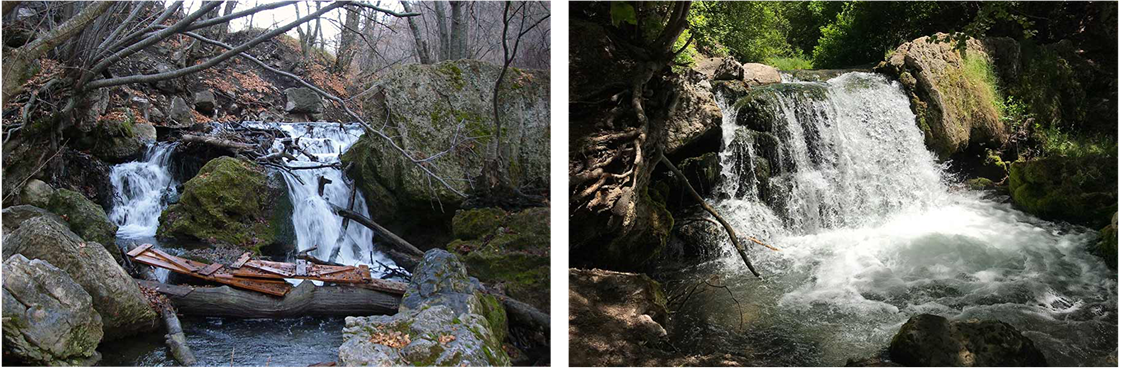
Photo from McKell, 2021, Utah Division of Wildlife, public domain
Summary
As society evolves, expands, and progresses, environmental impacts are inevitable and expected. This has allowed more sensitive species, such as the cutthroat trout, to dwindle in abundance. However, through careful research and conservation efforts, scientists are able to restore the habitats and populations of sensitive native organisms. Additionally, fishing and participating in events, such as the Utah Cutthroat Slam, engages the community in local fisheries science, conservation, and aquatic management. For non-anglers, maintaining good environmental stewardship is imperative to keeping Utah’s waters and surrounding habitat healthy for species like the native cutthroat trout. As the community connects with and understands the environment, we feel more accountable in caring for it and appreciating the organisms that call Utah’s streams home.
References
- Bengston, A. (2015, May 18). The cutthroat trout – a Utah native. Wild About Utah, Utah Public Radio. https://wildaboututah.org/the-cutthroat-trout-a-utah-native/
- Brunson, C. (2020). Evaluating the effect of the removal of non-native trout in two high elevation tributary streams in the Intermountain West (Publication No. 1471)[Master’s thesis, Utah State University]. Digital Commons. https://digitalcommons.usu.edu/cgi/viewcontent.cgi?article=2499&context=gradreports
- Budy, P. E., Walsworth, T., Thiede, G. P., Thompson, P. D., McKell, M. D., Holden, P. B., Chase, P. D., & Saunders, W. C. (2021). Resilient and rapid recovery of native trout after removal of a non-native trout. Conservation Science and Practice, 3, e325. https://doi.org/10.1111/csp2.325.
- Hepworth, D. K., Ottenbacher, M. J., & Berg, L. N., (1997). Distribution and abundance of native Bonneville cutthroat trout (Oncorhynchus clarki utah) in southwestern Utah. Great Basin Naturalist, 57(2), 11–20. https://scholarsarchive.byu.edu/gbn/vol57/iss1/2/
- McKell, M. (2021, January 14). Cutthroat trout conservation success. Utah Division of Wildlife. https://wildlife.utah.gov/index.php?option=com_content&view=article&id=1112&catid=37
- Shiozawa, D. K., Evans, R. P., Houston, D. D., & Unmack, P. J. (2018). Geographic variation, isolation, and evolution of cutthroat trout with comments on future directions for management and research. Cutthroat Trout Evolutionary Biology and Taxonomy, 129–172. Retrieved April 30, 2025, from https://www.researchgate.net/publication/328006594_Geographic_variation_isolation_and_evolution_of_cutthroat_trout_with_comments_on_future_directions_for_management_and_research
- Trout Unlimited. (2025). Where do I find native cutthroat trout in Utah? Utah Division of Wildlife Resources and Trout Unlimited. https://www.utahcutthroatslam.org/utah-native-cutthroat-trout/
- Utah Cutthroat Slam. (n.d.). Which cutthroat are native in Utah? https://www.utahcutthroatslam.org/
- Uthe, P. R. (2015). Life history characteristic and the effects of climate on growth of Yellowstone cutthroat trout in headwater basins [Master’s thesis, Montana State University]. ScholarWorks. https://scholarworks.montana.edu/server/api/core/bitstreams/0a224446-ff2a-4db8-a255-9cdcea146942/content

June 2025
Utah State University Extension
Peer-reviewed fact sheet
Authors
Hope Northagen, Sevier County Director; Ethan Gilliam, USU Extension Assistant Professor

Ethan Gilliam
Extension Assistant Professor | Agriculture and Natural Resources | BQA State Coordinator- UTAH | Sevier and Wayne County Director
Agriculture and Natural Resources