
Aphids
Green Peach Aphid
Description
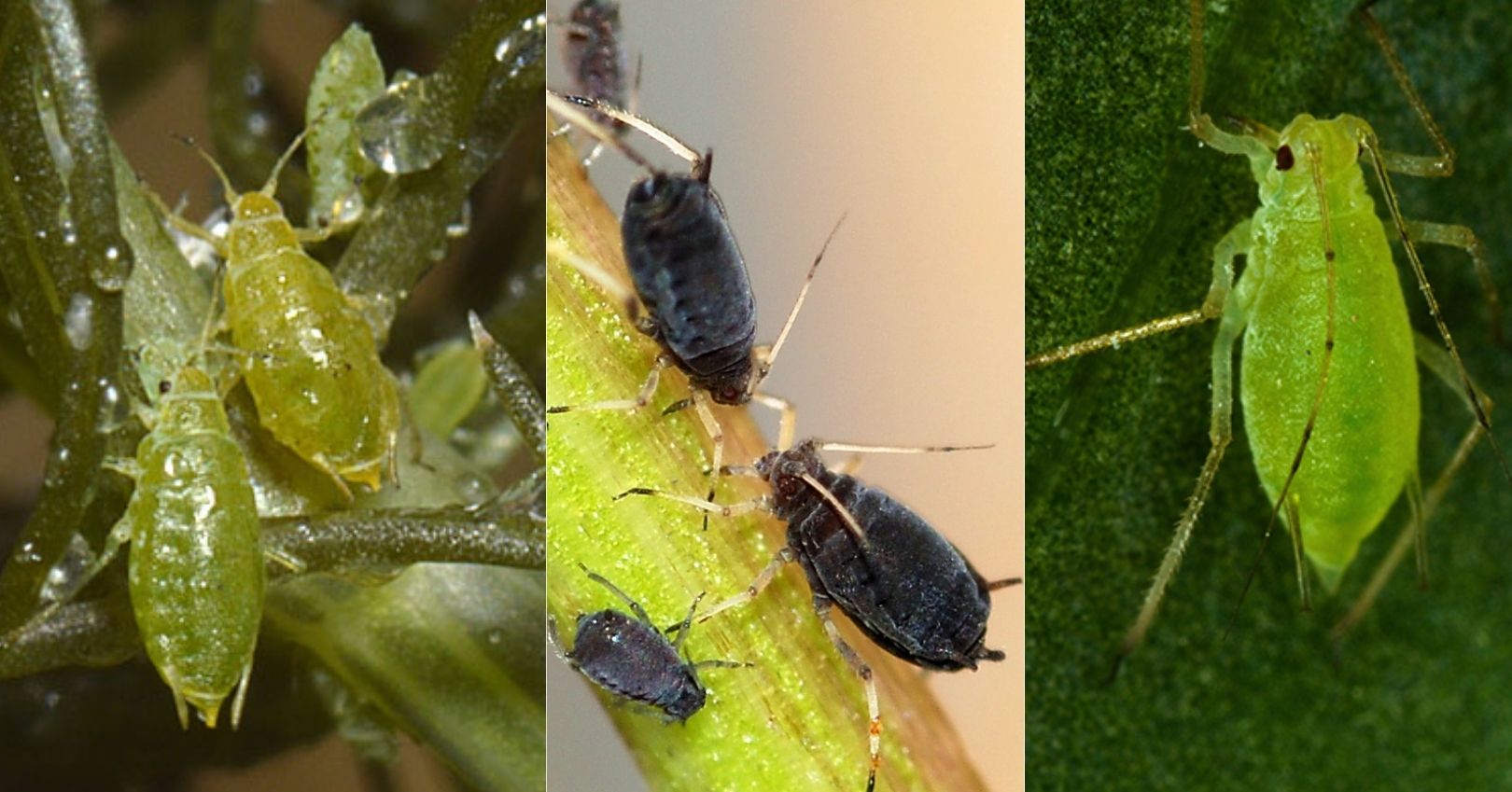
Adult: With soft, pear-shaped bodies and red eyes, adults have tailpipe-like appendages called cornicles on the rear of the body. Wingless adults are yellowish or greenish. The winged adult has a yellow-green abdomen, with a large dark patch on its back. It has a black head and thorax and is the same size as the wingless form. The oviparous (egg-laying) form is pinkish.
Egg: Eggs are initially yellow or green, eggs become shiny-black as they mature. Eggs measure about 0.5 mm long and 0.25 mm wide. Eggs are usually deposited near buds of Prunus spp. trees.
Nymph: Though similar in shape and color to the wingless adult, nymphs are smaller. Nymphs that develop into winged adults may be pinkish.
Life History
The green peach aphid overwinters as eggs at the base of buds in peach/nectarine trees. Green peach aphid populations peak on vegetable crops during July and early August.
Damage
One of the major concerns of aphids is their ability to transmit plant viruses. Over one hundred different viruses can be transmitted by adults as well as nymphs. Both persistent viruses, which move through the aphid’s feeding secretions, and non-persistent viruses, which are only temporary contaminants of aphid mouthparts, are effectively transmitted by aphids. Green peach aphids cause damage by transmitting plant viruses.
Willow-Carrot Aphid
Description
Adult: Wingless aphids are pale green with dark legs, cornicles, and cauda (tail structure). Compared to other aphids, they are medium in size and have elongated oval-shaped bodies. Winged forms have a black head and pale green abdomen with darker areas on each side.
Egg: Eggs are metallic black.
Nymph: A rusty color in spring and green in summer, nymphs measure up to 12 mm in length.
Life History
The willow-carrot aphid requires two hosts to complete its life cycle. It overwinters as eggs near buds of willow trees (Salix spp.). Eggs hatch in early spring, and new aphids feed on willow foliage for a few weeks. In early summer, winged aphids migrate to umbelliferous crops and weeds such as carrot, celeriac, celery, and parsnip, and feed until early fall. They then migrate back to willow trees, reproduce as males and females, mate, and lay eggs.
Damage
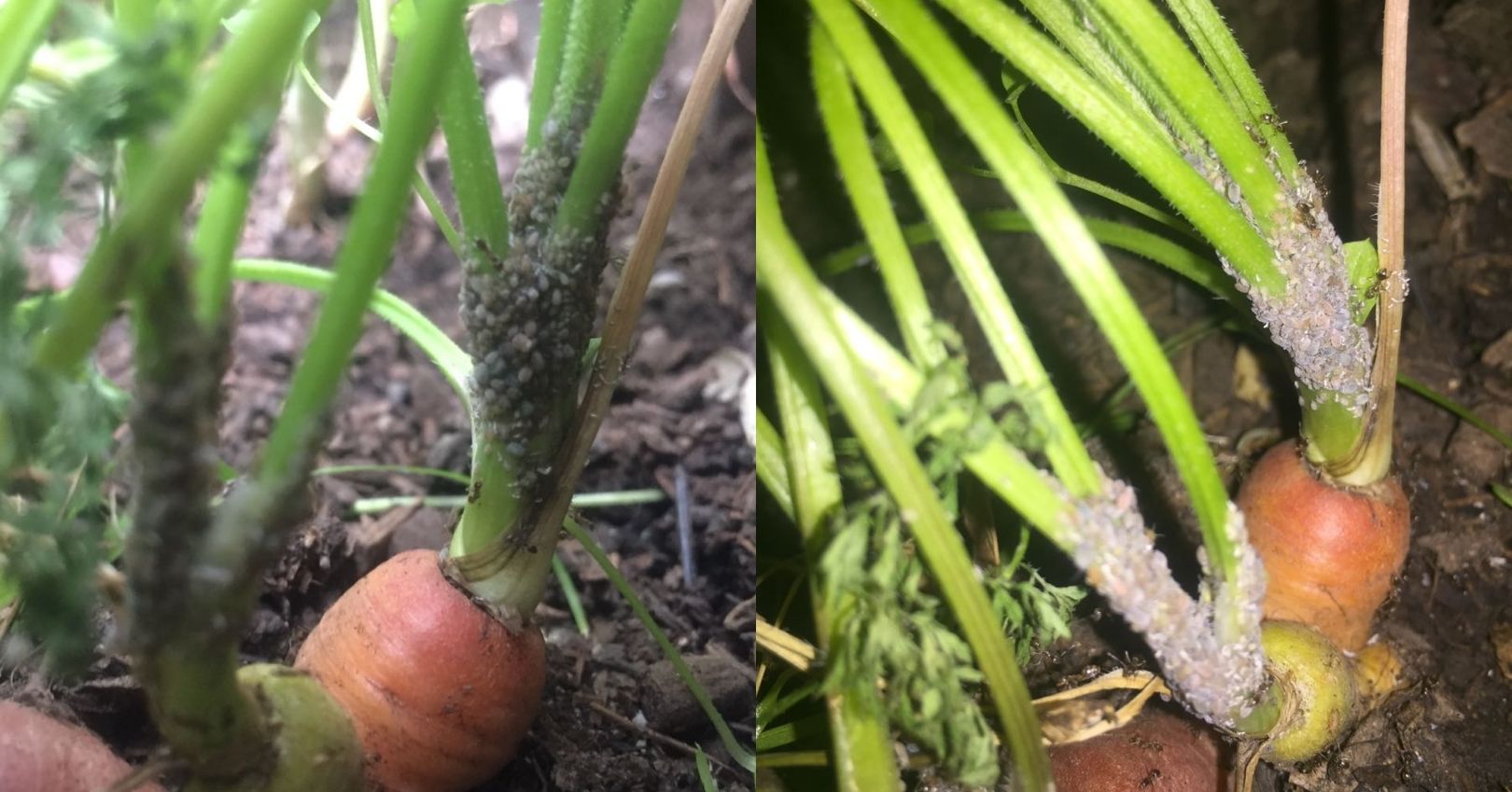
Willow-carrot aphids cause direct feeding damage on foliage, turning it yellow to red. As they feed, they excrete sticky honeydew that covers the plant. Willow-carrot aphids vector multiple viruses, such as parsnip yellow fleck virus, Anthriscus yellow virus, or carrot motley dwarf virus (none have been reported in Utah).
Bean Aphid
Description
Adult: Both winged and wingless forms are dark green-black. They have a dull matte appearance (not to be confused with the cowpea aphid, which are shiny).
Egg: Eggs are initially green, then turn to a metallic black.
Nymph: Nymphs are dark green, with four pairs of white stripes on the surface of the abdomen.
Life History
Bean aphids overwinter as eggs inside the cracks of bark and bud axils of Euonymus and Viburnum spp. Eggs hatch in early spring and produce one to two generations of wingless parthenogenetic females, followed by a generation of winged females which migrate to umbelliferous crops, such as carrot, celeriac, celery, parsnip or related weed species such as lambsquarter and curly dock. In early fall, bean aphids return to host shrubs to lay eggs for overwintering.
Damage
Many roots crops are affected by bean aphids. Feeding symptoms include curling and yellowing leaves. The bean aphid vectors multiple viruses to host plants, notably beet yellows virus.
Honeysuckle Aphid
Description
Adult: Wingless aphids are about 1 mm long, with a dark yellow head and gray-green antennae, legs, and cornicles. The body appears dusted with a white wax. Winged forms have a green abdomen with a darker green patch around the base of each cornicle.
Egg: Initially green, eggs eventually turn black. They are oval-shaped and less than half a millimeter.
Life History
Honeysuckle aphids overwinter as eggs on woody hosts in the Caprifoliaceae family (honeysuckle). During the summer months, honeysuckle aphids are found on both woody and herbaceous hosts, including carrot. Sexual forms of the aphids are found in all seasons.
Aphid Management
- Inspect transplants before field-planting. Prevent introducing new populations to a site.
- Remove weeds. Reduce the amount of umbelliferous weeds in and near the growing site, as they serve as alternative hosts.
- Avoid excessive fertilization. Aphid densities tend to be higher on vigorously growing plants that have received excess nitrogen.
- Foliage pruning. If the population is identified on a few leaves, they can be pruned out.
- Treat nearby woody hosts with horticultural oil at bud burst.