
Creating Sustainable School and Home Gardens: Misconceptions About Bees
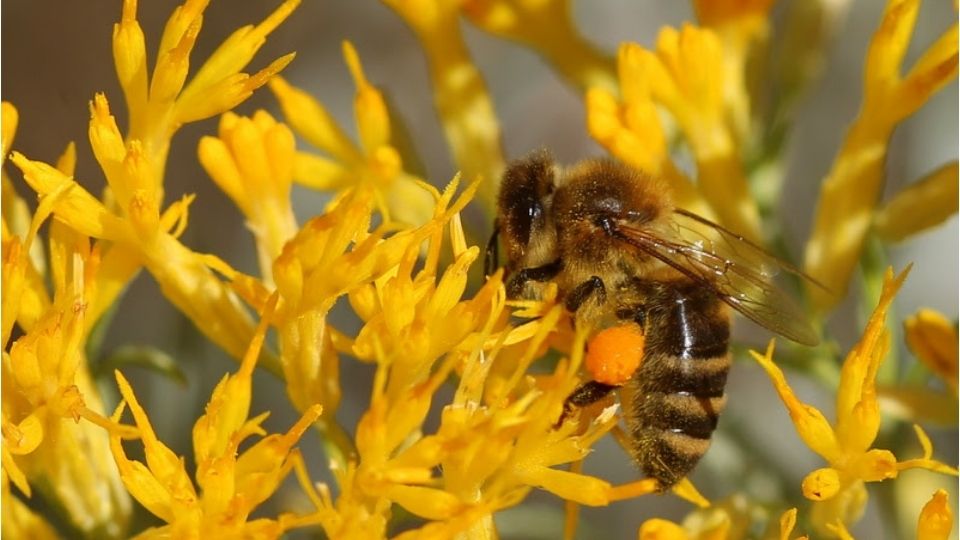
Bees are fascinating creatures that play a crucial role in pollination and ecosystem health. However, misconceptions about bees are widespread. Understanding the facts about bees helps us appreciate their significance and take appropriate action to protect them. Here are common myths and the truths behind the misconceptions about bees.
1. All bees make honey.
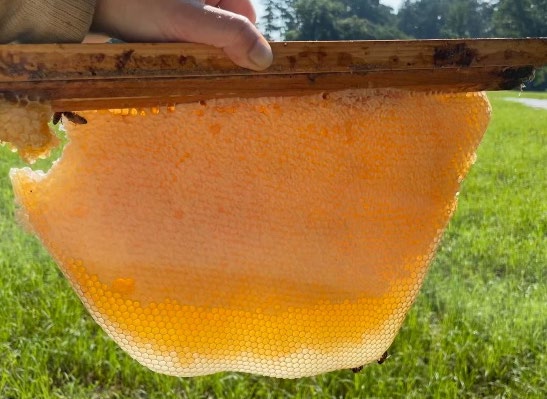
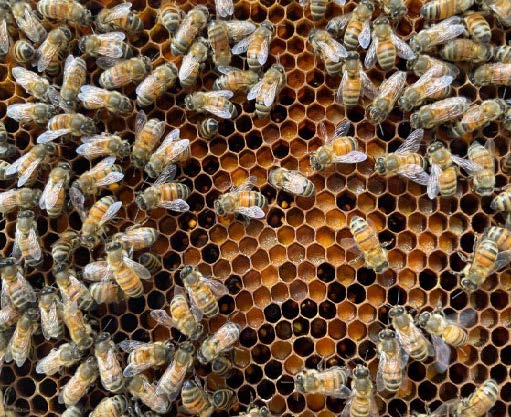
Not all bees are honey producers. Out of the approximately 3,600 bee species in the U.S., only the honey bee (Apis mellifera) makes honey (U.S. Geological Survey [USGS], 2025). Honey bees store honey (Figure 1) to survive harsh conditions, allowing their colonies to live for years. Most bees, such as solitary bees, do not create honey, though bumble bees can make small amounts.
2. Bees are aggressive.
Almost all bees can sting to protect themselves in life threatening situations or when provoked, but they are generally nonaggressive and tend to avoid conflict. Honey bees are more aggressive than most bee species because they have populous hives with lots of resources, like honey and developing larvae (i.e., baby bees), to protect. But even so, they tend to avoid conflict whenever possible.
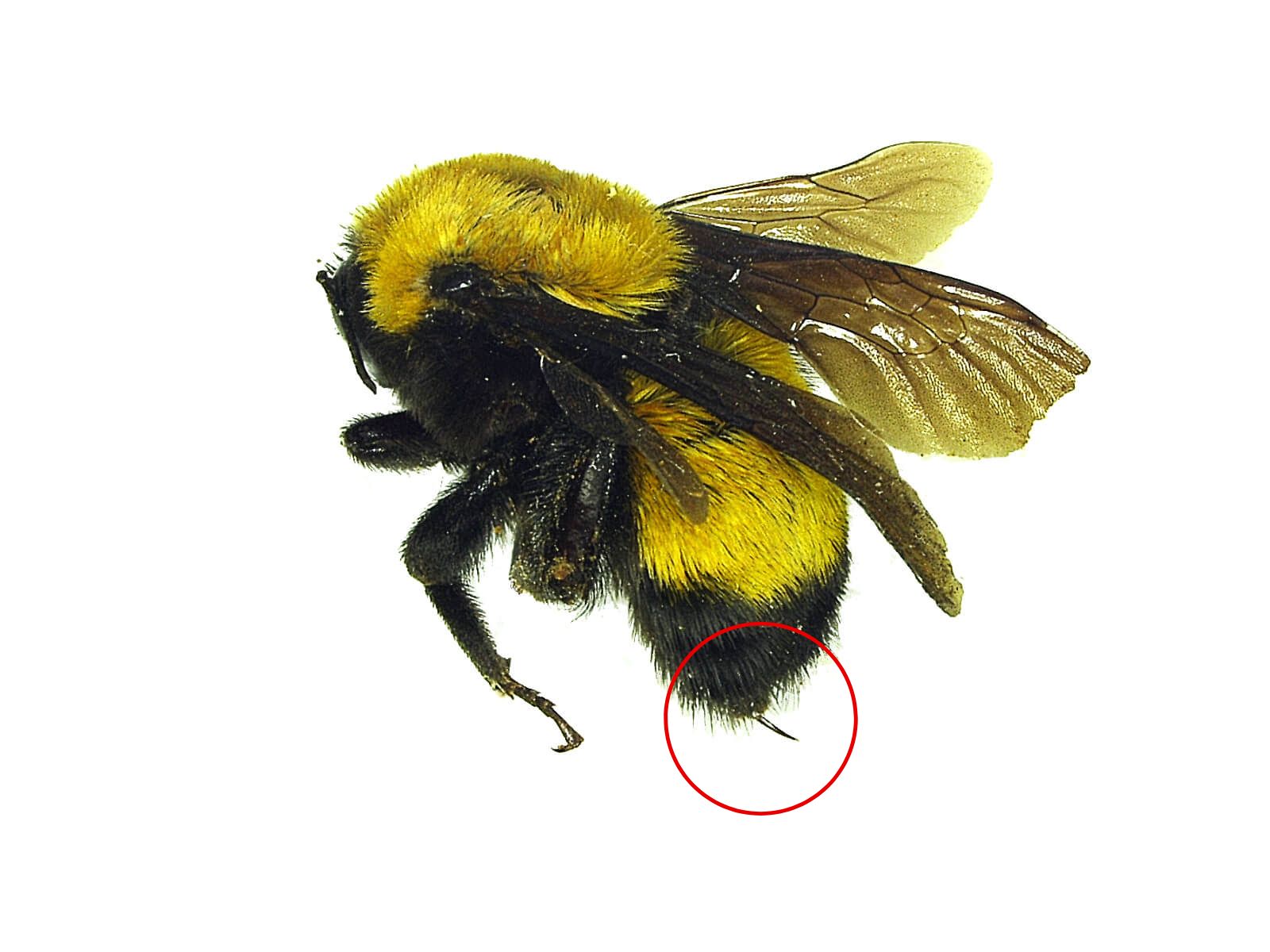
Photo credit: Joseph Wilson, Utah State University
3. Bees always sting.
Bees sting only when threatened. The stinger is a structure derived from the ovipositor (used for egg-laying) in female bees; therefore, the male bees cannot sting at all! (see Figure 2.) Additionally, stingless bees (Meliponini) are a type of tropical bee which no longer has a functional sting and will bite instead (Roubik, 2023).
4. Bees die after stinging.
This is true only for honey bee workers, whose barbed stingers get stuck in the skin of mammals. Queen bees, and all other bees, can sting multiple times without dying.
5. Honey bees are the best pollinators.
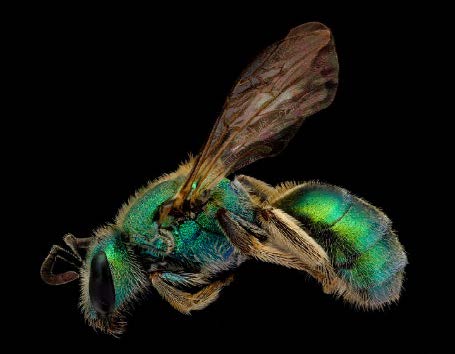
Photo credit: USGS Bee Lab (public domain)
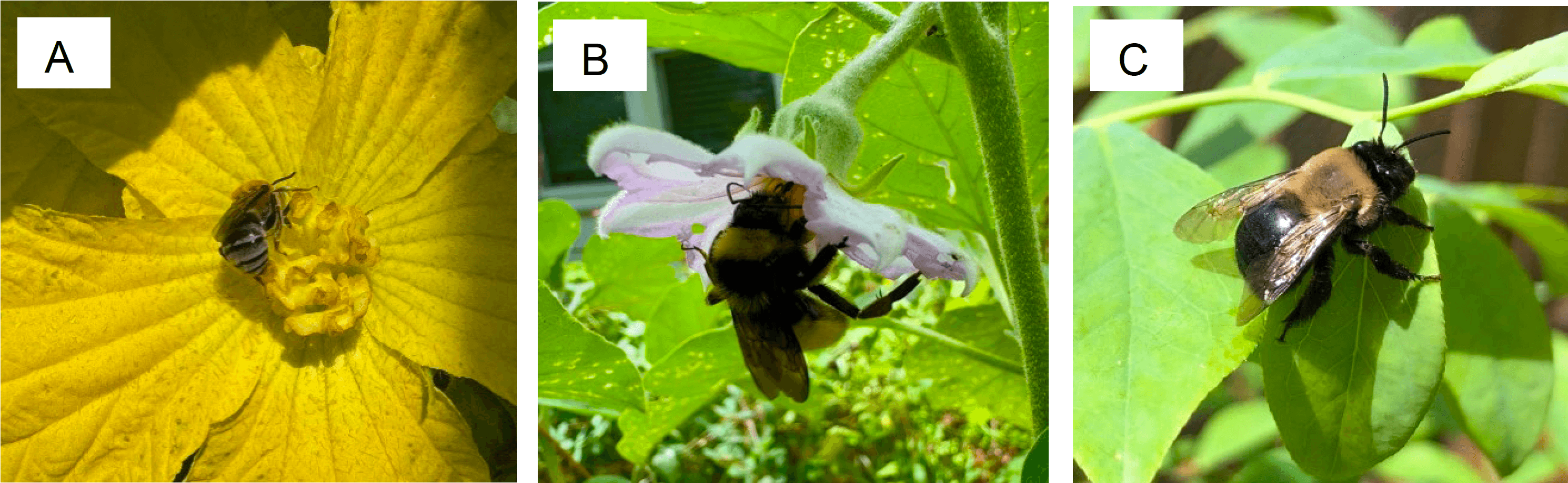
Honey bees, which are extremely important economically to industrialized food production systems, have large colonies that can be trucked around the country as needed to meet pollination demands. However, they are not the bestpollinators for many crops. For example, squashbees (e.g., Peponapis and Eucera) are specifically adapted to pollinate squash, pumpkins, and gourds (Figure 3A) and will even sleep inside the flowers at night. Bumble bees (Bombus sp.; Figure 3B) and southern blueberry bees (Habropoda laboriosa; Figure 3C) use buzzpollination, which efficiently releases pollen fromplants in the nightshade family (tomatoes, eggplants, potatoes) and blueberries.
6. Bees are all black and yellow.
While honey bees are often black and yellow, bees come in a variety of colors, including green, metallic blue, red, and orange (Droege, n.d.; Figure 4).
7. Bees live in hives.
Only honey bees live in hives (Figure 5). Most of the native bees in the U.S. nest in the soil, though some species like mason bees, leaf cutter bees, and carpenter bees use twigs or wood for their nests.

8. Bee hotels are harmful.
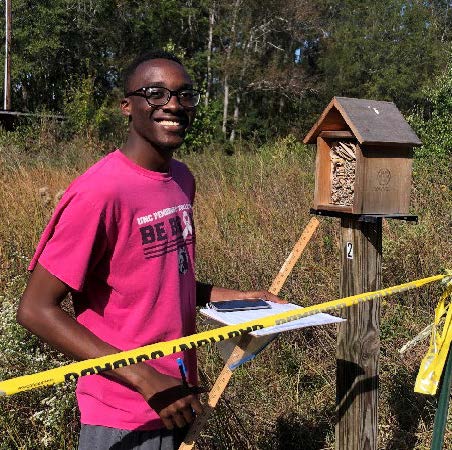
Properly designed bee hotels (i.e., native bee homes) can provide safe nesting spaces for many solitary bees (e.g., mason bees, leaf cutter bees, and resin bees), aiding conservation efforts. Bee hotels can become detrimental through the buildup of parasites and pathogens when they are not well cared for. Nesting material should be replaced frequently, and homes should be monitored for parasites (Youngsteadt & Favre, 2022; Mull et al., 2022; Figure 6).
9. Bees are only interested in flowers.
Although bees are vital pollinators, gathering pollen and nectar, they also seek water and resin, which they use to cool the hive and seal up the hive, respectively.
10. Wasps are just angry bees.
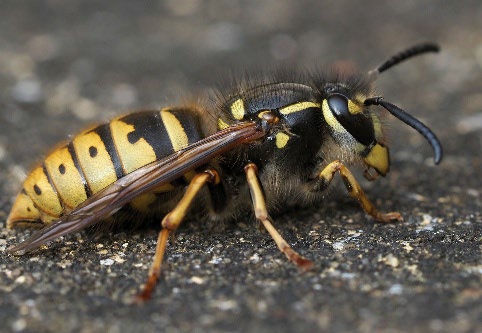
Photo credit: (c) bsteer (CC BY-NC)
Bees and wasps are distinct groups of organisms. Wasps are predatory, and social species such as paper wasps, yellow jackets and hornets, may be particularly aggressive, often giving bees a bad reputation. Wasps are important predators in the ecosystem, helping to control pests. Bees are typically focused on pollination and nectar collection and will not act aggressively unless they are harmed. Wasps are typically more slender and less fuzzy than bees (Pollinator Partnership, n.d.; Figure 7).
11. Honey bees are endangered. We should start hives to “save the bees.”
Honey bees (Apis mellifera) are not endangered. In the U.S., honey bees are an introduced, non-native species with over 2.7 million hives (U.S. Department of Agriculture, 2024; Figure 8). While honey bees undergo substantial losses due to parasites, pathogens, and other stressors, keeping honey bees is not recommended as a means to help pollinators. Remember, honey bees in the U.S. are only one species of bee! Instead, consider improving pollinator habitats to support native bees like threatened bumble bee species (Hatfield & Shepherd, 2025; Xerces Society for Invertebrate Conservation, n.d.). You can improve pollinator habitat by planting native wildflowers that bloom in the spring, summer, and fall.
12. Everyone would die if bees went extinct.
Bees are very important to agriculture, particularly for fruit production. The quote “If the bee disappeared off the surface of the globe, then man would only have four years of life left” is often attributed to Albert Einstein. However, there is no evidence to support the attribution or statement (Quote Investigator, 2013). Many parties have attempted to gauge the extent to which our crops are dependent on pollinators, and the studies have demonstrated that there would be a yield loss, but not a complete collapse (Aizen et al., 2009; Aizen et. al., 2019; Ritchie et al., 2021). Those in agriculture will need to prioritize management practices that preserve pollinator biodiversity to promote high yields in the face of declining pollinator populations (Aizen et. al., 2019; Ritchie et al., 2021).
Resources
- Aizen, M. A. Aguiar, S., Biesmeijer, J. C., Garibaldi, L. A., Inouye, D. W., Jung, C., Martins, D. J., Medel, R., Morales, C. L., Ngo, H., Pauw, A., Paxton, R. J., Sáiz, A., & Seymour, C. L. (2019). Global agricultural productivity is threatened by increasing pollinator dependence without a parallel increase in crop diversification. Global Change Biology, 25, 3516–3527.
- Aizen, M. A., Garibaldi, L. A., Cunningham, S. A., & Klein, A. M. (2009). How much does agriculture depend on pollinators? Lessons from long-term trends in crop production. Annals of Botany, 103, 1579–1588. https://doi.org/10.1093/aob/mcp076
- Droege, S. (n.d.). USGS bee lab. Photostream - Flickr, and U.S. Geological Survey. https://www.flickr.com/photos/usgsbiml/
- Hatfield, R., & Shepherd, M. (2025). Want to save the bees? Focus on habitat, not honey bees. Xerces Society for Invertebrate Conservation. https://xerces.org/blog/want-to-save-bees-focus-on-habitat-not-honey-bees
- Mull, A., Spears, L., Hansen, S., Walker, A., Ramirez, R., & Gunnell, J. (2022). Making and managing wild bee hotels [Fact sheet]. Utah State University Extension. https://extension.usu.edu/planthealth/research/making-and-managing-wild-bee-hotels
- Pollinator Partnership. (n.d.) Bees vs. wasps. https://www.pollinator.org/bees-vs-wasps
- Quote Investigator. (2013). Quote origin: If the bee disappeared off the face of the earth, man would only have four years left to live. https://quoteinvestigator.com/2013/08/27/einstein-bees/https://onlinelibrary.wiley.com/doi/10.1111/gcb.14736
- Ritchie, H. (2021). How much of the world’s food production is dependent on pollinators? Our World in Data. https://ourworldindata.org/pollinator-dependence
- Roubik, D. W. (2023). Stingless bee (Apidae: Apinae: Meliponini) ecology. Annual Review of Entomology, 68, 231–256. https://doi.org/10.1146/annurev-ento-120120-103938
- U.S. Department of Agriculture. (2024). Southern region news release honeybee colonies. https://www.nass.usda.gov/Statistics_by_State/Regional_Office/Southern/includes/Publications/Livestock_Releases/Bee_and_Honey/2024/BEECOL2024.pdf
- U.S. Geological Survey. (2025). How many species of native bees are in the United States? U.S. Department of the Interior. https://www.usgs.gov/faqs/how-many-species-native-bees-are-united-states
- Youngsteadt, E. & Favre, M. (2022). How to manage a successful bee hotel [Fact sheet]. North Carolina State University Extension. https://content.ces.ncsu.edu/how-to-manage-a-successful-bee-hotel
- Xerces Society for Invertebrate Conservation. (n.d.) At-risk bumblebees. https://xerces.org/endangered-species/species-profiles/at-risk-bumble-bees
Acknowledgments
Smart Foodscapes (usu.edu/smart-foodscapes)
Scan the QR code to learn more.

USDA – National Institute of Food and Agriculture (NIFA) – Sustainable Agricultural Systems (SAS)
Grant #2021-69012-35952
Kaitlin Campbell provided the photos in this fact sheet, unless otherwise specified.
January 2026
Utah State University Extension
Authors
Kaitlin U. Campbell, Kathy Cabe Trundle, and Rita Hagevik
Related Research