
Low Impact Development in Utah
Low impact development (LID) is a method of developing urban areas to manage and treat stormwater on-site. The goal of LID (also commonly referred to as green stormwater infrastructure) is to divert runoff from entering storm sewers by catching runoff from impervious surfaces such as sidewalks, roads, and buildings to slow down the flow and allow runoff to soak into the ground. On-site management of stormwater runoff provides many ecological and social benefits, including flood mitigation, water quality improvement, water conservation, neighborhood greening, biodiversity, and urban cooling.
LID typically incorporates natural elements, including native plants and soils, to provide natural treatment of stormwater.
However, not all LID relies on these elements. Porous pavement and rain barrels are examples of LID that reduce stormwater runoff from urban surfaces but do not have plants in their designs. Porous pavement uses engineered paving materials on top of soils to absorb stormwater runoff, and rain barrels can be used to collect runoff from buildings.
Because of Utah’s semi-arid climate, it is important that LID in the state is designed to suit our unique environment to achieve long term success. With very hot, dry summers and cold, snowy winters in Utah, plants selected for LID must be drought tolerant, cold-hardy, and low maintenance. Native vegetation is well suited for LID as it is adapted to Utah’s harsh climate and can survive through the extreme seasons. Freeze-thaw cycles are another important consideration for LID designs in Utah, since many types of LID use a combination of hard materials, such as concrete and pavement, and natural elements, such as soils and plants. There are many types of LID that are well-suited for Utah’s environment, including green roofs, rain gardens, bioretention, retention ponds, porous pavement, and rainwater harvesting.
Green roofs, also referred to as eco-roofs or living roofs, are a layered system of engineered membranes, soil, and vegetation installed on flat or slightly sloped roofs. Green roofs allow stormwater to soak into the soil layers, reducing the runoff from the roofs of buildings. Any stormwater that does drain off the roof is filtered by the soil and plants.
Green roof benefits:
- Reduces and treats stormwater runoff from buildings
- Reduces the urban heat island effect
- Lowers building energy costs by providing insulation
- Extends roof life by protecting roofing materials from solar exposure
- Provides habitat for wildlife such as insects, birds, and pollinators
- Offers recreational opportunities with walkways, seating, and unparalleled views of the landscape
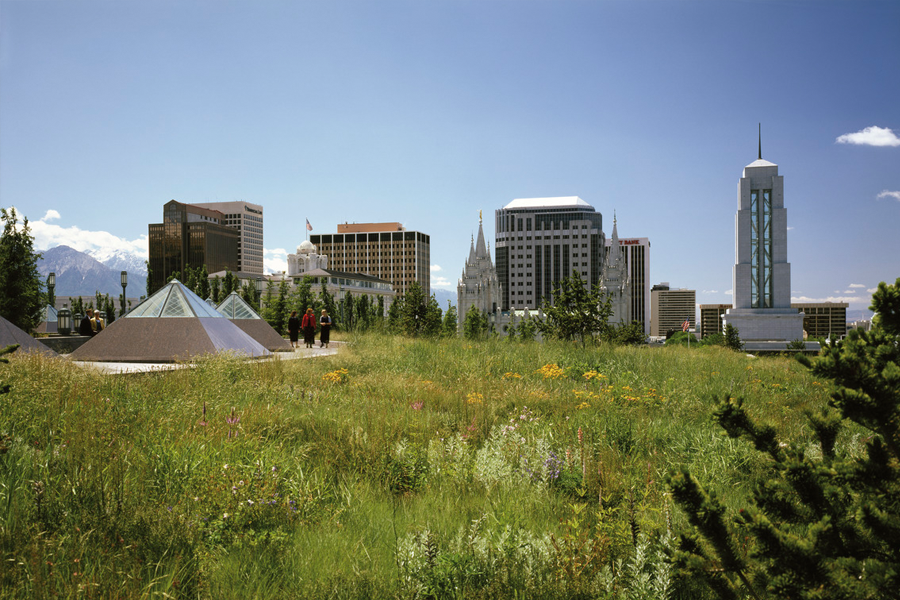
Image is the green roof atop the Church of Jesus Christ of Latter-Day Saints Conference Center in Salt Lake City, Utah. Photo courtesy of Olin Labs.
Rain gardens are depressions in the ground that collect rain and stormwater runoff from roofs, driveways, and roads and allow it to infiltrate into the ground. Rain gardens typically use existing soils at the site and are planted with grasses, perennials, shrubs, and trees.
Rain Garden benefits:
- Reduces and treats stormwater runoff from the surrounding area
- Native, drought tolerant plants in rain gardens typically require little to no maintenance once established
- Provides shade and local cooling effects
- Neighborhood greening and aesthetic benefits
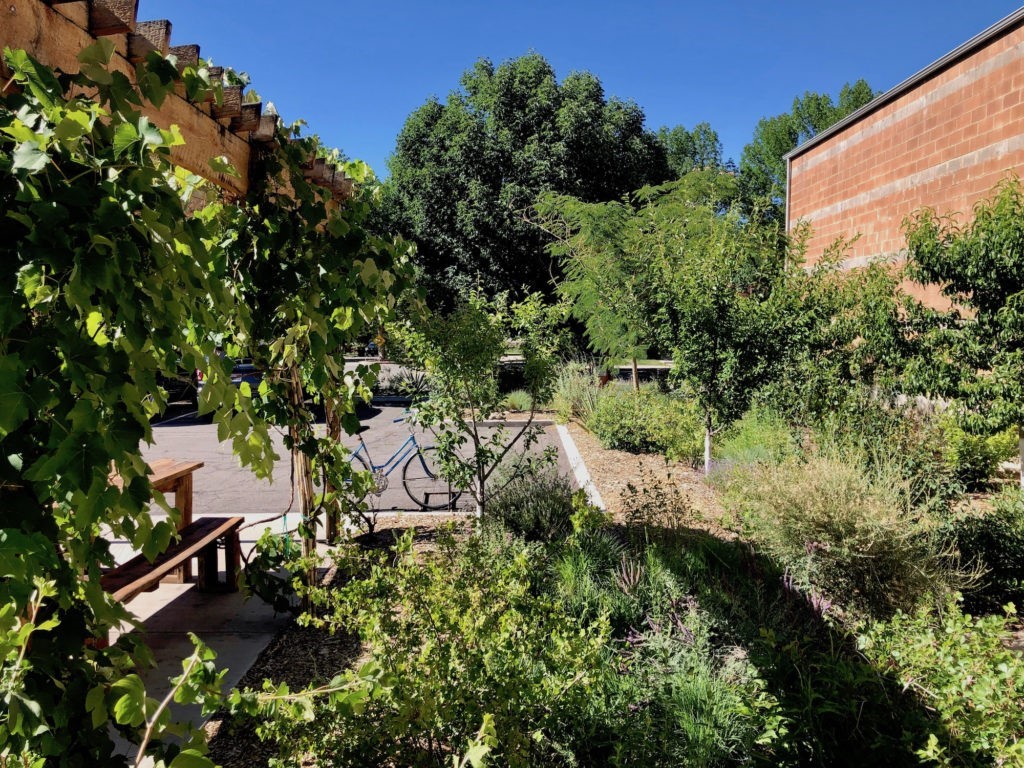
Image is of North Rain Garden on USU Moab Campus in Moab, Utah. Image courtesy of Dr. Roslynn McCann.
Bioretention systems are one of the most commonly used types of LID. Bioretention systems are comprised of an engineered soil, vegetation, and drainage system that is lower than the height of the surrounding pavement and bordered by concrete curbs to collect, store, and filter large volumes of runoff from the surrounding area. Bioretention systems are typically installed along roadsides, sidewalks, and in parking lots. Bioretention systems may or may not provide complete infiltration of runoff depending on the underlying hydrology. If soils do not drain quickly, some systems may be designed with underdrains that direct water that has filtered through the vegetated soils into the storm sewer system. Bioretention systems may be referred to by many names, including stormwater planters, bioswales, or curb extensions.
Bioretention benefits:
- Reduces and treats stormwater runoff from the surrounding area
- Can be integrated into densely developed urban settings
- Increases biodiversity and habitat in urban areas
- Increases green space in developed areas, providing aesthetic benefits to communities
- Can be designed to provide traffic calming in residential areas
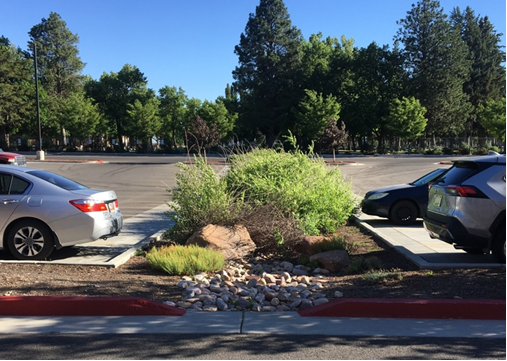
Image is of bioretention system on Utah State University campus in Logan, Utah. Image courtesy of Lilian Taft.
Retention and detention ponds provide the most storage capacity among the various types of LID. These systems are large basins that collect runoff from large areas, such as neighborhoods, large parking lots, and roads. Detention ponds generally fully infiltrate runoff and dry out between storm events whereas retention ponds retain consistent amounts of water and have outlet structures that release water once the pond reaches a certain level. Retention ponds may feature vegetation around the perimeter of the water, whereas detention ponds are typically fully vegetated since they are not permanently flooded.
Retention and detention pond benefits:
- Reduces and treats stormwater runoff from the surrounding area
- Can hold high volumes of runoff from large areas
- Prevents flooding risks during high rainfall events
- Detention ponds can be multi-functional during dry periods, offering habit and/or recreational space
- Can provide storage for plowed snow during winter months

Image is of a dry detention pond that doubles as a recreational field during dry periods in Bluffdale, Utah. Image courtesy of City of Bluffdale.

Image is of the Kaysville retention ponds at the Botanical Center in Kaysville, Utah. Image courtesy of USU Extension.