
Thousand Cankers Disease of Walnut (Geosmithia morbida)

Fig. 1. Walnut twig beetle (Pityophthorus juglandis).
Introduction
- Thousand cankers disease is caused by the fungus Geosmithia morbida.
- It is transmitted by the walnut twig beetle (Pityophthorus juglandis).
- Once symptoms are visible, trees can die within two to three years.
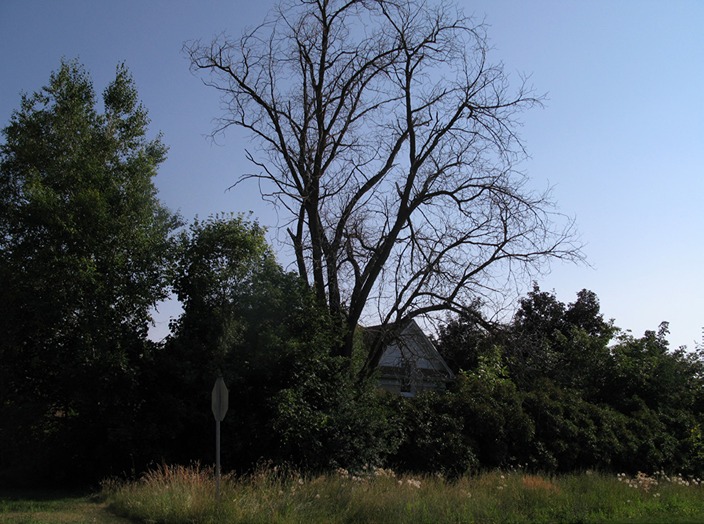
Thousand cankers is a disease of walnuts, caused by a fungus (Geosmithia morbida) that is spread by the walnut twig beetle (Pityophthorus juglandis, Fig. 1). The beetle is endemic to the native range of Arizona walnut (Arizona, New Mexico, and Chihuahua, Mexico), and was first identified in Utah in 1988. Widespread black walnut mortality in the early 2000s in Colorado and Utah led to the discovery of the pathogen-vector complex. The name of the disease comes from the numerous necrotic lesions (cankers, Fig. 4) found on the cambium of infected trees (Tisserat et al., 2009). The fungus kills black walnut trees (Fig. 2), often within three years of developing the first symptoms (Cranshaw and Tisserat, 2008).
Hosts
Black walnut (Juglans nigra) and black walnut hybrids are very susceptible to Geosmithia. California walnut (J. hindsii, J. californica) and Persian walnuts (J. regia) are slightly susceptible. Cankers do not seem to form on Arizona walnuts (J. major) (Cranshaw and Tisserat, 2008).
Symptoms
It may take several years of insect and fungal attack before symptoms are visible, starting with yellowing leaves on affected branches, and thinning tree crown. As the disease progresses, foliage wilts, larger branches die, and eventually the tree dies (Fig. 2) (Tisserat et al., 2009). Minute exit holes caused by the twig beetle can be found on branches and the main trunk (Fig. 3).
Walnut Twig Beetle - Vector

The walnut twig beetle (Pityophthorus juglandis) (Fig. 1) is a minute beetle (size of a grain of rice). Its life cycle is not fully understood, but it is believed to have two or more generations (Cranshaw and Tiseratt, 2008). Adult beetles fly from April-October to walnut hosts and bore into the trunk and branches over 3/4 inch in diameter to feed and lay eggs. They do not feed on small twigs as the name implies. Larvae then tunnel within the cambium where they feed until pupation. Emerging adults carry fungal spores of Geosmithia to other trees (Tisserat et al., 2009).
Disease Cycle
The walnut twig beetle adults carry and deposit spores of the fungus in the cambium during egg-laying. Geosmithia then colonizes and kills the cambium and phloem tissue surrounding the larval feeding gallery. Cankers form around every twig beetle feeding site, resulting in thousands of small cankers that coalesce to several large ones, which eventually leads to tree death.
Management

Once the fungus has colonized the host tissue, management is difficult. The best strategy in Utah is to prevent introduction of the beetle and the fungus to areas where it does not already occur through early detection, prevent moving infested firewood, and timely destruction of infested trees (Frank and Bambara, 2010). Some tree care professionals have applied injections of emamectin benzoate plus propiconazole (TREE-äge G4, Propizol) in spring and found some success when used to protect healthy trees or on trees that have had not shown dieback (but borer holes are visible). Where dieback has started, the fungus has likely colonized too much of the tree for systemic pesticides to prevent further progress of the disease (Frank and Bambara, 2010).
References
- Cranshaw, W., & Tisserat, N. (2008). Pest alert: Walnut twig beetle and thousand cankers disease of black walnut. Colorado State University.
- Frank, S., & Bambara, S. (2010). Walnut twig beetle and thousand cankers disease in NC. North Carolina State University Extension.
- Tisserat, N., Cranshaw, W., Leatherman, D., Utley, C., & Alexander, K. (2009). Black walnut mortality in Colorado caused by the walnut twig beetle and thousand cankers disease. Plant Health Progress.
May 2025
Utah State University Extension
Authors
Claudia Nischwitz,Extension Plant Pathologist; Marion Murray, Extension IPM Specialist

Claudia Nischwitz
Plant Pathology Specialist
Biology Dept

Marion (Mair) Murray
IPM Specialist | Professional Practice Extension Professor
Extension Specialist in the Biology Department