
Integrated Pest Management
Honeylocust Plant Bug
Diaphnocoris chlorionus
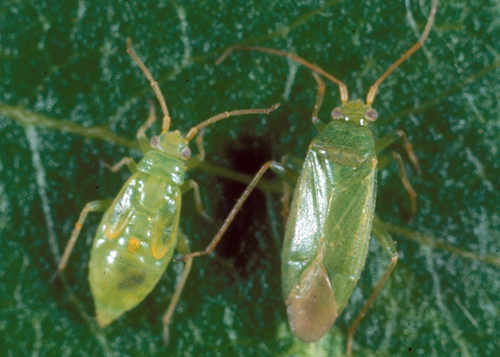
Honeylocust plant bugs (Daniel Herms, The Ohio State University, Bugwood.org)

Honeylocust plant bug nymph (Whitney Cranshaw, Colorado State University, Bugwood.org)

Honeylocust plant bug damage (Whitney Cranshaw, Colorado State University, Bugwood.org)
Pest Description
- adults: ~ 3/16 inch; pale green; highly mobile
- nymphs: smaller than adults; do not have wings, and have an orange spot on the back
- eggs: oblong and white in color
Host Plants, Diet & Damage
- honeylocust
- feed on sap of honeylocust leaves and buds with straw-like mouthparts
- white stippling on top of leaves; wilting, chlorotic, dwarfing, curling, bent and drying leaves
- dead leaf tissue will fall out of leaves when expanded causing irregular holes in leaves
- heavy damage can kill small branches and inhibit leaf development
- most damage occurs on young foliage in late-May and June
Biology, Life Cycle & Damaging Life Stage
- overwinter as eggs inserted into bark of twigs and branches
- egg hatch begins in May at the time of vegetative budbreak
- mate in late-May or June and lay overwintering eggs
- nymphs and adults disappear in July
- one generation per year
- nymphs and adults are the damaging stages
IPM Recommendations
- Manage trees to improve or maintain health.
- Damage is mostly aesthetic, especially on larger trees.
- Plant resistant cultivars.
- Young or nursery trees may require control.
- Begin monitoring prior to budbreak.
- Apply an insecticide (carbamate; pyrethroid; horticultural oils; insecticidal soap) just after budbreak.