
Integrated Pest Management
Honeylocust Spider Mite
Platytetranychus multidigituli
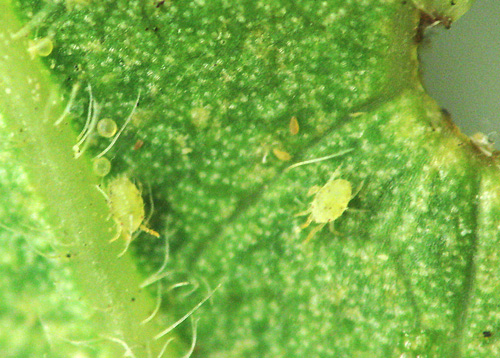
Honeylocust spider mites (Utah State University Extension)

Overwintering female honeylocust spider mites (Whitney Cranshaw, Colorado State University, Bugwood.org)

Yellowing of leaves caused by honeylocust spider mites (Whitney Cranshaw, Colorado State University, Bugwood.org)
Pest Description
- adults: very tiny, ~ 1/80 – 1/60 inch; pale green to yellowish green
- immatures: smaller and pale green
- eggs: smaller than adults and greenish
Host Plants, Diet & Damage
- honeylocust
- feed on undersides of leaves typically near the mid-rib
- stippling causes yellowing of leaves and canopy
- most damage caused by mid-summer
- may cause premature leaf drop in late summer
Biology, Life Cycle & Damaging Life Stage
- overwinter as orange-colored females on or under bark or bud scales
- adults become active around budbreak
- eggs are laid on leaves and hatch around early-June
- one generation can occur every week to 2 weeks
- prefer hot, dry weather
- populations build through July and decline in August
- can disperse via wind
- overlapping life stages present in late spring throughout the growing season; many generations per year
- immatures and adults are the damaging stages
IPM Recommendations
- Manage trees to improve or maintain health.
- Monitor spider mite populations on host plants with a “paper test” starting after budbreak. To conduct the test, hold a white sheet of paper under affected branches and shake vigorously. Tiny specks moving around on the paper indicate the presence of mites.
- Preserve beneficial mites and organisms.
- Apply a dormant oil to target overwintering adults. Apply an insecticide/acaricide (dicofol; horticultural oil; insecticidal soap; METI acaracide; organotin miticide; pyrethroid) when mites are present on leaves.