
Integrated Pest Management
Cooley Spruce Gall Adelgid
Adelges cooleyi
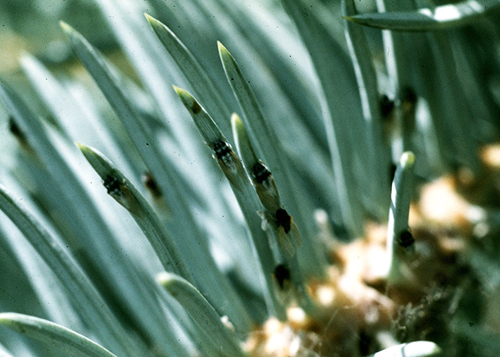
Winged adults (Whitney Cranshaw, Colorado State University, Bugwood.org)

Cooley spruce gall adelgid infestation (Petr Kapitola, Central Institute for Supervising and Testing in Agriculture, Bugwood.org)

Galls on spruce branches, typical of Cooley spruce gall adelgid infestation (Whitney Cranshaw, Colorado State University, Bugwood.org)
Pest Description
- small; early stages may be 1/20 inch long
- aphid-like appearance
- produce white, cottony egg masses on spruce twigs
- most visible inside of 2–3 inch pinecone-looking galls
- galls are green in the spring and turn brown in summer
Host Plants, Diet & Damage
- spruce (primary host) and Douglas-fir (alternate host)
- feed on plant sap; cause large, 2–3 inch long galls on spruce
- stipple and bend needles on Douglas-fir
- damage primarily aesthetic
- damage is rarely a threat to tree health
Biology, Life Cycle & Damaging Life Stage
- overwinter as adult females or nymphs on spruce bark or beneath spruce buds
- in spring, eggs are laid near new buds and hatch around budbreak
- nymphs feed on sap at the base of needles, forming galls
- galls protect insects from foliar pesticide applications
- in mid-summer, nymphs exit galls and fly to Douglas-fir
- multiple generations occur on Douglas-fir before some adelgids return to spruce
- some adelgids overwinter on Douglas-fir
IPM Recommendations
- The Cooley spruce gall adelgid has little negative effect on tree health; tolerate pest.
- Some spruce trees are more resistant than others.
- Do not plant spruce and Douglas-fir close together.
- Apply horticultural oil before budbreak (warning: oils may discolor spruce needles).
- Apply cover spray (carbamate or pyrethroid) before budbreak.
- Apply a systemic insecticide (neonicitinoid) in the spring.