
Integrated Pest Management
Boxelder Leafroller
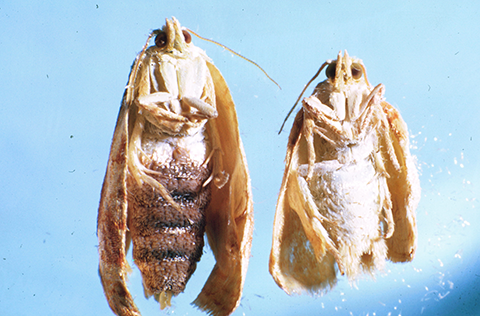 Female (left) and male (right) boxelder leafroller moths. (U.S. Department of Agriculture Forest Service, Bugwood.org)
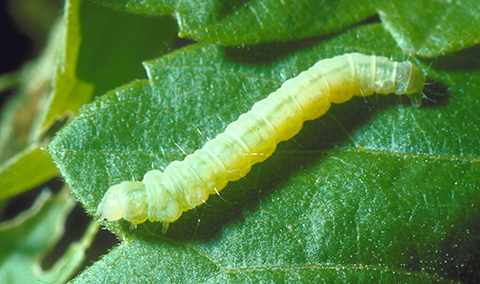 Boxelder leafroller larva. (Bill Klein, USDA Forest Service, Bugwood.org)
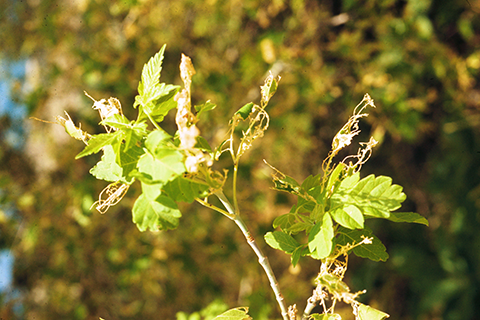 Boxelder leafroller damage.(U.S. Department of Agriculture Forest Service, Bugwood.org)
HOSTS
- Birch
- Boxelder
- Elderberry
- Elm
- Raspberry
- Various ornamental shrubs
DESCRIPTION
The boxelder leafroller (Archips negundana) is a native caterpillar that primarily feeds on boxelder leaves. Adults are buff-colored moths with wing spans of about 1 inch. Males are slightly smaller than females. Mature larvae are green and nearly 1 inch long.
BIOLOGY
The leafroller spends winter as eggs in cracks and crevices on its host plant. Eggs hatch soon after budbreak, and young larvae crawl to developing leaves, feeding in small groups. As larvae mature, they disperse and feed individually within leaves they have rolled with webbing. The larvae pupate within the rolled leaves or bark crevices, taking approximately 2 weeks. Moths may be present from late June through July in northern Utah, mating and laying eggs for overwintering. There is one generation per year.
SYMPTOMS
- Leaf Damage - young larvae create webs along leaf folds and veins, consuming tissue between the veins
- Rolled Leaves - mature larvae roll individual leaves and may web several leaves together
- Defoliation - heavy infestations can lead to complete defoliation by early to midsummer. Fortunately, boxelder trees can produce a second set of leaves if the first set is removed
MANAGEMENT
Control measures are rarely needed due to the leafroller’s low populations each year. Damage is worse in native mountain habitats. If necessary, an organic spray of Bacillus thuringiensis (Bt) soon after egg hatch is effective. There are many brands of products that contain the ingredient, Bt.