
Integrated Pest Management
Western Flower Thrips
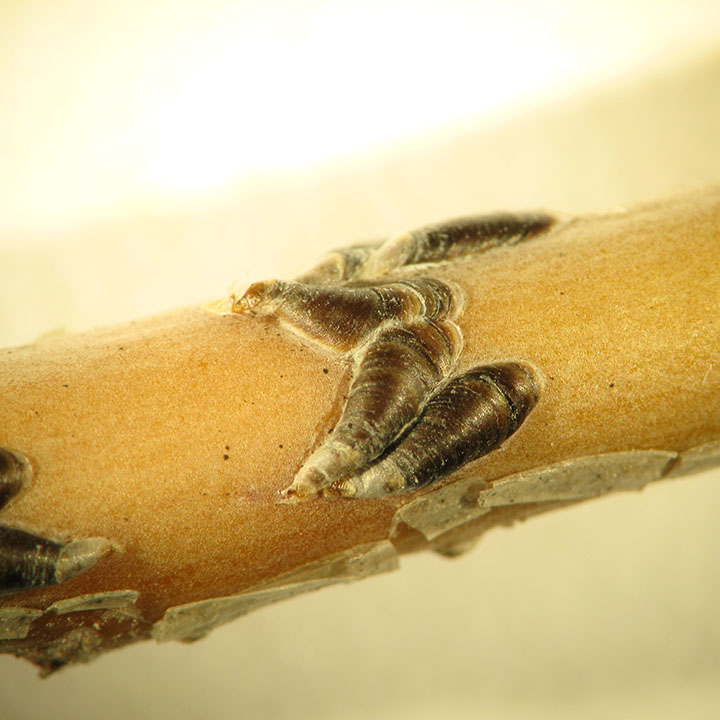 Oystershell scale on willow branch.
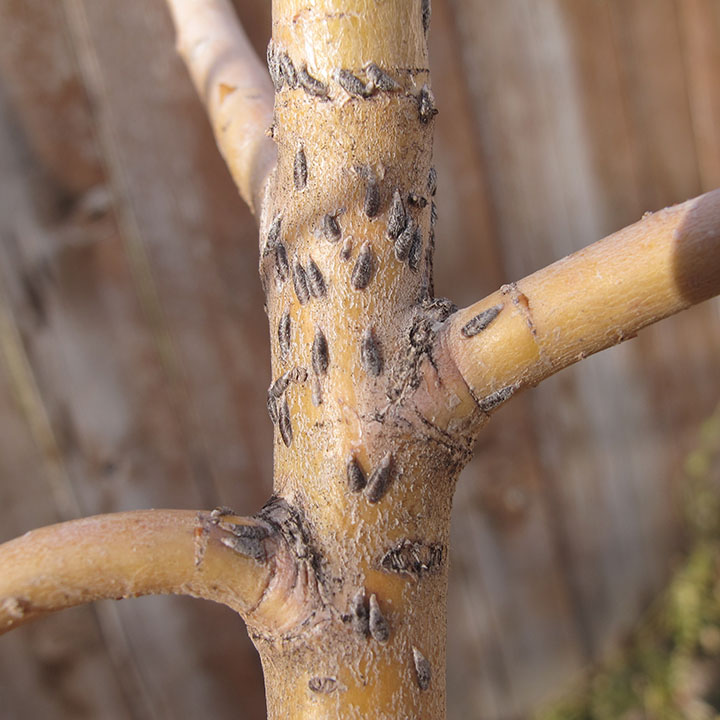 Oystershell scale on willow.
HOSTS
- Apple
- Plum
- Peach/Nectarine
- Grapes
- Pistachio
- Strawberry
- Tomato
- Many field crops (eg. Alfalfa and Corn)
- Weeds
DESCRIPTION
This species feeds on hundreds of different weed and crop hosts. Western Flower Thrips (WFT) populations can rapidly increase during fruit bloom and are especially abundant in the warmer areas of the Mountain West. Adults feed on blossoms, fruits, and pollen primarily from pink through the young fruitlet stage.
WFT feed on plant tissues as well as pollen. They feed by a “punch and suck” method, whereby they push their mouth cone into plant tissue or pollen, and then suck the contents through their straw-like stylets.
BIOLOGY
Bodies of adult WFT are tubular in shape; females are about 1/25 of an inch (1 mm) long, and males about one-third smaller; females have many color forms varying from pale yellow to dark brown; males are light yellow; wings are fringed on the margins and are clear to yellow in color.
Eggs are laid into leaf, bud, and floral tissues during bloom and early fruit set, and can only be seen with the aid of a microscope; egg-laying damage is visible in young fruitlets.
Larvae begin to hatch from eggs within 4 to 15 days after adults move into blossoms and are found throughout the bloom period; larval development requires 2 to 3 weeks. Although very mobile, larvae will remain in the blossom clusters (all stages of blossom development) while pollen is available.
SYMPTOMS
Damage from thrips on fruits often results in scars from oviposition while fruits are young. As fruits enlarge, scaring results in russeting and netting. Strawberries become deformed thrips feeding and oviposition on flowers and fruitlets.
GENERAL MANAGEMENT
During the spring, alternate hosts (e.g., orchard ground covers, clover, weeds, and nearby field crops) should be monitored for the presence of thrips and management of these hosts can help reduce populations in apples, nectarines, and other sensitive crops.
Two methods can be used to monitor thrips: sticky traps and direct counts in blossoms of fruit crops. This method is easier because it does not involve setting out traps. Blossoms of any plant can be shaken or flicked vigorously into a white cup (either Styrofoam or plastic), even without removing the blossom from the plant. In tree fruits, four blossom clusters per tree should be sampled on at least four trees for each block of trees and cultivar being evaluated. The larger adult female thrips can be distinguished from the smaller and lighter colored male. Blossom clusters with >5 female thrips are considered very high.
There are a number of predators and parasites that attack western flower thrips. However, only those biological controls that target the adult female have any chance of reducing damage, and they must respond quickly when adult female thrips first move into the blossoms.
INSECTICIDES
Controlling thrips in the petal fall stage is the most effective because most flowers have been pollinated and young fruitlets are developing. Thrips concentrate in the remaining blossoms and fruit at the time and are more exposed to insecticides. Better insecticide coverage is achieved on the remaining open blossom and petal fall clusters. However, if the campylomma bug is also a problem in the orchard and sprays are required during bloom, some benefit may result from a pink or peak bloom spray.
- formetanate hydrochloride (Carzol) - minimize bee hazard by spraying before bees are placed in the orchard; apply late evening or at night if fruit trees are blooming
- spinosad (Success, EntrustO)H