
Integrated Pest Management
Spider Mites in Corn

Two-spotted spider mites on corn leaves.
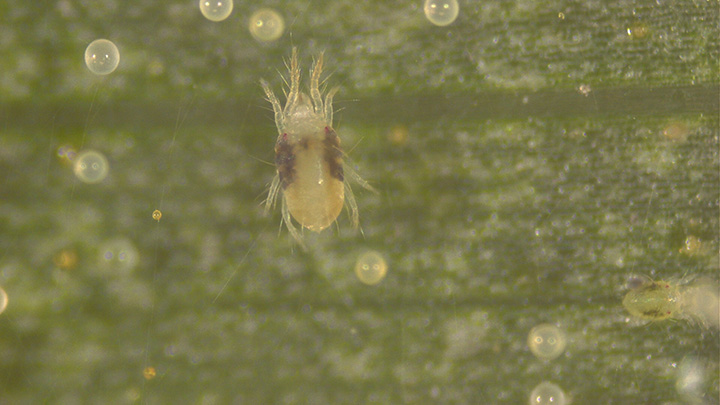
Two-spotted spidermite on corn leave.
HOSTS
- Corn
DESCRIPTION
Spider mites are tiny arachnids (related to ticks and spiders) that feed on the underside of corn leaves. Banks grass mites (BGM) and two-spotted spider mites (TSSM) have a similar appearance. BGM have black spots that cover the entire sides of the abdomen, and these spots can merge in some individuals, while TSSM have two well-defined black spots on the anterior part of the abdomen. BGM have slimmer bodies than TSSM and have a greenish tint, while TSSM are cream colored. These differences, which are not visible to the naked eye, can be easily observed with a 10X hand lens.
BIOLOGY
Adult spider mites of both species overwinter in the soil, litter, or weeds within and along corn fields. In spring and summer, they disperse by crawling, or by being carried in wind currents. Females lay approximately 20 clear, circular eggs per day, and live for 2-4 weeks. The young mites pass through multiple stages as they mature.
Populations build very quickly in hot, dry, dusty conditions. By late summer, mites start to prepare for winter and migrate back to the soil and groundcovers.
SYMPTOMS
- Chlorotic (yellow) leaves
- Bronzed/scorched leaves
- Low yield or undersized corn
GENERAL MANAGEMENT
- Some agricultural practices can help prevent damaging mite populations, such as:
- Frequent and uniform irrigation to avoid drought stress
- Overhead irrigation or heavy rain wash mites off and reduce dust, which protects mites from predators.
- Either reduce fertilization, or apply more frequent lower nitrogen doses, since high nitrogen concentrations promote the development of mite populations.
INSECTICIDES
In general, chemical applications for spider mites in corn should occur before the formation of the kernel, or when the injury is visible in the lower third of the plant and mites can be found in the middle region of the plant.
Because mites can build up chemical resistance, be sure to use a miticide (not insecticide) or horticultural oil.
Residential examples include: Horticultural oil (1%), neem oil, sulfur
Commercial examples include: Zeal, Oberon 2 SC, Comite II, Onager, horticultural oil (1% - organic)