
Ask an Expert – Gardening Counts as Exercise: Protect Your Body While You Work
Gardening can be a full-body workout, so it’s important to treat it like any other physical activity. Hydrate and stretch throughout the day, and use correct techniques, posture, and tools to help you avoid injuries and minimize pain and soreness.
Three techniques can help with most gardening tasks. These distribute the work to larger muscles or improve your body’s natural movement to help you avoid repetitive strain injuries. These occur in muscles, tendons, and nerves from repetitive movements or overuse. They mostly happen in hands, wrists, shoulders, elbows, knees, and lower back.
- Squat—This exercise works well for picking up and putting items down. It engages the quads, hamstrings, hips, glutes, and abdominals and helps avoid strain to the back, knees, ankles, neck, and shoulders.
- Pivot technique—This technique allows you to change directions without twisting. It works well for shoveling and dumping dirt or moving bags and other materials from one side to another. It also helps avoid strain to the back, knees, and ankles.
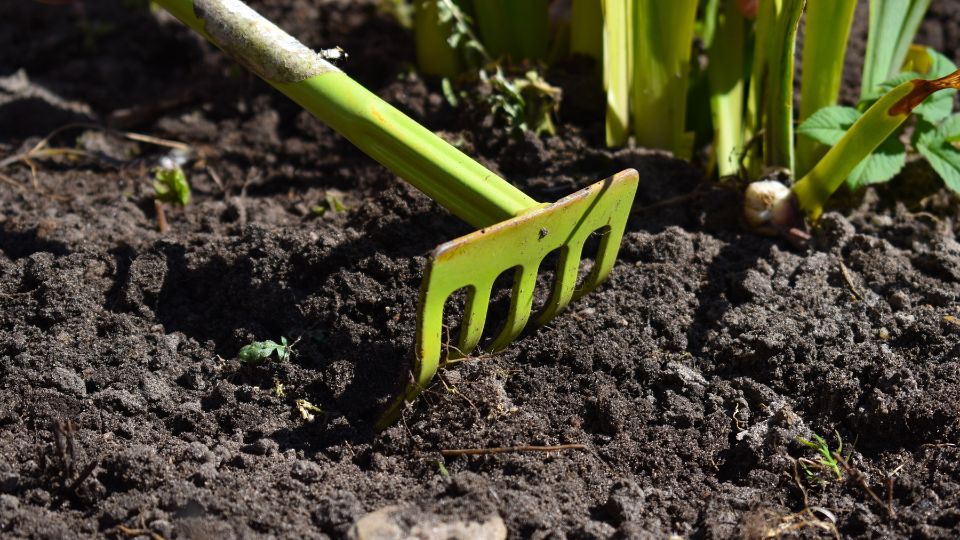
- Back-and-forth weight transfer—This technique helps when moving items back and forth with a long-handled tool, such as a rake. This helps avoid hunching over, pulling, and twisting, and uses larger leg muscles that prevent straining the back, shoulders, and arms.
Your garden layout as well as soil type can also determine the amount of work, materials, and/or equipment you need to make tasks easier and less stressful on the body.
- Heavy soil, such as clay or loam: These soil types hold nutrients, don’t drain well, and are dense, making them a challenge to work with. That resistance can make working with tools harder, which in turn can cause injuries to the wrists, lower back, and shoulders. Work with smaller loads when shoveling, hoeing, or digging; amend the soil when planting to make it less dense and easier to work with; take breaks more often to avoid over-exerting yourself; and wear proper footwear with ankle support and grip.
- Sandy soils: This soil type drains quickly, lacks cohesion, and is unstable, increasing the risk for ankle injuries, falls, and repetitive strain injuries from working with loose soil. Amend the soil to retain nutrients and moisture, use tools with wider scoops to help capture more soil at a time, and wear proper footwear that provides ankle support and full foot coverage. Consider making walking and working areas more stable by laying wood chips, flagstone, or pavers around gardening and walking areas.
- Rocky soils: This soil type has features of both heavy and sandy soils, with rocks of all shapes and sizes added to the mix. To maintain safety, work with smaller loads, take breaks more often, wear proper footwear, and work carefully with tools and equipment to prevent injury.
Click here to see a video on the three techniques of movement in the yard and garden.
Contact
Gabriela Murza
Utah State University Extension associate professor, health and wellness
Gabriela.Murza@usu.edu