
Mobile Drip Irrigation for Pivots and Laterals Quickguide
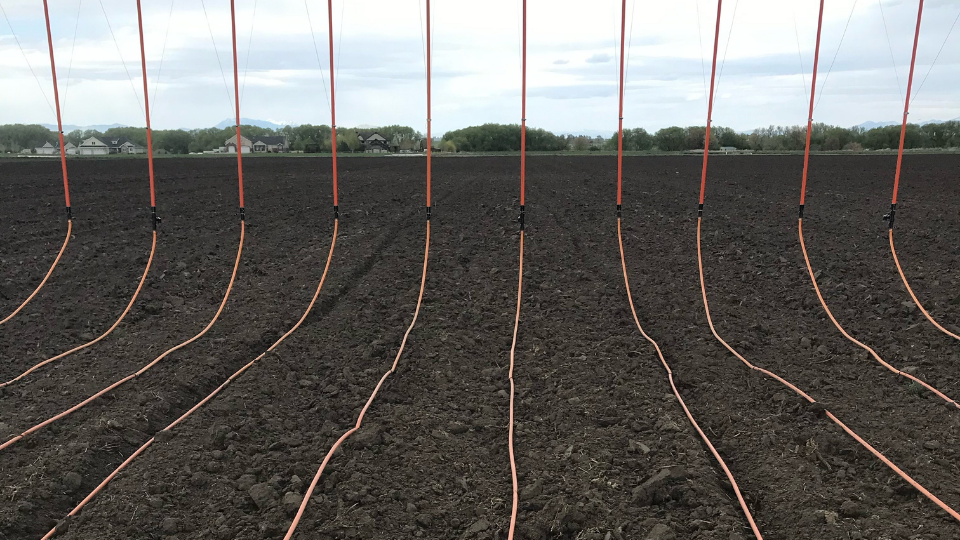
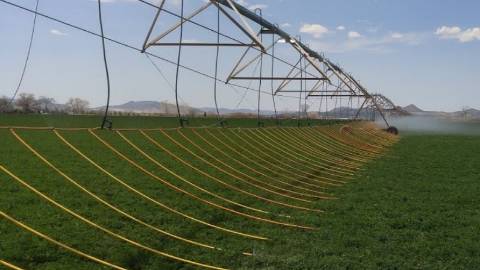
Mobile Drip Irrigation (MDI) or Precision Mobile Drip Irrigation (PMDI) technologies for pivot and lateral/linear sprinklers feature the attachment of drip tape or lines to mobile irrigation systems. The drip tape is usually placed at close spacing, about 20-40 inches apart with 1 or 2 gallon per hour emitters spaced approximately every 6 inches. Mobile drip irrigation systems can be attached to existing pivots and can be used for both low profile and high profile crops. New technologies like MDI have the potential to improve irrigation efficiency thereby increasing water available to the crop and conserving water by reducing loss.
Potential Advantages
- Can be installed on existing irrigation equipment so costs are less than subsurface drip irrigation systems.
- Improved soil infiltration for sloped fields or tight soils.
- Enhanced irrigation application uniformity and efficiency.
- Reduced soil and plant canopy evaporation and wind drift losses.
- Reduced diseases and other pets from having a drier canopy.
- Reduced flow rates to allow the use of lower-capacity pumps.
- Dry wheel tracks.
Potential Disadvantages
- Increased equipment cost compared to other pivot sprinkler packages.
- Increased labor costs associated with installing and maintaining equipment.
- Increased filtration equipment and labor costs.
- Rodent and grazing animal damage to drip tape.
- Inability to physically wash spider mites from corn plants.
- Limitations on germination and chemigation options.
- Managing around drip tape that extends away from pivot.
Steps to Take When Considering MDI
-
Consider your water source.
-
Conduct a water quality analysis.
- Ensure proper filtration and/or water treatment.
-
Determine other systems changes that might be necessary.
Costs
Prices for MDI equipment and installation on existing pivots or laterals will vary by access to suppliers, field conditions, and other factors. Growers might anticipate spending about $150-$200 per acre for equipment and installation of MDI but should consult with suppliers for more precise quotes.
Required Maintenance
Maintenance of MDI systems will usually include occasional repositioning of drip lines from disturbances caused by high winds, grazing or wild animals, or other factors. Drip lines should be periodically flushed out to remove contaminants. The useful life of MDI systems will vary depending on the environment, but most may last for about 10-15 years.
Utah State University is an affirmative action/equal opportunity institution and is committed to a learning and working environment free from discrimination, including harassment. For USU’s non-discrimination notice, see equity.usu.edu/non-discrimination
References
Authors
Katelyn Parker, Matt Yost, Jonno Holt, Chad Reid, Dean Winward, Niel Allen, and Earl Creech