
Srategies for Deficit Irrigation of Forage Crops Quickguide
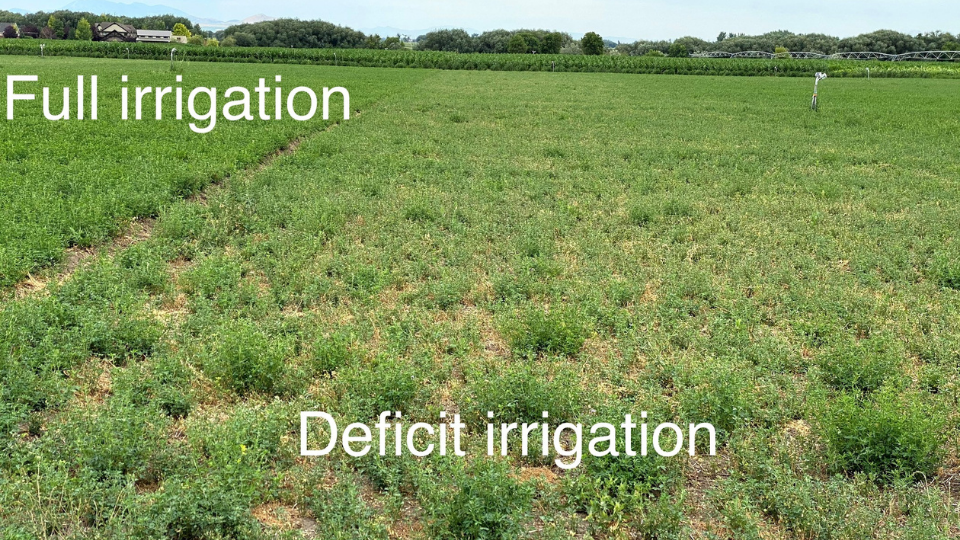
Deficit irrigation is generally not the ideal way to produce forages. It is, however, necessary in some cases due to water shortages or other reasons. Deficit irrigation strategies can include modifying irrigation schedules, concentrating irrigation to critical crop growth stages, reducing rates, terminating irrigation early, or increasing irrigation efficiency in a variety of ways.
Alfalfa
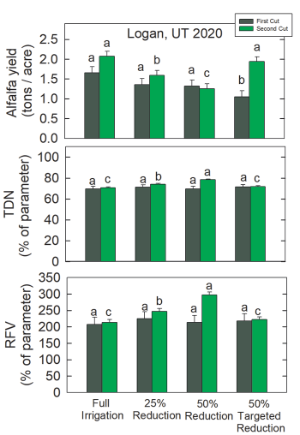
Alfalfa is naturally drought tolerant and has a unique ability to go into drought-induced dormancy.
The approach of ceasing irrigation is usually superior to keeping the alfalfa dull green in color with little to no growth. When irrigation or soil moisture can return to adequate levels, plants break the induced dormancy and resume growth—often returning to full production levels.
Alfalfa uses water most efficiently during spring growth so irrigation should be targeted earlier in the season.
Small Grain Forage
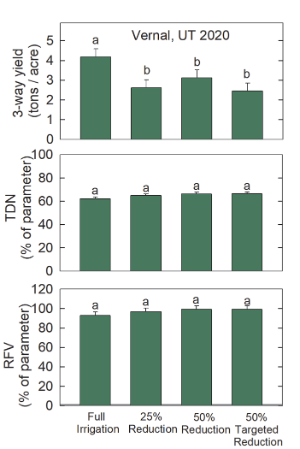
Small grains such as wheat, barley, and oats are good annual forage crops during a drought because their water use occurs early in the season, where they can take advantage of precipitation and potential spring runoff.
Small grain forage requires slightly less total irrigation than small grains harvested for grain, but also have less opportunity for deficit irrigation than grain.
Larger irrigation reduction of 50% can be made without losing extra forage yield compared to 25% reduction.
Silage Corn
Expected water supply and timing of availability should be considered before planting corn to ensure plants can reach maturity. Shorter day corn matures quicker and can be planted in cases where water may be limited toward the end of the growing season.
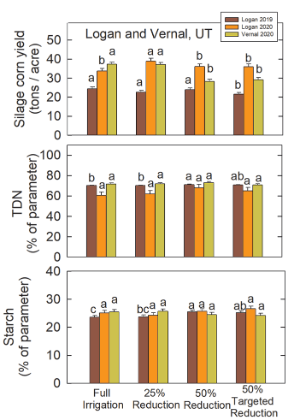
Deficit irrigation should be targeted to critical growth stages where near full irrigation levels are crucial to yield determination.
Small reduction in irrigation all season might be ideal for deficit irrigation.
Teff
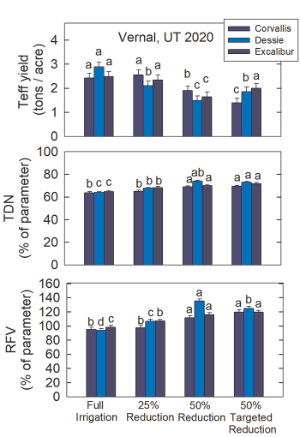
Teff is known as a drought-tolerant crop that thrives on low irrigation levels at frequent intervals. It is planted in early summer which generally allows for early water to be concentrated on other crops.
Teff requires about half the amount of irrigation that alfalfa requires, and excessive irrigation decreases forage quality.
Some varieties can handle deficit irrigation better than others.
References
Download PDF
Authors
Katelyn Parker, Matt Yost, Tina Sullivan, Niel Allen, Boyd Kitchen, Megan Baker, and Earl Creech