
Acceptance and Commitment Therapy: A Treatment Option for Substance Use Disorders

What Is a Substance Use Disorder (SUD)?
Highlights
- A substance use disorder (SUD) happens when someone keeps using alcohol or other substances, even when it causes problems in their life.
- People can and do get better from SUDs with flexible options that meet each person’s needs.
- Treatments can range from medication management to physical activity--or a combination.
- One helpful treatment option is called acceptance and commitment therapy (ACT).
- Techniques used in ACT include identifying and clarifying your values, acceptance/willingness, cognitive defusion, mindfulness, and committed action.
- ACT is an effective treatment and support for SUD recovery.
- Working with a professional therapist can address your entire self and well-being.
A substance use disorder (SUD) happens when someone keeps using alcohol or other substances (e.g., tobacco, opioids, methamphetamines)—even when it causes problems in their life. It can affect how people think, feel, and act, and make it hard to stop using the substance, even if they want to do so. This can lead to health issues, relationship troubles, or problems at work or school (American Psychiatric Association [APA], n.d.; National Institute of Mental Health [NIMH], n.d.). The good news is that help is available. People can and do recover (APA, n.d.; Substance Abuse and Mental Health Services Administration [SAMHSA], n.d.)
What Are the Treatments for SUDs?
SUDs are complex, so the same treatment doesn’t work for everyone (McGovern & Carroll, 2003). There is not a single reason why people experience SUDs. Many people share common experiences, such as going through a difficult event in childhood or facing trauma as an adult. Because of this, supporting people with SUDs often requires flexible treatment approaches, since one size doesn’t fit all. For example, in Utah, alcohol use disorder is the most common SUD (Public Health Indicator Based Information System, 2025). Many individuals seeking help report past trauma or mental health concerns, which means care needs to meet people where they are and address each unique situation (SAMHSA, 2014). There are many evidence-based treatments for individuals experiencing SUDs that support both individuals and families. Psychological treatments are effective for a wide range of SUDs, making them a key approach for helping people with differing needs.
Are There Benefits for Psychological Treatments or Alternative Treatments for Individuals Experiencing SUD?
Yes, there are many varying treatments for people with SUD, ranging from medication management to physical activity. Below is a brief review of the evidence for various well-researched psychological or alternative treatments.

- Medication: It is well established that medications effectively treat SUDs, including alcohol, opioid, and nicotine use disorders (National Institute on Drug Abuse, n.d.).
- Behavioral therapy: Behavioral therapies are an effective intervention for SUDs. Well-researched examples include dialectical behavioral therapy (DBT), cognitive behavioral therapy (CBT) (National Institute of Mental Health [NIMH], n.d.) and acceptance and commitment therapy (ACT) (Osaji et al., 2020).
- Peer support: Research shows peer support has been beneficial and effective for long-term recovery maintenance with SUDs (Scannell, 2021; Tracy & Wallace, 2016).
- Acupuncture: Individual experiences vary, and some people report some benefit to acupuncture for SUD treatment. For example, one systematic review and meta-analysis examining 41 studies with 5,227 participants found no strong evidence supporting the use of acupuncture for SUD treatment (Grant et al., 2016). However, an eight-week, randomized clinical trial found that acupuncture, in addition to therapy and methadone for opioid use disorder (OUD) treatment, significantly decreased methadone dose (by 20% or more) and lowered opioid cravings, supporting acupuncture as a potential adjunct—not replacement—to medication for OUD (Lu et al., 2024).
- Hypnotherapy: There are mixed findings on the effects of hypnotherapy for SUDs. Turner and colleagues’ (2023) randomized controlled trial suggests hypnotherapy may aid in quitting smoking; however, the evidence is not definitive.
- Yoga: Studies have shown yoga to be an effective intervention (Walia et al., 2021). However, these studies had a small sample size, so these results may not generalize to larger populations. However, given the low risk of negative side effects, yoga is generally safe when practiced correctly. Certain precautions should be taken for pregnant women and people with medical conditions such as high blood pressure, glaucoma, and sciatica (NIMH, n.d.).
- Physical activity: Except for tobacco, another systematic review examining 43 articles and 3,135 participants found a decrease in substance use following physical activity (Piche et al., 2023).
Acceptance and Commitment Therapy as a SUD Treatment Support
Given that acceptance and commitment therapy (ACT) is an effective treatment for SUDs (Osaji et al., 2020), let’s dive deeper into how this works with an example (see Figure 1) using alcohol use disorder (AUD) and several example techniques used in ACT that can help.
Oscar is a 33-year-old restaurant manager who has been experiencing an alcohol use disorder for the past seven years. Initially, he drank socially with coworkers, but over time, he began using alcohol to cope with stress, self-doubt, and feelings of isolation. He now drinks daily after work and sometimes in the mornings on his days off. Oscar has attempted to quit drinking several times, but he always returns to use when faced with stress or self-criticism. He describes himself as a perfectionist and feels like a failure when he struggles to control his drinking. His partner has expressed concerns, and Oscar worries that his drinking is affecting his relationship and work performance.
Values

Why does this all matter? What is the cost of alcohol for Oscar? Oscar values being a caring partner, a responsible leader at work, and someone who is in control of his life. However, his drinking contradicts these values, causing internal conflict and shame. Values are personally meaningful life directions. They are ongoing and not goals you can check off. They guide you on how you want to live, not on what you can get (Hayes et al., 2012). Examples of values include:
- Connection – being a loving and present partner, friend, or coworker.
- Personal growth and learning – seeking to learn and challenge yourself.
- Compassion – being kind and caring toward yourself and others.
- Integrity – living honestly and in line with your principles.
Cognitive Defusion
Oscar may benefit from ACT. He often believes “I am a failure” and “I can’t handle stress without drinking.” Oscar is stuck (or “fused”) with unhelpful thoughts and sees them as absolute truths.
One way to use ACT is cognitive defusion, which involves stepping back from your thoughts and seeing them for what they are just words, images not truths or commands that must be followed. Here are some techniques to practice cognitive defusion:
- Label the thoughts as “just thoughts.”
- Thank your mind for the thought.
- Try singing or saying the thought in a silly voice, such as a cartoon character.
- Repeat the thought or word over and over again until it loses meaning.
Acceptance
Sometimes when we are facing difficult emotions, conversations, or thoughts, we tend to avoid them by “numbing” or avoiding the pain through substance use. It is a normal reaction to try to avoid painful experiences. However, rather than running from painful experiences, we can choose to face them. This means having a willingness to experience the discomfort caused by these internal experiences. Rather than trying to get rid of the self-doubt before going to work, Oscar can practice acceptance by saying “Self-doubt is here; I’m going to bring it with me while I reconnect with the value of helping others through my work.” Helpful techniques include:

- Practice emotion awareness. Notice and label the emotions (e.g., here is stress, sadness, etc.).
- Allow distance between you and the emotion. Create space around the emotion by saying, “I am having the feeling that I am angry,” then “I am noticing that I am having the feeling that I am angry.”
- Acknowledge pain without allowing it to control your actions. Visualize carrying your emotional discomfort in a way that keeps you moving toward what matters. Imagine writing your painful thoughts or feelings on a piece of paper and placing it in your pocket. It's still with you. You're not ignoring it, but it's no longer right in front of your face, blocking your view or controlling your actions. This way, you can acknowledge the pain and still
Present-Moment Awareness

Oscar engages in self-criticism and ruminates on past failures. This takes away from his ability to be present. To fully experience the present with openness, curiosity, and without judgment, Oscar needs to be in the present rather than being stuck in thoughts about the past or future. Figure 2 demonstrates the “five senses” technique to help stay in the present moment by focusing on your five senses.
Committed Actions
Committed action is a way of taking steps toward our values, even in the presence of discomfort, fear, or other internal barriers. Examples include:
- Have difficult conversations. If you value connection, a committed action may be initiating a difficult conversation with a loved one even if you are anxious about how it will go.
- Connect with others. Oscar values health so he sets a goal to attend a weekly support group (such as Alcoholics Anonymous [AA] or a therapy session) to connect with others working toward recovery.
- Practice mindfulness. Use mindfulness or deep breathing when feeling the urge to drink, accepting the discomfort without acting on it.
Table 1 presents key ACT concepts alongside practical strategies and relevant examples. This table is intended to illustrate how these processes can be applied in practice to support psychological flexibility.
Table 1. ACT Strategies and Examples
| ACT concept | Strategies | Examples |
|---|---|---|
| Acceptance | Practice willingness to experience the cravings, urges, and distressing emotions without trying to control them. | Noticing and observing cravings without acting on them. |
| Cognitive defusion | Detach from self-defeating, self-criticizing, or judgmental thoughts (e.g., “I am a failure.”) | This video from the University College Dublin Contextual Behavioral Science Laboratory (2021) illustrates how individuals can observe and accept difficult internal experiences without letting them dictate their behavior using the “passengers on a bus” metaphor. |
| Self-as-context | Seeing yourself beyond your substance use, reducing shame and self-judgment. |
Are you a child, sibling, student, or employee? What roles do you have? Imagine a chess board. On the board are red pieces (painful thoughts, emotions) and green pieces (positive thoughts, coping strategies). Most people try to help the green pieces win or get rid of the red ones. ACT invites you to notice you are not the pieces but rather the board. The board holds all the pieces without being any of them. |
| Present-moment awareness | Notice the urges and automatic behaviors you engage in. | When the urges show up, notice where you feel them in your body. What sensations show up? |
| Values | What are the important things in your life? What kind of life do you want to build beyond substance use? | Clarify your values with an example of the “Values Card Sort” (Warren & Warren, 2024) activity. |
| Committed actions | What small step can you take in the direction of your values? | Notice values path vs avoidance path. Choose a recent decision or upcoming challenge. If you followed your avoidance urge, what would that path look like? If you followed your values path, what action would you take? |
Conclusion
Many treatments are effective for addressing and supporting substance use disorder (SUD) recovery. Acceptance and commitment therapy (ACT) is an effective treatment and support for SUD recovery (Osaji et al., 2020) with many tools that enhance well-being (i.e., acceptance, cognitive defusion, self-as-context, present-moment awareness, values, committed actions). The examples above can help you think of ways to incorporate these concepts in your daily life; however, working with a licensed behavioral health professional and addressing your entire self is key for well-being. Start your recovery journey today with evidence-based treatments to support you or a loved one with SUD.
Resources
- Utah State University ACT Program
- 988 Suicide and Crisis Lifeline
- American Psychiatric Association
- Substance Abuse and Mental Health Services Administration (SAMHSA)
- Benefits of ACT for Chronic Pain
Photo Credits
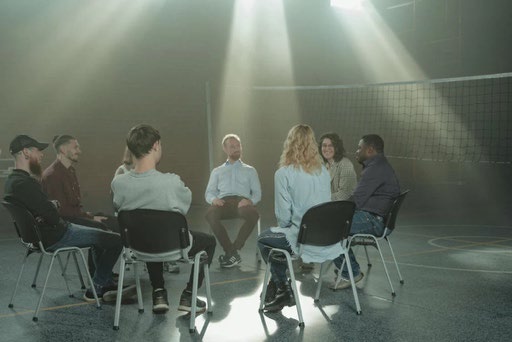
Pexels provided the free stock photos in this fact sheet: (1) Person stands on brown pathway; (2) People doing yoga together; (3) Black psychologist with African American client; (4) Hiker in mountains; (5) People sitting on chairs inside room.
References
- American Psychiatric Association. (n.d.). What is a substance use disorder? https://www.psychiatry.org/patients-families/addiction-substance-use-disorders/what-is-a-substance-use-disorder
- Grant, S., Kandrack, R., Motala, A., Shanman, R., Booth, M., Miles, J., Sorbero, M., & Hempel, S. (2016). Acupuncture for substance use disorders: A systematic review and meta-analysis. Drug and Alcohol Dependence, 163, 1–15. https://doi.org/10.1016/j.drugalcdep.2016.02.034
- Hayes, S. C., Strosahl, K. D., & Wilson, K. G. (2012). Acceptance and commitment therapy: The process and practice of mindful change (2nd ed.). Guilford Press.
- Lu, L., Chen, C., Chen, Y., Dong, Y., Chen, R., Wei, X., Tao, C., Li, Wang, Y., Fan, B., Tang, X., Xu, S., He, Z., Mo, G., Liu, Y., Gu, H., Li, X., Cao, F., Xu, H., Zhang, Y., Li, G., Liu, X., Zeng, J., Tang, C., & Xu, N. (2024). Effect of acupuncture for methadone reduction: a randomized clinical trial. Annals of internal medicine, 177(8), 1039-1047. https://doi.org/10.7326/M23-2721
- McGovern, M. P., & Carroll, K. M. (2003). Evidence-based practices for substance use disorders. The Psychiatric Clinics of North America, 26(4), 991.
- National Institute on Drug Abuse. (n.d.). Treatment. U.S. Department of Health and Human Services. https://nida.nih.gov/research-topics/treatment
- National Institute of Mental Health (NIMH). (n.d.). Substance use and mental health. National Institute of Health, U.S. Department of Health and Human Services. https://www.nimh.nih.gov/health/topics/substance-use-and-mental-health
- Osaji, J., Ojimba, C., & Ahmed, S. (2020). The use of acceptance and commitment therapy in substance use disorders: A review of literature. Journal of Clinical Medicine Research, 12(10), 629–633. https://doi.org/10.14740/jocmr4311
- Piché, F., Daneau, C., Plourde, C., Girard, S., & Romain, A. J. (2023). Characteristics and impact of physical activity interventions during substance use disorder treatment excluding tobacco: A systematic review. PLOS ONE, 18(4), e0283861. https://doi.org/10.1371/journal.pone.0283861
- Public Health Indicator Based Information System (IBIS). (2025). Substance use. Utah Department of Health and Human Services. https://ibis.utah.gov/ibisph-view/topic/SubstanceUse.html
- Scannell C. (2021). Voices of hope: Substance use peer support in a system of care. Substance Abuse: Research and Treatment, 15. https://doi.org/10.1177/11782218211050360
- Substance Abuse and Mental Health Services Administration (SAMHSA). (n.d.). What is substance use disorder? https://www.samhsa.gov/substance-use/what-is-sud
- Substance Abuse and Mental Health Services Administration (SAMHSA). (2014). Trauma-informed care in behavioral health services: Treatment Improvement Protocol (TIP) series [No. 57]. U.S. Department of Health and Human Services. https://www.ncbi.nlm.nih.gov/books/NBK207195/
- Tracy, K., & Wallace, S. P. (2016). Benefits of peer support groups in the treatment of addiction. Substance Abuse and Rehabilitation, 7, 143–154. https://doi.org/10.2147/SAR.S81535
- Turner, A. P., Edwards, K. A., Jensen, M. P., Ehde, D. M., Day, M. A., & Williams, R. M. (2023). Effects of hypnosis, mindfulness meditation, and education for chronic pain on substance use in veterans: A supplementary analysis of a randomized clinical trial. Rehabilitation Psychology, 68(3), 261–270. https://doi.org/10.1037/rep0000507
- University College Dublin Contextual Behavioral Science Laboratory (UCD CBS Lab). (2021, May 4). Passengers on the bus | Choose your own adventure video series | Acceptance & Commitment Therapy [Video]. YouTube. https://www.youtube.com/watch?v=huVc6SphzC0
- Walia, N., Matas, J., Turner, A., Gonzalez, S., & Zoorob, R. (2021). Yoga for substance use: A systematic review. Journal of the American Board of Family Medicine: JABFM, 34(5), 964–973. https://doi.org/10.3122/jabfm.2021.05.210175
- Warren, J., & Warren, M. (2024). Values card sort. https://www.valuescardsort.com/index/html
The authors of this content used ChatGPT to create the Figure 2 image. Authors reviewed and edited the content provided by the AI tool, and they take full responsibility for the content.

Utah State University Extension
Peer-reviewed fact sheet
Authors
Miriam Mukasa Kasozi, Ashley Yaugher, and Ty Aller

Ashley Yaugher
Professional Practice Extension Associate Professor | Health and Wellness | HEART Initiative | Carbon & Emery Counties
Home and Community Department