
Home on the Range: Where Deer and Antelope Compete With Feral Horses for Limited Resources
Introduction
Key Takeaways
- More than 70,000 feral horses live on federal lands, with approximately half in Nevada.
- Feral horses compete with native wildlife, particularly big game animals, for habitat.
- Feral horses can degrade wetlands, help spread noxious weeds, and have been observed aggressively herding elk and pronghorn away from natural springs.
- Expanding feral horse populations could have economic implications for rural communities in Great Basin states.
- Horses may dominate water sources and potentially prevent other, smaller-bodied animals from drinking.
Feral horses are widely distributed across western rangelands. Nearly half of all federally managed horses occur in Nevada, where they display extensive habitat overlap with valued big game animals, such as mule deer, elk, bighorn sheep, and pronghorn antelope (Stoner et al., 2021). Despite growing concerns among state wildlife managers about feral horses competing with native wildlife, we know very little about their behavior around permanent water sources.
To address these concerns, we conducted a photo survey of two springs in southern Nevada to monitor animal visitation patterns. We found that feral horses and mule deer were the most commonly photographed species at the springs, accounting for 1,248 images (1,023 horses; 225 deer). However, during peak summer temperatures, horses visited water up to 10 times more often than deer, largely during the day and again at dusk. Like horses, deer also visited water in the day but showed a second peak during the pre-dawn hours when horses were least active. In winter, these patterns reversed, with horses showing more activity at night, while deer completely avoided water at night. Over 2 years of monitoring, we observed both species drinking simultaneously on only two occasions. Given the social value of big game animals in the West and the unpredictable rainfall, the expansion of horse populations into deer and pronghorn habitats could have economic implications for rural communities in the Great Basin states.
Background
Feral animals are domestic species that are now living in the wild without human support. Horses (Equus caballus) were domesticated in central Asia approximately 6,000 years ago and introduced to North America in the late 15th century (Librado et al., 2021). Since that time, they have increased and expanded to form feral populations. Today, more than 70,000 feral horses live on federal lands across 10 western states (Bureau of Land Management [BLM], 2025). In Nevada, species such as mule deer, elk, bighorn sheep, and pronghorn antelope outnumber feral horses > 2:1, yet if we were to put all these animals on a scale, horses would outweigh the big game animals combined by 2.5 times. Importantly, big animals have big appetites, and when measured on a daily basis, horses consume twice as much food—mostly grasses and shrubs—as an elk, and more than 6 times as much as a mule deer or pronghorn. Horses consume many of the same plants as our native deer, which could lead to competition, especially when range conditions are poor.
Along with the bald eagle, the public considers the wild horse an icon of American heritage and a living symbol of the pioneer spirit of the West. As such, these animals enjoy legal protections under the Wild Free-Roaming Horses and Burros Act (Public Law 92-195, 1971). This law mandates that these two species are to be conserved on designated units managed by the BLM and the United States Forest Service (USFS) as part of “a thriving natural ecological balance on public lands.” Federal agencies establish population targets based on prevailing environmental conditions and other permitted land uses, such as livestock grazing, wildlife habitat, industrial operations, and recreation. Animal numbers are managed through removals called “gathers” combined with fertility control drugs.
Unfortunately, these actions have failed to keep pace with herd growth rates and, given extensive habitat and dietary overlap with state-managed game animals, many wildlife managers are concerned that horses may be competing with wildlife for limited resources (Stoner et al., 2021). Numerous studies have found that feral horses can degrade wetlands and help spread noxious weeds, including cheatgrass (Davies et al., 2014; Kaweck et al., 2018; King et al., 2019). However, the strongest evidence for competition with native wildlife surrounds the use of permanent water sources. Recent studies have documented horses moving outside designated management units to make use of livestock tanks and wildlife guzzlers (Hall et al., 2016; Gooch et al., 2017; Stoner et al., 2023). In the process, horses have been observed aggressively herding elk and pronghorn away from natural springs, raising concerns about competition for limited resources in dry rangelands (Perry et al., 2015; Hennig et al., 2022).
Horses, Deer, and Water

In desert environments, water dependence varies for both horses and deer. Each species has evolved different ways to digest plant foods and regulate body temperature in hot climates. Deer and other big game animals obtain water from their food, so they don’t completely depend on open water from streams or ponds (Monteith et al., 2023). On the other hand, under certain conditions, horses require 7–14 gallons of water a day, much of which they excrete during digestion (Schoenecker et al., 2022). If horses are not able to drink enough, they risk getting sick, which can result in decreased food intake or even death (Liburt, 2026). For horses, the need to satiate their thirst leads to excessive trailing and soil erosion between water sources, and rapid consumption can affect the recharge rate of small springs and seeps. It also means that, because of their large body and group sizes, horses can dominate other wildlife near water (Perry et al., 2015; Gooch et al., 2017). Potential conflicts with wildlife can become a problem in drier climates, such as the southwestern United States, where water availability is often sparse and unpredictable.
More than 80% of federal management units delineated for horses or burros also support populations of mule deer and/or pronghorn antelope. Both species tend to select sparsely forested ranges characterized by extensive shrub and grass cover. Mule deer and pronghorn are very efficient at extracting water from the plant foods they consume, which can satisfy up to 80% of their daily water needs, depending on the plant and season. To optimize water retention, deer move and forage more during cooler hours, resting during the hottest parts of day. This independence from free water allows them to move farther from water sources and use those sources less frequently (Davies, 2024). Nevertheless, on average, deer need to drink about 1.5 gallons of water per day, and like horses, during times of heat stress or lactation, water demands increase (Liburt, 2026; Freeman, 2021).
Spring Visitation by Feral Horses and Mule Deer
To address concerns expressed by managers over wildlife access to water, we used trail cameras on two permanent springs in an area where mule deer and horses exhibit substantial habitat overlap (Iacono, 2023). Both springs were located in southeast Nevada (Figure 1) at about 6,000 feet elevation, where average summer high temperatures typically exceeded 90 °F. Trail cameras were established in April 2021 and were active year-round until April 2023. We used the images collected from these cameras to compare mule deer to feral horses in terms of the frequency and timing of visits to water sources during both summer and winter seasons.
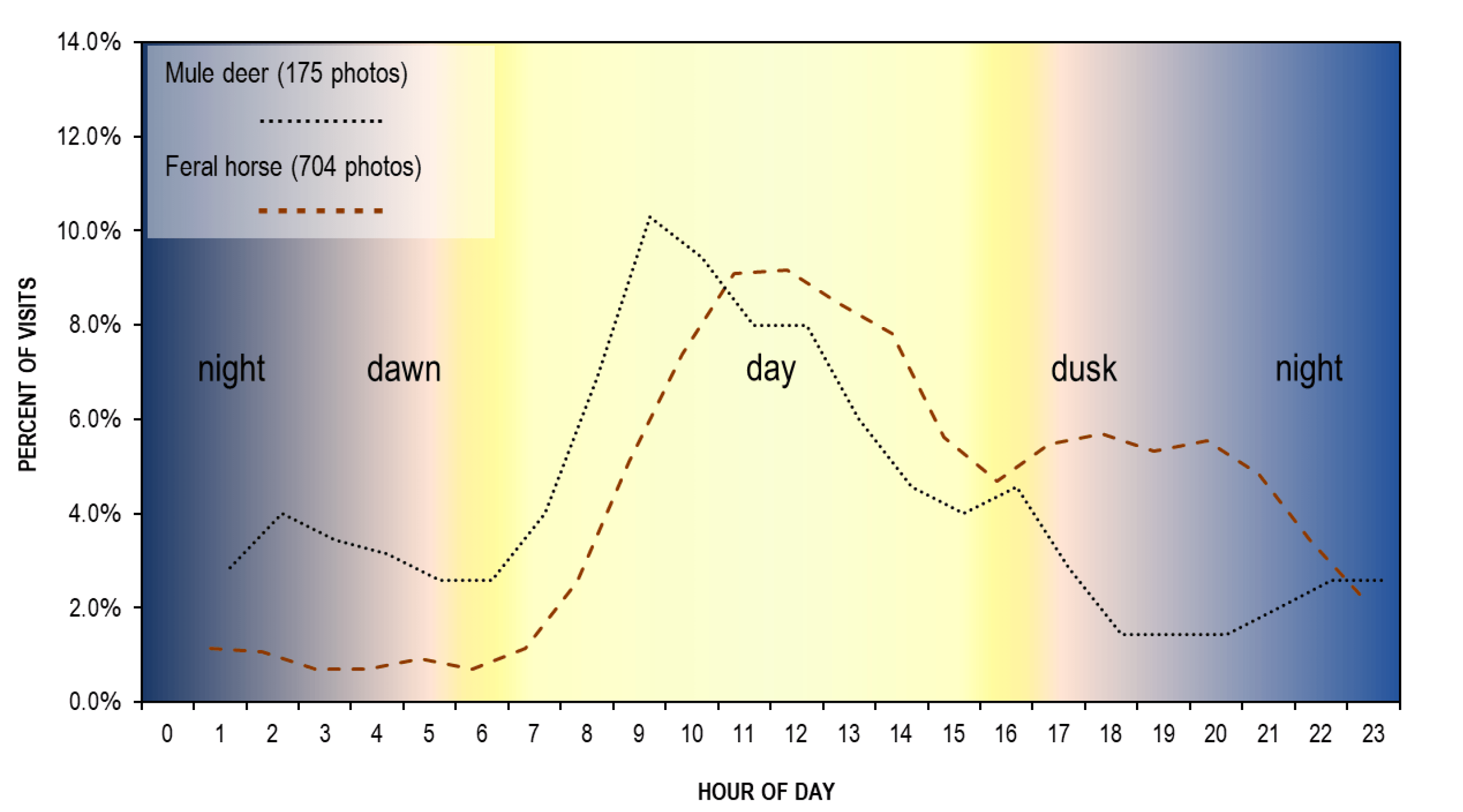
Over the course of our 2-year survey, feral horses and mule deer were by far the most observed animals at these springs. We obtained 1,248 photographs of wildlife, including 879 photos in summer (704 horses; 175 deer; see Figure 2), and 369 in winter (319 horses; 50 deer). Despite occurring in similar numbers on the study area, horses were captured at springs 10 times more frequently than deer in summer (12 vs. 1.2 visits/hour) and 6 times more in winter (6 vs. 1 visit/hour). Notably, we only documented both species drinking simultaneously on two occasions (Figure 3).
Although both species visited water throughout the day, during summer months, horses were found primarily during daylight hours (64%), with a second pulse just after dusk (25%). Similarly, mule deer exhibited a day-time peak (50%), followed by a second pulse just before dawn (43%). The greatest separation between species was at dusk, when horse use was 3 times higher than deer (9% vs. 3%, respectively).
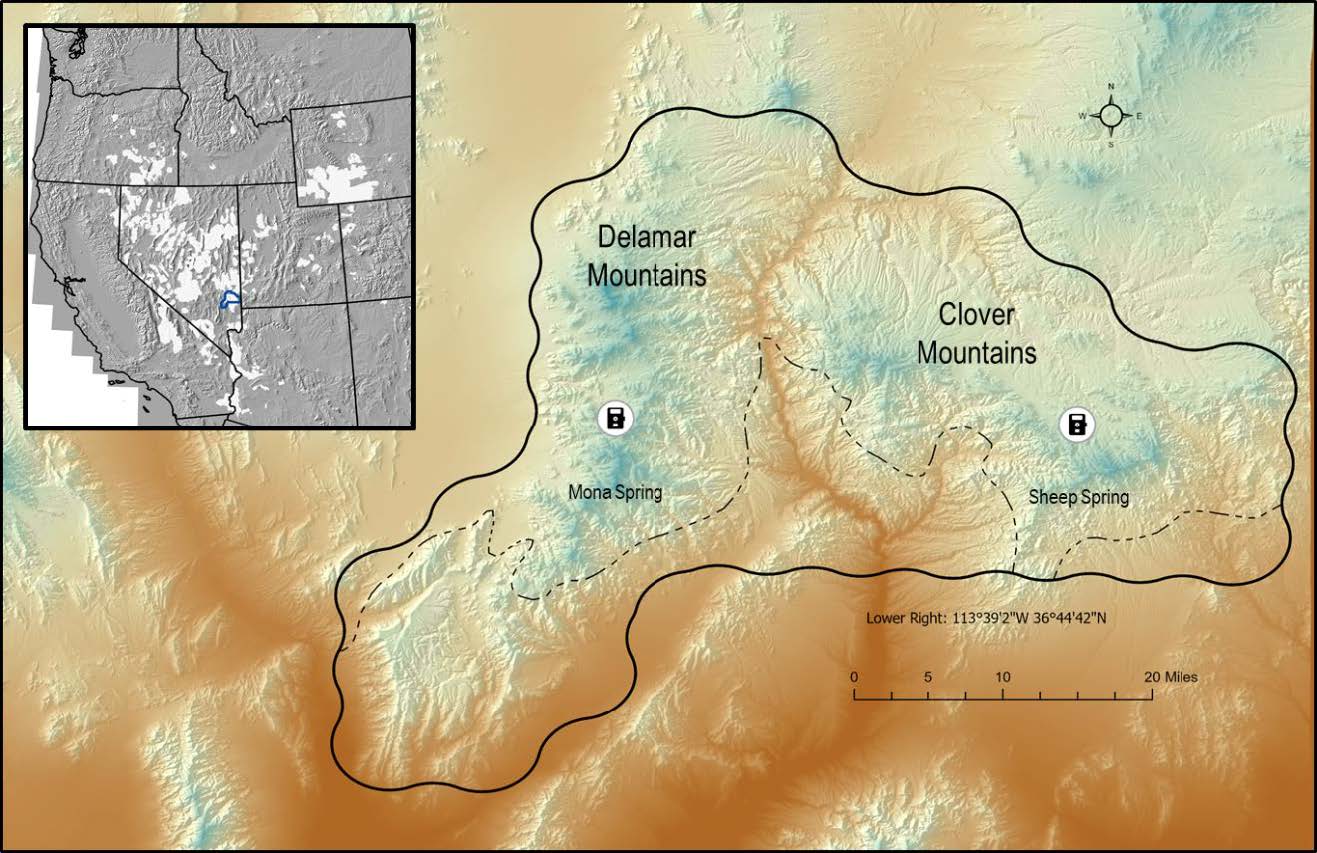
Inset: White polygons represent all BLM and USFS wild horse management units in the western United States.
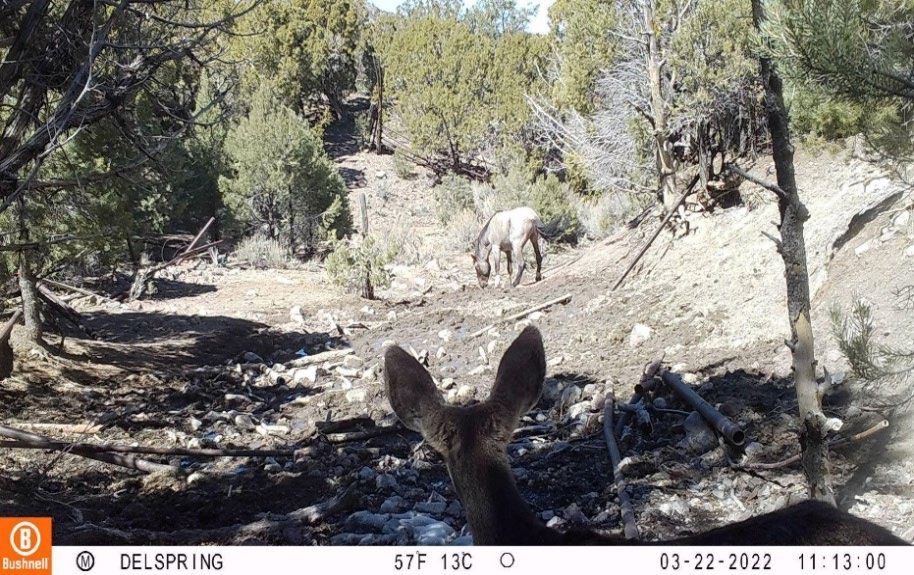
Note the deer’s behavior in response to the lone horse at the spring.
Photo: Peter Iacono and Hannah B. Klugman
The timing of water visits also differed between seasons. In winter, horse use was similar between day and night (19% vs. 23%, respectively), whereas deer were not detected at night (33% vs. 0%, respectively). Both species visited water infrequently during twilight hours, with the greatest separation at dusk (7% vs. 3% for horses and deer, respectively). Horses displayed a preference for nighttime visits when the weather was cooler, but the overall reduction in water visits during winter by both species may reflect the presence of other readily available sources, such as snow and runoff. That said, deer may be more dependent on surface water, such as springs or snow during winter because they cannot extract enough moisture from the dry forage that they eat in winter.
Where Do We Go From Here?
All desert wildlife depends on scarce, often unreliable water sources. Despite high summer temperatures, horses remained active during the day, when mule deer were also most likely to visit springs. These patterns may be of interest to both managers and the public, as horses are 6 times larger than adult mule deer, frequent water sources at least 6 times more often than deer and generally travel in groups twice as large. All these qualities allow horses to dominate water sources and potentially prevent other, smaller-bodied animals from drinking. This could force deer and other animals to travel farther for water or visit at times when they may be more vulnerable to predators (Stoner et al., 2023; Davies, 2024). Additionally, the physical and behavioral advantages horses have enabled them to cope with drought and to survive in areas with limited dependable water. Because of the cultural and economic value of mule deer and other western big game animals, the patterns we found are concerning. Competition with feral horses could result in lower fawn survival, smaller antler size, or smaller populations of valued wildlife. Given projections for continued drought conditions in the West, a better understanding of how native wildlife respond to competition with feral horses will be critical for developing effective conservation programs in the future.
Acknowledgments
We extend our gratitude to our cooperators with the BLM Caliente Field Office and to our field crew, Peter Iacono, Madison McPhail, and Casey Devine. Funding was provided by the U.S. Geological Survey, Fort Collins Science Center, and the Nevada Department of Wildlife (NDOW). Special thanks to Pat Jackson and Cody Schroeder of the NDOW for project support.
The authors did not use generative AI in creating this content, and it is solely the work of the authors.
USU Extension provided the photos in this fact sheet, unless otherwise noted.
References

June 2026
Utah State University Extension
Peer-reviewed fact sheet
Authors
Katelyn Davies, Hannah B. Klugman, Kathryn A. Schoenecker, and David C. Stoner

David Stoner
Extension Assistant Professor in Human-Wildlife Interactions