
Transition to Organic: Alfalfa Production in Utah

Overview
Transitioning to organic production may not require drastic operational changes on the part of the producer, as alfalfa production lends itself to more organic practices by default. As a legume, alfalfa does not require nitrogen fertilization and can even provide a “nitrogen credit” for a following crop such as corn or wheat (Sheaffer et al., 2022). Note that alfalfa will require some additional nutrients, as discussed later. In good conditions and with a healthy stand, conventional producers may already be using little, if any, synthetic pesticides and herbicides. The 36-month transition period begins after the last application of prohibited material. Therefore, if no prohibited inputs have been used in recent months or years, the transition time to become certified organic could be relatively shorter. Management considerations such as irrigation and harvest will also be more or less the same. Taken together, these factors mean less time in transition and a more manageable transition plan.

Once established, alfalfa is a resilient and drought-tolerant crop, well-adapted to Utah climates (Yost et al., 2020). Organic livestock and dairy industries must use organic feed and, therefore, depend on organic alfalfa producers, ensuring a level of market security and an organic premium. Alfalfa can play an important role in an organic producer’s crop rotation strategy. Used in rotation with organic cereals or organic small grains, alfalfa can suppress weeds and insects and build soil nutrients, while still offering a harvestable crop that can be sold or used as feed (Tallman, 2011).
Producers may decide to transition to certified organic production to capture organic price premiums, access niche market opportunities, reduce the use of synthetic inputs, meet growing consumer demand, enact personal values around environmental stewardship, and support soil and biodiversity conservation (Curtis et al., 2019). Whatever a grower’s motivation, the first step to transition is understanding organic production systems, National Organic Program (NOP) regulations, and crop-specific considerations.
Site Selection and Stand Establishment
Characteristics of a proper site for organic alfalfa include a level area with good drainage, at least 10 inches of annual rainfall or irrigation, and a close-to-neutral pH. If possible, pre-planting irrigation could be used to flush weeds and ensure low weed pressure at the time of planting. Fall planting is generally recommended in organic production, as it allows for stand establishment before more aggressive pressure from summer annual weeds (Long et al., 2008). Plant alfalfa at least one month before the first frost and select cold-tolerant cultivars. Planting oats alongside spring-planted alfalfa can function as a “nurse crop” and help to outcompete annual weeds during stand establishment. The nurse crop may reduce alfalfa yield and hay quality in the first year, so consider producer goals and available markets (Fuerst, 2009).

Organic seed varieties must be used if commercially available. If your chosen seed variety is unavailable in a certified organic form, you may use a nonorganic variety, provided it is not treated with a prohibited material and is not genetically modified, such as Roundup-ready varieties (Coleman, 2012). Select varieties with pest resistance and cold tolerance specific to your site. The organic seeding rate may be slightly higher than that of conventional to ensure good stand density and competition with weeds. For a good stand, a general rule of thumb is about 20 seedlings per square foot. This density will thin to about 10 plants per foot after the first year. If the site has not had alfalfa in the last 10 years, inoculate the field or ensure the seed comes pre-inoculated with an organically approved nitrogen-fixing bacteria (Rhizobium sp.) (Long et al., 2008).
Nutrient Management
As a legume, alfalfa will not require nitrogen fertilizers but may require phosphate, potash, sulfur, and other nutrients for optimal nutrient management. Organically approved sources for these nutrients are expensive, so completing annual soil testing and tissue analysis (after establishment) are important for cost efficiency and proper nutrient management (Koenig et al., 2009). Manure is the most common source of these nutrients, so ensure a good source is readily available (Long et al., 2008). As a crop not intended for human consumption, applying manure in organic alfalfa is less regulated than on crops intended for human consumption (Code of Federal Regulations, 2000). Compost and manure are typically applied prior to stand establishment. Apply and incorporate compost or manure before planting at a rate sufficient to meet crop phosphorus needs for the first few years. Avoid excessive rates that could promote nitrogen leaching, especially if using fresh manure. Additional compost can be top-dressed as needed to help maintain an older stand. Fresh manure must be incorporated into the soil at least two weeks before seeding to avoid damaging emerging seedlings.
Weed Management
Maintaining a healthy alfalfa stand is critical in organic production to ensure competition against weeds. If the stand becomes thin, plant a perennial grass like orchard grass or meadow brome into the existing stand to extend its life. Again, producers should consider their market, as this will change the hay type and quality. Another option is to be more aggressive in crop rotation and take out the stand early to prevent weed invasion. Learning the specific weeds and their life cycles is vital to understanding the optimal timing of interventions and establishing and maintaining a healthy stand (Fuerst et al., 2009).
Insect and Disease Management
As with weeds, understanding the local alfalfa plant pests is vital to an effective organic pest management plan. Common alfalfa pests in Utah include alfalfa weevil, aphids, armyworms, alfalfa caterpillars, and grasshoppers (Stephens & Ramirez, n.d.). Using preventive and cultural methods should be emphasized before using organically approved insecticides or fungicides. Nonchemical tools will depend on the specific pest and the level of infestation but include plant resistance, conserving natural enemies, and early harvest or grazing. Apply an approved organic pesticide only after scouting results of pests have determined that populations are approaching economically damaging thresholds.
Irrigation, Harvest, and Storage

In general, irrigation, harvest, and storage of organic alfalfa are similar to that of conventional alfalfa. Harvest equipment should be cleaned between fields in a split operation (one that has both organic and nonorganic production). If the field is weedy, the weeds and alfalfa may not dry at the same rate in the windrow, so reaching proper moisture may delay baling.
Rotation and Transition Planning
Crop rotation for alfalfa is not only a requirement of the NOP but can also be part of an effective organic weed and pest control plan (Tallman, 2011; U.S. Department of Agriculture - Agricultural Marketing Service [USDA-AMS] n.d.). An average alfalfa stand will be productive for five years, depending on location and market quality requirements. During these years, alfalfa will suppress perennial weeds and build soil nitrogen. After alfalfa, corn or wheat can grow effectively without additional nitrogen (Kaiser et al., 2023).
Given market availability, rotation options in Utah include wheat, safflower, specialty crops (onions or melons, for example), or pasture if using livestock in the rotation. A rotation plan with varying crops, row spacing, and planting dates improves soil health and fertility, reduces weed and pest pressure, and allows for access to diverse markets (Kahl et al., 2009). A good organic transition plan will include a good rotation plan. Using alfalfa during transitional years can be seen as investing in cleaner fields, nitrogen stores, and organic matter for future higher-value crops (Mohler & Johnson, 2009).
Organic Alfalfa Markets
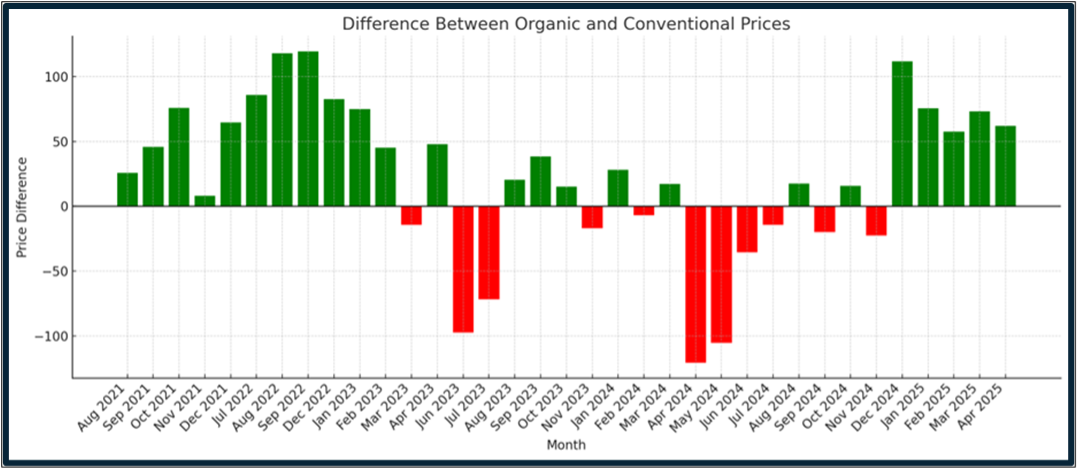
Figures 1 and 2 illustrate the price differences between organic and conventional alfalfa from August 2021 to April 2025. The data was collected from USDA-AMS weekly hay reports from California, Oregon, Washington, Idaho, Arizona, and Utah. The average price difference between organic and conventional alfalfa over the period was $22.87 per ton. Overall, organic prices were higher than conventional prices, particularly in late 2022 and early 2023, where the difference peaked, most notably in September 2022, when organic prices exceeded conventional by over $119 per ton. However, there were notable exceptions, especially throughout mid-2023 and spring 2024, where conventional prices surpassed organic prices by significant margins, including the sharpest negative gap of $120 per ton in April 2024. This volatility suggests shifts in market dynamics, potentially driven by supply fluctuations, seasonal demand, or broader economic factors. Prices stabilized in late 2024 and early 2025, returning to a pattern where organic prices once again led, though not as sharply as during the earlier highs. Improved supply chain logistics connecting sellers and buyers is a major hurdle but would greatly improve the organic alfalfa market.

USDA Organic Certification
Organic transition involves creating and implementing an Organic System Plan (OSP), used as part of an application to an accredited certifying body. The OSP outlines how your operation plans to stay in compliance with the National Organic Program regulations. This document details your production practices, from field preparation through harvest and sale, and describes how you plan to keep necessary records, including field maps, crop list, rotation plan, and so on. Your certifying body will provide a template for the OSP to ensure all areas of concern are addressed. As mentioned above, land must be free of prohibited materials, as defined in the NOP regulations, for 36 months before a crop can be sold as organic (Coleman, 2012). This includes termination of any genetically engineered alfalfa varieties or risk a delay in certification. If no prohibited substances have been used in the past 36 months, the land is eligible for certification right away.

Once an OSP is submitted and reviewed to meet the basic requirements for certification, the certifier will schedule an inspection that will verify the OSP and review applicable records. Based on the findings, the certifier will determine an official certification status. Annual OSP updates and inspection are required to maintain certification. The cost of certification will depend on the operation and selected certifying body. Initial and annual certification costs should be considered when deciding to transition.
Do’s and Don’ts of Organic Alfalfa
| DO | DON'T |
|---|---|
| Select an alfalfa variety with pest-resistant traits and appropriate hardiness and dormancy for your region. | Use genetically modified organism (GMO) and genetically engineered (GE) alfalfa seed varieties. |
| Test soil and amend with approved inputs only if needed. | Use synthetic inputs, such as synthetic fertilizers, herbicides, and pesticides, not approved for use in organic production. |
| Consider adding alfalfa to an organic rotation and when transitioning new ground. | Use equipment from conventional fields unless cleaned. |
| Plant in the fall and use a higher seeding rate. | Allow comingling due to poor record-keeping. |
| Follow National Organic Program standards and keep good records, especially if only part of the operation is organic. | Use prohibited seed inoculants. |
| Slack on scouting for weeds and pests. |
References
- Code of Federal Regulations. (2000). Part 205—National organic program [see 7 C.F.R. § 205.203(c)(1)(i)]. National Archives and Records Administration. https://www.ecfr.gov/current/title-7/subtitle-B/chapter-I/subchapter-M/part-205.
- Coleman, P. (2012). Guide for organic crop producers. U.S. Department of Agriculture National Organic Program, National Center for Appropriate Technology (NCAT), and ATTRA Sustainable Agriculture. https://www.ams.usda.gov/sites/default/files/media/GuideForOrganicCropProducers.pdf
- Curtis, K. R., Rice, E., & Quarnstrom, D. L. (2019). Adopting organic wheat: Grower motivations and concerns [Applied economics fact sheet]. Utah State University Extension. https://digitalcommons.usu.edu/extension_curall/1984
- Creech, E., Griggs, T., Israelsen, C., Bingham, T., Clark, J., & Pieper, M. (2015). Irrigated alfalfa variety performance, 2011–2014; North Logan, Utah [Fact sheet]. Utah State University Extension. https://extension.usu.edu/crops/research/irrigated-alfalfa-variety-performance-2011-2014-north-logan-utah
- Fuerst, E. P., Koenig, R. T., Kuglar, J. Painter, K., Stannard, M., & Goldberger, J. (2009). Organic alfalfa management guide. [EB2039E]. Washington State University Extension. https://wpcdn.web.wsu.edu/wp-extension/uploads/sites/2071/2024/04/EB2039E-Organic-Alfalfa-Mgmt-Guide-Copy.pdf
- Kahl, K., Painter, K., Tautges, N., & Borrelli, K. (2022). Exploring organic grain and forage production as a profitable enterprise for Palouse farmers [PNW748]. Pacific Northwest Extension and University of Idaho Extension. https://www.uidaho.edu/extension/publications/pnw/pnw748
- Kaiser, D. E., Fernandez, F., Wilson, M., Coulter, J. A., & Piotrowski, K. (2023). Fertilizing corn in Minnesota. University of Minnesota Extension. https://extension.umn.edu/crop-specific-needs/fertilizing-corn-minnesota
- Koenig, R. T., Horneck, D., Platt, T., Petersen, P., Stevens, R., Fransen, S., & Brown, B. (2009). Nutrient management guide for dryland and irrigated alfalfa in the inland Northwest [PNW0611]. Pacific Northwest Extension and Washington State University Extension. https://pubs.extension.wsu.edu/product/nutrient-management-guide-for-dryland-and-irrigated-alfalfa-in-the-inland-northwest/
- Long, R. F., Meyer R. D., & Orloff, S. B. (2008). Producing alfalfa hay organically. In C. G. Summers, D. H. Putnam (Eds.), Irrigated alfalfa management in mediterranean and desert zones (Chapter 21). University of California. https://alfalfasymposium.ucdavis.edu/irrigatedalfalfa/pdfs/UCAlfalfa8307Organic_free.pdf
- Mohler, C. L., & Johnson S. E. (2009). Crop rotation on organic farms - A planning manual. Sustainable Agriculture Research and Education (SARE) Outreach. https://www.sare.org/resources/crop-rotation-on-organic-farms/
- Sheaffer, C., Goplen, J., Wiersma, J., & Kaiser, D. (2022). Alfalfa and red clover can supply N for following crops when grown for one year [Web log post]. Minnesota Crop News, University of Minnesota Extension. https://blog-crop-news.extension.umn.edu/2022/04/alfalfa-and-red-clover-can-supply-n-for.html
- Stephens, E., & Ramirez, R. (n.d.). Beneficial insects & pests of Utah alfalfa. Utah State University Extension. https://extension.usu.edu/planthealth/files/pubs/alfalfa-beneficials-pests.pdf
- Tallman, S. (2011). Weed management in organic small grains [IP 390, Slot 386, Version 092211]. National Center for Appropriate Technology and ATTRA Sustainable Agriculture. https://attra.ncat.org/publication/weed-management-in-organic-small-grains/
- U.S. Department of Agriculture - Agricultural Marketing Service (USDA-AMS). (n.d.). Crop rotation practice standard. https://www.ams.usda.gov/grades-standards/crop-rotation-practice-standard
- Yost, M., Allen, N., Creech, E., Putnam, D., Gale, J., & Shewmaker, G. (2020). Ten reasons why alfalfa is highly suited for the West. Utah State University Extension. https://digitalcommons.usu.edu/extension_curall/2085/

June 2025
Utah State University Extension
Peer-reviewed fact sheet
Authors
Earl Creech, Ryan Larsen, Marion Murray, Jennifer Reeve, and Michele Schahczenski


Marion (Mair) Murray
IPM Specialist | Professional Practice Extension Professor
Extension Specialist in the Biology Department

Ryan Larsen
Agribusiness Specialist
APEC Dept