What is Certified Organic?
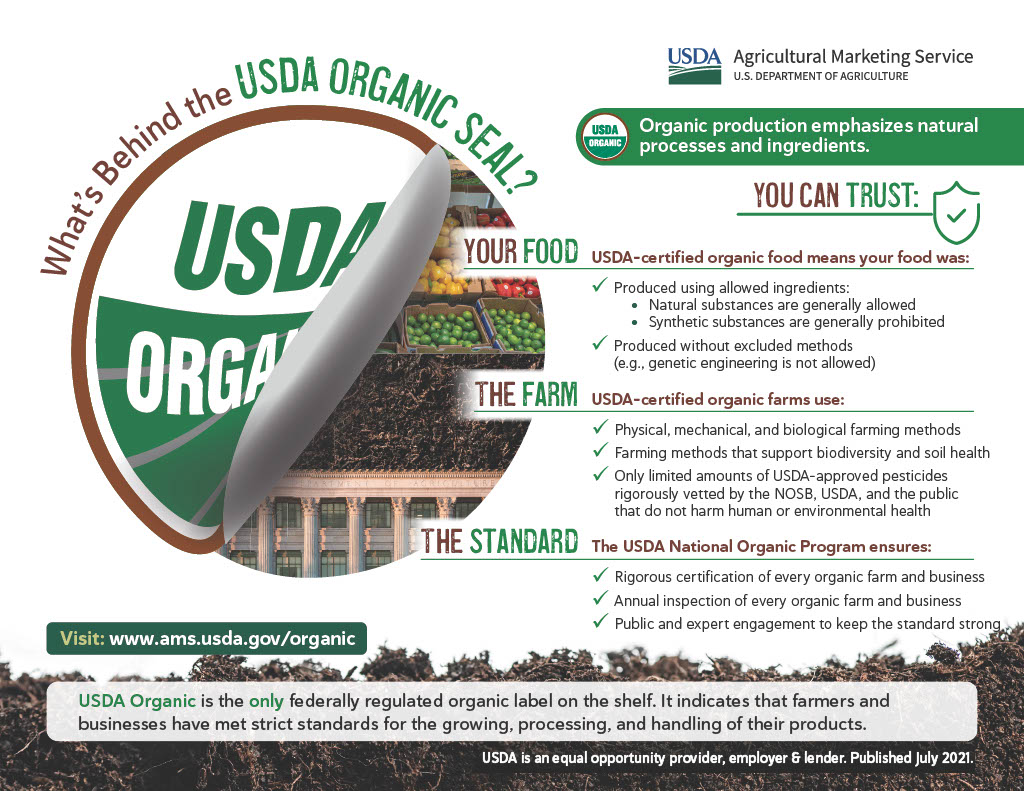
Certified Organic is a USDA-regulated system of agriculture that follows the standards established by the National Organic Program (NOP). Producers must meet specific requirements for their applicable scope of operation—crops, livestock, wild crops, or handling—and obtain certification through a USDA-accredited certifying agent. Once certified, producers can market and sell eligible products as organic, using the USDA Organic seal and labeling claims in accordance with NOP regulations.
All products sold or represented as organic in the United States must be certified by the USDA- NOP.
Do I need to become certified?
If you want to sell agricultural products as organic- YES!
While anyone can benefit from and use organic gardening and farming practices, those wishing to commercially market and sell products as organic must meet USDA certification requirements, with limited exemptions.
Producers with less than $5,000 in annual gross organic sales are exempt from certification but must still follow applicable organic standards and cannot use the USDA Organic seal.
Producers who use organic practices without undergoing certification cannot market their products as organic or use the USDA Organic seal.
The USDA National Organic Program Regulations
Overview of the regulations
The USDA National Organic Program (NOP) standards are a set of federally enforced regulations that define how agricultural products must be grown, raised, handled, and labeled to be sold as organic in the United States. Established under the Organic Foods Production Act of 1990, these standards are federal law, outlined in the Code of Federal Regulations (7 CFR Part 205). They specify which practices and materials are allowed or prohibited, as well as requirements for recordkeeping, inspections, certification, and labeling.In simpler terms: USDA organic isn't just a set of recommended farming practices—it's a legally regulated standard that producers must meet to market and sell products as organic.
Key organic requirements include:
-
- Land management: No prohibited substances for at least three years before organic crop harvest.
- Soil health and fertility: Use crop rotations, cover crops, and approved soil amendments to maintain soil health.
- Pest, weed, and disease management: Prioritize preventive, mechanical, physical, and biological controls; use only approved materials when needed.
- Seeds and planting stock: Use organic seeds and planting stock when commercially available.
- Livestock management: Provide organic feed, outdoor access, pasture for ruminants, and preventive health care
- Approved materials: Use only substances permitted under USDA organic regulations.
- Prohibited practices: No genetic engineering (GMOs), ionizing radiation, or sewage sludge.
- Handling and labeling: Prevent commingling with non-organic products and follow USDA requirements for organic product claims and labeling.
*For more details on organic practices and regulations visit Organic in Practice or the links provided.
Allowed & Prohibited Materials
The USDA National List identifies which substances may and may not be used in organic crop production, livestock production, and food processing and handling. It is part of the federal organic regulations (7 CFR Part 205) and helps producers determine which fertilizers, soil amendments, pest control products, livestock treatments, and other inputs are permitted.In general:
- Natural (nonsynthetic) substances are allowed unless specifically prohibited in the National List.
- Synthetic substances are prohibited unless specifically allowed in the National List.
- Some allowed substances have additional restrictions, such as limits on application rates, approved uses, or conditions of use.
Material Review Organizations
Material review organizations evaluate fertilizers, soil amendments, pest control products, and other agricultural inputs to determine whether their ingredients comply with USDA organic standards. The most well known of these organizations is Organic Materials Review Institute (OMRI). OMRI is an independent nonprofit that reviews products submitted by companies for compliance with the National List. Those that meet its review criteria are listed and can be searched in its online directory. WSDA, the EPA, and your accredited certifying body may also have searchable lists of allowed materials.
An OMRI listing or WSDA registration is a helpful starting point, but not a substitute for certifier approval. Always check with your certifying agent before using a new product, even if it appears on one of these lists. Your certifier makes the final determination for your operation and intended use.
Use of a prohibited material will immediately disqualify land from certification and require you to restart the 36 month transition period. Always check with your certifier BEFORE you apply a material.