
What Are Equine-Assisted Services? A Practical Guide for Families and Communities


Equine-Assisted Services
Highlights
- Equine-assisted services support human education, well-being, or health.
- Research shows that horses can improve people’s mental, physical, and social well-being.
- In the U.S., no regulatory agency currently exists for EAS, but many thirdparty organizations certify professionals to provide services.
- Types of EAS programs include equineassisted learning, adaptive riding, and psychotherapy and physical, occupational, or speech therapy incorporating equines.
- When searching for a program, prioritize those that have a designated structure and clear safety practices that also value the horse’s welfare.
Equine-assisted services (EAS) is an umbrella term describing any service that incorporates horses to support human education, well-being, or health. The human-equine relationship is a long one, starting with humans hunting horses for subsistence and then domestication occurring on the Eurasian steppe around 2200 BCE,1 with arguments existing for even earlier domestication events in different parts of the world. In documented literature, equines have been used intentionally to benefit people cognitively, emotionally, and physically for hundreds of years, gaining in popularity, funding, and research in the last 50 years.
Horses are herd animals, highly attuned to body language and emotions, which can positively influence participants’ emotional learning. Horses are very present animals, meaning they provide immediate, nonjudgmental feedback. Their nature and size can often encourage confidence, responsibility, and self-regulation. While still under active research, preliminary findings about various EAS programs show that they can support mental health (reducing anxiety, depression, PTSD symptoms), physical health (improved core strength, balance, and motor coordination), and social wellness (increased empathy, communication skills, and self-confidence).2,3
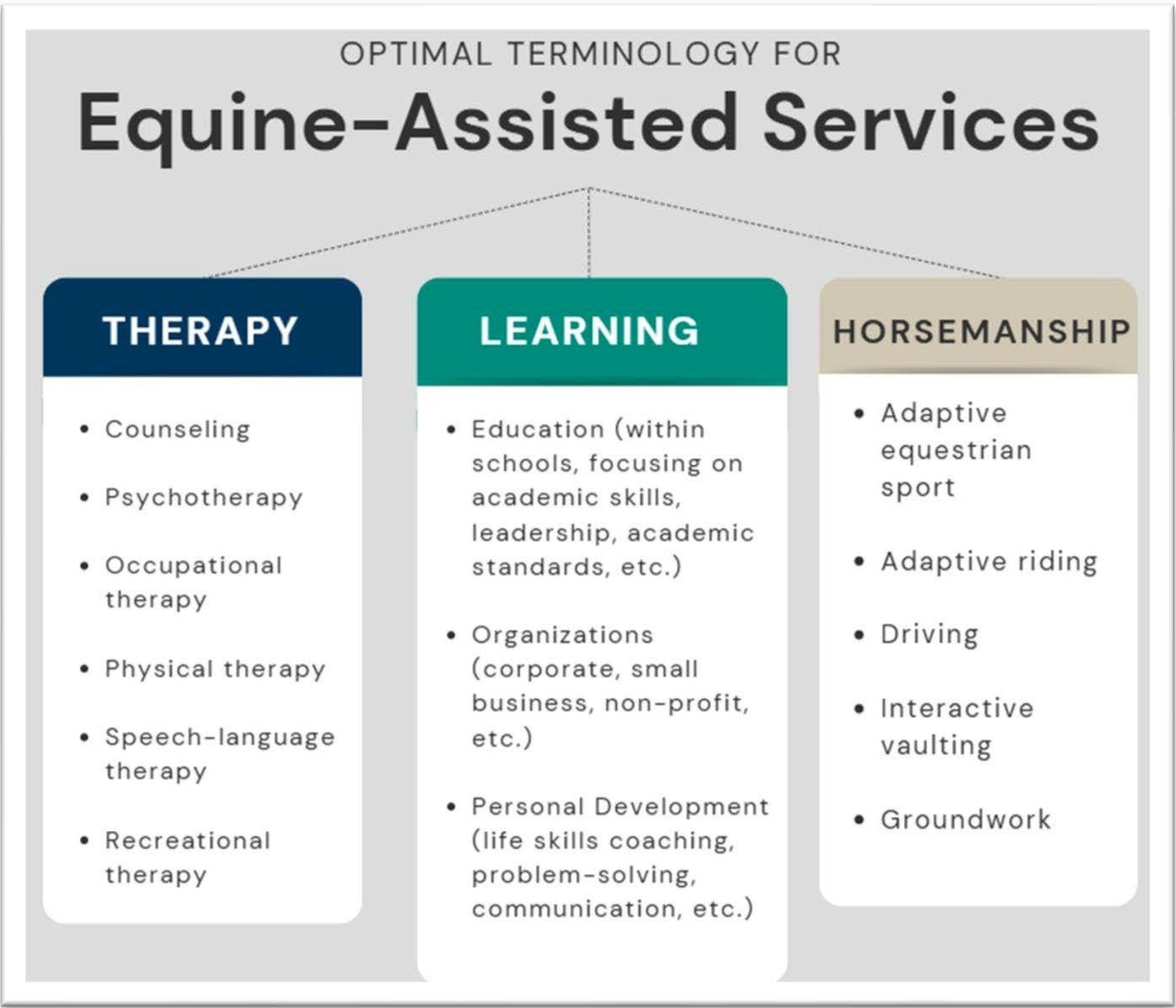
In 2020, several organizations and stakeholders in the equine-assisted services industry came together and agreed on easily defined terms for EAS to provide more consistent and accurate definitions of program. This information can be used for research, programming, and to better educated the public on understanding equine-assisted services. See Figure 1 for more information.
Families and communities who are looking into EAS for themselves or a loved one need to understand these terms, as they will help guide them to the type of program best suited to meet expected needs, as well as help them find quality programs.
Credit: Makenna Pahlke
Note. Identifying which branch of EAS you are participating in can help you also identify which professionals should be providing these services. Therapies must always have a licensed therapist.
Certified Professionals
In the United States, there is no regulatory agency for horsemanship or EAS, so finding programs that are structured to benefit clients in meaningful ways and to manage the welfare for their horses is of utmost importance. However, there are multiple third-party organizations that support education and certification of professionals in the EAS industry. Some examples of such organizations include:
- American Hippotherapy Association (AHA)
- Professional Association for Therapeutic Horsemanship, Intl. (PATH Intl.)
- Certified Horsemanship Association (CHA)
- Horse-Powered Reading (HPR)
- Equine Assisted Growth and Learning Association (EAGALA)
- Natural Lifemanship
- Arenas for Change (ARCH)
You can talk to your local EAS provider about who they are certified with, and if they are not certified, how they gained their experience in providing EAS to the public. Quality staff will participate in ongoing professional development. Each organization offers something different and unique, so this is your opportunity to “shop around” for a program that suits your needs. Staff should be able to explain what outcomes participants might expect from their programs, and the program can share success stories, testimonials, or research connections.
Who Can Benefit From EAS Programs?
Many people can benefit from EAS, especially if you understand the type of program in which you are participating.
Program Types
- Equine-assisted learning (EAL): These activities with horses build life skills, such as communication, leadership, and teamwork in education, personal development, or organizational settings. It should be provided by a learning professional (educator, life coach, etc.) with an equine specialist present.
- Adaptive riding: This program teaches riding skills adapted for individuals of diverse ages and abilities, improving balance, coordination, and confidence. It should be provided by an educated and certified adaptive riding instructor or other qualified riding instructor.
- Psychotherapy incorporating equines: Commonly called equine-assisted psychotherapy, a licensed mental health professional (clinical social worker, therapist, psychotherapist) works with horses and clients for therapeutic purposes.
- Physical/occupational/speech therapy incorporating equine movement: Commonly called hippotherapy, this unique setting uses horse movement as a tool in occupational, physical, or speech therapy sessions. Always delivered by licensed therapists, we recommend it is provided by therapists who have undergone certification.
Program Beneficiaries
Table 1 lists people who can benefit from EAS services.
Table 1. EAS Program Beneficiaries Beneficiary Explanation
| Beneficiary | Explanation |
|---|---|
| Individuals with physical disabilities | People with cerebral palsy, spina bifida, multiple sclerosis, or recovering from strokes can improve balance, coordination, and muscle strength through the horse’s rhythmic movement. Riders with limited mobility often experience increased range of motion and core stability. |
| Individuals with cognitive or developmental disabilities | Those with autism spectrum disorder, Down syndrome, or intellectual disabilities may gain in communication, social interaction, and focus. Structured equine activities can also reinforce life skills and independence. |
| Individuals with emotional or behavioral challenges | Youth or adults struggling with anxiety, depression, ADHD, or trauma can build coping skills, self-regulation, and confidence. Equines’ calm but responsive presence helps model healthy relationships and trust. |
| Veterans and first responders | EAS often supports those dealing with PTSD, moral injury, or reintegration stress, offering a safe, nonjudgmental space for healing. Equines’ sensitivity to human emotion makes them powerful partners in restoring trust and confidence. One example is USU Equine Experience's Valor Detachment, a program that supports military participant horsemanship (Figure 2). |
| At-risk youth and families | Young people navigating difficult home environments, school challenges, or social pressures can develop responsibility, empathy, and resilience. Families can strengthen bonds through shared equine experiences. |
| Older adults and seniors | Equine activities promote mobility, balance, and mental engagement, which are beneficial for aging populations. EAS can also reduce loneliness and provide meaningful purpose. |
| Community and professional groups | Leadership, corporate, and team-building programs use EAS to strengthen communication, collaboration, and problem-solving. |
Find a Quality Program
Prioritize programs that have a designated structure and clear safety practices. Defined rules, participant and volunteer handbooks, appropriately maintained personal protective equipment like riding helmets, emergency procedures, and proper mounting equipment identify a quality program. Equines are carefully matched with participants based on size, temperament, and activity. Equines should always be well-trained, healthy, and regularly evaluated for their suitability for program use. Equines should show calm, relatively predictable behavior and not be overworked or unduly stressed.
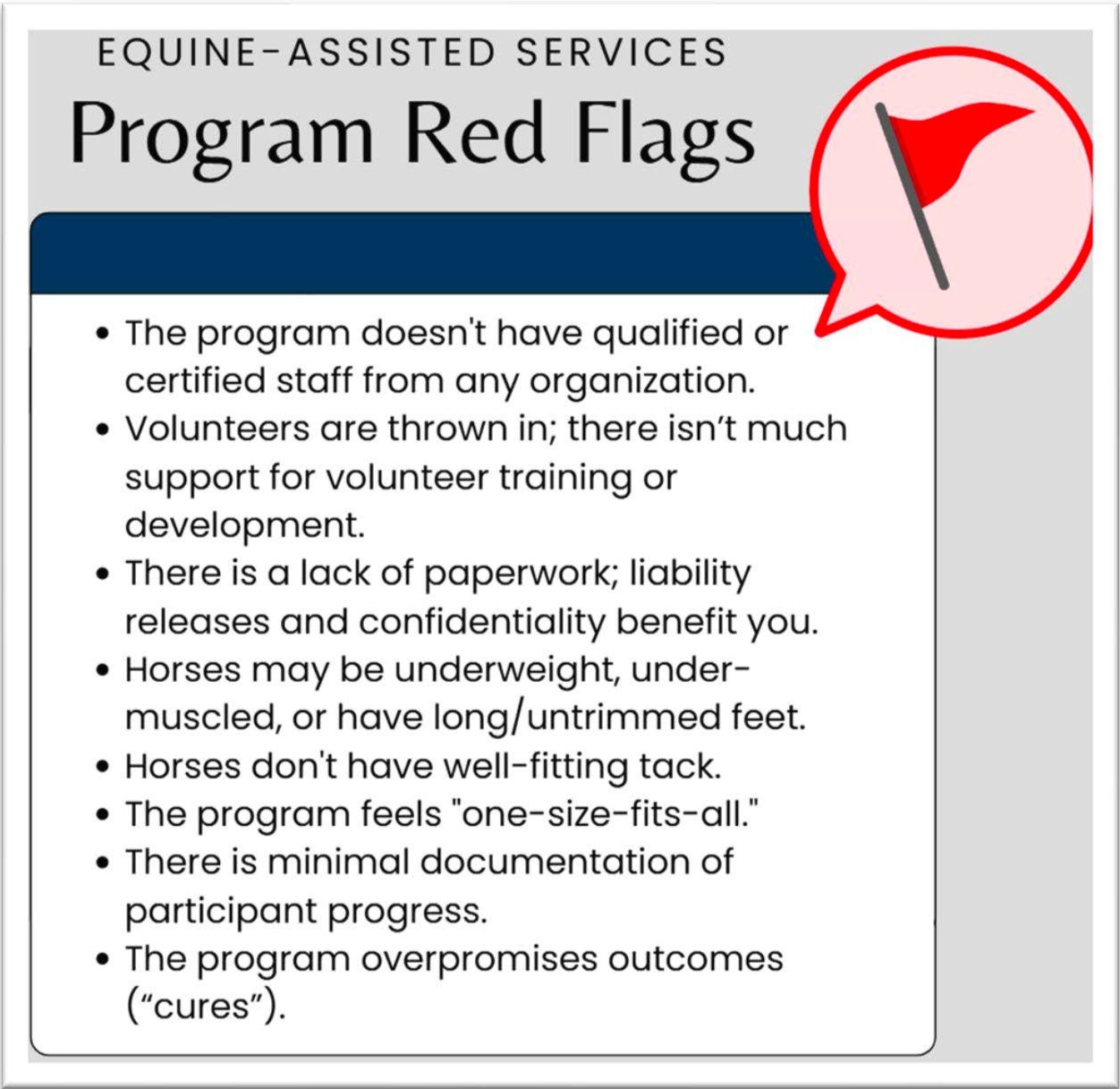
The facilities should be well-maintained with safe fencing, good footing for equines and humans, and clearly separate areas for horse housing and programming. Programs should also connect to their local community, collaborating with schools, healthcare providers, or other community organizations. If the program feels safe, professional, transparent, and horse- and participant-centered, it’s likely a quality program. If things feel unsafe, disorganized, or vague, ask more questions. See Figure 3, which lists some examples of programming lacking quality, and some things to watch out for as an inquiring participant.
Credit: Makenna Pahlke
Note. Paying close attention to the documentation and paperwork processes will help you understand the organization and professionalism of services provided.
Conclusion
Equine-assisted services provide unique opportunities for personal growth, health, and community connection for all, even for those with no equine experience. Understanding the optimal terminology for equine-assisted services will help you select the appropriate program for you or your loved one.
Do your due diligence to select reputable programs that prioritize equine welfare and understand what to expect from sessions. Every program runs sessions differently: some programs are hours-long retreats, some are once-a-week sessions for several months, some offer sessions every other week or multiple times a week. Consider your schedule and commitment carefully, but there is something out there for everyone in equine-assisted services.
References
1Librado, P., Tressières, G., Chauvey, L., Fages, A., Khan, N., Schiavinato, S., Calvière-Tonasso, L., Kusliy, M. A., Gaunitz, C., Liu, X., Wagner, S., Sarkissian, C. D., Seguin-Orlando, A., Perdereau, A., Aury, J., Southon, J., Shapiro, B., Bouchez, O., Donnadieu, C., Running Horse Collin, Y., . . . Orlando, L. (2024). Widespread horse-based mobility arose around 2200 BCE in Eurasia. Nature, 631(8022), 819–825.https://doi.org/10.1038/s41586-024-07597-5
2Ferlazzo, A., Fazio, E., Cravana, C., & Medica, P. (2022). Equine-assisted services: An overview of current scientific contributions on efficacy and outcomes on humans and horses. Journal of Veterinary Behavior, 59, 15–24. https://doi.org/10.1016/j.jveb.2022.11.010
3Holmes, C. M. P., Goodwin, D., Redhead, E. S., & Goymour, K. L. (2011). The benefits of equine-assisted activities: An exploratory study. Child and Adolescent Social Work Journal, 29(2), 111–122.https://doi.org/10.1007/s10560-011-0251-z
4Wood, W., Alm, K., Benjamin, J., Thomas, L., Anderson, D., Pohl, L., & Kane, M. (2020). Optimal terminology for services in the United States that incorporate horses to benefit people: A consensus document. The Journal of Alternative and Complementary Medicine, 27(1), 88–95. https://doi.org/10.1089/acm.2020.0415

November 2025
Utah State University Extension
Peer-reviewed fact sheet
Authors
Makenna Pahlke, USU Extension Equine-Assisted Services

Makenna Pahlke
Equine-Assisted Services Extension Assistant Professor | Cache County
Agriculture and Natural Resources Department