
Vines in the Landscape: Virginia Creeper
Plant Characteristics
Scientific Name
- Parthenocissus quinquefolia
Common Names
- Virginia creeper
- Woodbine
- Five-finger

Virginia creeper (Parthenocissus quinquefolia) is a vigoraouas and aggressive deciduous vine in the grape family (Vitaceae), known for its rapid growth, dense foliage, and striking fall color. Native to eastern and central North America, its natural range extends from southern Canada to much of the United States.
Virginia creeper can climb 50–60 feet, sometimes growing as much as 20 feet in a single season. After unchecked growth over multiple years, Virginia creeper can weigh hundreds of pounds; therefore, a heavy-duty, well-built trellis is required to support it. The trellis should be able to support substantial weight and wind pressure. For a lightweight trellis system, it is wise to prune the plant to keep it in the same shape and size each year. Virginia creeper can also attach to most rough surfaces, such as bark, rock, or masonry, using tendrils tipped with small adhesive pads. Some landscapers consider this plant a nuisance because of its aggressive growth, potential damage to weak structures, and difficulty in removing, but others love it for its potential for erosion control, rapid coverage, fall color, and as a bird and pollinator habitat.

Foliage

Virginia creeper is a broadleaf, deciduous vine with foliage that transforms from rich green in summer to vibrant crimson and purple in fall. The leaves are alternate and palmately compound, typically composed of five obovate-shaped leaflets, each measuring 3 to 6 inches long. The leaf margins are coarsely toothed, with a glossy green upper surface and a paler underside, adding texture and visual interest throughout the growing season (Figure 1).

Flowers
Virginia creeper produces inconspicuous flowers, hidden in the foliage. Flowering time in Utah is usually from June to August. The flowers of Virginia creeper are small, about ¼ inch in diameter, and greenish-white in color. The blooms are insect-pollinated and may be perfect, staminate, pistillate, or a mixture of all three types on a single plant (Figure 2).
Fruits
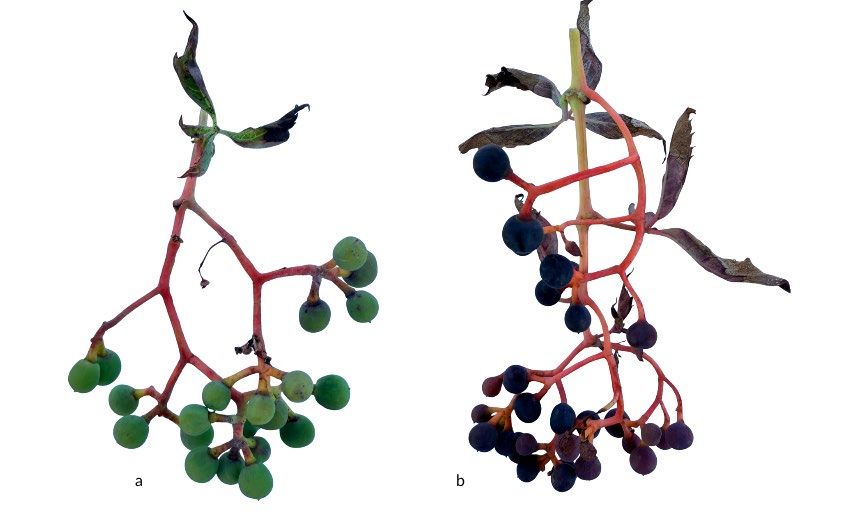
Flowers turn into clusters of bluish-black berries that mature in late summer and often persist into early winter. Each berry contains two to three seeds, and while toxic to humans and domestic animals if consumed in large quantities, it serves as an important food source for birds and small wildlife such as squirrels and chipmunks (Figure 3).
Soil
Virginia creeper thrives in moist, well-drained soils but can also adapt to drier conditions. It is both heatand cold-tolerant and can grow in partial shade or full sun. The older vines are better equipped to handle drought conditions than the younger ones. These vines are commonly found along open clearing borders, fencerows, and streambanks. Additionally, these vines also exhibit a higher tolerance to saline soils.
Planting Guidelines
Virginia creeper is easy to grow and tolerates a wide range of soil and environmental conditions. However, it is essential to understand that this plant is dominant and grows quickly, so it can overtake nearby plants. Virginia creeper is often grown from seeds spread by birds, but they can also be propagated through softwood, semi-hardwood, or hardwood stem cuttings, root cuttings, or layering.
Virginia creeper is usually sold in 1- to 5-gallon containers. To plant vines sold in containers, dig a hole at least twice as wide as the root ball and as deep as the container. Then, gently place the root ball in the hole. Break the root ball if the plant is root-bound, i.e., many visible roots circling the outer edge of the root or the root ball is hard. Fill the hole with the removed soil, water it, and mulch to retain moisture. Finally, loosely attach the vine to a strong trellis or fence system to guide its growth.
Pests and Diseases
Virginia creeper is considered a resilient plant with very few serious pests or diseases. However, it can occasionally be affected by leaf spots, powdery mildew, or fungal leaf blight, especially during humid or crowded conditions. Insects such as aphids, scale, and leafhoppers may feed on the foliage but rarely cause significant damage. Good air circulation, proper spacing, and avoiding overhead irrigation can help minimize moisture issues. Infrequently, beetles and sphinx moth caterpillars may also attack the plant.
Management and Cautions
Virginia creeper requires regular pruning to control its rapid spread. Its adhesive pads can cling tightly and may damage painted or stucco surfaces. The berries are toxic to humans, and the sap can irritate the skin of many pets. Hence, wear gloves when pruning. Without proper management, the plant can easily overwhelm small gardens or climb into trees, becoming difficult to contain.
Look-Alikes
Use a helpful mnemonic to distinguish
between Virginia creeper and poison ivy:
“Leaflets three, let it be;
leaflets five, let it thrive.”
Several vines can be mistaken for Virginia creeper due to their similar growth habits and leaf structures. Poison ivy (Toxicodendron radicans) is one of the most common look-alikes. It has three leaflets and clings to surfaces using hairlike aerial roots, whereas Virginia creeper has five leaflets and climbs using tendrils tipped with adhesive pads. A helpful mnemonic to distinguish them is: “Leaflets three, let it be; leaflets five, let it thrive.” Another similar species is the false Virginia creeper (Parthenocissus inserta), which resembles the Virginia creeper but lacks adhesive pads and climbs by twining around supports instead of adhering directly to surfaces.
Landscape Performance in Utah
Virginia creeper performs well under Utah’s diverse climate conditions, tolerating both the intense summer heat and snowy winters, as well as Utah’s alkaline soils (Figure 4). Older vines are drought-tolerant, but irrigation is required during the establishment phase. The vine’s showy fall color is most vibrant and consistent when plants are thriving and are grown in full sun. Landscapers can use Virginia creeper as a versatile plant that can grow rapidly to cover fences, walls, trellises, and arbors. It can also be grown as a groundcover on slopes for effective erosion control.

Takeaways: USU Greenville Research Farm Virginia Creeper Study
In June of 2023, researchers planted twenty-four 1-gallon Virginia creeper plants at Utah State University’s Greenville Research Farm in Logan, Utah. Each vine had its own trellis and drip irrigation outlet and received ample irrigation, i.e., 80% of reference evapotranspiration (Eto) in the first year.
In 2024 and 2025, vines either received low (two irrigations), medium (four to five irrigations), or high (eight to nine irrigations); however, none of the plant was impacted by irrigation treatments. Despite record snowfall in the winter of 2023–24 and an unusually hot and dry summer in 2025, all vines kept growing vigorously (Figure 5). These findings confirm Virginia creeper’s strong adaptability to semi-arid, high-elevation climates and its suitability for low-water landscaping in the Intermountain West.

Disclaimer
The authors used ChatGPT, a generative AI language model by OpenAI, to assist with brainstorming topics and organizing content for this fact sheet. All final decisions and content were reviewed and verified by the authors, and they take full responsibility for the content. This content should not be used for the purposes of training AI technologies without express permission from the authors.
Photo Credit
The banner photo was purchased from DepositPhotos, and authors provided all other images in the fact sheet.
References
Foster, J. (2025). Virginia creeper – A guide to Parthenocissus quinquefolia [Web log post]. Growit Buildit. Retrieved August 17, 2025, from https://growitbuildit.com/virginia-creeper-parthenocissus-quinquefolia
Lady Bird Johnson Wildflower Center. (2025, March 13). Parthenocissus quinquefolia (Virginia creeper). The University of Texas - Austin. https://www.wildflower.org/plants/result.php?id_plant=PAQU2
National Plants Database. (USDA NRCS). (2005). Virginia creeper (Parthenocissus quinquefolia) plant guide. Natural Resources Conservation Service, U.S. Department of Agriculture. https://plants.usda.gov
North Carolina State Extension. (n.d.). Parthenocissus quinquefolia (Virginia creeper). Retrieved October 10, 2025, from https://plants.ces.ncsu.edu/plants/parthenocissus-quinquefolia/
OpenAI. (2025). ChatGPT (Version GPT-5) [Large language model]. Retrieved October 13, 2025, from https://chat.openai.com

February 2026
Utah State University Extension
Peer-reviewed fact sheet
Authors
Saroj Burlakoti, Youping Sun, Ph.D., and Shital Poudyal, Ph.D.

Shital Poudyal
Assistant Professor | Ornamental Horticulture Specialist
Plants, Soils and Climate
Related Research
Are Organic Matter Soil Amendments Created Equal?
Each class of material has specific characteristics and management issues when it comes to using it as a soil amendment.
Backyard Composting in Utah
The benefits of using compost as a soil amendment include increasing soil tilth, fertility, water holding capacity, aeration, and drainage.
Gardening in Sandy Soils
Learn the basics of clay, silt and sand soils with an emphasis on gardening in soils with high sand content. Get tips for gardening tips for managing sandy soils, and the types of plants that grow best in sandy soils.
It's All About Soil Structure!
The single best soil amendment—the one that provides desirable benefits regardless of the soil one applies it to—is organic matter.

Policies and Programs for Water-Wise Residential Landscaping in Utah
Water-wise landscaping is the practice of using plants in a landscape that are adapted to local conditions and only need small amounts of water. Converting yards to water-wise landscaping conserves water and is a climate adaptation action residents can ta

Preparing and Improving Garden Soil
A great garden starts with healthy soil. In Utah, there are unique considerations for creating and maintaining healthy soils.