
Vines in the Landscape: Goldflame Honeysuckle
Plant Characteristics
Scientific Name
- Lonicera × heckrottii ‘Goldflame’
Common Names
- Hybrid honeysuckle
- Goldflame honeysuckle

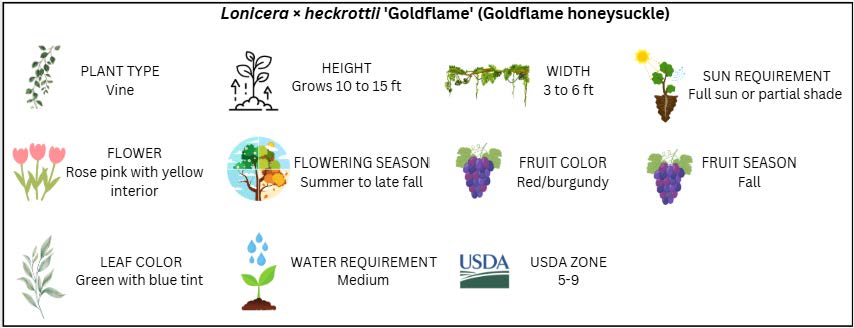
Goldflame honeysuckle (Lonicera × heckrottii 'Goldflame') is a twining vine that produces clusters of fragrant flowers from summer to late fall. It is deciduous in colder climates but semi-evergreen in warmer climates, where foliage may persist during mild winters. This hybrid ornamental vine is derived from a cross between two eastern U.S. native species: L. sempervirens and L. americana. It belongs to the genus Lonicera, which originates from the temperate regions of the Northern Hemisphere, with its greatest diversity found in East Asia.
Goldflame honeysuckle is a moderately growing vine with a mature height of 10–15 feet and can spread around 3–6 feet in a single growing season. It grows well on fences, arbors, and trellises; however, canopy coverage is usually sparse and may not be suitable as a privacy screen. The vine grows well in full sun and well-drained soil, attracting hummingbirds and butterflies throughout the blooming season. It is hardy in USDA zones 5–9. Unlike Japanese honeysuckle (L. japonica), Goldflame honeysuckle is non-invasive and does not aggressively spread by runners.
Foliage

Most of the leaves of this honeysuckle are simple, opposite, but the uppermost leaves may be connate. Leaves are oblong to elliptical in shape (up to 2 inches long), smooth, and bluish-green above with a slightly pale underside. The young leaves are bright green, which gradually matures to a deeper blue-green hue. Leaves grow directly from reddish stems (Figure 1).
Flowers
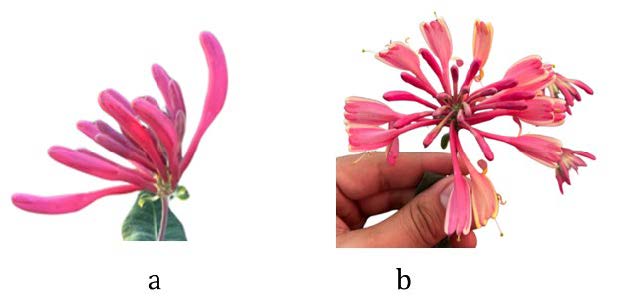
Flowers are 1 to 3 inches long, tubular, rose-pink in color, with yellow interiors that bloom at the terminal whorls. Goldflame is a vigorous cultivar producing abundant flowers with intense coloring. The flowers are attractive and start appearing in early summer, peak at midsummer, and remain showy until early fall, with occasional late fall blooms. Each flower is formed from fused petals and ends in five small lobes arrangements, and the blooms are held in whorls on showy, leaf-like bracts. The flower blooms more profusely in full sun compared to shaded locations. These flowers also produce a mild fragrance and attract butterflies and hummingbirds (Figure 2).
Fruits
Goldflame honeysuckle is a hybrid cultivar, so it rarely produces fruit. When produced, the fruits are small red berries that grow up to about ¼ inch and usually appear in the fall. Fruits are inedible.
Soil
Honeysuckle thrives in fertile, moist, and well-drained soil but can also tolerate drought conditions. It prefers neutral to slightly acidic soils ranging from pH 5.5 to 7, however it can also perform well in neutral to slightly alkaline soil with pH of 7 to 8.
Planting Guidelines
Goldflame honeysuckle is easy to grow and is adapted to a wide range of soil and environmental conditions. For best success, plant in early spring or late fall. Space plants 5–6 feet apart, depending on the training method and desired spread. Honeysuckle can be propagated from softwood or semi-hardwood cuttings in summer or bought as a container plant. When planting from a container, if the plant is root-bound, gently loosen or tease apart the roots to encourage outward growth. Make sure the root ball is moist, place the roots in the hole and backfill with soil. Firm ground gently around the roots. Irrigate well during establishment to encourage strong root growth and planting success. Install a trellis or support structure at or before planting and use horizontal wires or slats to help the vine twine naturally.
Follow standard fertilization guidelines based on a soil test or manufacturer’s recommendation. Using a slow or smart-release fertilizer granule with micronutrients is advisable and can be done in late fall or early spring before new growth begins.
Pests and Diseases
Goldflame honeysuckle is considered resilient and low-maintenance, with very few serious pest or disease problems. However, powdery mildew, leaf spot, leaf blight, and aphids can occasionally affect it. If planted in areas with standing water, it may develop root rot.
Good air circulation and proper plant spacing are crucial in preventing powdery mildew, which thrives in overcrowded or humid conditions. Avoid overhead irrigation and keep foliage dry to reduce the risk of leaf spot and other fungal leaf diseases. Plant in well-drained soil and avoid waterlogged areas to prevent root rot, which occurs when roots remain in saturated conditions. Regular scouting of foliage, especially at the tips, will allow early detection of pests and diseases so they can be treated promptly before damage spreads.
Management and Cautions
Goldflame honeysuckle is not an invasive vine in most of the U.S.; however, it can become vigorous with age and may require occasional pruning to keep it within its intended space. Pruning, if needed, should be done during early spring or late fall. It does not cling to walls or smooth surfaces, but can grow well on arbors, pergolas, fences, trellises, and other structures that provide support for its twining stems. The vine’s young shoots are tender and can break easily, so handle the plant carefully during pruning and training.
Landscape Performance in Utah
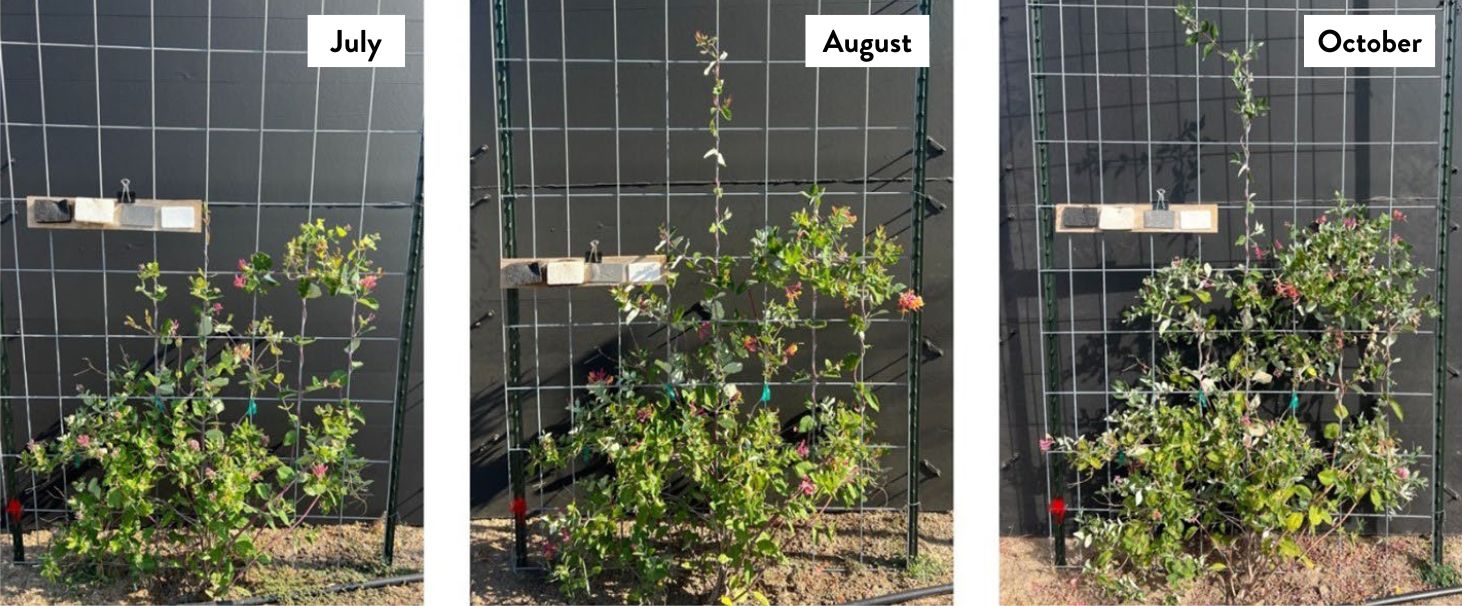
Goldflame honeysuckle thrives in Utah’s varied climate, tolerating both the intense summer heat and snowy winters, as well as moderately alkaline soil conditions. Once established, the vine is moderately drought-tolerant and low maintenance (Figure 3). It produces fragrant, tubular rose-pink flowers with a yellow interior and attracts hummingbirds, bees, and butterflies. It is considered rabbit- and deer-resistant. It has a moderate growth rate in Utah and adds colorful seasonal accents to landscape designs. In landscapes, it is ideal for patios, rock walls, vertical spaces, and walkways, fitting beautifully into cottage or pollinator gardens as a border or specimen plant.
Research Performance: USU Greenville Study
In June of 2023, researchers planted twenty-four 1-gallon honeysuckle plants at Utah State University’s Greenville Research Farm in Logan, Utah. Each vine had its own trellis and drip irrigation outlet and received ample irrigation, i.e., 80% of reference evapotranspiration (Eto) in the first year.
In 2024 and 2025, vines either received low (two irrigations), medium (four to five irrigations), or high (eight to nine irrigations) each season; however, no differences in plant growth and survival were observed among different irrigation treatments. Despite record snowfall in the winter of 2023–24 and an unusually hot and dry summer in 2025, all vines maintained vigorous growth (Figure 4). These findings confirm Goldflame honeysuckle’s strong adaptability to semi-arid, high-elevation climates and its suitability for low-water landscaping in the Intermountain West.

Disclaimer
The authors used ChatGPT, a generative AI language model by OpenAI, to assist with brainstorming topics and organizing content for this fact sheet. All final decisions and content were reviewed and verified by the authors, and they take full responsibility for the content. This content should not be used for the purposes of training AI technologies without express permission from the authors.
Photo Credit
The authors provided all the images for this fact sheet.
References
Missouri Botanical Garden. (n.d.). Lonicera × heckrottii ‘Gold Flame’ (honeysuckle). https://www.missouribotanicalgarden.org/PlantFinder/PlantFinderDetails.aspx?kempercode=b839
Monrovia Nursery Company. (n.d.). Goldflame honeysuckle (Lonicera × heckrottii ‘Goldflame’). https://www.monrovia.com/goldflame-honeysuckle.html
North Carolina State University Cooperative Extension. (n.d.). Lonicera × heckrottii. https://plants.ces.ncsu.edu/plants/lonicera-x-heckrottii/
OpenAI. (2025). ChatGPT (Version GPT-5) [Large language model]. Retrieved January 30, 2026, from https://chat.openai.com
February 2026
Utah State University Extension
Authors
Saroj Burlakoti, Youping Sun, Ph.D., and Shital Poudyal, Ph.D.

Shital Poudyal
Assistant Professor | Ornamental Horticulture Specialist
Plants, Soils and Climate
Related Research
Are Organic Matter Soil Amendments Created Equal?
Each class of material has specific characteristics and management issues when it comes to using it as a soil amendment.
Backyard Composting in Utah
The benefits of using compost as a soil amendment include increasing soil tilth, fertility, water holding capacity, aeration, and drainage.
Gardening in Sandy Soils
Learn the basics of clay, silt and sand soils with an emphasis on gardening in soils with high sand content. Get tips for gardening tips for managing sandy soils, and the types of plants that grow best in sandy soils.
It's All About Soil Structure!
The single best soil amendment—the one that provides desirable benefits regardless of the soil one applies it to—is organic matter.

Policies and Programs for Water-Wise Residential Landscaping in Utah
Water-wise landscaping is the practice of using plants in a landscape that are adapted to local conditions and only need small amounts of water. Converting yards to water-wise landscaping conserves water and is a climate adaptation action residents can ta
Preparing and Improving Garden Soil
A great garden starts with healthy soil. In Utah, there are unique considerations for creating and maintaining healthy soils.