
Tips for Growing Garden Vegetables in Utah: Soil Fertilization
Highlights
- When preparing to plant, base fertilizer applications on soil test recommendations and crop nutrient requirements.
- Organic fertilizers are animal- or plant-based and range from rapid to slow nutrient release and require careful selection to meet plant requirements throughout the season.
- Synthetic fertilizers, produced through industrial processes, can provide precise concentrations, but there are risks for misuse.
- Broadcasting fertilizers is faster to apply but less efficient than banding.
- Improper fertilizer use can lead to surface and groundwater pollution, trigger nutrient deficiencies or toxicities in plants, and cause salt injury.
- Nutrient requirements should be calculated based on the specific needs of each vegetable species.
Successful vegetable gardens require precise nutrient management to achieve maximum yields. Fertilization must provide adequate nutrients to support plant growth throughout the season. Fertilizer applications should be based on soil test recommendations and crop nutrient requirements. This fact sheet provides Utah gardeners with practical guidance and tips on soil fertilization for vegetable gardening.
Soil Testing
Soil tests determine the current levels of plant-available nutrients in the soil and provide the basis for estimating fertilizer needs to support optimal plant growth. When soil fertility falls below optimum levels, plant growth and yields are reduced. Regular testing can help gardeners improve and maintain yields, as well as avoid problems from overapplication of fertilizers. A basic soil test assesses soil texture (sand, silt, and clay composition), pH, salinity, as well as the most important nutrients: nitrogen (N), phosphorus (P), and potassium (K) levels (Figure 1). Contact your local county Extension agent for guidance on proper soil sampling and interpretation. For soil testing, visit Utah State University Analytical Laboratories (USUAL).
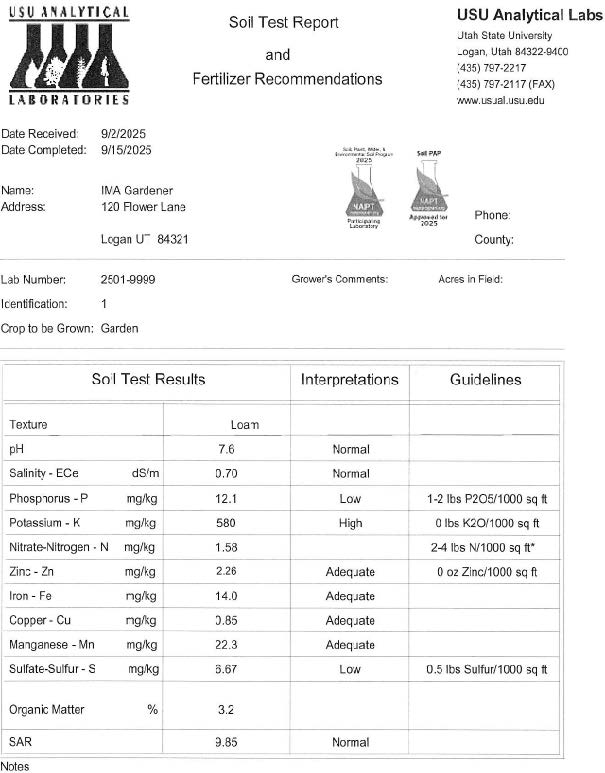
Source: USU Analytical Laboratories, 2025
Organic vs Synthetic Fertilizers
Organic
Organic fertilizers are animal and/or plant-based solid waste such as compost, manure, bone meal, blood meal, fish emulsion, and seaweed extract, which possess specific chemical compositions and nutritional value, supplying sufficient nutrients for plant growth and development. Organic fertilizers vary in nutrient content and release rate. Some materials, such as poultry manure and blood meal, are considered high-nutrient fertilizers because they release nutrients rapidly. Others, including composted livestock manure and mixed composts, provide a more balanced nutrient supply. Materials such as straw mulch, wood chips, leaf compost, and wool pellets are considered slow-release sources that gradually improve soil fertility and organic matter over time. Ensure that nutrient release rates align with plant requirements.
Synthetic
On the other hand, inorganic or chemical fertilizers can be based on the following: nitrogen, phosphate, potassium, nitrogen-phosphorus-potassium (NPK), calcium, and sulfur. These fertilizers are produced synthetically through industrial processes. While inorganic fertilizers provide nutrients at precise concentrations, they are highly soluble, and their misuse can lead to nutrient imbalances, soil degradation, human health risks, and potential greenhouse gas release.
Choosing and Applying Fertilizers in the Garden
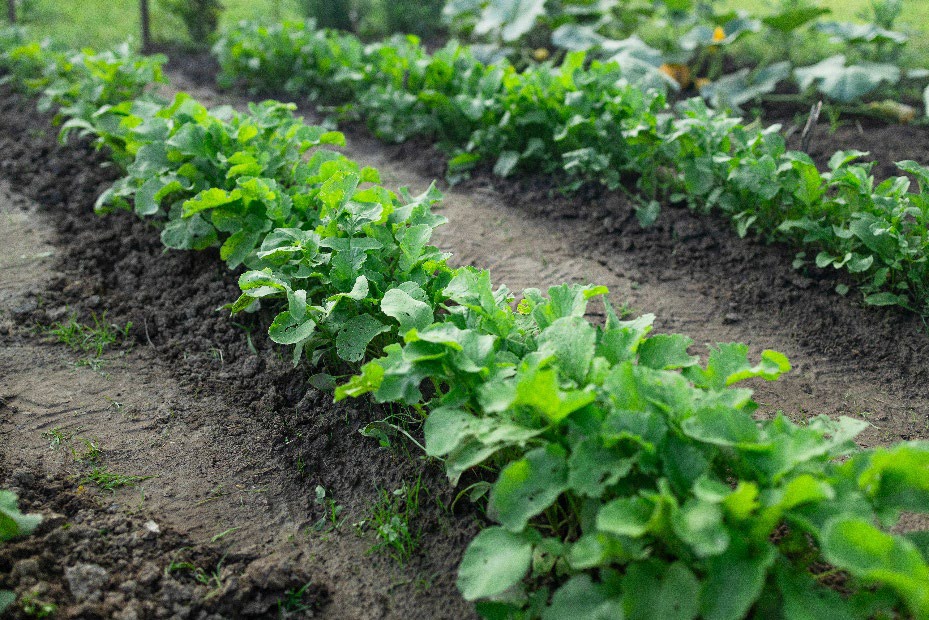
Appropriate fertilizer application methods ensure crops in the garden receive nutrients efficiently. Avoid placing fertilizer too close to seeds or transplants, as fertilizer salts can injure germinating seeds or damage the young roots of transplants. With the banding method, fertilizers are placed in the root zone by applying 2–3 inches beside and 1–2 inches below the planting depth which encourages vigorous growth. For example, place 2–3 tablespoons of a balanced fertilizer, such as 16-16-8, at the recommended location. Side-dressing can also be used to provide nutrients throughout the growth and development of long-season crops. Apply ½ cup of ammonium sulfate or ¼ cup of urea per 10 feet of row. Broadcasting fertilizers is faster, but less efficient than banding or side dressing. It can also encourage weed growth between the rows, as weeds receive the same amount of fertilizer as the garden crops. Just before planting, uniformly apply 10–12 pounds of a complete fertilizer, such as 16-16-8, per 1,000 square feet, and incorporate it into the soil surface by raking or rototilling. Ensure that fertilized areas are watered well to move fertilizers into plant root zones.
Improper fertilizer use can lead to surface and groundwater pollution, create nutrient deficiencies or excess buildup that can cause salt injury. With proper application, both organic and inorganic fertilizers are safe for plants and the environment. Applying the “4R” nutrient management principles—right source (type of fertilizer), right rate (application rate), right place (application method), and right time—can improve nutrient use efficiency and reduce environmental losses. For more information, see the SMART Nutrient Management Plan (Natural Resources Conservation Service, n.d.).
Fertilizer Rate Calculations
Nutrient recommendations for garden areas are typically expressed in pounds per 1,000 square feet (Figure 1). Garden areas typically vary in size and are not exactly 1,000 square feet. Therefore, when calculating the required amount of fertilizer, besides soil test recommendations, consider fertilizer nutrient content and field size. Nutrient requirements should be calculated based on the specific needs of each vegetable species. See the nitrogen requirements in Table 1.
Table 1. Vegetable Crops Categorized by Nitrogen Requirement (Low, Medium, High)
| General requirements | Vegetables | Recommendation |
|---|---|---|
| Low | Peas, beans | 1 to 2 pounds of nitrogen/1,000 sq ft |
| Intermediate | Asparagus, beet, carrot, melon, cauliflower, broccoli, Brussels sprouts, celery, pepper, tomato, lettuce, radish, spinach, turnip, squash, pumpkin |
2 to 3 pounds of nitrogen/1,000 sq ft |
| High | Onion, sweet corn, potato | 4 to 6 pounds of nitrogen/1,000 sq ft |
Fertilizer Formula
To calculate the area to be fertilized, measure its length and width, either by pacing or with a measuring tape. Walking areas between rows or beds should not be used in the calculation. A simple formula for calculating the amount of fertilizer needed to meet a nutrient recommendation is:
| Fertilizer needed (lb) = |
|
× |
|
× | Z sq ft |
Where:
- X = Nutrient recommendation from a soil test report (typically expressed in pounds/1,000 sq ft).
- Y = Percent of the nutrient in the fertilizer divided by 100.
- Z = Total area to be fertilized (sq ft).
For additional detail, see USU Extension's Selecting and Using Inorganic Fertilizers (Koenig & Rupp, 2011).
Example
A gardener plans to apply compost (2-2-0.5) to supply 4 pounds of nitrogen per 1,000 square feet, as recommended by a soil test (Figure 1). If the targeted garden area is 96 square feet, how much compost should be applied? The same gardener also noticed from the soil test that 2 pounds of phosphorus per 1,000 square feet was recommended (Figure 1). How much phosphorus should also be applied?
Solution 1, Nitrogen Requirement
- X = 4 pounds of required nitrogen
- Y = 0.02 (the nitrogen concentration expressed as a decimal from 2%)
- Z = 96 square feet of garden area
After following the calculation described above, approximately 19 pounds of compost would be needed for the 96-square-foot garden area.
Solution 2, Phosphorus Requirement:
Because the compost is 2-2-0.5, it contains 2% phosphorus. If the soil test recommendation is 2 pounds of phosphorus per 1,000 square feet, then:
- X = 2 pounds of required phosphorus
- Y = 0.02 (the phosphorus concentration expressed as a decimal from 2%)
- Z = 96 square feet of garden area
After following the calculation described above, approximately 9.6 pounds of compost would supply the 2 pounds of phosphorus requirement for the 96-square-foot garden area. If the gardener had applied approximately 19 pounds of compost to satisfy the nitrogen requirement, the phosphorus recommendation would have been exceeded. Repeated compost applications based solely on nitrogen needs may result in excessive phosphorus accumulation and increased salt buildup in the soil over time. Other sources of only nitrogen are available and can be applied separately to meet the recommended amounts.
One option would be to use wool pellets (9-0-2) as the primary nitrogen source since they contain no phosphorus. The gardener could then separately apply Triple Super Phosphate (0-45-0) to meet the phosphorus recommendation. Using the calculation described above, approximately 0.43 pounds of Triple Super Phosphate would be needed to supply the recommended 2 pounds of phosphorus per 1,000 square feet for the 96-square-foot garden area.
References
Hatch, D. (1990). Fertilizing for a successful garden [Fact sheet]. Utah State University Extension. https://extension.usu.edu/yardandgarden/files/HG_H_02.pdf
Koenig, R., & Rupp, L. (2011). Selecting and using inorganic fertilizers [Fact sheet]. Utah State University Extension. https://extension.usu.edu/yardandgarden/research/selecting-and-using-inorganic-fertilizers
Natural Resources Conservation Service. (n.d.). Nutrient management. U.S. Department of Agriculture. https://www.nrcs.usda.gov/getting-assistance/other-topics/nutrient-management
Nick, J. M. A., & Marshall Bradley, F., & Atthowe, H. (Eds.). (1994). Growing fruits & vegetables organically: The complete guide to a great-tasting, more bountiful, problem-free harvest. Rodale.
Utah State University Extension. (2016). Vegetables, fruits & herbs. https://digitalcommons.usu.edu/extension_curall/819
Wagner, K., Stock, M., & Sagers, L. (2020). Preparing and improving garden soil [Fact sheet]. Utah State University Extension. https://extension.usu.edu/yardandgarden/research/preparing-and-improving-garden-soil
The authors used no generative AI in the creation of this content, and it is solely the work of the authors.
July 2026
Utah State University Extension
Authors
Gastone Makalaya, Josh Martin, and Milena M. T. de Oliveira

Josh Martin
Professional Practice Extension Assistant Professor | Horticulture | Iron County
Agriculture and Natural Resources

Milena Oliveira
Assistant Professor, Vegetable Extension Specialist
Related Research