
Exploring Biostimulant Efficacy for Onion Cultivation Under Limited Water and Nitrogen in Utah
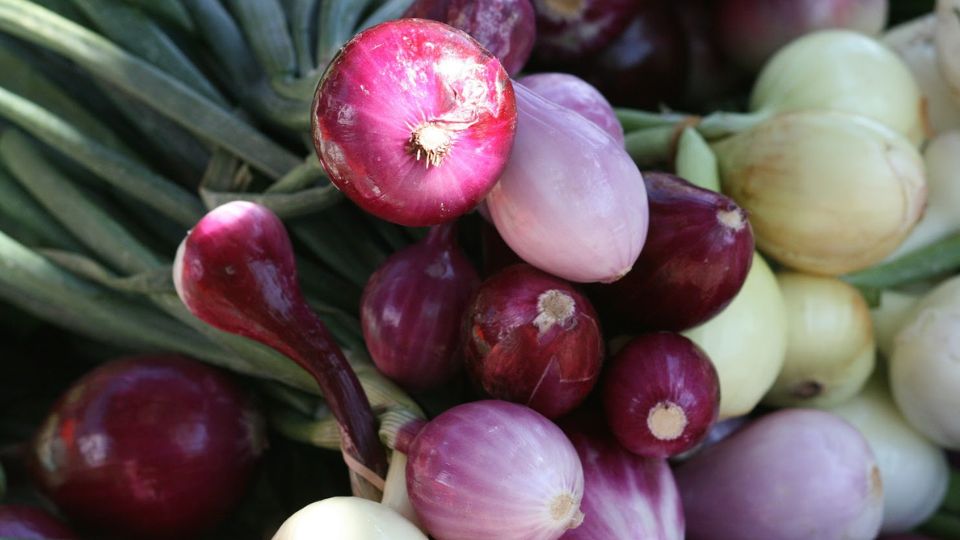
Onion Cultivation Under Utah’s Agricultural Challenges
Highlights
- Onions (Allium cepa L.) are valued for their economic importance, culinary versatility, and nutritional benefits.
- In Utah, late season water shortages make efficient irrigation management crucial to sustaining crop productivity.
- Onions are especially vulnerable to water scarcity due to their shallow root systems.
- Innovative agricultural solutions are necessary to enhance water use efficiency and optimize nitrogen management.
- Biostimulants are natural or microbial products that enhance plant health, improve stress resilience, and boost nutrient uptake efficiency.
Utah, the second driest state in the U.S., faces significant challenges in agricultural production due to its arid climate and unpredictable precipitation patterns. Approximately 95% of Utah’s water supply originates from mountain snowpack, making the state’s agricultural sector particularly vulnerable to drought conditions and climate variability. In semi-arid regions like Utah, late-season water shortages exacerbate this issue, making efficient irrigation management crucial to sustaining crop productivity.
Onions (Allium cepa L.) are a globally significant vegetable crop valued for their economic importance, culinary versatility, and nutritional benefits. They are cultivated in diverse climates, from temperate to tropical regions. However, onions are especially vulnerable to water scarcity because their shallow root systems are concentrated in the top 12 inches (30 cm) of soil. This makes them highly susceptible to water stress, particularly during the critical stages of bulb formation and enlargement.
In addition to water-related challenges, nitrogen deficiency poses a major constraint to onion production. Nitrogen is a key nutrient that influences leaf expansion, bulb development, and overall yield. However, insufficient nitrogen can stunt growth and delay maturity, while excessive nitrogen can produce soft bulbs, reduce storage quality, and increase the risk of nitrogen leaching. In addition, the timing of nitrogen application is especially critical in onions, as uptake is most efficient during the early vegetative phase and prior to bulb initiation. To optimize nitrogen use efficiency, it is generally recommended to apply nitrogen in split doses, timed to coincide with the key growth stages, typically beginning 2–4 weeks after planting and continuing through the onset of bulb initiation.
Role of Biostimulants
Innovative agricultural solutions are necessary to enhance water use efficiency and optimize nitrogen management. One such promising approach is using plant biostimulants. Biostimulants are natural or microbial products that enhance plant health, improve stress resilience, and boost nutrient uptake efficiency. Biostimulants can be broadly categorized into microbial and nonmicrobial types, with many products containing multiple species or components that contribute synergistically to plant performance.
- Macrobial biostimulants (beneficial bacteria and mycorrhizal fungi) enhance nutrient availability by fixing nitrogen, stimulating root growth, increasing plant stress tolerance, and extending root systems.
- Nonmicrobial biostimulants (humic acids and seaweed) improve nutrient retention, aeration, water holding capacity, promote cell division, root elongation, and stress tolerance.
Microbial biostimulants include formulations based on beneficial bacteria and mycorrhizal fungi. Bacteria-based biostimulants contain beneficial microbes that enhance nutrient availability by fixing nitrogen, stimulating root growth, and increasing plant stress tolerance. Mycorrhizal fungi establish a symbiotic relationship with plant roots, extending the root system and improving access to water and nutrients. Some products contain only a few microbial species, while others include a wide range of strains, offering broader functionality and adaptability across diverse soil and environmental conditions.
Nonmicrobial biostimulants, such as humic acids and seaweed extracts, contribute to plant health through different mechanisms. Humic acids contribute to soil fertility by improving nutrient retention, aeration, and water holding capacity, while stimulating root growth and microbial activity, leading to improved nutrient use efficiency and stress resilience. Seaweed extracts, derived from marine algae, are rich in natural growth hormones that promote cell division, root elongation, and stress tolerance.
Incorporating biostimulants into onion production systems could help growers increase crop resilience, improve resource use efficiency, and enhance sustainable farming practices in regions prone to drought and nutrient limitations.
Case Studies in Utah
Utah State University (USU), in collaboration with local growers, tested the efficacy of biostimulants for onion cultivation in Utah. Two case studies were conducted: (1) On-farm trials, which compared biostimulants against local farmer practices, and (2) USU biostimulant research trials, which tested biostimulants under limited water and nitrogen conditions.
1. On-Farm Trials
Trials were conducted on two commercial onion farms in Utah in collaboration with local growers. Seven biostimulants (Figure 1) were used, including:
- Three bacterial (Continuum [Impello Biosciences], Spectrum DS [Taino Biologicals Inc.], Tribus Original [Impello Biosciences])
- Two mycorrhizal (Myco Apply [Mycorrhizal Applications], Mighty Mycorrhizae [Wildroot Organic])
- One humic-acid based (Huma Pro 16 [Bio Huma Nectics Inc.]), and
- One seaweed-based (Kelpak seaweed [Kelp Products Pty Ltd.])
All biostimulants, except Seaweed, were applied to the soil using a watering can, starting when plants had at least six to seven leaves, while Seaweed was applied as a foliar spray at the same growth stage. Tribus Original and Continuum were applied weekly, while Seaweed foliar sprays were applied every 2 weeks, and Huma Pro 16 was applied every 4 weeks. The remaining biostimulants (Spectrum DS, Myco Apply, and Mighty Mycorrhizae) were applied once during the season. A non-treated control plot was included for comparison to assess the effects of each biostimulant relative to untreated plants.
Figure 1. Biostimulants Used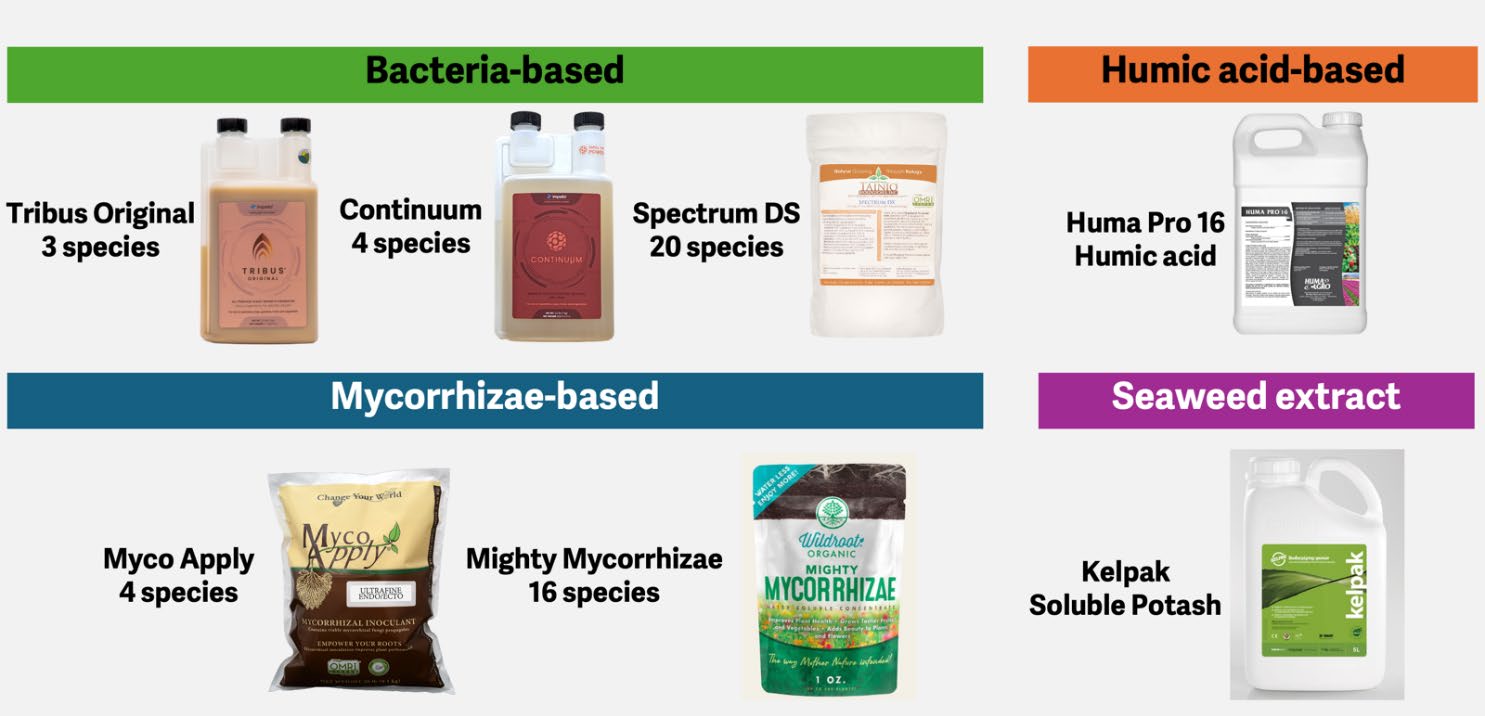
2. USU Biostimulant Research Trials
Trials were conducted in 2024 at USU Kaysville Research Farm. Following prior greenhouse screening for seedling vigor, two biostimulants were selected for field evaluation: a humic acid-based (Huma Pro 16) and a bacteria-based (Spectrum DS) biostimulant. A non-treated control was included for comparison. Field trials were conducted using four onion cultivars: ‘Bridewhite’ (white), ‘Marenge’ (red), ‘Vaquero’ (yellow), and ‘Walla Walla’ (sweet). The experimental plots were established on raised beds with common cultivation practices, as outlined in the Utah Vegetable Production Guide. To simulate stress conditions, two water treatments were applied for 1 month, starting in early August: a wet treatment (100% of reference evapotranspiration [ETr]) and a deficit treatment (75% of ETr).
In a separate trial, nitrogen stress was introduced through two fertilization levels. A recommended rate (150 lbs⋅ac-1) and a reduced rate (100 lbs⋅ac-1) were applied in three split doses during June and early July.
Harvest
Bulbs from the on-farm trials were harvested in late August, whereas those from the USU Kaysville trial were harvested in mid-September, following standard farming practices. The bulbs were sorted based on market class: colossal (4 inches or larger), jumbo (3–4 inches), medium (2.25–3 inches) and small (< 2.2 inches), with weights recorded for each category. For the commercial growers involved in the on-farm trials, results were averaged across two sites.
Findings
1. On-Farm Trials
The findings represent the average of two farm trials. As shown in Table 1, among the biostimulant treatments, Spectrum produced the highest total yield of 111,583 lbs·ac-1, with majority of the onions classified as colossal (37%) and jumbo (61%) bulbs. Continuum followed with 98,554 lbs·ac-1, yielding primarily jumbo (68%) and medium (23%) onions, but with fewer colossal (8%) bulbs. Humic also performed well with the total yield of 97,649 lbs·ac-1, with 75% of the yield in the jumbo category and no small onions. Seaweed resulted in a lower total yield of 78,042 lbs·ac-1 and produced the highest proportion of jumbo onions (82%) and no small bulbs. The lowest yield was Mighty Mycorrhizae (77,386 lbs·ac-1), although most of its onions were still in the jumbo class (61%). In comparison, no biostimulant (current farmer practice) yielded 103,891 lbs·ac-1, with 26% colossal and 54% jumbo onions.
Across the biostimulant treatments, the jumbo class consistently dominated, indicating that most biostimulants enhanced production of market-preferred bulb sizes. The lowest production of medium (1%) and small (1%) onions were observed in Spectrum, suggesting this treatment may be effective in shifting production toward larger-sized bulbs, which are desired by the local producers.
Table 1. Onion Yield by Market Class with Seven Types of Biostimulants Treatments
| Biostimulants | Total (lbs·ac-1) | Yield distribution by market class (%) | |||
|---|---|---|---|---|---|
| Colossal | Jumbo | Medium | Small | ||
| No biostimulant (current farmer practice) | 103,891 | 26 | 54 | 16 | 3 |
| Tribus Original | 85,284 | 25 | 66 | 8 | 1 |
| Continuum | 98,554 | 8 | 68 | 23 | 1 |
| Spectrum DS | 111,583 | 37 | 61 | 1 | 1 |
| Myco Apply | 90,599 | 33 | 56 | 10 | 1 |
| Mighty Mycorrhizae | 77,386 | 16 | 61 | 21 | 1 |
| Huma Pro 16 | 97,649 | 13 | 75 | 12 | 0 |
| Seaweed | 78,042 | 5 | 82 | 13 | 0 |
2. USU Biostimulant Research Trials
2.1. Water Stress
Yield distribution data revealed that biostimulant application influenced onion size class under both wet (100% ETr) and deficit (75% ETr) conditions (see Table 2). Red onions produced lower yields (35,752–46,595 lbs⋅ac-1) and no colossal-sized bulbs. Although deficit irrigation reduced total yields across cultivars, the Spectrum treatment helped maintain and even enhance jumbo bulb production under water stress, notably increasing the jumbo class to 76% in red onions and no small bulbs. However, the Control and Humic treatments, under both irrigation levels, resulted in higher medium (54%–64%) and small (up to 8%), which are less desirable in the market.
Yellow onions consistently outperformed red onions in total yield and marketable size distribution. The highest yield overall (67,538 lbs⋅ac-1) was recorded for yellow onions treated with Spectrum under wet conditions, followed closely by Humic under wet conditions (63,848 lbs⋅ac-1). These treatments also produced a high proportion of jumbo onions (78%), with no small bulbs. Under deficit irrigation, Humic and Spectrum still maintained high jumbo percentages (79% and 67%), respectively, although total yields were reduced by 22%. In contrast, control treatments on yellow onions produced 24% and 38% medium onions and 0% and 2% small onions under deficit and wet conditions, respectively.
Table 2. Onion Yield by Market Class at Harvest for Two Cultivars Under Water Stress Treated with Two Types of Biostimulants
| Cultivars | Biostimulant | Water (ETr) | Total yield (lbs⋅ac-1) | Yield distribution by market class (%) | |||
|---|---|---|---|---|---|---|---|
| Colossal | Jumbo | Medium | Small | ||||
| Red | Control Control Humic Humic Spectrum Spectrum |
Deficit Wet Deficit Wet Deficit Wet |
46,595 41,664 35,752 36,129 41,897 38,591 |
0 0 0 0 0 0 |
35 29 41 29 76 38 |
62 64 54 63 24 58 |
2 7 5 8 0 4 |
| Yellow | Control Control Humic Humic Spectrum Spectrum |
Deficit Wet Deficit Wet Deficit Wet |
36,160 58,509 50,099 63,848 52,521 67,538 |
2 1 1 0 0 0 |
74 60 79 78 67 78 |
24 38 16 22 30 22 |
0 2 3 0 2 0 |
2.2. Nitrogen Stress

Nitrogen and biostimulant treatments influenced both yield and size distribution differently between cultivars (see Table 3). For red onions, total yield was lower than yellow onions across all treatments (24,572-30,366 lbs⋅ac-1), with no colossal bulbs produced. Yields were dominated by medium and jumbo bulbs, with Spectrum and 150 lbs⋅ac-1 of nitrogen yielding the most (30,366 lbs⋅ac-1) and increasing the jumbo onions to 54%. In contrast, Humic-treated red onions showed higher proportion of medium class (68%–72%) regardless of nitrogen rate. Higher nitrogen rates (150 lbs⋅ac-1) generally led to increased yields compared to reduced nitrogen (100 lbs⋅ac-1), with only Humic-treated red onions showing a 10.6% decrease (24,572 vs. 27,474 lbs⋅ac-1). For yellow onions, yields were substantially higher, ranging from 28,575 to 62,988 lbs⋅ac-1. Humic and 150 lbs⋅ac-1 of nitrogen resulted in the highest yield (62,988 lbs⋅ac-1), with 84% jumbo and no colossal bulbs. Spectrum and 100 lbs⋅ac-1 of nitrogen produced 94% jumbo onions, with the lowest yield of 28,575 lbs⋅ac-1. Notably, no biostimulant (Control) and 150 lbs⋅ac-1 of nitrogen produced 36% colossal onions, indicating that adequate nitrogen alone can drive larger bulb development in high-performing cultivars.
Table 3. Onion Yield by Market Class at Harvest for Two Cultivars Under Nitrogen Stress Treated with Two Types of Biostimulants
| Cultivars | Biostimulant | Nitrogen (lbs⋅ac-1) | Total yield (lbs⋅ac-1) | Yield distribution by market class (%) | |||
|---|---|---|---|---|---|---|---|
| Colossal | Jumbo | Medium | Small | ||||
| Red | Control Control Humic Humic Spectrum Spectrum |
100 150 100 150 100 150 |
26,792 28,616 27,474 24,572 29,679 30,366 |
0 0 0 0 0 0 |
30 55 27 27 41 54 |
69 45 68 72 59 39 |
1 0 5 1 0 7 |
| Yellow | Control Control Humic Humic Spectrum Spectrum |
100 150 100 150 100 150 |
35,427 44,538 50,819 62,988 28,575 46,326 |
2 36 0 0 4 1 |
80 58 82 84 94 78 |
18 5 16 15 2 21 |
0 1 1 2 0 0 |
Summary
In on-farm trials, using biostimulants showed some variations in onion growth, bulb size, and yield. While some treatments appeared to support better plant growth and bulb development, results varied. These results highlight the potential of biostimulants in onion production in Utah but emphasize the need for further evaluation to assess their long-term effectiveness and reliability under diverse conditions.
In the USU research trials, humic acid and bacteria-based biostimulants showed some potential in supporting onion production under water and nitrogen stress, with effectiveness varying by cultivar, irrigation level, and nitrogen rate. While yellow onions showed greater responsiveness to biostimulant application, red onions also benefited under certain stress conditions, particularly in terms of reducing small bulb production. Water and nitrogen stress highlighted that some biostimulants helped maintain yield and improve size distribution, even under limited inputs. However, outcomes were not consistent across all treatments.
While these results highlight the value of combining biostimulants with optimal irrigation and fertility management, only two biostimulants were tested in the university field trials. Additional research is needed to evaluate a broader range of products and refine recommendations across cultivars and stress conditions, which could enhance onion yield and quality in Utah’s semi-arid climate.
Literature Cited
Volesky, N., Murray, M., Olds, A., & Carey, B. (2024). Utah vegetable production guide (5th ed.). Utah State University Extension. https://digitalcommons.usu.edu/extension_curall/2460.
Sources
- Bejo. (2025). ‘Bridewhite’ [White onion]. https://www.bejo.com/onion/bridewhite.
- Bio Huma Nectics Inc. (2021). Huma Pro 16. https://humagro.com/wp-content/uploads/2020/09/Huma-Pro-16-Product-Technical-Bulletin-HG.pdf.
- Impello Biosciences. (2025a). Tribus original microbial inoculant. https://impellobio.com/products/tribus-original?variant=37510072107196.
- Impello Biosciences. (2025b). Continuum microbial inoculant. https://impellobio.com/products/continuum?variant=43975475986649.
- Kelp Products Pty Ltd. (2025). Kelpak biostimulant [Seaweed]. https://www.kelpak.com/biostimrange.html.
- Mycorrhizal Applications. (2025). MycoApply® ultrafine endo/ecto. https://mycorrhizae.com/mycoapply-ultrafine-endoecto/.
- Numhems. (2025a). ‘Marenge’ [Red onion]. https://www.nunhems.com/dam/jcr:579298d7-67a1-4ad9-a161-ad4f246ab8cb/nunhems/www/usa/Onions/Tech-Sheets/2024-Nunhems-ONL-Variety-Guide-_-Final.pdf
- Numhems. (2025a). ‘Vaquero’ [Yellow onion]. https://www.nunhems.com/dam/jcr:579298d7-67a1-4ad9-a161-ad4f246ab8cb/nunhems/www/usa/Onions/Tech-Sheets/2024-Nunhems-ONL-Variety-Guide-_-Final.pdf
- Taino Biologicals Inc. (2025). Spectrum DS—biological inoculant for drought-stressed soils. https://tainio.com/product/spectrum-ds-biological-soil-inoculant/.
- Territorial Seed Company. (2025). ‘Walla Walla’ [Sweet onion]. https://territorialseed.com/products/onion-walla-walla-1.
- Wildroot Organics. (n.d.). Mighty Mycorrhizae. https://wildrootorganic.com/pages/promo-myco.
The authors used no generative AI in the creation of this content, and it is solely the work of the authors. This content should not be used for the purposes of training AI technologies without express permission from the authors.

December 2025
Utah State University Extension
Peer-reviewed fact sheet
Authors
Prakriti Nepal, Daniel T. Drost, Youping Sun, and Milena M. T. de Oliveira

Milena Oliveira
Assistant Professor, Vegetable Extension Specialist
Related Research
Are Organic Matter Soil Amendments Created Equal?
Each class of material has specific characteristics and management issues when it comes to using it as a soil amendment.
Backyard Composting in Utah
The benefits of using compost as a soil amendment include increasing soil tilth, fertility, water holding capacity, aeration, and drainage.
Gardening in Sandy Soils
Learn the basics of clay, silt and sand soils with an emphasis on gardening in soils with high sand content. Get tips for gardening tips for managing sandy soils, and the types of plants that grow best in sandy soils.
It's All About Soil Structure!
The single best soil amendment—the one that provides desirable benefits regardless of the soil one applies it to—is organic matter.

Policies and Programs for Water-Wise Residential Landscaping in Utah
Water-wise landscaping is the practice of using plants in a landscape that are adapted to local conditions and only need small amounts of water. Converting yards to water-wise landscaping conserves water and is a climate adaptation action residents can ta
Preparing and Improving Garden Soil
A great garden starts with healthy soil. In Utah, there are unique considerations for creating and maintaining healthy soils.