
Black Medic (Medicago lupulina) Identification and Control in Residential Landscapes
Summary
Black medic:
- Colonizes dry, infertile soils.
- Fixes nitrogen through symbiotic bacteria.
- Propagates primarily by seed in summer and fall.
- Has non-herbicide control options, including improving lawn health and soil fertility.
- Can be controlled by many available herbicides.
Description
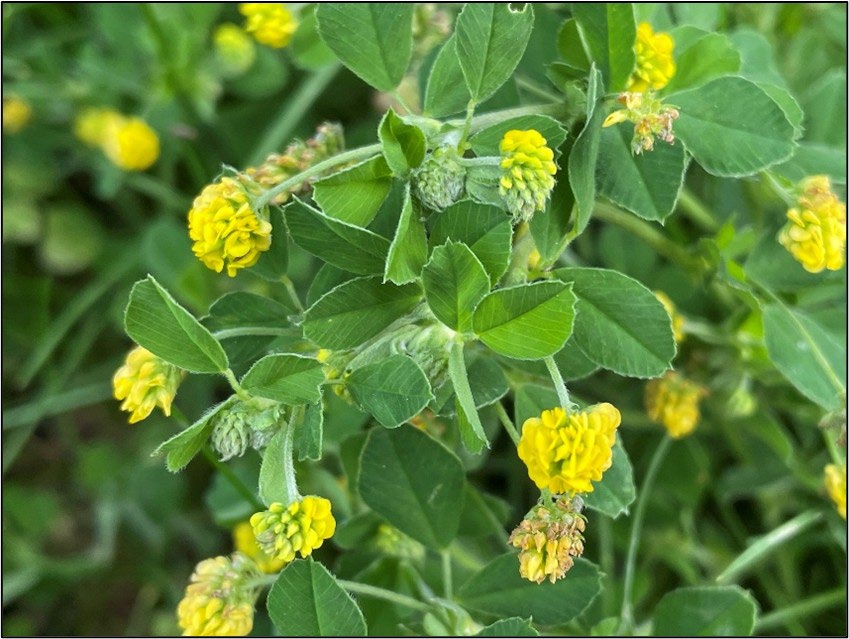
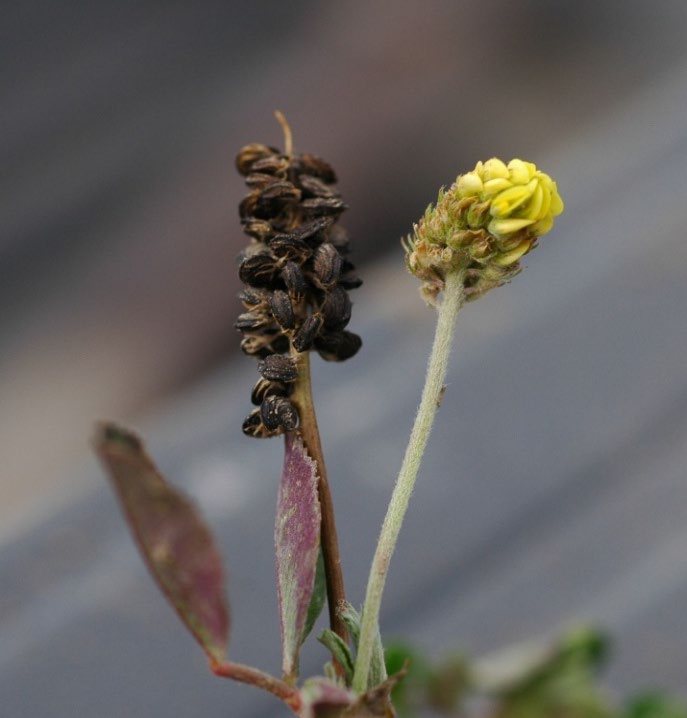
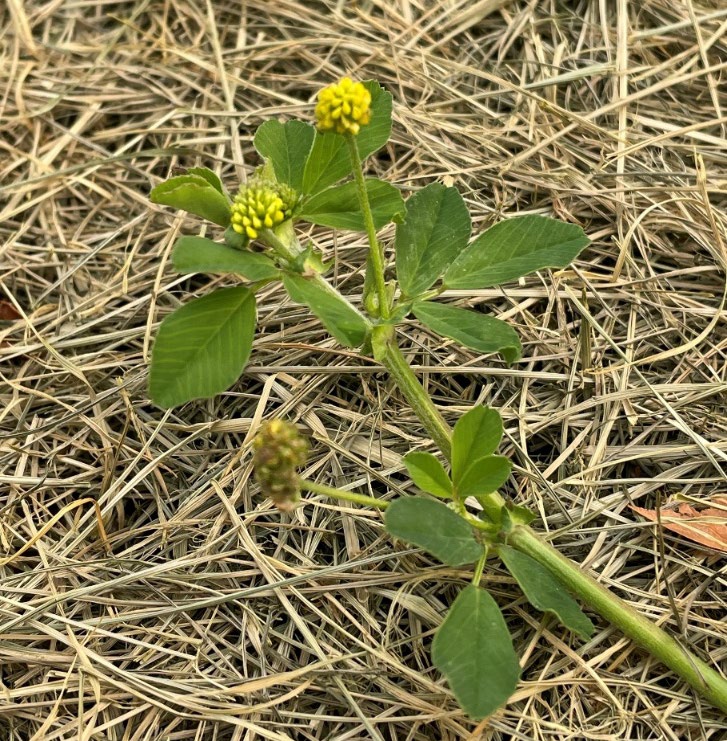
Black medic (Medicago lupulina) is an herbaceous winter or summer annual broadleaf landscape weed. Black medic is a member of the legume family (Fabaceae), which includes familiar garden plants such as beans, peas, alfalfa, and clover. Black medic often goes unnoticed until the small 1/8-inch bright yellow flowers appear (Figure 1). Flowers produce small, dark, kidney-shaped pods that contain one seed (Figure 2). It flowers and produces seeds continuously from April to September. Leaves are divided into three leaflets and resemble clover leaves. The middle leaflet is on a short stalk; all leaflets are finely-toothed with prominent veins (Figure 3). Black medic has a deep taproot and horizontal stems spreading from the plant crown at the soil surface (Figure 3). Black medic does not form roots along its stems but reproduces by seed, germinating in the spring and occasionally in winter.
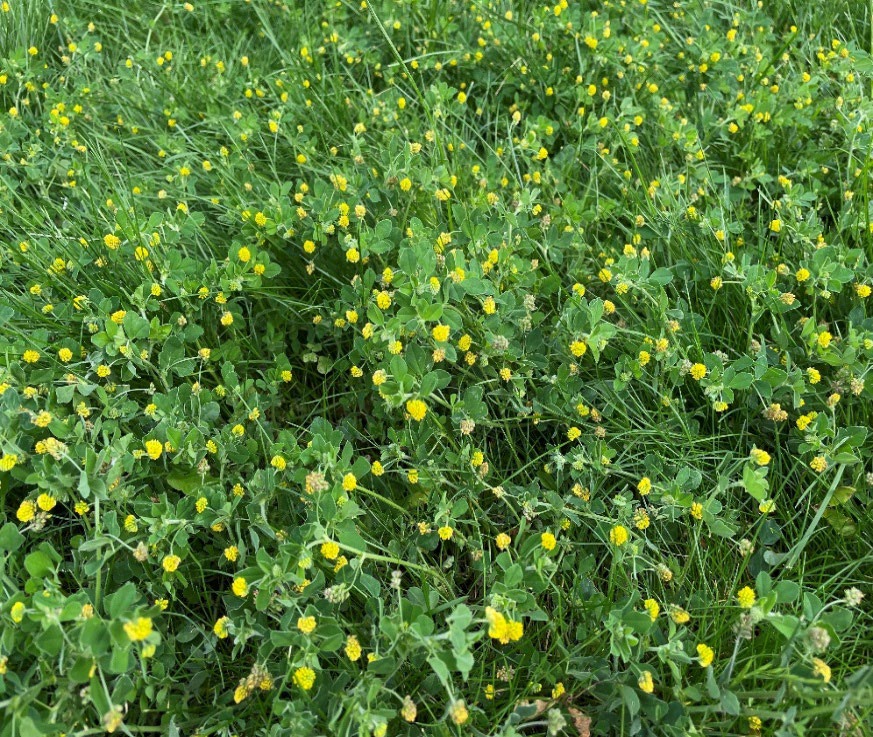
Black medic colonizes dry, thin turfgrass stands, gravel areas, and other dry, disturbed areas with low soil nitrogen levels (Figure 4). As a legume, it forms a symbiotic relationship with nitrogen-fixing Rhizobium bacteria, which form root nodules to convert atmospheric nitrogen gas into biologically usable forms of nitrogen that the plants can use. Because it produces its own nitrogen, black medic can easily outcompete turf and other plants in low-fertility soils.
Suppression and Control Options
Cultural Control
The most effective preventive method for black medic in lawns is maintaining a healthy lawn through proper fertilization, core aeration, increasing mowing height, and effective irrigation management. Since black medic thrives in poor soils, regular fertilization is necessary to maintain healthy and competitive lawns. On lawns and crops in sandy soils, using a slow-release nitrogen fertilizer such as polymer-coated urea (PCU) or sulfur-coated urea (SCU) helps prevent nutrient leaching and maintain consistent plant growth. Also, since black medic grows primarily horizontally, raising the mower height to 3 inches or more can help suppress black medic and other lawn weeds. Overseeding a thin lawn in the spring or fall can also improve the lawn's competitiveness and discourage new weed growth. Applying a layer of bark or leaf mulch at least 3 inches thick around garden beds can suppress weed growth, including black medic.
Mechanical Control
Pulling out plants by hand (including their roots) can be an adequate method for small infestations, especially when the soil is moist. This method is easiest when the plants are young. Tilling garden beds and other landscaped areas can be practical for controlling black medic, but it will also bring new weed seeds to the surface. Additional tillage, hand hoeing, or hand pulling may be required to keep areas clear.
Chemical Control
Many registered postemergence broadleaf herbicides can selectively control black medic in turf. Products containing 2,4-D, dicamba, MCPP, fluroxypyr, sulfentrazone, quinclorac, and triclopyr, as well as products containing a combination of two or more of these active ingredients, are available to control black medic in lawns and other landscape areas. Do not use products containing dicamba in areas near or under trees, as roots can absorb it, potentially damaging the plants.
Nonselective postemergence herbicides can be used to control black medic in non-turn areas. Glyphosate is a systemic nonselective herbicide that controls black medic in non-turn areas. Additionally, some reduced-risk nonselective herbicides that suppress black medic include acetic acid at 5% or higher concentration and pelargonic acid. These products burn back the shoots, but black medic usually resprouts from the crown.
Preemergence herbicides can also control or suppress black medic in established lawns, shrubs, perennial beds, and bare areas. Products containing dithiopyr, oxyflurofen, oryzalin, and isoxaben have been shown to prevent black medic growth. Always read the label for specific application sites, precautions, and mix rates.
Acknowledgments
Corey Ransom provided the images in this fact sheet.
The authors did not use generative AI in creating this content, and it is solely the work of the authors. This content should not be used for the purposes of training AI technologies without express permission from the authors.
Literature Cited
Abbey, T. (2024, November 24). Black medic. Penn State Extension. https://extension.psu.edu/black-medic
Landschoot, P., Delvalle, T., & Abbey, T. (2024, November 24). Lawn and turfgrass weeds: Black medic (Medicago lupinula L.). Penn State Extension. https://extension.psu.edu/lawn-and-turfgrass-weeds-black-medic-medicago-lupulina-l
Lowry, B. J., Whitesides, R. E., Dewey, S. A., Ransom, C. V., & Banner, R. E. (2011). Common weeds of the yard and garden. Utah State University Extension. https://issuu.com/usuextension/docs/common_weeds_of_the_yard_and_garden
North Dakota State University. (2024, November 24). Black medic (Medicago lupulina). https://www.library.nd.gov/statedocs/AgDept/Blackmedic20070514.pdf

March 2026
Utah State University Extension
Peer-reviewed fact sheet
Authors
Michael Caron, Taun Beddes, and Corey Ransom

Michael Caron
Extension Assistant Professor | Horticulture | Utah County
Agriculture and Natural Resources

Taun Beddes
Extension Associate Professor | Horticulture | Utah County Director | Juab County
Agriculture and Natural Resources

Corey Ransom
Weed Specialist
PSC Dept
Related Research
Are Organic Matter Soil Amendments Created Equal?
Each class of material has specific characteristics and management issues when it comes to using it as a soil amendment.
Backyard Composting in Utah
The benefits of using compost as a soil amendment include increasing soil tilth, fertility, water holding capacity, aeration, and drainage.
Gardening in Sandy Soils
Learn the basics of clay, silt and sand soils with an emphasis on gardening in soils with high sand content. Get tips for gardening tips for managing sandy soils, and the types of plants that grow best in sandy soils.
It's All About Soil Structure!
The single best soil amendment—the one that provides desirable benefits regardless of the soil one applies it to—is organic matter.

Policies and Programs for Water-Wise Residential Landscaping in Utah
Water-wise landscaping is the practice of using plants in a landscape that are adapted to local conditions and only need small amounts of water. Converting yards to water-wise landscaping conserves water and is a climate adaptation action residents can ta

Preparing and Improving Garden Soil
A great garden starts with healthy soil. In Utah, there are unique considerations for creating and maintaining healthy soils.