
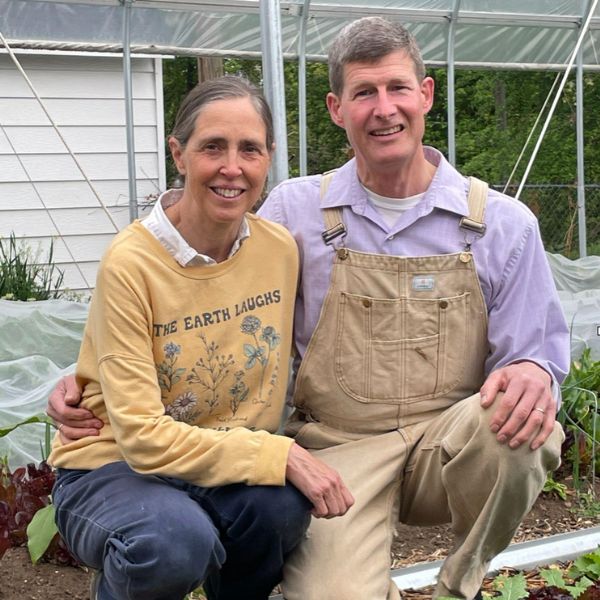
About Farmer Karl:
Karl Ebeling is the co-founder of Faircrest Farms, a regenerative urban farm in Weber County. Alongside his wife, Rita, Karl launched the farm in 2022 after leaving a 30+ year career in business consulting. Inspired by the legacy of his grandfather’s farm in Pennsylvania, Karl now focuses on growing fresh produce, teaching sustainable practices, and building community food systems. He is also the founder of Eden Streets, a nonprofit that supports Grow Ogden, a program that trains and employs people experiencing homelessness through farm-based work.
What inspired the founding of your farm, and how has your mission evolved?
Since I was 10 years old, I’ve loved vegetable gardening. My grandfather, “Pappy,” was my biggest influence. On his farm in Kutztown, Pennsylvania, he taught me the beauty and challenge of landscape design, flowers, and vegetables. He called it Faircrest Farms, and I wanted to recreate that kind of experience for my grandchildren.
When the COVID pandemic hit, I was in my 33rd year as a business consultant with Axalta Coating Systems near Philadelphia. Rita and my five children were all in Utah. I realized this was my window to reinvent myself and finally do what I’d dreamed of since childhood.
I had seen firsthand how gardening could lift the lives of inner-city youth in Philadelphia, and I asked myself: What if farming could re-launch lives? That question became Eden Streets, a nonprofit that helps farmers with social missions. Through Eden Streets, we’ve launched the Grow Ogden pilot farm, which has already supported people facing homelessness with job training and stability.
When we moved to Ogden in 2022, we started Faircrest Farms as a for-profit farm to sustain this work. Three years later, we’re supplying regeneratively grown produce to neighbors, restaurants, and farmers' markets, while also growing all the seedlings for Grow Ogden’s program.
What sustainable or regenerative growing practices do you use, and why are they important?
From day one, we’ve followed permaculture design principles to grow food and beauty in harmony with the land. We don’t use synthetic chemicals, and we’re working toward organic certification. Instead, we rely on drip irrigation, composting, mulching, and other earth-friendly techniques I learned while working at Green Phoenix Farm.
At Faircrest Farms, you’ll see companion planting, pollinator habitat, and compost systems that show what a regenerative model looks like in practice. These same methods also provide hands-on learning opportunities during our classes and workshops, where we teach neighbors how to grow food more sustainably at home.
We believe the healthiest, most nutrient-dense food comes from living soil—soil rich in organic matter, microbes, and beneficial organisms. I’ve seen the abundance that’s possible when farms nurture their soil, like at the Funk Demeter Farm in Bavaria, which has practiced biodynamic farming for more than 300 years.
How does your farm contribute to a more sustainable local food system?
Most people don’t realize how fragile our national food system is. The average American farmer is 60 years old, and fewer young people are choosing this path.
At the same time, small-scale urban farms are proving they can be both profitable and resilient. In Weber County, very few local vegetable farms exist. By growing and selling directly to our neighbors, we keep money in the community, create jobs, and strengthen food security.
Faircrest Farms supplies food locally through markets and restaurants, but it also supports Grow Ogden by raising the seedlings used in their job-training program. The produce grown there is donated to the Catholic Community Food Pantry, serving about 200 people each week. Together, our for-profit and nonprofit arms show how farming can be both an economic engine and a social mission.
What challenges do you face farming in Utah, and how have you adapted?
Utah’s high-desert climate is no joke. At 4,500 feet, we deal with intense sun, little rainfall, and pests like grasshoppers and aphids. High winds and sudden downpours can be just as challenging.
But permaculture teaches us to work with nature. At Faircrest Farms, we use pollinator plants that attract beneficial insects to manage pests, and we’ve built compost systems that improve soil health year after year. We also rely on high tunnels, shade cloth, mulching, and row coverings to protect crops. These adaptations not only sustain our farm but also serve as models for others who want to grow food in similar conditions.
How does your farm support community involvement?
Faircrest Farms welcomes volunteers to learn and work alongside us. We partner with two drug rehabilitation centers that bring clients to the farm each week. There’s something healing about working with the soil—watching a seed sprout and caring for it until it produces fruit.
Our workshops and classes give people tools to start gardens at home, while our volunteers help with seedlings in the spring that later go to Grow Ogden. At the Ogden Farmers Market, volunteers also join us in selling produce, creating another touchpoint for community connection.
Eden Streets expands that mission further. Through Grow Ogden, people experiencing homelessness gain farming skills, confidence, and community. The food they grow goes directly back into the community, making fresh produce more accessible for those who need it most.
What’s one thing you wish more people understood about small-scale farming?
That it’s not just about food—it’s about community. Buying local keeps money in Weber County, supports jobs, reduces healthcare costs, and strengthens connections between neighbors. When people know their farmers, and farmers feel valued, everybody benefits.
At Faircrest Farms, we like to say we’re more than a farm—we’re a farmily. That sense of connection is what makes small-scale farming so powerful.
What advice would you give to someone who wants to grow food more sustainably?
Start by volunteering with a local farm. Hands-on experience is the best way to learn how to grow successfully in Utah’s climate. We’re always glad to share what we’ve learned at Faircrest Farms, whether that’s through volunteering or one of our community classes.
What is one way you practice sustainability in your daily life?
I like the word regenerative more than sustainable. Sustainability maintains what’s broken. Regeneration heals. Composting is one of the best ways to start—turning food scraps, leaves, or straw into living soil within months. If everyone composted, we’d be much closer to a regenerative future.
You can learn more about Farmer Karl, Faircrest Farms, and Eden Streets at https://faircrestfarms.org/.