
Guest Blogger: Edwin Stafford

USU Extension Sustainability helps everyday people live more healthy, happy and sustainable lives. This is the nineteenth of a series of posts that feature real people who are making real changes in their lives to be more sustainable.
This month we are featuring USU marketing professor and clean technology marketing expert Edwin Stafford. Discover Ed's thoughts about marketing clean energy, his green home, Cache Valley's air quality problem, and more!
1. What made you want to market renewable energy and clean technology?
I worked with Dr. Cathy Hartman, a USU marketing professor who has retired. But she and I were partners for nearly 20 years on sustainability issues, beginning with our study of the McDonald’s-Environmental Defense Fund partnership. The partnership was a radical “strategic alliance” between an environmental advocacy group and the fast food chain to identify ways the fast food giant could reduce its waste. EDF acted as a consultant of sorts – even had some of their environmental analysts work behind McDonald’s counters to “learn” the fast food business so that they could make informed recommendations on reducing waste AND maintaining a successful fast food business. Interestingly, the partnership found numerous ways McDonald’s could cut waste – which saved the fast food giant millions of dollars! This radical partnership demonstrated that environmental and business interests could come together for mutual gain.
Was the partnership controversial? Absolutely. And Cathy and I studied those issues in extensive research on what we called “green alliances.”
Over time, we found that green alliances often focused on environmental innovations and “clean technology.” In another initiative, we studied Greenpeace’s entrepreneurial work in marketing Greenfreeze, an ozone- and climate-safe refrigerant – and this work focused our research on “how to market green technologies” into the marketplace – and make them mainstream. Greenpeace was working on wind power in 2000 or so, and Cathy and I decided that we’d study wind energy’s development here in Utah – in our backyard – so that we could study a clean technology’s emergence and diffusion close-up locally. That resulted in our procuring over $2 ¼ million dollars in grants – that in turn led to documentaries, research, and student projects. One of our students even landed an excellent position at the National Renewable Energy Laboratory.
Since my initial study of wind and refrigeration, I’ve become increasingly interested in other clean technologies, largely because Silicon Valley (where I’m from) has made this a priority – from Apple’s solar-powered new headquarters in Cupertino to Tesla Motors – clean technology is now a booming industry, and it is interesting to see mainstream companies – from Walmart to Kohl’s to others – move into sustainability and clean/efficient technologies.
2. What are your top suggestions for making sustainability more “sexy”?
Seriously, linking sustainable behavior and products to the core values of your target audience is very important. The founder of Tesla Motors, Elon Musk, purposely designed his company’s electric vehicles to shatter pre-conceived myths that EVs couldn’t be anything more than go-karts or golf-carts. Specifically, he leveraged electric battery technology’s instant torque to create no-compromise, sexy cars that are faster than regular gasoline-powered hyper cars. Electric vehicles are inherently faster than gas-powered cars, but people didn’t know that until Musk demonstrated it with his Roadster and now the Model S and X. Thus, today, mainstream consumers covet Teslas not because they’re green – but because they are sexy, fast, and exciting. Sadly, other EVs, such as the LEAF, reinforce the go-kart image of EVs, and they’ve had a difficult time broadening their appeal. You don’t have to make an environmental product ugly or unappealing. Indeed, if you think about it, if green products are to have a beneficial impact on society, then EVERYONE has to adopt them. You need to make green mainstream in appeal.

Often, environmentalism and sustainability are described in terms of limits and restrictions (which are inherent with the need to be thinking about resources and our future), but if those very concepts can be re-framed on what people do care about, that can help make sustainability more sexy. I built a green home some years ago, and when I told people that I was building one, I remember many saying that they couldn’t live in the weird-shaped “green” homes that they had seen in magazines… I built my home to be an Italian Villa. It doesn’t look green until I show people what makes it so energy-efficient. Sure, it’s cheap to live in my house, but what makes my home worthwhile, however, is its overall comfort. Because the house is designed to work in harmony with the sun’s natural positions throughout the seasons, we’re not “battling” the sun in the summer warranting massive air conditioning… The sun stays out of the house in the summer, and the house stays naturally cooler. In the winter, the passive solar design exploits the winter sun to heat up our darkened tile floors to help heat the house. People are often shocked by what we’ve done – but many of the things we did were simply “off the shelf” green techniques that have been known for decades (if not longer). We also designed our xeriscape landscaping to look like an Italian garden. We essentially took Utah native plants that mimic Italian species so that we could achieve a super-water efficient landscaping – but it doesn’t look water-efficient. Thus, I’ve tried to defy the negative stereotypes of “going green.”
In short, make and design “green” into something that people will want. That’s how to make it “sexy.”
3. In your opinion, what are some major mistakes the environmental movement has made in trying to get “green” to better catch on?
This is a complex issue, but I’ve focused on one area related to my expertise in marketing. People act on emotions and the values that are most important to them. Unfortunately, much of the green movement has been myopic – focusing on “save the earth” environmental values at the expense of what people are more concerned about. For conservatives, issues such as freedom, family, security, jobs, and the economy are “higher-order” values compared to environmental and personal health concerns, and often, environmentalism is framed as a “scarcity” or “restriction” issue that flies in the face of conservative beliefs in “freedom” and “family.” For example, restrictions on ATVs and other recreational vehicles in some public lands are often seen as a threat to freedom and family time and the ability for families to play together, connect, etc.
I believe when environmental issues are connected to issues and values people care about, then it better resonates and people come to care about environmental concerns. One issue that I’ve considered is how coal-fired power plants emit mercury into the atmosphere, a toxin that can impact the digestive, immune, and nervous system in humans. Mercury emissions get into the food chain as lower-order animals get consumed by high-order animals, and the mercury accumulates as you move up the food chain. High mercury levels are often the reason the state puts warnings and restrictions on the consumption of certain popular fish and waterfowl in Utah – inhibiting the recreation of hunting in the state. In essence, coal pollution directly threatens the ability of people to hunt and consume their game/fish in Utah -- an important family pastime. In this example, concerns about coal pollution can be directly tied to hunting and family activities that people really care about. I believe if environmentalists better “connected the dots” on how environmental interests directly linked to what people care about, the movement would have more support.
4. What is your favorite sustainability-related project that you're currently working on?
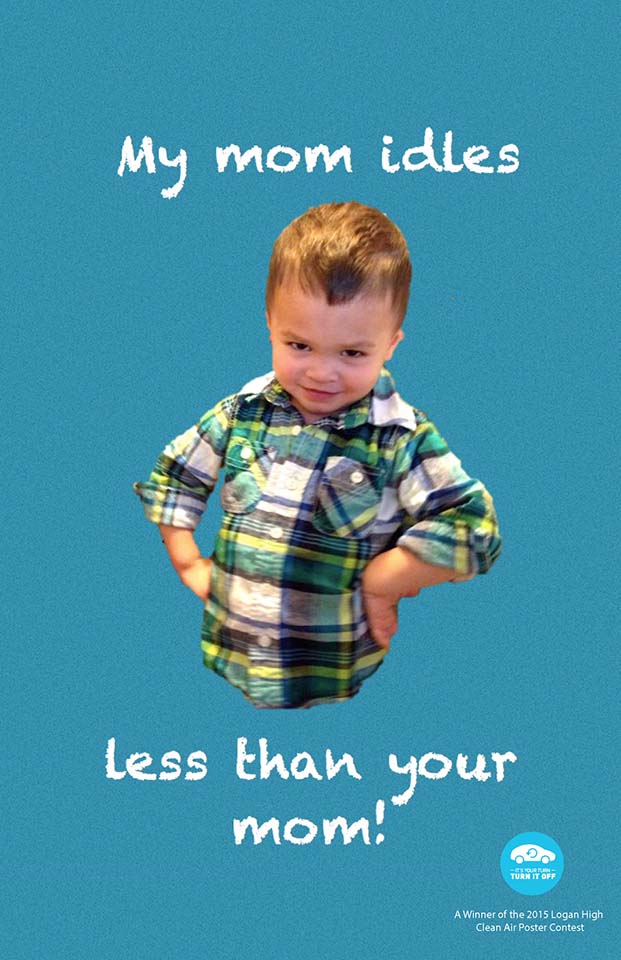
My latest work now centers on clean air. Sounds mundane, right? But here in Cache Valley, we have some of the worst air quality in the nation due to our winter inversions and growing fleet of cars, buildings, and agricultural businesses. It is what we call a “wicked problem” in that there are so many sources of pollution and challenges facing our air situation that there are no silver bullets to “solve” it. I’ve decided to take it on, however, and apply what I’ve learned about marketing wind power and other clean technologies and apply it locally to empower and convince Cache Valley residents to care about the air that they breathe. Specifically, I’m working on how to convince citizens to engage in everyday actions to help preserve air quality – from not idling their cars to refraining from burning wood during inversions to trip-chaining. I have a public service announcement study under way with Alexi Lamm, a doctoral student in Natural Resources.
Another venture I’m doing with Dr. Ros Brain is a county-wide clean air power contest at the local high schools that engages high school students learning to drive to develop educational posters about what they can do people can do to preserve air quality (e.g., carpool, not idle, etc.). I teach the high school kids about savvy marketing techniques and USU students help mentor the high school students develop their posters. For your interest, two from past years are attached – one employs juvenile humor and the other parody. It is so fun to see young kids develop fairly sophisticated social messages that are edgy and potentially resonate with their peers. I get local businesses to donate $50 gift cards as prizes and Logan City Mayor Craig Peterson (a retired econ professor in the Huntsman School) has donated $100 to the top poster over the past two years. The winning posters are displayed locally (and here on campus). It has become an annual event – part of my education outreach.
5. What made you want to participate in this project?

I believe faculty need to do research and education outreach that makes a difference. Too often, faculty conduct research that may have limited application in the real world. I don’t want to be that kind of professor. I need to be in the field, applying my expertise to problems. When I worked on wind power in Utah, I was very active working in various communities, with developers, with our legislature and governor’s office, and with federal energy agencies, and it was exciting to be a part of wind energy’s development in the early part of this century. Every time I drive by the Spanish Fork Wind Project, I think back to when I was a founding member of the Utah Wind Working Group – a small group of concerned citizens, local landowners, government workers, and advocates – who would meet once a month to discuss ways that Utah could kick-start its wind industry. There was significant opposition at the time, but little-by-little, we made inroads, got tax incentives passed to attract developers (via a billboard campaign I helped design), and engaged communities about the benefits of local wind power development. Clearly, my work on wind power has been my most important lasting legacy.
6. Which sustainability project have you worked on that you think has left the most impact?

As mentioned above, I believe helping to kick-start wind energy in Utah and then helping other states advance their wind power development, has been my most significant contribution. Cathy and I produced a documentary, Wind Uprising, about the Spanish Fork experience that was screened all over the country, and it continues to help communities understand the issues involved with local wind power development. However, I believe clean air will become even more important as our state grows and more and more children are affected by our polluted air.
7. What does sustainability mean to you?
As a business professor, I think the best metaphor I like to consider in “defining” sustainability is viewing the earth as a big “service provider.” That is, the earth provides so many services for us as human beings to live and make a living. Trees make our air and store carbon; wetlands filter our water; soil grows our food, etc. Rather than exploit the earth to simply consume its resources for the short-term (cut down trees to make toilet paper), we need to live more harmoniously with nature, recognize and understand how the earth works, and strive to reap the benefit from the earth’s “services” without destroying its ability to continue to provide those services.
If I were to summarize my work in a short sentence, I would describe it as “Getting non-green consumers to buy green products” (or getting non-green folks to buy into being green). How you do that is connecting green to what people truly care about. It may not be easy, but increasingly I see “non-greens” buying into green because it aligns with their broader, personal values.
Recent Posts