
Like-kind Exchanges After Tax Cuts and Jobs Act
Guido van der Hoeven, Extension Specialist / Senior Lecturer Emeritus
Department of Agricultural and Resource Economics, North Carolina State University
Download PDF Version
Introduction
Farmers and ranchers generally expand and grow their respective businesses over the course of their involvement in the business. Frequently, the time-honored method of “trading up” was used to facilitate business growth. In tax language, trading is referred to as conducting a “like-kind exchange” (LKE). Recent legislation changes which LKEs are allowed tax-deferred treatment. The significant change is that personal property (equipment, machinery, breeding livestock, etc.) are no longer allowed; and if a trade of this type of business asset is made, the “trade value” is treated as a “deemed sale” and reported on IRS Form 4797, Sale of Business Property.
This discussion will focus on the like-kind exchange of real property under recent legislation and revenue rulings (discussed below). The point of this discussion is to give readers a better understanding of correct income tax reporting for exchanges of real property, which, for now, is the only property type which qualifies for LKE treatment. Farmers and ranchers should consult with their tax professional to ensure that the correct procedure is followed preventing a disallowance of the LKE.
Like-kind Exchange Legislative History
Broadly, LKEs are allowed for business and investment properties that qualify for the tax-deferred treatment under the like-kind exchange rules. Over time, the rules, regulations, and definitions were added to the Internal Revenue Code (IRC) providing guidance to taxpayers and tax practitioners. A brief review of the history of LKEs follows.
Esch-Cummins Act (Revenue Act of 1921)
This Act provided initial guidance to the concept of a like-kind exchange. In Federal Tax Code Section 202, the rules were enacted to allow for tax-deferred exchanges for similar use properties thus preventing investors and business operators from skirting the law and evading tax. The language of congressional records referred to real estate exchanges of like value where no cash was part of the exchange, as a case of “continuity of an investment”, thus a taxable event did not occur.
Section 1031, Created by the 1954 Amendment to the Federal Tax Code
The 1954 Amendment codified Section 1031 by changing the code section from Section 112(b)(1), previously Section 202, to Section 1031 of the Internal Revenue Code. The most pointed takeaway was that the IRC adopted stronger definitions and descriptions of a tax-deferred LKE. These changes lay the foundation for the LKE real estate exchanges, which are common and popular today.
9th US Circuit Court of Appeals: The Starker Decision (1979)
The ruling in this case provided necessary flexibility for conducting an LKE in real time. Prior to this ruling, the prevailing belief was that an LKE had to be simultaneously executed by both parties of the exchange. The “Starker Rules” provided for a distinct timeline to be followed: 45- and 180-day restrictions to complete the exchange. These restrictions are discussed more fully below.
Treasury Regulations § 1.1031, Deferred Exchange Regulations (1991)
Final regulations regarding LKEs were issued in 1991, providing guidance by the IRS in resolving issues that were in question at the time: deferral, constructive receipt, agency, and other technical points to which both taxpayers and tax professionals must pay careful attention.
Additionally, safe harbors were included in the regulations addressing the following issues:
- Security and Guarantees
- Qualified Escrows or Trusts
- Qualified Intermediary
- Interest or Growth Factors
Revenue Procedure 2000-37, (2000)
Rev. Proc. 2000-37 introduced the concept of “parking” properties in an LKE through the application of a safe harbor. Either the Replacement or the Relinquished property may be “parked” with a third party until the actual exchange can be made. Generally, the rules governing LKEs must be observed. This Rev. Proc. has given rise to what is referred to as a “reverse like-kind exchange” where the replacement property is bought first and “parked” until the relinquished property is sold. It should be noted that the 180-day rule (discussed below) could cause this type of LKE to fail.
Recent Law Changes
Tax Cut and Jobs Act (TCJA) Limits Like-Kind Exchanges to Real Property Only (2017)
When the TCJA was passed, it amended IRC § 1031 to only allow the exchanges of real property. For this purpose, real property includes land (regardless of quality), developed real estate, and other interests in real estate; e.g., a tenancy-in-common.
Thus, the significant result from this legislation is that personal property and intangible property are no longer eligible for an LKE.
The IRS Issues Treasury Decision 9935 for the Purpose of IRC § 1031 (2020)
The IRS provided final regulations in the form of Treasury Regulation § 1.1031(a)-3(a)(1), where the definition of real property is found for the purpose of an LKE. These final regulations also provide that state and local law provides for classification of real property for the purpose of an LKE.
Additionally, improvements to land can be considered real property, if classified as being such under state or local law, or are permanently attached to the land.
Definitions of Real Property
The final regulations provide four overarching definitions of what is “real property” for the purposes of a tax-deferred LKE. These are:
- Land and improvements to land
- Unsevered natural products of land, including growing crops, plants and timber
- Water and air space superjacent to land
- An interest in real property, including fee ownership, co-ownership, a leasehold, an option to acquire real property, an easement, stock in a cooperative housing corporation, and certain shares in a mutual ditch, reservoir, or irrigation company.
Definitions of Improvements to Land
The final regulations also provide guidance regarding improvements to land, such that if they are “inherently permanent structures”, they qualify. Examples are given in the regulations; however, the list is not all-inclusive. The following common improvements for agricultural purposes are considered to be real estate:
- Buildings (structures which are enclosed with walls and covered by a roof that are permanently in place)
- Roads
- Bridges
- Paved parking areas
- Fences
- Grain storage bins and silos
If specific item or improvement is not on the detailed list within the regulations, the rules provide that affixation can be accomplished by weight alone (e.g., a shipping container used as a shop which is placed on a gravel pad). A pole barn under which equipment is stored should also fit the definition. Likewise, standing orchards and vineyards should meet the requirements, as these plants are attached (affixed) to the land.
Application of the “Starker Rules” to Real Estate LKEs
Real estate transactions may not occur on the same dates because of legal requirements. Consequently, IRC Section 1031 has specific date requirements for like-kind exchanges. These date requirements were a result of the Starker case mentioned above.
IRS requires the replacement business or investment property be identified within 45 days of the transfer or sale of the relinquished property. This identification must be in writing and provided to a qualified intermediary when dealing with a real estate like-kind exchange. The second rule is that the exchange is to be closed within 180 days of the transfer or sale of the relinquished property, or by the due date of the return in which the like-kind exchange occurred.
Note: For exchanges occurring late in the year, in order to utilize the entire 180-day period, it may be necessary to file for an extension of the return filing date.
The taxpayer may not receive any cash or other property from the exchange until the exchange is completed. Consequently, IRS has included rules to allow any cash from the relinquished property to go to a qualified intermediary, who purchases the replacement property and then transfers the property plus any remaining cash to the taxpayer. Since the taxpayer does not “control” the cash (meaning they might change their mind and do something else with the cash), the property sale can be treated as a tax-deferred exchange even though the timing of the transaction is not on the same day due to a lengthier sales process.
Once the exchange is completed, Form 8824, Like Kind Exchanges is used to report the transaction.
Examples of Agricultural and Forestry Tax-deferred Like-kind Exchanges
Under IRC 1031 and its regulations, the properties involved in an LKE must be of the same nature and character for business or investment purposes. The relinquished and replacement properties do not need to be of the same quality or grade, improved or unimproved, to qualify for an LKE. Similarly, under the Treasury Regulations, exchanges of a farm, ranch or forestland, or urban rental real estate qualifies. Additionally, a leasehold interest of 30 years or more also qualifies for LKE treatment if part of a tax-deferred exchange.
Example 1: Exchanging Farmland for Ranchland
JC owns 160 acres of prime farmland in Oklahoma, with a basis of $250,000 and a fair market value (FMV) of $500,000. Ruby owns a 1,000-acre ranch in Utah, with a basis of $300,000 and FMV of $500,000. JC and Ruby enter into a like-kind exchange agreement. An attorney is engaged to create new deeds upon the exchange and record the new deeds in the appropriate jurisdiction. JC defers $250,000 gain, while Ruby defers $200,000 of gain. JC and Ruby complete an IRS Form 8824, Like-Kind Exchanges, reporting the transaction to the IRS. JC’s Form 8824, Like-Kind Exchanges is below; he fills out Parts I and III.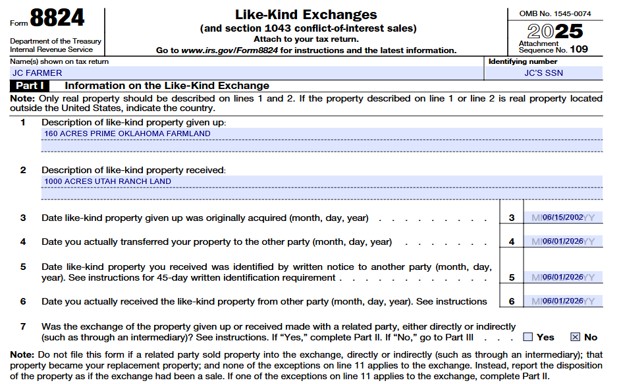
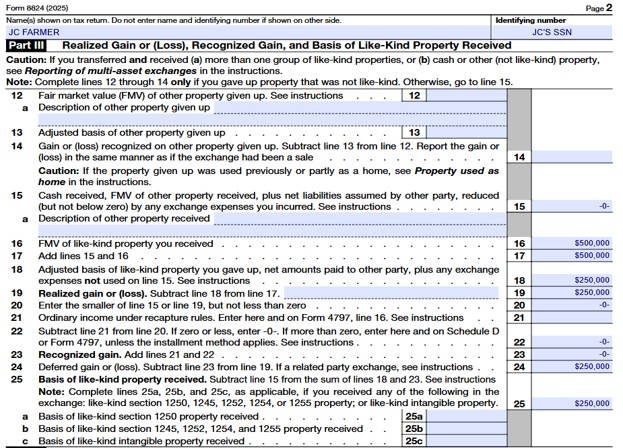
In this example, JC now has deferred gain of $250,000; his basis in the Utah ranchland is $250,000 (his carry-over basis from his Oklahoma farmland). Should JC dispose of the Utah ranchland in the future by sale, he would then recognize gain in excess of his $250,000 transferred basis.
Example 2: Farmland for Farmland Plus Cash Boot
Rosa owns 100 acres of land on the outskirts of town; she has a basis of $25,000 in the land, which was inherited many years ago. The land has FMV of $500,000. Rosa has entered into a LKE with Greg for 80 acres of land he owns, which has a FMV of $450,000 and basis of $250,000. Greg will pay Rosa $50,000 in cash to equalize the exchange. Because Rosa is receiving $50,000 in cash, which is unlike property, she will recognize gain on the $50,000. Her basis in the received property will be $25,000, the carryover basis from her relinquished 100 acres. Rosa will have realized gain of $425,000 ($500,000 - $25,000 - $50,000) which is deferred by the LKE.
Rosa will report the gain initially on IRS Form 8824, Like-Kind Exchanges, Part III, as illustrated below. Additionally, her carryover basis is calculated on Part III as well. IRS Form 8824, Like-Kind Exchanges should be kept with her permanent land records to prove basis in the future as needed.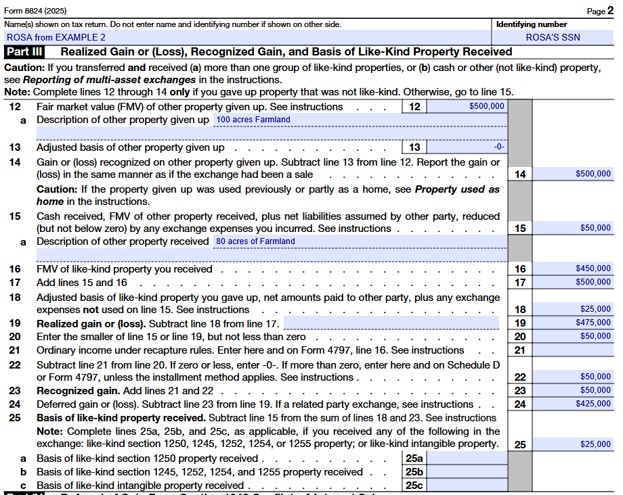
Example 3: Farmland for Other Types of Real Estate
Tomas owns 500 acres of farmland, which is modestly improved with fences, irrigation wells, several machinery sheds, and grain storage bins. Tomas’ adjusted tax basis for this property is $300,000; the FMV is $1,000,000. Tomas wants to move to a coastal resort area and become a property developer. He finds four undeveloped beach lots with a FMV of $250,000 each, and initiates a LKE for the lots by exchanging his farm and improvements. Because both properties meet the definition of real estate, even the farm with its improvements, Tomas can defer the $700,000 ($1,000,000 - $300,000) of gain ($175,000 [$700,000 ÷ 4] for each of the 4 lots). Tomas reports the LKE similarly to how JC in Example 1 reported his LKE.
However, when Tomas develops the beach lots, he will allocate the appropriate $175,000 gain per lot, in addition to any gains resulting from property improvements.
Example 4: Forestry for a Tenancy-in-Common
Adam owns 750 acres of forestland, which has timber standing (attached by the roots) and is about eight years from final harvest. Adam has a basis in the property of $500,000, which was the FMV when he inherited from his grandfather. The current FMV of the land and standing timber is $5,000,000, due to current timber prices being at near record high values. Adam wants to take advantage of the opportunity, but he doesn't want to recognize the gain. Additionally, Adam prefers to simplify his life and invest in a property which provides a retirement income stream. He learns that he can sell his forestland and standing timber, and invest the sale proceeds in a financial vehicle which is a Tenancy-in-Common (TIC) managed commercial property, paying a 7-percent return following the rules under IRC § 1031. This ownership/equity interest in real estate qualifies for LKE treatment. Adam can invest $5 million and defer his $4.5 million gain. The income generated by the investment is treated as ordinary income subject to income tax. Adam reports the LKE in a similar manner to JC and Tomas in the previous examples.
Example 5: Real Estate with Non-Like-Kind Property (Cut Timber)
Sonya owns 250 acres of timberland, which has commercially harvestable yellow pine on the property. The timber is valued at $4,000 per acre, or $1,000,000 in total. Sonya plans to harvest the yellow pine trees, and then reforest for the benefit of her children and grandchildren in the future. Sonya’s basis in the timber is $50,000 resulting in a total gain of $950,000. Sonya wants to exchange the cut timber (severed from the land) for another tract of land, thus deferring the tax liability on the gain.
The TCJA and the 2020 Final Regulations clearly state that severed timber does not meet the definition qualification of real estate for like-kind exchange. Thus, this transaction fails the tests for like-kind property; Sonya will pay tax on the gain.
Conclusion
Readers may appreciate that the concept of a tax-deferred like-kind exchange has been included and allowed in tax law for over 100 years. The concept has evolved and matured as “real life” provided challenges for compliance with the law; therefore, Congress passed additional legislation, and the IRS provided additional guidance over time. The most recent changes are discussed above with definitions and examples in the sections of this fact sheet. A like-kind exchange, properly executed, can defer significant tax liabilities, and, with step-up in basis upon death, may completely erase the tax liability.
It is strongly recommended that farmers and ranchers considering the use of a tax-deferred like-kind exchange seek knowledgeable tax advice to ensure the best outcome for their businesses.
Resources
- IRC Section 1031
- IRS Publication 225, The Farmer’s Tax Guide
- Agricultural Tax Issues, Fall 2025, Like-kind Exchange of Real Property, pp. 215-227
IRS Publications
IRS forms and publications can be found by going to www.irs.gov and typing in the name of the publication/form or the publication/form number in the search bar toward the top of the webpage. Publications may be viewed online or downloaded.
Additional Topics
This fact sheet was written as part of Rural Tax Education, a national effort including Cooperative Extension programs at participating land-grant universities to provide income tax education materials to farmers, ranchers, and other agricultural producers. For a list of universities involved, other fact sheets and additional information related to agricultural income tax please see RuralTax.org.
This information is intended for educational purposes only. You are encouraged to seek the advice of your tax or legal advisor, or other authoritative sources, regarding the application of these general tax principles to your individual circumstances. Pursuant to Treasury Department (IRS) Circular 230 Regulations, any federal tax advice contained here is not intended or written to be used, and may not be used, for the purpose of avoiding tax-related penalties or promoting, marketing or recommending to another party any tax-related matters addressed herein.
USDA is an equal opportunity provider, employer, and lender. Rural Tax Education is part of the National Farm Income Tax Extension Committee. The land-grant universities involved in Rural Tax Education are affirmative action/equal opportunity institutions.
This material is based upon work supported by the U.S. Department of Agriculture, under agreement number FSA21CPT0012032. Any opinions, findings, conclusions, or recommendations expressed in this publication are those of the author(s) and do not necessarily reflect the views of the U.S. Department of Agriculture. In addition, any reference to specific brands or types of products or services does not constitute or imply an endorsement by the U.S. Department of Agriculture for those products or services.
July 2026
Back to Top