
Project Overview
Gateway and natural amenity regions throughout the Western U.S. are facing a number of unprecedented challenges that threaten their economies, the wellbeing of their residents, and the health of tourists who flock to these areas for recreation. Most recently, the COVID-19 pandemic has led to concerns amongst gateway community leaders about tourists spreading the virus, harming local residents, and overwhelming these communities’ limited healthcare resources. With local economies that depend on the flow of outdoor recreationists and tourists, the disruption of those flows can have immediate and disastrous consequences for these types of communities. 
With funding from the National Science Foundation, our research team brings together expertise from the social and spatial sciences capable of transforming the way gateway and natural amenity region communities across the Western U.S. plan for and respond to interruptions in the flow of tourists brought about by natural disasters and crisis events like the COVID-19 pandemic. Our vision is to develop predictive models of tourism flows and a respective decision support system that gateway and natural amenity region communities can use to explore and inform local policy decisions. We are currently piloting our models and decision support system with San Juan County in Southeastern Utah. The County is home to Navajo tribal lands and over a dozen small communities which are heavily reliant on tourism.
This project will bring new insights into the efficacy of co-producing knowledge and understanding through smart and connected technologies. The project will also advance our understanding of effective data visualization using free and open source web mapping approaches. These insights can be used to improve approaches to civic engagement in the context of complex feedbacks from natural hazards and other crisis events on local economies.
Stakeholder Outcomes
- Data to support and inform community and tourism development decisions on a regional scale
- Data to support future individual business decisions, including but not limited to:
- Potential investments
- Optimal business hours
- Business services
- Customer demographics
- Economic trends
Read the full grant application.
Meet the Research Team
Our project team is composed of individuals with expertise in both research and civic engagement (Figure 1). The research team brings a wealth of experience in using spatial and social science research methods to explore visitation trends in and around GNAR communities. The community engagement team brings experience working with GNAR communities to collaboratively develop planning and policy solutions to emerging development challenges.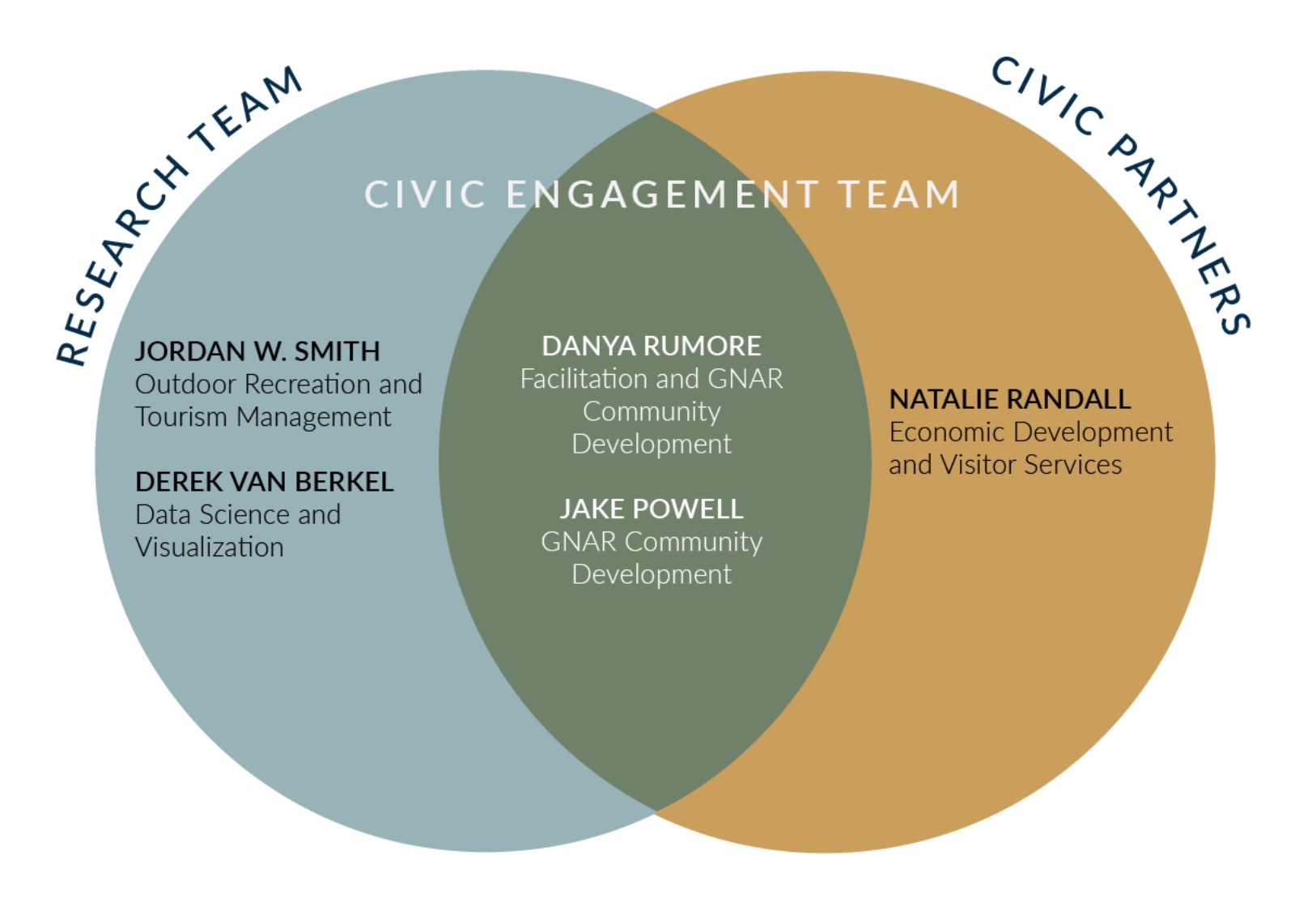
- Jordan W. Smith, Ph.D. (Utah State University). Jordan leads the Institute of Outdoor Recreation and Tourism, an Extension program dedicated to working with GNAR communities and outdoor recreation planners and managers to provide data and information on how to best manage outdoor recreation and tourism throughout the Intermountain West. (jordan.smith@usu.edu)
- Derek Van Berkel, Ph.D. (University of Michigan). Derek uses social media data to quantify the preferences of outdoor recreationists and tourists. Dr. Van Berkel will be leading the development of the project’s decision support system.
- Danya Rumore, Ph.D. (University of Utah). Danya works with GNAR communities to collaboratively develop sustainable policy and planning solutions. Dr. Rumore will be facilitating regular planning meetings and workshops with GNAR communities.
- Jake Powell (Utah State University). Jake is the GNAR Initiative Lead and as such will work to integrate the activities of our pilot project into the broader outreach and education tools provided by the GNAR Initiative.
- Natalie Randall (San Juan County, Utah). Natalie is the Director of Economic Development & Visitor Services within San Juan County, Utah, the home of our pilot project. Natalie will be working with the research team to develop, pilot, and evaluate the project to ensure that it is responsive to the civic priorities of communities within San Juan County.
- Elizabeth Sodja (Utah State University). Liz is the GNAR Coordinator and will be coordinating the monthly civic engagement workshops in San Juan County. (liz.sodja@usu.edu)
Timeline for Stakeholder Workshops
| DATE | WORKSHOP | SUMMARIES AND REGISTRATION LINKS |
|---|---|---|
| January 19-21 | Initial Listening Session with Southern and Northern County Stakeholders as well as Federal Land Managers | Summary |
| February 24-25 | First Collaborative tool development workshop | Summary |
| April 14-15 | Final Collaborative Tool Development Workshop | Register for April 14 Register for April 15 |
Want to learn more about the project? Contact Jordan W. Smith (jordan.smith@usu.edu) and Liz Sodja (liz.sodja@usu.edu).