
Guiding Transformation Towards Community Wellbeing in High Amenity Rural Places
By: Alexander Theophilus, PhD Student at the Utah State University
NOTE: This post originally appeared on the Intermountain West Transformation Network in June 2026. We are reposting it here with their permission.
Across the United States, people are attracted to communities in close proximity to desirable natural features such as mountains, lakes, and public lands for outdoor recreation, aesthetics, or other lifestyle purposes. The process of people migrating to communities because of these desirable environments is known as “amenity migration.” While amenity migration is not inherently an issue, it can pose challenges for communities where it results in significant or rapid growth. Many “high amenity” communities have historically had small, middle- and working-class populations, relatively inexpensive land prices and costs of living, and strong bonds between community members. Amenity migrants are generally wealthier individuals from urban or suburban areas, with tastes and preferences distinct from those of long-time residents in the receiving community. Common challenges faced by these communities include gentrification, displacement of long-time residents, social and cultural disputes amongst long-time residents and amenity migrants, and environmental harms caused by housing development that caters to wealthier newcomers
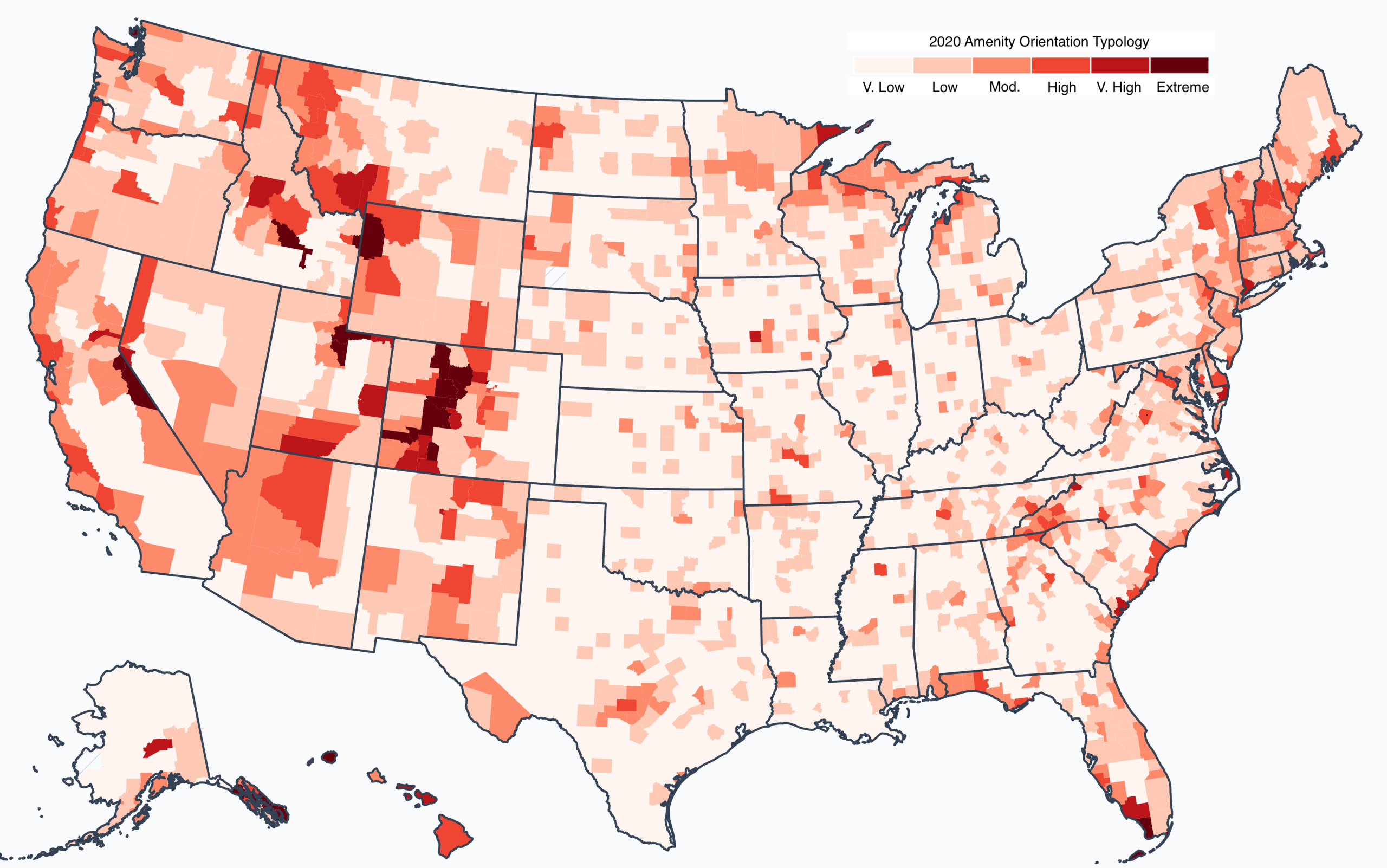
To better understand which communities might be facing these challenges and what to do about them, team members in the Transformation Network’s Intermountain West Synthesis Collaborative Working Group and Dr. Richelle Winkler (Michigan Technological University) set out to quantify and track changes related to amenity migration and related development in the 21st century. The research team for this project includes myself, Dr. Richelle Winkler, Dr. Jessica Ulrich-Schad, Dr. Kat Fowler, Dr. Richard Rushforth, and Dr. Courtney Flint. Expanding on what is known as “the New West-Old West typology” (described in detail in Winkler et al. 2007), we classified counties on a spectrum of “very low” to “extreme” amenity orientation; counties with “extreme” amenity orientation are more likely to face the challenges associated with amenity migration. We found that while high, very high, and extreme amenity orientation are represented in all regions of the U.S., the Western U.S. has the greatest share of these counties (Figure 1), indicating that many western communities may be facing issues related to amenity-driven growth.
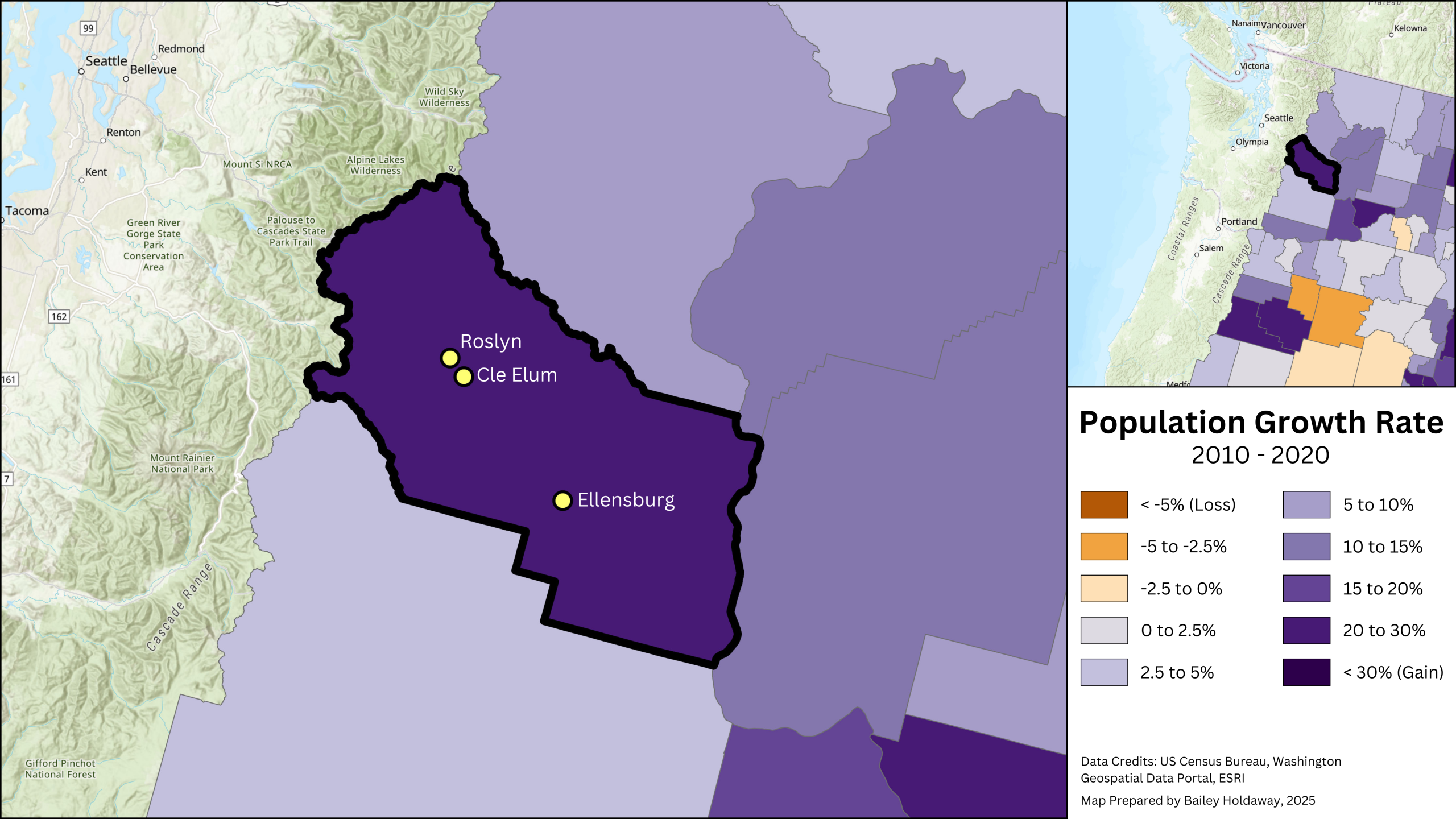
To understand the transformations necessary to improve livelihoods in places experiencing amenity-driven change, I have also conducted community-level research to understand residents’ and community leaders’ experiences and values under the TN’s Characterizing Wellbeing Across the Intermountain West Charter. One community — Kittitas County, Washington (Figure 2) — was classified as high amenity orientation in 2020, an increase from moderate in 2000. In 2023, our research team conducted 81 interviews in three different Kittitas County communities to understand community wellbeing, defined broadly as the aspects of a community that contribute to a good life for all people in that place. Interview participants described a process of community change markedly similar to other highly amenity-oriented communities in the Western U.S., discussing issues such as rising housing costs and disputes between community factions as examples of hindrances to community wellbeing. In the words of one Kittitas County community member:
"It’s a community that is grappling with imminent change. It’s a community that knows who it has been, and doesn’t know who it’s about to be… But there’s so much change happening so quickly, so much population growth, so many people being priced out of housing, so few jobs that allow kids to stay in the area after graduation, that there’s just a lot of change and there’s a lot of angst about that change. And I think some feelings of helplessness about, you know, how do we maintain the identity of our communities.”
When highlighting actions to address the county’s affordable housing needs, community members referenced possible changes to planning and land use, as well as incentives for lower-cost housing development. Low levels of economic diversification and low worker wages were also discussed as challenges the community is facing. These concerns highlight the potential benefits to community wellbeing that may come from incentivizing new types of economic development and/or higher pay in tourism and accommodation industries.
Kittitas County has a unique context with unique challenges, as does every community, but in the words of a long-time resident “we’re seeing what you see all over the Mountain West, just too many people in too small a space, too much money versus too little money.” In these high amenity places, action steps that lead to the development of community wellbeing can help communities avoid a state in which development in their community excludes some people, and this action must start with envisioning the changes that residents want to see enacted. Socially and environmentally sustainable high amenity communities are attainable when all community members’ voices are made visible. Community-engaged research, such as our team’s, can help shine a spotlight on certain voices and increase local interactions around these topics, helping the community then build decision-making structures that elevate wellbeing through democratic policy and planning.
Additional Resources:
Work Cited:
- Flint, Courtney G., Casey Trout, Bailey Holdaway, Jacob Lancaster, and Patrick Gee. 2023. Wellbeing Characterization Data and Maps.
- Winkler, Richelle, Donald R. Field, Al E. Luloff, Richard S. Krannich, and Tracy Williams. 2007. “Social Landscapes of the Inter-Mountain West: A Comparison of ‘Old West’ and ‘New West’ Communities.” Rural Sociology 72(3):478–501. https://doi.org/10.1526/003601107781799281

Alex Theophilus has published research on rural community wellbeing, the community impacts of tourism and amenity migration, and the sociology of food & agriculture. Much of Alex’s current research focuses on rural community development and the impacts of population growth and economic transitions on high amenity rural communities. Alex holds an M.S. in Sociology from Utah State University, and a B.A. in Environmental Geography from Colgate University.