
Colostrum and Rethinking Passive Transfer in Dairy Calves
Key Takeaways
- Calves are born without antibodies and rely entirely on colostrum for early immunity.
- Higher serum IgG concentrations are associated with improved calf health and survival.
- Passive transfer should be evaluated using categories (excellent, good, fair, poor) rather than a single cutoff value.
This fact sheet provides an overview of colostrum and passive transfer in dairy calves, with information applicable to producers, consultants, educators, and students.
What Is Colostrum?
Colostrum is the first milk produced by a cow after calving. It is a mixture of milk and components from the cow’s bloodstream that build up in the udder before birth (Foley & Otterby, 1978). Colostrum contains many important components, including antibodies (immunoglobulins), immune cells (leukocytes), growth factors, hormones, antimicrobial compounds, and nutrients (Godden et al., 2019).
For a more practical, producer-focused overview of these components and their functions, see the USU Extension fact sheet “Colostrum Management for Dairy Calves: Key Practices for Calf Health and Performance.”
For a more technical explanation of these components and their functions, see USU Extension’s “Colostrum Management in Dairy Calves: Technical Guidelines for Evaluation and Implementation.”
Why Colostrum Matters
Calves are born without antibodies because the ruminant placenta prevents the transfer of maternal immunoglobulins before birth (Barrington & Parish, 2001). As a result, calves are born immunologically naïve and must obtain protection against disease by absorbing antibodies from colostrum after birth.
Colostrum contains maternal antibodies that help protect calves from common diseases, such as scours and pneumonia, during the first weeks of life. Immunoglobulin G (IgG) is the most abundant antibody in colostrum, making up approximately 85%–90% of total immunoglobulins. Immunoglobulin A (IgA) and Immunoglobulin M (IgM) account for about 5% and 7%, respectively (Larson et al., 1980).
Passive Transfer of Immunity
When a calf consumes colostrum and absorbs immunoglobulins, particularly IgG, these maternal antibodies provide protection until the calf’s own immune system becomes fully functional, which occurs at approximately 6 months of age (Chase et al., 2008). This process is known as passive transfer of immunity.
IgG is the primary antibody responsible for systemic immunity and is the main indicator used to evaluate successful passive transfer in calves. The level of passive immunity depends largely on the total amount of IgG consumed and absorbed within the first 24 hours of life (Godden et al., 2019).
The duration of passive immunity varies among calves and can be influenced by factors such as disease exposure, infection, and vaccination. As the calf begins to develop its own immune response, it gradually transitions from passive immunity to active immunity.
The goal of colostrum feeding is to provide both immediate energy and adequate passive transfer of immunity to support early calf health.
Rethinking Failure of Passive Transfer
Traditionally, failure of passive transfer has been defined as serum IgG <10 g/L measured at 24–48 hours of age, based on increased risk of disease and mortality below this threshold (Godden et al., 2019).
More recent recommendations move beyond a single cutoff and instead evaluate passive transfer using categories of serum IgG concentrations (Lombard et al., 2020).
Under this system:
- Excellent is ≥25.0 g/L.
- Good is 18.0-24.9 g/L.
- Fair is 10.0-17.9 g/L.
- Poor is <10.0 g/L.
At the herd level, desired targets are:
- >40% calves in excellent.
- ~30% in good.
- ~20% in fair.
- <10% in poor.
Passive transfer in calves is commonly evaluated using serum IgG concentrations or indirect on-farm tools such as serum total protein (TP) and Brix refractometer measurements. These methods provide practical indicators of colostrum program success. Table 1 shows the equivalent values for serum total protein and Brix refractometer measurements.
Table 1. Consensus Serum IgG Concentrations and Equivalent Serum Total Protein (TP) and Blood Brix Measurements, and Percentage of Calves Recommended in Each Transfer of Passive Immunity (TPI) Category
| TPI category | Serum IgG (g/L) | Equivalent TP (g/dL) | Equivalent % Brix | Consensus target (% calves) |
|---|---|---|---|---|
| Excellent | ≥25.0 | ≥6.2 | ≥9.4 | >40 |
| Good | 18.0–24.9 | 5.8–6.1 | 8.9–9.3 | ~30 |
| Fair | 10.0–17.9 | 5.1–5.7 | 8.1–8.8 | ~20 |
| Poor | <10.0 | <5.1 | <8.1 | <10 |
Source: Lombard et al., 2020
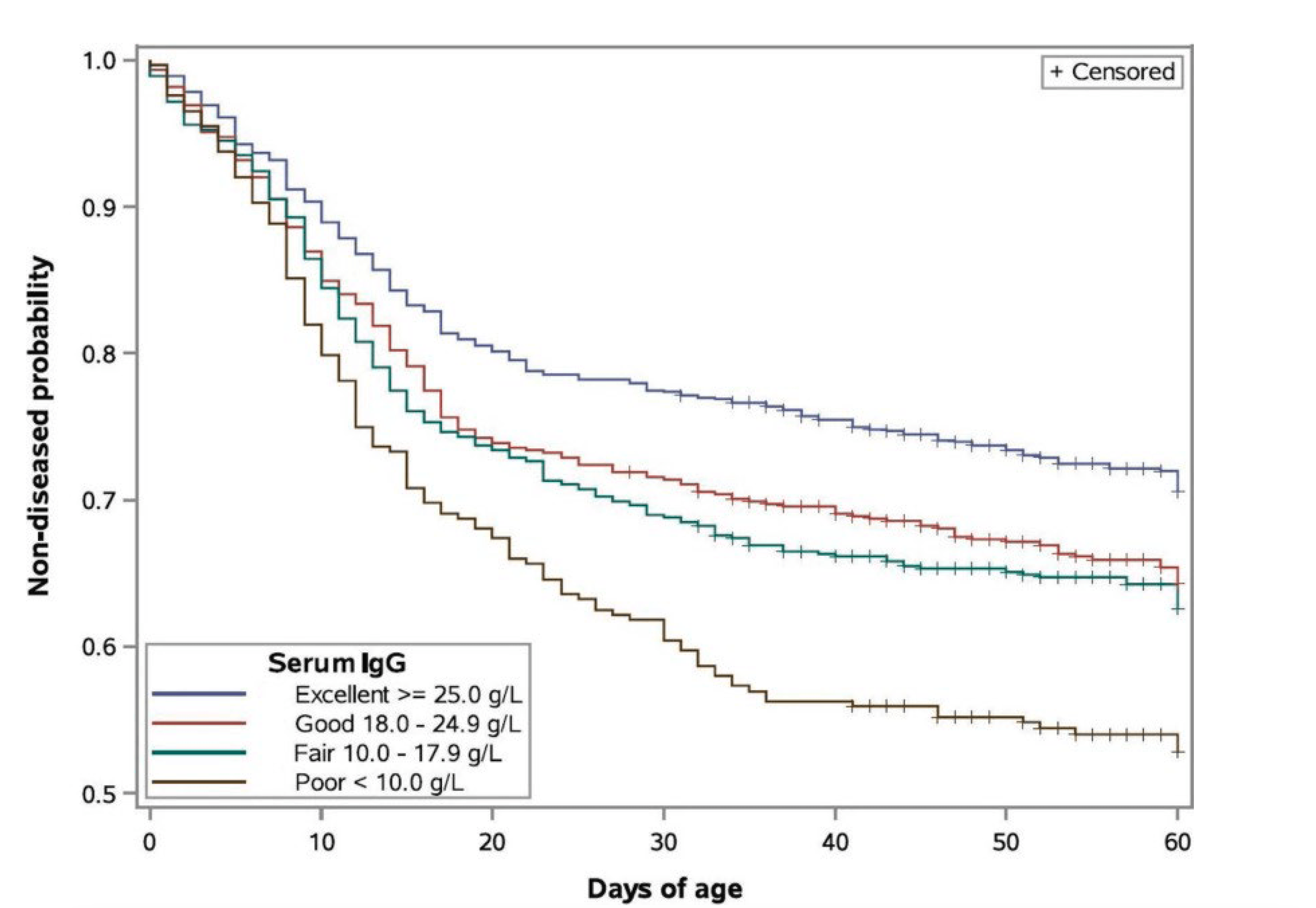
Calves with higher levels of passive immunity tend to remain healthier during the first weeks of life. During the first week after birth, there are few differences among calves in the excellent, good, fair, and poor categories. However, by 7–10 days of age, clear differences begin to emerge.
Calves in the excellent category have the highest proportion remaining healthy, followed by calves in the good and fair categories, while calves in the poor category experience the highest rates of disease. These differences continue to widen through 60 days of age (Figure 1). By that time, approximately 28.5% of calves with excellent passive transfer become sick compared with 34.8%, 36.1%, and 46.1% of calves in the good, fair, and poor categories, respectively (Lombard et al., 2020).
Figure 1. Non-Diseased Probability by Serum IgG Concentration for Pre-Weaned Dairy Heifer Calves in the NAHMS Dairy 2014 Study (n = 2,360)
Source: Lombard et al., 2020
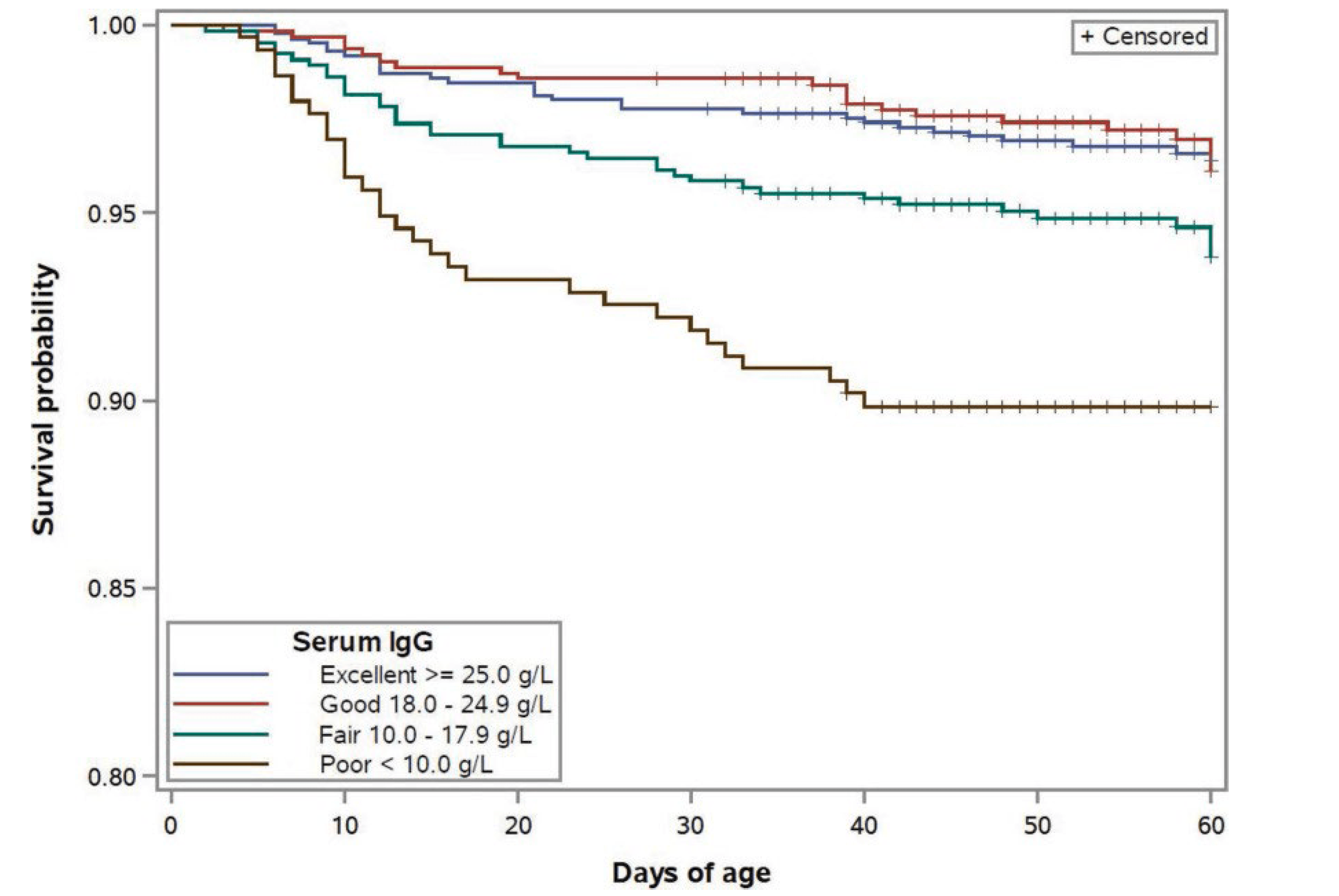
A similar pattern is observed for calf survival (Figure 2). Mortality rates are similar during the first week of life but begin to diverge after 7–10 days. By 60 days of age, mortality is approximately 2.5% in calves with excellent passive transfer, compared with 1.5%, 3.8%, and 7.4% in calves classified as good, fair, and poor, respectively (Lombard et al., 2020).
Figure 2. Survival Probability by Serum IgG Concentration for Pre-Weaned Dairy Heifer Calves in the National Animal Health Monitoring System (NAHMS) Dairy 2014 Study (n = 2,360)
Source: Lombard et al., 2020
These results show that higher serum IgG concentrations, rather than simply avoiding failure, are associated with improved calf health and survival. To achieve this, calves should be fed colostrum as soon as possible after birth, ideally within 1–2 hours. Earlier feeding improves antibody absorption and supports successful passive transfer (Fischer et al., 2018).
Summary

Colostrum plays a critical role in protecting newborn calves during the first weeks of life. Because antibodies do not pass through the ruminant placenta before birth, calves are born without circulating immunoglobulins and rely entirely on colostrum to acquire passive immunity. Immunoglobulin G (IgG) is the primary antibody responsible for systemic immunity and the main indicator used to evaluate successful passive transfer.
Traditionally, failure of passive transfer has been defined as serum IgG concentrations below 10 g/L. However, newer recommendations evaluate passive transfer using categories of serum IgG, with higher concentrations associated with improved calf health and survival. These findings emphasize the importance of aiming for higher IgG levels rather than simply avoiding failure.
Monitoring serum IgG, serum total protein, or Brix refractometer values provides a practical way to assess colostrum program success. Effective colostrum management remains essential for achieving excellent passive transfer and improving early calf health.
References
Barrington, G. M., & Parish, S. M. (2001). Bovine neonatal immunology. Veterinary Clinics of North America: Food Animal Practice, 17, 463–476. https://doi.org/10.1016/S0749-0720(15)30001-3.
Chase, C. C., Hurley, D. J., & Reber, A. J. (2008). Neonatal immune development in the calf and its impact on vaccine response. Veterinary Clinics of North America: Food and Animal Practice, 24(1), 87-104. doi: 10.1016/j.cvfa.2007.11.001. PMID: 18299033; PMCID: PMC7127081.
Fischer, A. J., Song, Y., He, Z., Haines, D. M., Guan, L. L., & Steele, M. A. (2018). Effect of delaying colostrum feeding on passive transfer and intestinal bacterial colonization in neonatal male Holstein calves. Journal of Dairy Science 101, 3099–3109. https://doi.org/10.3168/jds.2017-13397.
Foley, J. A., & Otterby, D. E. (1978). Availability, Storage, Treatment, Composition, and Feeding Value of Surplus Colostrum: A Review1, 2. Journal of Dairy Science 61:1033–1060. https://doi.org/10.3168/jds.S0022-0302(78)83686-8.
Godden, S. M., Lombard, J. E., & Woolums, A. R. (2019). Colostrum management for dairy calves. Veterinary Clinics of North America: Food Animal Practice, 35, 535–556. https://doi.org/10.1016/j.cvfa.2019.07.005.
Larson, B. L., Heary, H. L., & Devery, J. E. (1980). Immunoglobulin production and transport by the mammary gland. Journal of Dairy Science, 63, 665–671. https://doi.org/10.3168/jds.S0022-0302(80)82988-2.
Lombard, J., Urie, N., Garry, F., Godden, S., Quigley, J., Earleywine, T., McGuirk, S., Moore, D., Branan, M. Chamorro, M., Smith, G., Shivley, C., Catherman, Haines, D., Heinrichs, A. J., James, R., Maas, J., & Sterner, K. (2020). Consensus recommendations on calf- and herd-level passive immunity in dairy calves in the United States. Journal of Dairy Science, 103, 7611–7624. https://doi.org/10.3168/jds.2019-17955.
The authors of this content used ChatGPT to improve writing clarity and flow. The tool was not used to identify sources, generate ideas, or interpret findings. Authors reviewed and edited the content provided by the AI tool, and they take full responsibility for the content.

June 2026
Utah State University Extension
Peer-reviewed fact sheet
Authors
Drew Swartz, Kalen Taylor, and Maggi Mathews

Drew Swartz
Extension Assistant Professor | Dairy Cattle Specialist

Kalen Taylor
Extension Assistant Professor | Agriculture | Millard County
Agriculture and Natural Resources

Maggi Mathews
Extension Assistant Professor | Weber and Morgan Counties
Agriculture and Natural Resources