
Training Turfgrass for Drought Resilience

Key Takeaways
- During drought, the most effective strategy is not to apply more water, but to use water more effectively.
- By gradually training turfgrass to rely on deeper soil moisture through proper irrigation practices and improving soil health over time, landscapes can remain functional and resilient while significantly reducing water use.
- These approaches support both immediate drought response and long-term sustainability of Utah’s amenity landscapes.
Utah’s semi-arid climate always makes efficient irrigation essential, but never more so than during a drought. In many communities, outdoor landscape irrigation represents the largest share of residential water use during the summer months. At the same time, research and Utah State University (USU) Extension observations have consistently shown that lawns across the state are often overwatered, leading to shallow root systems and increased vulnerability to heat and drought stress. Adjusting irrigation practices during drought not only conserves water but also improves the long-term health and resilience of turfgrass systems.
Training Roots
Turfgrass roots develop in response to water availability in the soil. When irrigation is applied frequently and in small amounts, moisture remains near the soil surface, encouraging shallow root growth. This results in turfgrass that becomes dependent on frequent watering to keep shallow soil depths moist and shows stress quickly when irrigation is reduced. In contrast, extending the time between irrigation events and watering deeper allows soil moisture to move lower into the soil profile, encouraging roots to follow. Over time, this can result in deeper root systems that are better able to access stored soil moisture and withstand drought conditions.
Building Long-Term Soil and Root System Resilience
While irrigation practices provide immediate benefits, long-term drought resilience depends heavily on soil health and rooting capacity. Increasing soil organic matter:
- Improves the soil’s ability to retain water,
- Enhances soil structure, and
- Supports beneficial microbial activity.
Practices such as returning grass clippings when mowing, applying compost or organic amendments, and minimizing soil disturbance will gradually increase organic matter over time, which improves moisture-holding capacity.
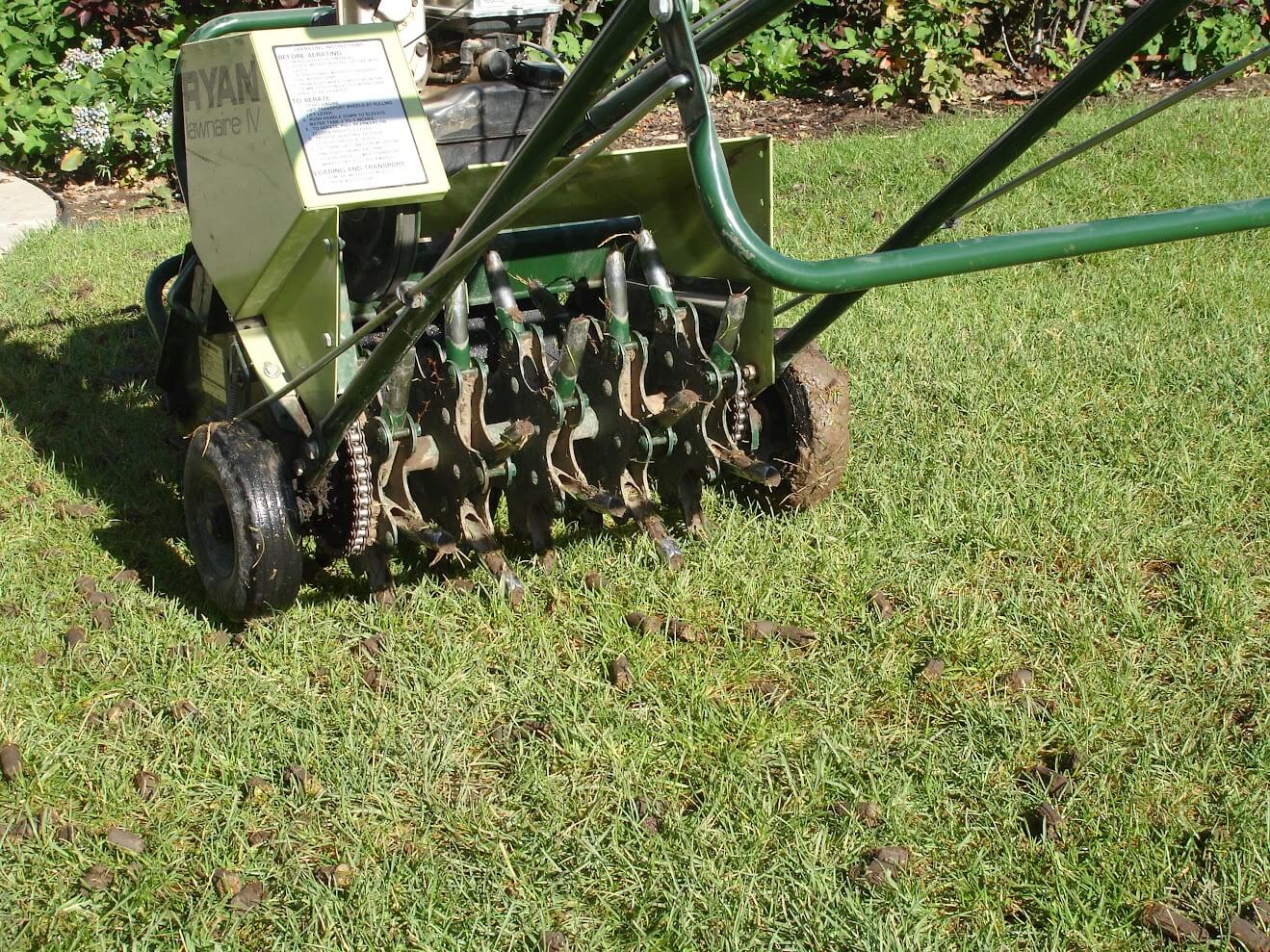
In addition, cultural practices that promote deeper rooting, such as aeration to relieve compaction and appropriate fertilization to support balanced growth, help expand the volume of soil that turfgrass can access for water. Together, improved soil water-holding capacity and deeper root systems allow landscapes to retain more water between irrigation events and maintain function under extended dry conditions.
Establishing Irrigation Practices That Build Drought Tolerance
Developing drought-resilient turfgrass requires a gradual shift in irrigation practices. Reducing irrigation frequency over time allows the plant to adapt without causing severe stress. Even in coarse-textured or sandy soils, incremental changes can condition turfgrass to tolerate longer intervals between watering events. At the same time, apply irrigation deeply enough to wet the active root zone rather than lightly wetting the surface layers of the soil. This approach supports root elongation and improves the plant’s ability to use water stored deeper in the soil.
Allowing turfgrass to experience mild, temporary stress is also an important part of this process. Slight leaf wilting or a dull, bluish-gray leaf color can indicate that the plant is beginning to run low on available soil moisture, signaling the need for irrigation. These early stress symptoms do not indicate permanent damage and can help promote deeper rooting when addressed appropriately. Monitoring how deeply water is penetrating the soil with a simple tool, such as a screwdriver or soil probe, can help ensure irrigation reaches the intended depth. Either tool will move easily through moist soils but not through dry soils.
Managing Turfgrass During Drought Conditions
During drought, expectations for turfgrass appearance should shift. The primary goal should be maintaining plant survival and function rather than uniform green color. Turfgrass is genetically predisposed to enter dormancy under extended drought conditions, a natural survival mechanism that allows it to recover when water becomes available again. This response is particularly important in Utah’s climate, where periods of high temperature and limited precipitation are common during the growing season.
Irrigation timing also plays a critical role in water conservation. Applying water early in the morning can reduce losses due to evaporation, but prioritize periods of low wind to improve overall efficiency. Avoiding frequent, shallow irrigation is especially important during drought, as it increases water loss and weakens the turf over time. Mowing practices can further support drought resilience, as maintaining a higher mowing height helps shade the soil surface, reduce evaporation, and support deeper rooting. Reducing mowing frequency during periods of stress can also minimize additional strain on the plants.
Understanding Common Misconceptions
Several common misconceptions can lead to inefficient water use and reduced turfgrass performance.
| Misconception | Reality |
|---|---|
| Lawns require daily watering. | Most turfgrass performs better when irrigation is applied less frequently and more deeply. |
| Sandy soils require frequent watering. | While sandy soils drain more quickly than finer-textured soils, turfgrass can still be trained to tolerate longer intervals between irrigations with proper management. |
| Straw-colored or brown turf is dead. | This is not necessarily true. In many cases, drought-stressed grass is simply dormant and is capable of recovery when more favorable conditions return. |
Acknowledgments and Disclaimers
The authors of this content used ChatGPT to generate an outline for the information included in this fact sheet. Authors reviewed and edited the content provided by the AI tool, and they take full responsibility for the content. Utah State University is an affirmative action/equal opportunity institution and is committed to a learning and working environment free from discrimination, including harassment. For USU’s non-discrimination notice, see equity.usu.edu/non-discrimination.
April 2026
Utah State University Extension
Authors
Kelly Kopp and Jerry Goodspeed

Kelly Kopp
Professor | Water Conservation and Turfgrass Specialist | CWEL Director
Plants, Soils and Climate

Jerry Goodspeed
Extension Professor | USU Botanical Center Director | Davis County
Agriculture and Natural Resources
Related Research