
Selecting Irrigated Alfalfa Varieties
Introduction
Alfalfa Variety Selection: Key Points
- Yield potential
Use local/regional performance data or conduct on-farm trials. - Fall dormancy
FD 3–5 suits Utah; higher FD = more yield, less winter hardiness. - Pest resistance
Prioritize varieties with resistance to bacterial wilt, verticillium wilt, and phytophthora root rot. - Winter survival
Utah recommended winter hardiness range: 3–5. Select for local winters. - Added value of biotech trait
Roundup Ready® and HarvXtra® offer benefits but increase cost. - Price/availability/service
Focus on long-term returns, not just seed cost. - Other considerations
Salinity tolerance, grazing tolerance, water availability, inter-seeding tolerance.
Selecting an alfalfa variety is one of the most important decisions an alfalfa producer can make and is the cornerstone of successful alfalfa production. Variety selection directly impacts yield potential, forage quality, stand persistence, pest and disease resistance, and environmental adaptation—all factors that can have a major economic impact. Research has shown that yield can vary by as much as 30% between different varieties grown under the same conditions (Putnam et al., 2007). Because alfalfa is a perennial crop, variety selection will impact productivity and profitability for several years. Choosing the wrong variety can result in hundreds of dollars of lost revenue per acre annually over the life of the stand.
In addition to its agronomic and economic importance, variety selection serves as the first line of defense in integrated pest management (IPM) for alfalfa. Breeders continue to release new varieties with improved insect, disease, and nematode resistance. More so than many other crops, variety selection may be the only way to combat some of these pests. Currently, over 280 commercial alfalfa varieties are available in North America (see the National Alfalfa & Forage Alliance), which can make selecting the right variety overwhelming. However, informed decisions can be made by carefully considering the goals of your operation and following the criteria set forth in this fact sheet.
Growing Alfalfa in Utah
Alfalfa is widely grown across the state of Utah, but the environments on individual farms can vary greatly due to elevation. Alfalfa production in high-elevation mountainous areas often requires different varieties than those in lower elevation valleys. Of particular importance to understand for stand persistence in your specific location are fall dormancy and winter hardiness ratings. In addition, considering soil type and the intended use of the alfalfa will help guide variety selection decisions.
Key Selection Criteria
The following criteria are some of the most important factors to consider when selecting an alfalfa variety.
Yeild Potential
Yield is usually the most important economic factor for alfalfa producers. Therefore, when choosing a new alfalfa variety,
yield potential is key. Environment plays a large role in how different varieties perform. As a result, regional performance
trials can be an exceptionally useful tool to determine how a variety will perform in your area. Historically, universities
and alfalfa seed companies have worked together to obtain performance trial data. Find the most up-to-date variety trial
data from Utah State University (USU) Extension on their Crop Resources – Alfalfa website.
However, in recent years, these collaborative efforts have declined due to industry consolidation and diminishing interest
and/or funding from companies. As a result, growers need to be creative in finding performance data. Variety trial data
from universities in surrounding states with a similar environment is one approach, but a more straightforward and
relevant process is for growers to conduct their own on-farm trials. Strip trials are an excellent way to compare alfalfa
varieties. To set up an effective on-farm alfalfa trial, narrow your selection to a few varieties that have traits amenable to
your farm’s environment. When planning the trial, keep in mind that meaningful results come from collecting data over
multiple years, since some varieties perform strongly in the first season but decline later, or show the opposite pattern. It
is also important to track seasonal trends, as characteristics like fall dormancy ratings can significantly affect yields,
especially in the spring. Find detailed instructions for how to conduct on-farm trials effectively in this USU Extension On-Farm Research Guide.

A good practice when selecting a new alfalfa variety from university trial data is to narrow your selection to varieties in the top 25%–30% for yield and then zero in on those high-performing varieties to explore other traits such as fall dormancy, winter hardiness, pest and disease resistance, and other environmental adaptations that may be necessary for your farm. From these, select the one that is most likely to succeed in your area.
Fall Dormancy Rating
Fall dormancy (FD) relates to how soon an alfalfa variety stops growing in the fall, how early it begins growing in the spring, and how quickly it regrows after cutting. It is a response to day length and temperature and is rated on a scale from 1 (extremely dormant) to 11 (extremely nondormant). Ratings are developed by seed companies by comparing fall regrowth to that of a standardized check. FD ratings 1–4 are considered dormant, 5–7 semi-dormant, and 8–11 nondormant. The Intermountain West mostly supports FD 3– 5; however, where extended stand life is not a priority, selecting FD 6–7 may provide additional growth and subsequent yield. While higher FD may be beneficial for yield potential and earlier spring growth (Figure 1), stand life may be decreased, particularly in areas with harsh winters (Putnam et al., 2007; Redfearn & Zhang, 2017). This is because plants with higher FD tend to grow more aggressively in the fall, potentially depleting their root reserves and making them more susceptible to winterkill.

Fall dormancy primarily affects yield potential and alfalfa forage quality. Lower FD ratings will have slower spring growth, which may reduce yield potential compared to a higher FD variety; however, this often leads to higher alfalfa forage quality (Figure 2). Additionally, lower FD ratings can enhance water use efficiency (WUE), especially in the spring and fall (Yost et al., 2022). When selecting an appropriate FD rating, it’s essential to consider environmental conditions, grower experience, and the desired forage end use. Some common strategies include:
- Select the highest FD that can survive in that region for higher yields.
- Plant lower FD varieties to achieve higher quality.
- Choose different FD between fields to create variable cutting schedules across the farm.
In most of Utah, FD ratings between 3 and 5 generally perform well, depending on elevation and winter severity.
Winter Hardiness
Winter hardiness is a measure of the likelihood for an alfalfa variety to survive the winter without injury. It ranges on a scale of 1 (extremely hardy) to 6 (non-winter hardy). While this trait was originally linked to FD, breeders have discovered how to separate the traits, meaning that you can have an extremely winter-hardy variety that can still grow well into the fall. In Utah, winter hardiness ratings of 3–5 are generally recommended, as this protects the alfalfa from winter injury without sacrificing yield potential.
Disease and Insect Resistance
For many diseases, insects, and nematodes that affect alfalfa, variety selection is the only line of defense. As a result,
alfalfa breeders emphasize selecting varieties that elicit a certain degree of resistance to many alfalfa pests. Resistance is
not absolute—it simply reduces the likelihood and severity of injury. Often, an alfalfa variety will be ranked for resistance
to a given disease (Table 1). It is important to consider the diseases common in your area to best decide what resistance
traits are needed for a successful alfalfa stand. To find details of current resistance ratings for commercially available
alfalfa varieties, visit the National Alfalfa & Forage Alliance website.
Table 1. Alfalfa Disease and Pest Resistance Ratings
| Rating | Resistance | % Plants resistant |
|---|---|---|
| Q | Highly resistant | >50 |
| R | Resistant | 35–50 |
| MR | Moderately resistant | 20–35 |
| LR | Little resistance | 5–20 |
| S | Susceptible | <5 |
Diseases that Utah growers should be aware of when selecting a variety include bacterial wilt, verticillium wilt, and
phytophthora root rot. Common insects and nematodes for which resistance is available in alfalfa include blue, spotted,
and pea aphids, and stem and root knot nematodes.
Biotech Traits
Using biotech traits can increase crop management flexibility. The two common biotech traits in alfalfa are Roundup
Ready and HarvXtra:
- Roundup Ready allows growers to apply glyphosate to the alfalfa without crop injury occurring. This adds
tremendous flexibility to weed control for an alfalfa stand. - HarvXtra has been genetically enhanced for reduced lignan content. This offers improved forage quality and yield
flexibility by enabling growers to delay harvests without sacrificing feed quality and digestibility. In addition,
HarvXtra seed often includes Roundup Ready traits.
While it may seem like a simple decision to include these biotech traits in variety selection because of the flexibility they provide, the technology comes with a significant increase in cost and may have other negative features associated with the trait (i.e., certain markets may not accept some traits). Selecting a variety with biotech traits is fundamentally no different than selecting any other alfalfa variety, and factors such as yield potential, dormancy ratings, and disease resistance must not be compromised to include a biotech trait in the variety you select. It is also important to consider if the addition of a trait is necessary and sensible under your management strategies.
Economics and Availability
When selecting an alfalfa variety, prioritize performance over seed cost, as alfalfa’s perennial lifecycle spreads seed investment over several years. Choosing a variety well-adapted to your environment can result in higher yields and improved longevity, often more than compensating for higher initial seed cost (Figure 3). In contrast, selecting a variety solely on price can lead to long-term consequences, such as reduced performance, poor persistence, increased weed pressure, and greater disease susceptibility, ultimately resulting in substantial economic losses. One factor that can significantly raise seed prices is the inclusion of biotech traits. It is important to evaluate whether these traits will provide real benefits—such as improved management efficiency—or simply add costs without delivering a return. Consulting local seed dealers and university Extension experts can help identify which varieties are available, cost-effective, and likely to perform well on your operation.
Other Considerations
include tolerance to grazing,salinity,
water availability and timing, and
resistance to inter-seeding.
While the factors mentioned above are broad considerations that apply to all variety selection, understanding your specific environmental challenges is critical to choosing the best variety for your operation. Other factors to consider, depending on the environment and the objectives of the alfalfa stand, include tolerance to salinity, grazing tolerance, water availability and timing, and resistance to interseeding or mixing with other crop species like grasses or small grains.
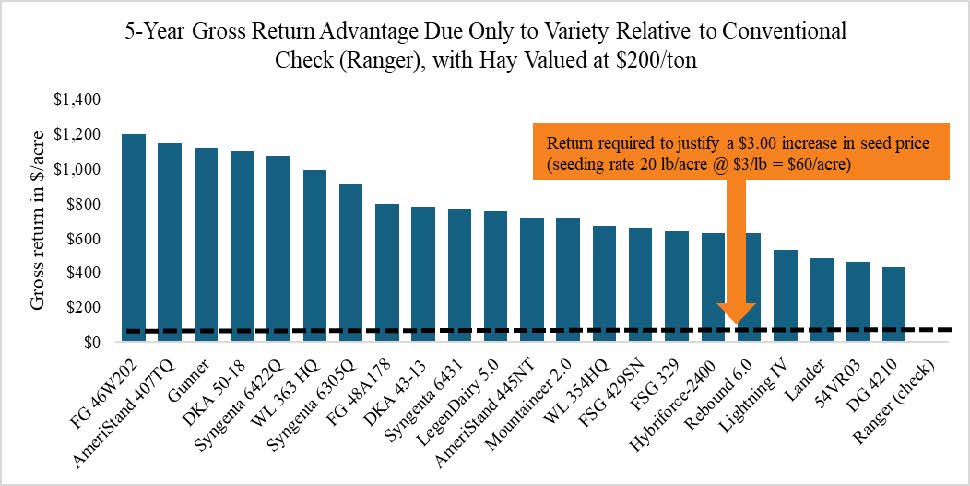 Figure 3. Gross Return Advantage of Alfalfa Varieties Over a 5-Year Stand, Relative to the Conventional Check Variety (Ranger), Assuming Hay Is Sold at $200/Ton
Notes. Ranger is set as the baseline ($0). To offset a $3 per pound increase in seed cost at a seeding rate of 20 lb/acre, a variety must generate at least $60 per acre more over those 5 years. This increase may be nominal when considering the potential gain best varieties can achieve. Yield data are from the 2011–2014 Irrigated Alfalfa Performance Trial in North Logan, Utah (Creech et al., 2015), with gross return differences calculated based on yield variation due to variety selection.
Summary
Alfalfa variety selection is a foundational agronomic decision with long-term implications for yield, forage quality, stand persistence, and overall economic returns. With over 280 commercial varieties available, selecting the right variety requires a comprehensive understanding of local environmental conditions and operational objectives. Key selection criteria include yield potential, fall dormancy and winter hardiness ratings, disease, insect, and nematode resistance profiles, and the potential value of biotech traits. Utah’s diverse growing environments necessitate site-specific variety selection, particularly with respect to fall dormancy and winter survival. Regional or on-farm performance trials provide critical yield data to inform decisions. While biotech traits like Roundup Ready and HarvXtra can offer management flexibility, their higher seed costs demand a careful cost-benefit analysis. Likewise, while seed price is a factor, it should not override agronomic suitability or long-term stand performance. Other considerations such as salinity tolerance, interseeding compatibility, and water use efficiency may also influence variety choice depending on operational goals.
Ultimately, success in alfalfa production begins with informed variety selection tailored to both agronomic conditions and economic objectives. Prioritizing traits that align with your management strategy and environmental constraints will help maximize long-term productivity and profitability. It is also important to have a working relationship with a seed dealer who understands your climate and growing objectives. In addition, USU Extension can help you select the optimal variety for your operation. Choosing an alfalfa variety is more than just selecting seed, it is a multi-year investment in productivity, quality, and economic return.
References
- Creech, E., Griggs, T., Israelsen, C., Bingham, T. J., Clark, J., & Pieper, M. (2015). Irrigated alfalfa variety performance,
2011–2014; North Logan, Utah [Fact sheet]. Utah State University Extension.
https://digitalcommons.usu.edu/extension_curall/762/ - Griggs, T. C. (2004). Alfalfa variety selection guidelines [Fact sheet]. Utah State University Extension.
https://digitalcommons.usu.edu/extension_curall/591/ - Putnam, D. H., Orloff, S. B., & Summerville, B. A. (2007). Alfalfa variety data [Publication 8291]. University of California,
Division of Agriculture and Natural Resources.
https://alfalfa.ucdavis.edu/sites/g/files/dgvnsk12586/files/media/documents/UCAlfalfa8291Variety-reg.pdf - Redfearn, D. D., & Zhang, H. (2017). Selecting alfalfa varieties [PSS-2602]. Oklahoma Cooperative Extension Service.
https://extension.okstate.edu/fact-sheets/print-publications/pss/selecting-alfalfa-varieties-pss-2602.pdf - Yost, M., Sullivan, T., Boren, D., Johnson, L., Mills, M., Creech, E., Kitchen, B., & Violett, R. (2022). Guide to drought
tolerance of Utah field crops [Fact sheet]. Utah State University Extension.
https://digitalcommons.usu.edu/cgi/viewcontent.cgi?article=3300&context=extension_curall

November 2025
Utah State University Extension
Peer-reviewed fact sheet
Authors
McKenna S. Barney, Earl Creech, and Matt Yost


Matt Yost
Agroclimate Specialist
PSC Dept